
石油炼化

Search documents
成品油零售价格或遇“二连涨” 春节期间加满一箱92号汽油将多花9元
Sou Hu Cai Jing· 2026-02-02 10:21
Core Viewpoint - The international crude oil prices have been on the rise during the current pricing cycle, leading to an expected increase in domestic refined oil retail prices, marking the first "double increase" of the year on February 3 [1] Pricing Trends - The WTI crude oil price has stabilized above $60 per barrel and has surpassed $65 per barrel, resulting in a positive change rate for crude oil [1] - As of January 30, the reference crude oil change rate was calculated at 5.32%, indicating an expected increase of 230 yuan per ton for gasoline and diesel [1] Consumer Impact - The upcoming price adjustment window on February 3 is likely to result in higher fuel costs for consumers, with an estimated additional cost of 9 yuan for filling a tank of 92-octane gasoline during the Spring Festival [1] - After the price adjustment, there will be no further price changes before the Spring Festival, leading to increased fuel costs for consumers during the holiday period [1]
风浪中的-硬资产-地缘催化下的能化资产再定价与油运合规牛
2026-01-29 02:43
Summary of Conference Call Records Industry Overview - The conference call discusses the impact of geopolitical events on the oil and chemical industries, particularly focusing on the effects of supply constraints from Venezuela, Russia, and Iran on China's refining sector and chemical asset pricing [1][2][4]. Key Points and Arguments Geopolitical Impact on Oil Supply - Geopolitical events have led to limited oil supplies from Venezuela, Russia, and Iran, which poses risks of rising costs and declining profits for Chinese independent refineries (地炼) [1][2]. - The takeover of Venezuelan oil by the U.S. is expected to redirect supplies away from East Asia, significantly affecting local refineries [2]. - U.S. sanctions have reduced Russian oil exports by approximately 50%, increasing transportation risks and tightening supply [2][4]. - Iran's oil supply is also under pressure due to intensified U.S. sanctions and domestic unrest, which may further limit future supply [2][4]. Impact on Chinese Refining Sector - Short-term effects include rising costs for Chinese independent refineries, with costs potentially increasing by over $10 per barrel, leading to significant profit declines or even losses for smaller refineries [4]. - In contrast, major state-owned enterprises like Sinopec and CNOOC, as well as private companies with stable resources, are expected to benefit from these supply constraints [2][4]. Chemical Industry Trends - The Chinese chemical industry is experiencing a tightening capacity cycle due to dual carbon policies, which is expected to lead to a revaluation of chemical assets over the next five years [1][5]. - By 2025, the export growth rate of Chinese chemical products is projected to increase significantly, with many products having over 20% exposure to overseas markets, helping to mitigate domestic real estate drag [5]. Asset Repricing and Beneficiaries - Strong capital and technology-intensive companies in the chemical sector, such as Wanhua Chemical, Hengli Petrochemical, and Rongsheng Petrochemical, are positioned to benefit from the upcoming asset repricing [6][7]. - The scarcity of chemical products is anticipated to drive asset revaluation, allowing these companies to gain pricing power by controlling supply and capitalizing on demand growth [6]. Global Oil Transportation Challenges - The global oil transportation system faces comprehensive sanctions challenges, affecting exporters, receiving ports, and shadow fleets [8]. - The shadow fleet has seen a significant increase, reflecting changes in U.S. policy towards Iranian oil, with a notable rise in operational challenges for these vessels [11][12]. Supply Chain Implications - India is reducing its imports of Russian oil from 1.7 million barrels per day to 1.3 million barrels due to U.S. pressure, which mirrors challenges faced by Chinese buyers [9]. - The potential loss of Venezuelan, Iranian, and Russian oil supplies could severely disrupt the overall supply chain, increasing international oil price risks [9]. Canadian Oil Exports - Canada exports approximately 4 million barrels of heavy oil to the U.S. daily, and the situation in Venezuela may pressure Canada to lower prices to meet demand, potentially shifting more oil to the East Hemisphere [10]. Market Dynamics and Pricing - The pricing of cyclical stocks should focus on value recovery rather than short-term price fluctuations, emphasizing the importance of performance realization and valuation centrality [15]. Additional Important Insights - The shadow fleet's growth has tripled over the past two decades, indicating a significant shift in the operational landscape for oil transportation [11]. - The global daily oil production is around 100 million barrels, with maritime transport accounting for 45 million barrels; the loss of Iranian exports could greatly impact this market [12]. - China's refining capacity is expected to increase by 1.5 million barrels per day in 2026, with a total refining capacity projected to reach 18 million barrels per day [13]. This summary encapsulates the critical insights from the conference call, highlighting the interplay between geopolitical events and market dynamics in the oil and chemical sectors.
石油化工行业周报:供给增量上调,EIA预计今年全球原油有283万桶、天的供应过剩-20260125
Shenwan Hongyuan Securities· 2026-01-25 13:13
Investment Rating - The report maintains a positive outlook on the petrochemical industry, indicating a favorable investment environment [4]. Core Insights - Three major institutions have raised their oil supply forecasts, with the EIA predicting a global surplus of 2.83 million barrels per day for this year [6][16]. - The EIA has adjusted its 2026 oil price forecast upward to an average of $56 per barrel, while lowering the natural gas price forecast to $3.46 per million British thermal units [7][11]. - The IEA expects a demand increase of 930,000 barrels per day in 2026, while OPEC and EIA have slightly reduced their demand forecasts [11][16]. Supply and Demand Summary - The EIA has raised its global oil supply forecast for this year by 120,000 barrels per day, while the IEA has increased its forecast by 100,000 barrels per day [13][16]. - The EIA anticipates that global oil production will rise by 1.37 million barrels per day in 2026, with OPEC+ contributing approximately 1.13 million barrels per day [15][16]. - The IEA projects a global oil supply increase of 2.5 million barrels per day in 2026, reaching 108.7 million barrels per day [16]. Price Trends Summary - The price of butadiene has surged over 28% since the beginning of the year, driven by a narrowing price spread between naphtha and ethylene [17]. - As of January 23, the spot price of butadiene reached 10,700 yuan per ton [17]. Investment Recommendations - The report recommends focusing on high-quality companies in the polyester sector, such as Tongkun Co. and Wankai New Materials, due to tightening supply and improving market conditions [21]. - It suggests monitoring major refining companies like Hengli Petrochemical, Rongsheng Petrochemical, and Dongfang Shenghong, as refining margins are expected to improve [21]. - The report also highlights the potential of offshore oil service companies like CNOOC Services and Haiyou Engineering, given the high capital expenditure in offshore exploration [21].



上海石化预亏近15亿元,2025年化工品价格大跌
Hua Xia Shi Bao· 2026-01-24 02:17
Core Viewpoint - Shanghai Petrochemical is expected to report a net loss of approximately 1.289 billion to 1.576 billion yuan in 2025, primarily due to declining international crude oil prices and reduced demand for its products [2] Group 1: Financial Performance - In 2025, Shanghai Petrochemical anticipates a net profit loss of about 12.89 billion to 15.76 billion yuan, with a similar range for its non-recurring net profit loss [2] - The company reported significant losses in 2022 and 2023, with a net loss of 2.872 billion yuan in 2022 and a net loss of 1.406 billion yuan in 2023 [6][7] - The revenue for 2022 was 82.518 billion yuan, a decrease of 7.57% year-on-year, while 2023 saw an increase in revenue to 93.014 billion yuan, a growth of 12.72% [6] Group 2: Market Conditions - The average annual price of WTI crude oil in 2025 is projected to be $64.73 per barrel, a decrease of 14.55% year-on-year, while Brent crude is expected to average $68.19 per barrel, down 14.62% [3] - Domestic gasoline and diesel prices are also expected to decline in 2025, with gasoline averaging 8,282 yuan per ton (down 5.76%) and diesel at 7,146 yuan per ton (down 5.51%) [3] Group 3: Product Pricing and Demand - The prices of key chemical products produced by Shanghai Petrochemical, such as polyethylene and polypropylene, are expected to decline significantly in 2025, with polyethylene prices dropping by 20.28% [4] - The average price of paraxylene is projected to decrease from $940.74 per ton in 2024 to $814.75 per ton in 2025, reflecting a 13.39% decline [5] - The demand for traditional petroleum products is under pressure due to the rise of electric vehicles and alternative energy sources, leading to a decrease in gasoline and diesel consumption [7] Group 4: Operational Challenges - The company faced operational challenges due to maintenance shutdowns, which impacted production and increased material and energy consumption [5] - The overall refining profit margin for independent refineries in Shandong is projected to be low, averaging 260.1 yuan per ton in 2025 [4]


欧盟对俄原油炼制品进口禁令将生效
Zhong Guo Hua Gong Bao· 2026-01-20 02:40
Group 1 - The EU's import ban on Russian refined oil products will officially take effect on January 21, significantly impacting the Southeast European refining market due to supply chain disruptions [1] - The ban, part of the EU Regulation 833/2014, prohibits member states from purchasing, importing, or transiting Russian refined oil products, with limited exemptions for specific cooperating countries [1] - The ban targets oil products under customs code 2710, which are derived from Russian crude oil classified under customs code 2709, marking a significant escalation in energy sanctions against Russia [1] Group 2 - A Northwest European dealer indicated that the ban will have "no substantial impact" on their market, as many suppliers have already avoided products related to Russian crude oil refining [2] - In contrast, Southeast Europe is expected to face greater challenges due to its historical reliance on the Turkey-Romania corridor for Russian refined products [2] - The EU customs will implement stricter verification standards for the origin of crude oil used in refining, although the list of countries eligible for exemptions is still under review by the European Commission [2]
当2.8万亿能源巨无霸降临
Jing Ji Guan Cha Bao· 2026-01-18 06:11
Core Viewpoint - The merger between China Petroleum & Chemical Corporation (Sinopec) and China Aviation Oil Holding Company (China Aviation Oil) aims to create a powerful entity in the aviation fuel industry, enhancing supply chain control and competitiveness in line with China's dual carbon goals [3][24]. Industry Overview - The aviation fuel supply chain, valued at several hundred billion yuan, is undergoing significant restructuring, impacting upstream suppliers, midstream refining companies, independent traders, and downstream airlines [2][4]. - The merger is not merely a scale expansion but focuses on "professional integration," shifting competition from channel-based to efficiency and cost across the entire supply chain [4][5]. Merger Implementation - Following the merger announcement, both companies initiated the integration of production and procurement systems, aiming to optimize the supply chain from refineries to airports [3][6]. - A joint working group has been established to assess logistics, customer contracts, and supplier lists, with a focus on ensuring stable market supply during the transition [6][7]. Market Reactions - The merger has raised concerns among midstream small and medium-sized refining companies and independent traders, who fear losing business as Sinopec's capacity may cover most of China Aviation Oil's needs [13][14]. - Some companies are exploring alliances with other large refiners or considering direct supply to airports to maintain market presence [13][14]. User Perspective - Airlines, as the end users of aviation fuel, are closely monitoring the merger's impact on fuel costs, which constitute over 30% of their operational expenses [18][19]. - While the integration may enhance supply stability and reduce costs, airlines are concerned about diminished bargaining power against a unified supplier [18][19]. Future Considerations - The merger is expected to accelerate the green transition in the aviation sector, with both companies collaborating on sustainable aviation fuel (SAF) initiatives [24][25]. - Regulatory scrutiny is anticipated to ensure fair competition and prevent monopolistic practices, with the National Market Supervision Administration likely to review the merger [23][25].

当2.8万亿能源巨无霸降临
经济观察报· 2026-01-18 05:54
Core Viewpoint - The restructuring of China Petroleum & Chemical Corporation (Sinopec) and China Aviation Oil (China National Aviation Fuel Group) aims to create a powerful national entity capable of competing with international energy giants, driven by the dual goals of carbon neutrality and supply chain autonomy [2][4][6]. Group 1: Restructuring Overview - The merger combines Sinopec's extensive refining capabilities with China Aviation Oil's nationwide airport network, creating a comprehensive supply chain from refinery to fuel pump [2][3]. - The restructuring is not merely a scale expansion but focuses on "professional integration" to enhance efficiency and cost competitiveness across the entire aviation fuel industry [4][5]. - A clear timeline and task requirements have been set by the State-owned Assets Supervision and Administration Commission (SASAC) to ensure effective integration and realization of synergies [6]. Group 2: Operational Changes - Following the announcement, both companies initiated immediate actions, including establishing daily information sharing mechanisms and forming joint teams to identify overlapping and complementary resources [8][9]. - The integration aims to streamline logistics and production planning, potentially optimizing supply chain efficiency by reducing intermediary steps [10][12]. - In regions with existing infrastructure, such as the Guangdong-Hong Kong-Macao Greater Bay Area, teams are conducting on-site assessments to create direct supply networks from refineries to airports [14]. Group 3: Market Impact on Midstream Players - The merger has raised concerns among midstream players, including small refining companies and independent traders, who fear losing market share as China Aviation Oil may prioritize Sinopec's supply [17][18]. - Some companies are exploring alliances with other large refiners to enhance their bargaining power and are reassessing direct supply options to airports [19][21]. - The restructuring is expected to lead to a market reshuffle, pushing smaller firms towards specialization and service-oriented business models [24]. Group 4: User Perspective - Major airlines are closely monitoring the restructuring, as aviation fuel costs represent over 30% of their total operating expenses [27]. - While the integration may enhance supply stability and reduce costs, airlines are concerned about diminished bargaining power against a unified supplier [28][29]. - Airlines are exploring alternative supply channels and considering sustainable aviation fuel (SAF) as a strategic component in future negotiations [32][33]. Group 5: Regulatory and Environmental Considerations - The new entity's dominance in the aviation fuel market raises concerns about potential anti-competitive practices, prompting expectations of regulatory scrutiny [35][36]. - The merger is anticipated to accelerate the aviation industry's transition to greener fuels, with both companies leveraging their respective strengths in SAF development and distribution [37][38]. - SASAC views this restructuring as a model for deeper state-owned enterprise reform, emphasizing the need for effective regulatory oversight to ensure fair competition and environmental responsibility [38].


印尼媒体:耗资74亿美元,印尼升级改造全国最大炼油厂
Huan Qiu Shi Bao· 2026-01-13 23:07
Core Insights - Indonesia has officially launched the Bali Balikpapan refinery upgrade project, marking the end of a 32-year stagnation in large-scale energy infrastructure development [1] - The project, costing $7.4 billion, aims to modernize the existing refinery and enhance Indonesia's energy self-sufficiency [1] - The upgraded refinery's processing capacity will increase from 260,000 barrels per day to 360,000 barrels per day, meeting up to 25% of the country's fuel demand [1] Group 1: Project Details - The upgrade includes improvements to the crude oil reception system, pipeline network, and advanced processing units [1] - The refinery will produce low-sulfur fuel and increase liquefied petroleum gas (LPG) production capacity from 48,000 tons to 384,000 tons annually [1] - The project is classified as a national strategic initiative and commenced construction in 2019 [1] Group 2: Government Commitment and Goals - Indonesian President Prabowo emphasized the need for the country to achieve energy independence within the next five to seven years [2] - The Minister of Energy and Mineral Resources highlighted the government's renewed commitment to energy independence, aiming to stop diesel and jet fuel imports by 2027, relying only on crude oil imports [2] - Indonesia's current oil production is 608,100 barrels per day, while consumption is 1.6 million barrels per day, indicating a significant supply-demand gap [2] Group 3: Future Exploration and Production Plans - The Indonesian government is working to reverse the declining trend in oil production by auctioning eight new oil and gas blocks, which are expected to contain billions of barrels of oil and trillions of cubic feet of natural gas [3] - Plans are in place to open over 100 previously undeveloped oil and gas basins to global investors to unlock upstream exploration potential [3]
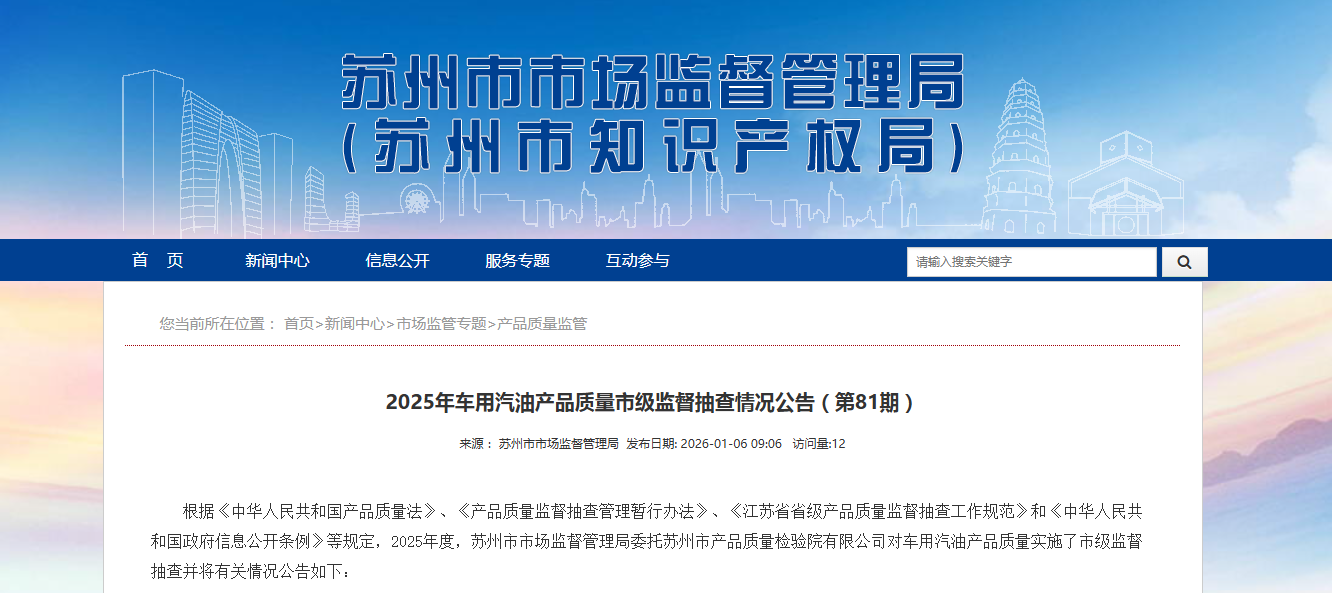
江苏省苏州市市场监管局公布2025年车用汽油产品质量市级监督抽查情况公告(第81期)
Zhong Guo Zhi Liang Xin Wen Wang· 2026-01-13 06:43
Product Overview and Industry Distribution - Automotive gasoline is a crucial petroleum product, derived from the refining of light petroleum fractions, characterized as a transparent or semi-transparent, volatile, and flammable hydrocarbon mixture [3] - The main components of gasoline include C5 to C12 aliphatic hydrocarbons and cycloalkanes, with a high octane rating indicating better anti-knock performance, suitable for high-compression engines [3] - The demand for automotive gasoline has significantly increased due to rapid economic development and the growth of the automotive industry in China, posing new challenges for gasoline quality [3] Industry Overview - The East China, Northeast, and Northwest regions are the primary production areas for refined oil in China, accounting for approximately 70% of the national total supply [4] - Major refining enterprises in East China include Jinling Petrochemical, Yangzi Petrochemical, and others, while Northeast and Northwest regions are home to major PetroChina refineries, contributing 21.1% and 15.9% of the national output, respectively [4] - In Jiangsu, key gasoline production companies include Jinling Petrochemical, Yangzi Petrochemical, and others, primarily located in cities like Nanjing and Taizhou [4] Inspection Basis and Items - The main inspection standard for automotive gasoline quality is GB17930-2016 [5] - Key inspection items include octane rating, density, lead content, distillation range, gum content, sulfur content, copper strip corrosion, mechanical impurities and moisture, benzene content, aromatic content, olefin content, and alcohols and ethers [5] Supervision and Inspection Results - A total of 100 batches of automotive gasoline were planned for inspection, all sourced from the circulation field, with a 0% non-conformity rate indicating overall good quality [6] - Sulfur content in gasoline is a significant impurity that can lead to environmental pollution and engine corrosion, affecting the lifespan of equipment [6] - Copper strip corrosion tests are conducted to assess the corrosive effects of gasoline on copper, with national standards requiring corrosion levels not exceeding grade 1 [7] - The density of gasoline is critical, as it affects engine performance; too low a density can cause knocking, while too high can lead to incomplete combustion and carbon buildup [7]
陕西:构建支撑有力的全域开放格局
Shan Xi Ri Bao· 2026-01-12 00:20
Core Insights - The first cross-Caspian China-Europe freight train departed from Xi'an, significantly reducing transit time from 15-23 days to approximately 11 days, enhancing trade efficiency [1] - Shaanxi's foreign trade has shown resilience, with an average annual growth of 4.7% during the 14th Five-Year Plan period, and a 13.7% year-on-year increase in total import and export value for the first 11 months of 2025 [1][2] - The province's export of electromechanical products reached 281.24 billion yuan, accounting for 86.1% of total exports, with significant growth in integrated circuits, automobiles, and data processing equipment [2] Trade and Investment Growth - Shaanxi's trade with countries along the Belt and Road Initiative has grown at an average annual rate of 11.7%, with notable increases in exports to ASEAN, Taiwan, and the EU [2] - The province's foreign direct investment and contract engineering revenues reached $1.585 billion and $7.64 billion respectively during the 14th Five-Year Plan period, indicating deepening international cooperation [4] - The actual use of foreign capital in Shaanxi has accumulated to $5.55 billion, with an annual growth rate of 18.4%, and 1,889 new foreign enterprises established [8] Foreign Investment Landscape - The establishment of foreign enterprises in Shaanxi, such as Eaton Electric Group's investment of 100 million yuan, reflects the province's attractive investment environment and robust industrial support [5][6] - Major foreign projects have been launched in Shaanxi, enhancing the province's investment appeal and fostering local industry growth [6] - The provincial government has implemented measures to optimize the business environment and support foreign investment, including the establishment of coordination mechanisms and service initiatives for multinational companies [7] Economic Policy and Future Outlook - Shaanxi's government emphasizes expanding openness as a key driver for high-quality development, with strategic plans to enhance its role as a significant node in the Belt and Road Initiative [7][9] - The province aims to further integrate into global cooperation and explore new development opportunities, positioning itself as a competitive player in the international market [9]
