
科学研究技术服务

Search documents
全国一般公共预算收入增长0.8%
Ren Min Ri Bao· 2025-11-17 19:07
Core Insights - The Ministry of Finance reported an increase in national general public budget revenue for October, with a year-on-year growth of 3.2% [1] - Cumulative revenue for the first ten months reached 18.65 trillion yuan, reflecting a growth of 0.8%, which is an improvement of 0.3 percentage points compared to the previous nine months [1] Revenue Analysis - In October, national tax revenue amounted to 2.07 trillion yuan, showing an increase of 8.6%, which is consistent with the previous month's growth of 8.7% [1] - For the first ten months, total tax revenue reached 15.34 trillion yuan, with a growth rate of 1.7%, marking a 1 percentage point increase from the first nine months [1] - Specific sectors such as equipment manufacturing and modern services demonstrated strong tax performance, with notable growth in computer and communication equipment manufacturing at 12.7%, electrical machinery and equipment manufacturing at 7.9%, scientific research and technical services at 14.8%, and cultural, sports, and entertainment sectors at 5.7% [1] Expenditure Overview - National general public budget expenditure continued to grow, with total spending for the first ten months reaching 22.58 trillion yuan, reflecting a year-on-year increase of 2% [1]
前10月财政收入持续回暖 科技民生投入强劲
Zheng Quan Shi Bao· 2025-11-17 16:54
Group 1 - The core viewpoint of the articles highlights the steady recovery in public budget revenue and a slowdown in expenditure growth, with significant increases in spending related to people's livelihoods and technology [1][3] - In the first ten months of the year, the national general public budget revenue reached 18.65 trillion yuan, an increase of 0.8%, with tax revenue growing by 1.7% to 15.34 trillion yuan [1] - The growth in public finance revenue is primarily driven by tax revenue, with notable increases in domestic VAT (4%), domestic consumption tax (2.4%), corporate income tax (1.9%), and personal income tax (11.5%) [1][2] Group 2 - The capital market's high activity level has significantly boosted personal income tax, corporate income tax, and securities transaction stamp duty, with the latter increasing by 88.1% to 162.9 billion yuan in the first ten months [1][2] - The equipment manufacturing and modern service industries showed strong tax revenue performance, with computer communication equipment manufacturing tax revenue growing by 12.7% and scientific research and technical services by 14.8% [3] - Social security and employment expenditures, education, health, science and technology, and environmental protection expenditures all saw growth, with social security and employment spending increasing by 9.3% [3]
10月税收 同比增长8.6% 财政收入持续回暖
Sou Hu Cai Jing· 2025-11-17 16:38
Group 1: Tax Revenue Performance - In the first ten months of the year, national general public budget revenue reached approximately 18.65 trillion yuan, a year-on-year increase of 0.8%, with tax revenue accounting for about 15.34 trillion yuan, up 1.7% year-on-year [1] - Tax revenue growth has been robust, with significant increases in July and August exceeding 5%, and September and October showing year-on-year growth rates of 8.7% and 8.6% respectively [1] - The active capital market has contributed to tax revenue growth, with securities transaction stamp duty revenue reaching 162.9 billion yuan, an increase of 88.1% year-on-year, and individual income tax revenue at 1.3363 trillion yuan, up 11.5% year-on-year [1] Group 2: Sector-Specific Tax Revenue Growth - The computer and communication equipment manufacturing industry saw tax revenue growth of 12.7%, while the electrical machinery and equipment manufacturing industry grew by 7.9% [2] - The scientific research and technical service industry experienced a tax revenue increase of 14.8%, and the cultural, sports, and entertainment industry grew by 5.7% [2] - The narrowing decline in the Producer Price Index (PPI) has reduced the negative impact on tax revenue, with PPI showing a month-on-month increase of 0.1% in October [2] Group 3: Government Fund Revenue - National government fund budget revenue for the first ten months was approximately 3.45 trillion yuan, a year-on-year decrease of 2.8%, with land use rights transfer revenue falling by 7.4% to about 2.49 trillion yuan [3] Group 4: Fiscal Expenditure - National general public budget expenditure reached approximately 22.58 trillion yuan in the first ten months, a year-on-year increase of 2%, although this growth rate has slowed by 1.1 percentage points compared to the previous nine months [4] - Government fund budget expenditure was about 8.09 trillion yuan, reflecting a year-on-year growth of 15.4%, but this growth rate has decreased by 8.5 percentage points compared to the previous nine months [5] - To maintain fiscal expenditure strength, the Ministry of Finance allocated 500 billion yuan from local government debt limits to support local government financial capacity and expand effective investment [5]
财政部:前10个月证券交易印花税同比增长88.1%
Zheng Quan Ri Bao· 2025-11-17 16:07
Group 1: Fiscal Revenue - In October, the national general public budget revenue reached 2.26 trillion yuan, a year-on-year increase of 3.2%, with central and local revenues growing by 2.3% and 4% respectively [1] - From January to October, the total general public budget revenue was 18.649 trillion yuan, up 0.8%, with an increase of 0.3 percentage points compared to the previous nine months [1] - Tax revenue showed robust growth, with October tax revenue at 2.07 trillion yuan, a year-on-year increase of 8.6%, maintaining a similar growth rate as September [1] Group 2: Tax Revenue Breakdown - Major tax categories from January to October included domestic VAT (up 4%), domestic consumption tax (up 2.4%), corporate income tax (up 1.9%), and individual income tax (up 11.5%), with increases compared to the previous nine months [1] - Stamp duty revenue reached 378.1 billion yuan, a significant year-on-year increase of 29.5%, with securities transaction stamp duty at 162.9 billion yuan, up 88.1% [1] Group 3: Fiscal Expenditure - National general public budget expenditure from January to October was 22.5825 trillion yuan, a year-on-year increase of 2%, with central expenditure growing by 6.3% and local expenditure by 1.2% [2] - Key expenditure areas included social security and employment (37.742 billion yuan, up 9.3%), education (34.117 billion yuan, up 4.7%), and health (16.877 billion yuan, up 2.4%) [2] Group 4: Government Fund Budget - From January to October, government fund budget revenue was 3.45 trillion yuan, a year-on-year decrease of 2.8%, while expenditure was 8.09 trillion yuan, an increase of 15.4% [3] - The increase in expenditure was primarily due to accelerated use of bond funds, with 4.54 trillion yuan spent on various types of bonds [3]
财政部最新发布!前10月证券交易印花税,增长88.1%!
券商中国· 2025-11-17 11:44
Core Insights - The article highlights the steady recovery in public budget revenue in China for the first ten months of 2025, with a notable increase in tax revenue and a slower growth rate in fiscal expenditure, while maintaining high growth in social welfare-related spending [1][2]. Revenue Performance - In the first ten months, the national general public budget revenue reached 18.65 trillion yuan, growing by 0.8%, which is an increase of 0.3 percentage points compared to the first nine months [1]. - Tax revenue accounted for 15.34 trillion yuan, with a growth rate of 1.7%, up by 1 percentage point from the previous nine months [1]. - Non-tax revenue decreased by 3.1% to 3.31 trillion yuan [1]. - Major tax categories showed growth: domestic VAT increased by 4%, domestic consumption tax by 2.4%, corporate income tax by 1.9%, and personal income tax by 11.5%, with respective increases of 0.4, 0.2, 1.1, and 1.8 percentage points compared to the previous nine months [2]. Capital Market Influence - The recovery in the capital market has significantly boosted tax revenue, particularly in the securities transaction stamp duty, which reached 162.9 billion yuan, reflecting an 88.1% year-on-year increase [3]. - The active capital market has positively impacted personal income tax and corporate income tax, with corporate income tax showing positive growth for the first time in eight months, driven by improved industrial profits [3]. Sector Performance - Tax revenue from key industries performed well: computer and communication equipment manufacturing grew by 12.7%, electrical machinery and equipment manufacturing by 7.9%, scientific research and technical services by 14.8%, and cultural, sports, and entertainment sectors by 5.7% [4]. Fiscal Expenditure Trends - General public budget expenditure for the first ten months grew by 2%, a decrease of 1.1 percentage points from the previous nine months, but spending in key areas like social security, education, and health remained strong [5]. - Notably, infrastructure-related spending in agriculture, forestry, and water management saw a decline of 9%, although the rate of decline narrowed by 2.1 percentage points compared to the previous nine months [5]. - Government fund budget revenue was 3.45 trillion yuan, down by 2.8%, while expenditure increased by 15.4% to 8.09 trillion yuan, driven by accelerated use of bond funds [5]. Future Outlook - The introduction of new policy financial tools is expected to support infrastructure investment in the fourth quarter and early next year, with a focus on improving fiscal infrastructure spending [6].


1—10月中国财政收入同比增长0.8%
Zhong Guo Xin Wen Wang· 2025-11-17 11:23
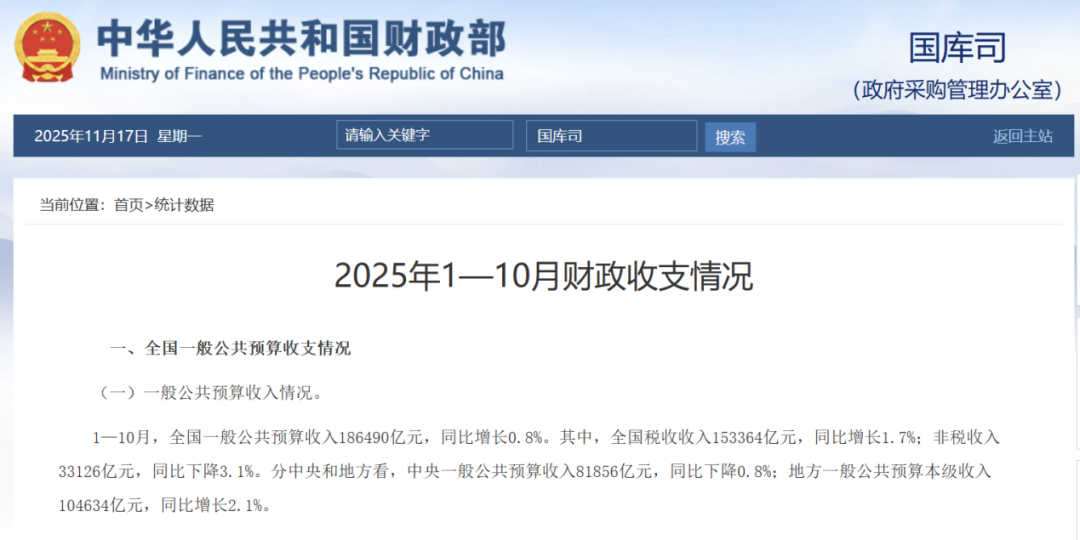
Group 1 - The core viewpoint of the articles indicates that China's fiscal revenue for the first ten months of the year has shown a modest growth of 0.8% year-on-year, with total public budget revenue reaching 186.49 billion yuan [1][2] - Tax revenue has increased by 1.7% year-on-year, amounting to 153.36 billion yuan, while non-tax revenue has decreased by 3.1%, totaling 33.13 billion yuan [1] - In October alone, public budget revenue was 22.6 billion yuan, reflecting a year-on-year growth of 3.2%, which is an improvement of 0.3 percentage points compared to the previous nine months [1] Group 2 - Public budget expenditure has also maintained growth, with total expenditure for the first ten months reaching 225.83 billion yuan, a year-on-year increase of 2% [2] - Key areas of expenditure include social security and employment, which grew by 9.3%, education at 4.7%, and health care at 2.4% [2] - Government fund budget revenue has decreased by 2.8% to 34.5 billion yuan, while expenditure has surged by 15.4% to 80.9 billion yuan, largely due to accelerated use of bond funds [2]
前10个月证券交易印花税增长88.1%!财政收入持续回暖
Zheng Quan Shi Bao· 2025-11-17 11:07
Core Insights - The fiscal revenue in China for the first ten months of 2025 shows a steady recovery, with public budget revenue increasing by 0.8% year-on-year, while expenditure growth has slowed down [1] - Tax revenue has been a significant contributor to the overall revenue increase, with notable growth in various tax categories [3] - Infrastructure-related spending is expected to rebound due to new policy measures and increased project implementation [5][6] Revenue Performance - Total public budget revenue reached 18.65 trillion yuan, with tax revenue at 15.34 trillion yuan, reflecting a growth of 1.7% [1] - Non-tax revenue decreased by 3.1%, amounting to 3.31 trillion yuan [1] - Major tax categories showed growth: VAT increased by 4%, consumption tax by 2.4%, corporate income tax by 1.9%, and personal income tax by 11.5% [3] Sectoral Tax Contributions - The equipment manufacturing and modern service sectors demonstrated strong tax revenue performance [4] - Specific sectors such as computer and communication equipment manufacturing saw a tax revenue increase of 12.7%, while scientific research and technical services grew by 14.8% [4] Expenditure Trends - Total public budget expenditure was 22.58 trillion yuan, with a year-on-year growth of 2% [1] - Key areas such as social security, education, and health saw significant expenditure increases, with social security and employment spending growing by 9.3% [5] - Infrastructure-related spending in agriculture, forestry, and water management decreased by 9%, although the decline rate has narrowed [5] Future Outlook - The introduction of new policy financial tools is expected to support infrastructure investment in the fourth quarter and early next year [6] - The central government has allocated additional funds for project construction, indicating a proactive adjustment in response to slowing infrastructure growth [6]
前10个月证券交易印花税增长88.1%!财政收入持续回暖
证券时报· 2025-11-17 11:02
Core Insights - The article highlights a recovery in fiscal revenue, with a steady increase in public budget income and a slowdown in expenditure growth, while maintaining high growth in social welfare-related spending [2][4]. Fiscal Revenue Recovery - In the first ten months of 2025, the national general public budget revenue reached 18.65 trillion yuan, growing by 0.8%, an increase of 0.3 percentage points compared to the first nine months [2]. - Tax revenue amounted to 15.34 trillion yuan, with a growth rate of 1.7%, up by 1 percentage point from the previous nine months [2]. - Non-tax revenue decreased by 3.1% to 3.31 trillion yuan [2]. Tax Revenue Growth - Major tax categories showed significant growth: domestic VAT increased by 4%, domestic consumption tax by 2.4%, corporate income tax by 1.9%, and personal income tax by 11.5%, with respective increases of 0.4, 0.2, 1.1, and 1.8 percentage points compared to the previous nine months [4]. - The securities transaction stamp duty saw a remarkable increase of 88.1%, totaling 162.9 billion yuan, driven by a recovery in market confidence and A-share trading volume [4]. Sector Performance - The equipment manufacturing and modern service industries demonstrated strong tax revenue performance, with notable increases in specific sectors: computer and communication equipment manufacturing by 12.7%, electrical machinery and equipment manufacturing by 7.9%, scientific research and technical services by 14.8%, and cultural, sports, and entertainment industries by 5.7% [5]. Fiscal Expenditure Trends - Total public budget expenditure for the first ten months was 22.58 trillion yuan, reflecting a year-on-year growth of 2%, although the growth rate decreased by 1.1 percentage points compared to the previous nine months [7]. - Key areas such as social security and employment, education, health, science and technology, energy conservation and environmental protection, and cultural tourism saw substantial increases in spending, with growth rates of 9.3%, 4.7%, 2.4%, 5.7%, 7%, and 2.5% respectively [7]. Infrastructure Spending Outlook - Infrastructure-related spending in agriculture, forestry, and water management declined by 9%, although the rate of decline narrowed by 2.1 percentage points compared to the previous nine months [8]. - Analysts expect a rebound in fiscal infrastructure spending, supported by new policy financial tools and additional allocations for project construction [8].

10月税收同比增长8.6%,财政收入持续回暖
Di Yi Cai Jing· 2025-11-17 10:15
Group 1 - Tax revenue in China showed a significant recovery, with total public budget revenue reaching approximately 18.65 trillion yuan, a year-on-year increase of 0.8% [1] - Tax revenue specifically amounted to about 15.34 trillion yuan, reflecting a year-on-year growth of 1.7% [1] - The growth in tax revenue has been driven by a narrowing decline in the Producer Price Index (PPI) and a low base from the previous year, with tax revenue growth rates of 8.7% in September and 8.6% in October [1][2] Group 2 - The securities transaction stamp duty reached 162.9 billion yuan, marking an impressive year-on-year increase of 88.1% [2] - Personal income tax collected was approximately 1.3363 trillion yuan, showing a year-on-year growth of 11.5% [2] - Several industries, including computer and communication equipment manufacturing, saw tax revenue growth rates of 12.7%, 7.9%, and 14.8% respectively [2] Group 3 - Non-tax revenue for the first ten months of the year was about 3.31 trillion yuan, reflecting a year-on-year decline of 3.1% [3] - Government fund revenue, primarily from land sales, decreased by 2.8% year-on-year, with land use rights revenue dropping by 7.4% [3] Group 4 - Total public budget expenditure reached approximately 22.58 trillion yuan, with a year-on-year growth of 2% [4] - Expenditure related to social security and employment was about 3.77 trillion yuan, increasing by 9.3% year-on-year [4] - The government allocated 500 billion yuan from local government debt limits to support local fiscal capacity and effective investment [4]
【新华解读】前三季度财政收入增幅逐季回升 四季度地方投资修复或是看点
Xin Hua Cai Jing· 2025-10-18 13:44
Group 1 - The core viewpoint of the article indicates that the fiscal revenue growth in the first three quarters of 2023 has shown a gradual recovery, reflecting a stable and improving economic situation [1][2] - National general public budget revenue reached 163,876 billion yuan, with a year-on-year growth of 0.5%, while public budget expenditure was 208,064 billion yuan, increasing by 3.1% year-on-year [1][5] - The central government budget revenue decreased by 1.2% to 70,837 billion yuan, while local government budget revenue increased by 1.8% to 93,039 billion yuan [2][5] Group 2 - Tax revenue, which is the main component of fiscal income, grew by 0.7% year-on-year, with notable performances in several key tax categories [2][3] - The growth rates for specific taxes included a 3.6% increase in value-added tax, a 2.2% increase in consumption tax, and a significant 9.7% increase in personal income tax [3] - The government plans to allocate 500 billion yuan from the local government debt limit to support local debt repayment and expand effective investment, indicating a proactive fiscal policy [4][5] Group 3 - The expenditure in key strategic areas such as social security, technology, and environmental protection has been well-supported, with social security and employment spending growing by 10% [5][6] - The overall public budget expenditure growth of 3.1% in the first three quarters is attributed to increased spending in social welfare, education, and health sectors, which are at their highest growth rates in three years [6] - The government fund budget revenue decreased by 0.5% to 30,717 billion yuan, while the expenditure increased significantly by 23.9% to 74,924 billion yuan, driven by bond funds [6][7]