财政税收

Search documents
财政部:1—10月证券交易印花税1629亿元 同比增长88.1%
Zheng Quan Shi Bao Wang· 2025-11-17 08:08
Core Insights - The Ministry of Finance reported fiscal revenue and expenditure for January to October 2025, highlighting a significant increase in stamp duty revenue [1] Group 1: Fiscal Revenue - For the period of January to October 2025, stamp duty revenue reached 378.1 billion yuan, representing a year-on-year growth of 29.5% [1] - Among the total stamp duty revenue, the securities transaction stamp duty accounted for 162.9 billion yuan, showing a remarkable year-on-year increase of 88.1% [1]
英国将发布年度预算案 所得税问题成难题
Xin Hua She· 2025-11-14 14:24
Core Viewpoint - The UK Labour government is set to release its Autumn Budget for 2025 on November 26, with significant attention on whether income tax rates will be increased. Recent reports indicate that the Chancellor, Rachel Reeves, has decided against raising income tax rates, opting instead to increase other types of taxes, which has led to negative market reactions across the UK stock, currency, and bond markets [1]. Group 1 - The decision not to raise income tax rates may undermine market confidence in the UK government's ability to improve its fiscal situation [1]. - The UK Office for Budget Responsibility reported in July that public debt is at its highest level since the early 1960s and is expected to increase further in the medium to long term [1]. - The government needs to enhance fiscal revenue to meet its financial targets [1].
上半年财政政策执行报告:1.1万亿元支持养老金发放
Di Yi Cai Jing· 2025-11-07 22:53
Core Insights - The report highlights the implementation of China's fiscal policy in the first half of 2025, emphasizing increased investment in social welfare and measures to control local government hidden debt [1][2]. Group 1: Social Welfare Investments - The fiscal policy has increased investment in social welfare, with a 2% rise in basic pension levels for retirees and a 20 yuan increase in the minimum standard for urban and rural residents' basic pensions [1]. - The central government allocated 1.1 trillion yuan in subsidies to support timely and full payment of basic pension benefits [1]. Group 2: Control of Hidden Debt - The report indicates effective measures to curb new hidden debt, prohibiting government expenditures and investment projects not included in the budget [2]. - A lifelong accountability system for government borrowing has been established, along with a mechanism for tracing debt issues, ensuring that any new hidden debt is identified and addressed promptly [2]. Group 3: Tax Reforms - The report mentions ongoing tax reforms, particularly the adjustment of consumption tax collection to enhance local revenue sources and improve the consumption environment [3]. - The specifics of which tax items will be shifted to the wholesale and retail stages and how the revenue will be distributed between central and local governments remain to be clarified [3]. Group 4: Future Fiscal Policy Outlook - The report outlines six key tasks for future fiscal policy, including the use of more proactive fiscal measures, support for employment and foreign trade, and improvement of social welfare [3]. - Emphasis is placed on enhancing services for the elderly and children, providing subsidies for elderly care, and implementing free preschool education [3]. - The Ministry of Finance will continue to enforce policies to manage hidden debt and strengthen financial monitoring and emergency response [3].
前三季中国财政运行总体平稳 财政收入16.39万亿
Chang Jiang Shang Bao· 2025-10-19 23:49
Core Insights - The Ministry of Finance reported that the general public budget revenue for the first three quarters of 2025 reached 16.39 trillion yuan, a year-on-year increase of 0.5% [2][3] - Tax revenue, which constitutes the main source of fiscal income, amounted to 13.27 trillion yuan, growing by 0.7%, while non-tax revenue decreased by 0.4% [2][4] - The fiscal revenue growth reflects a stable and improving economic environment, with the third quarter showing a significant increase of 2.5% in revenue [2][3] Revenue Breakdown - Central government budget revenue was 7.1 trillion yuan, down 1.2%, while local government budget revenue was 9.3 trillion yuan, up 1.8% [3] - The increase in third-quarter revenue indicates a recovery trend, with monthly growth observed [3] - Tax revenue from the domestic value-added tax, the largest tax category, grew by 3.6%, indicating improved performance in the industrial and service sectors [4] Expenditure Insights - Total general public budget expenditure for the first three quarters was 20.81 trillion yuan, a year-on-year increase of 3.1% [3] - Central government expenditure was 3.1 trillion yuan, up 7.3%, while local government expenditure was 17.7 trillion yuan, up 2.4% [3] - Key areas of expenditure such as social security and employment saw a growth of 10%, education increased by 5.4%, and health spending rose by 4.7%, marking the highest growth rates in three years for these categories [3] Government Fund Budget - Government fund budget revenue was 3.07 trillion yuan, down 0.5%, but the decline was less severe than in the first half of the year [5] - Fund budget expenditure reached 7.49 trillion yuan, a significant increase of 23.9%, driven by accelerated use of bond funds [5] Local Government Debt Management - The central government allocated 500 billion yuan from the local government debt limit to support local fiscal capacity, an increase of 100 billion yuan compared to 2024 [6] - This allocation aims to assist local governments in managing existing debts and supporting project construction in economically significant provinces [6][7] - The early issuance of new local government debt limits is intended to ensure the progress of key projects and stabilize the government bond market [7]


前八个月本市财政收入4528.8亿元
Sou Hu Cai Jing· 2025-09-29 19:52
Core Insights - Beijing's general public budget revenue reached 452.88 billion yuan from January to August, showing a year-on-year growth of 3.2% [1] Revenue Analysis - Local tax revenue amounted to 397.86 billion yuan, with a year-on-year increase of 5.3%, accounting for 87.9% of total revenue, indicating the highest revenue quality nationwide [1] - Value-added tax generated 139.38 billion yuan, growing by 3.3%, driven mainly by the growth in internet wholesale and key enterprises in the new energy vehicle sector [1] - Corporate income tax totaled 124.66 billion yuan, reflecting a robust year-on-year growth of 13.6%, supported by improved operational efficiency in key information technology enterprises [1] - Personal income tax reached 54.56 billion yuan, with a year-on-year increase of 7.2%, maintaining a growth rate of around 7% since the second quarter, influenced by an active capital market and dividends from listed companies [1] Expenditure Analysis - Total general public budget expenditure was 545.66 billion yuan, marking a year-on-year increase of 1.7%, with a focus on optimizing expenditure structure and ensuring financial support for key projects and public welfare initiatives [1]
财政数据点评:广义财政收支缺口加大,关注中央财政加码可能
Huafu Securities· 2025-09-17 13:06
Revenue and Budget Analysis - In August, general public budget revenue reached 1.24 trillion, with a year-on-year increase of 0.3%, but the monthly growth rate fell by 0.6 percentage points to 2.0%[3] - Tax revenue decreased by 1.6 percentage points to 3.4%, marking the second-highest decline since the beginning of the year, with significant drops in stamp duty and consumption tax on imported products[3] - The contribution of major taxes like VAT, corporate income tax, and personal income tax showed slight improvements, but their contributions remained limited due to low domestic inflation[3] Expenditure and Fiscal Gap - In August, general public budget expenditure growth fell by 2.2 percentage points to 0.8%, the second-lowest monthly figure of the year[4] - The fiscal gap from January to August expanded by 500.4 billion to 3.11 trillion, indicating increased pressure on government debt financing[4] - Government fund budget revenue turned negative in August, dropping by 14.6 percentage points to -5.7%, with land transfer revenue declining by 12.9 percentage points to -5.8%[5] Government Financing and Policy Implications - The cumulative fiscal deficit from January to August increased by 1.98 trillion, with government debt financing progress reaching 80.2% of the annual plan, significantly higher than previous years[7] - The ongoing economic structure optimization and cooling demand suggest a potential for increased fiscal stimulus and monetary easing to stabilize the real estate market and boost consumption[7] - Risks include the possibility that the extent of fiscal expansion may fall short of expectations[7]
透视前8个月“国家账本” 聚焦重点领域兜牢民生保障
Yang Shi Wang· 2025-09-17 10:24
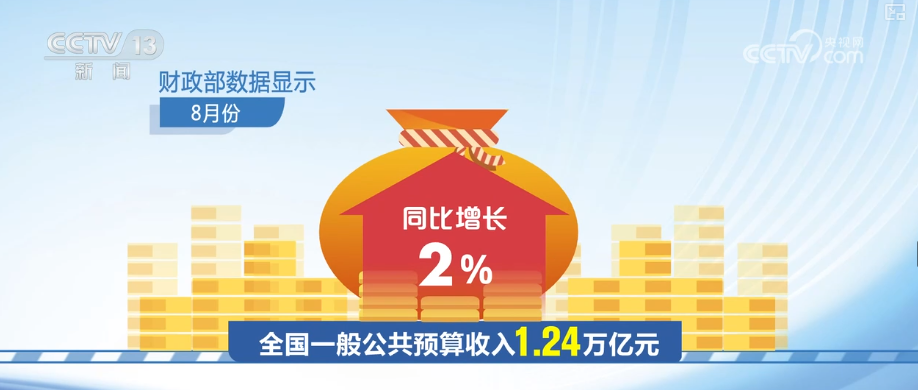
Core Insights - The Ministry of Finance reported that from January to August, the national general public budget revenue reached nearly 15 trillion yuan, while expenditure was close to 18 trillion yuan [1] - In August, the national general public budget revenue was 1.24 trillion yuan, showing a year-on-year growth of 2%, continuing the growth trend [3] - For the first eight months, the national general public budget revenue was 14.82 trillion yuan, an increase of 0.3%, with the growth rate improving by 0.2 percentage points compared to January to July [5] - Notably, the cumulative growth rate of tax revenue turned positive for the first time [5] Revenue Analysis - In August, national tax revenue grew by 3.4% year-on-year, maintaining positive growth for five consecutive months [7] - From January to August, national tax revenue totaled 12.11 trillion yuan, which is 2.6 billion yuan more than the same period in 2024, reflecting a slight increase of 0.02% [7] - By tax type, domestic value-added tax, domestic consumption tax, and individual income tax showed stable growth, while the cumulative growth of corporate income tax turned positive [9] Expenditure Analysis - From January to August, national general public budget expenditure was 17.93 trillion yuan, a year-on-year increase of 3.1%, with key areas of expenditure well-supported [13] - Expenditures in education, social security and employment, and health care all grew by over 5% year-on-year [13] - Additionally, local government special bonds and other long-term bonds contributed to a significant increase in government fund budget expenditure, which grew by 30% [15]
今年前8月证券交易印花税收入1187亿元,同比增长81.7%
Di Yi Cai Jing· 2025-09-17 08:24
Revenue Summary - National general public budget revenue for January to August reached 148198 billion yuan, with a year-on-year growth of 0.3% [1][3] - Tax revenue accounted for 121085 billion yuan, showing a slight increase of 0.02% year-on-year, while non-tax revenue was 27113 billion yuan, growing by 1.5% [3] - Central government revenue was 64268 billion yuan, down 1.7% year-on-year, whereas local government revenue was 83930 billion yuan, up 1.8% [3] Tax Revenue Breakdown - Domestic value-added tax generated 47389 billion yuan, increasing by 3.2% [4] - Domestic consumption tax amounted to 11523 billion yuan, with a growth of 2% [5] - Corporate income tax reached 31477 billion yuan, reflecting a growth of 0.3% [6] - Personal income tax was 10547 billion yuan, showing a significant increase of 8.9% [7] - Import VAT and consumption tax totaled 11770 billion yuan, down 6.7%, while customs duties were 1527 billion yuan, down 6.5% [8] - Export tax rebates were 15766 billion yuan, increasing by 9% [9] - Urban maintenance and construction tax was 3471 billion yuan, up 2.9% [10] - Vehicle purchase tax was 1334 billion yuan, down 17.7% [11] - Stamp duty revenue reached 2844 billion yuan, with a notable increase of 27.4%, including securities transaction stamp duty at 1187 billion yuan, up 81.7% [12] - Resource tax was 1943 billion yuan, down 2.8% [13] - Deed tax was 3012 billion yuan, down 15.3% [14] - Property tax amounted to 3307 billion yuan, increasing by 11.5% [15] - Urban land use tax was 1704 billion yuan, up 6.3% [16] - Land value increment tax was 2967 billion yuan, down 18.3% [17] - Cultivated land occupation tax was 1001 billion yuan, up 4% [18] - Environmental protection tax was 197 billion yuan, increasing by 11.5% [19] - Other tax revenues totaled 838 billion yuan, with a growth of 0.7% [20] Expenditure Summary - National general public budget expenditure for January to August was 179324 billion yuan, with a year-on-year increase of 3.1% [21] - Central government expenditure was 26570 billion yuan, up 8%, while local government expenditure was 152754 billion yuan, increasing by 2.3% [21] Major Expenditure Categories - Education expenditure reached 27078 billion yuan, growing by 5.6% [22] - Science and technology expenditure was 5874 billion yuan, up 3.1% [23] - Cultural, tourism, sports, and media expenditure totaled 2272 billion yuan, increasing by 4.3% [23] - Social security and employment expenditure was 30723 billion yuan, with a growth of 10% [24] - Health expenditure amounted to 13717 billion yuan, up 5.1% [25] - Energy conservation and environmental protection expenditure was 3315 billion yuan, increasing by 6.6% [26] - Urban and rural community expenditure was 12319 billion yuan, down 4.9% [27] - Agriculture, forestry, and water expenditure was 13589 billion yuan, down 9.4% [28] - Transportation expenditure reached 7128 billion yuan, down 1.3% [29] - Debt interest payment expenditure was 8715 billion yuan, increasing by 5.9% [30] Government Fund Budget Summary - National government fund budget revenue for January to August was 26449 billion yuan, down 1.4% [31] - Central government fund budget revenue was 2933 billion yuan, up 0.6%, while local government fund budget revenue was 23516 billion yuan, down 1.6%, with land use rights transfer revenue at 19263 billion yuan, down 4.7% [31][32] Government Fund Expenditure Summary - National government fund budget expenditure for January to August was 62602 billion yuan, increasing by 30% [33] - Central government fund budget expenditure was 7609 billion yuan, up 3.1 times, while local government fund budget expenditure was 54993 billion yuan, increasing by 18.8%, with land use rights transfer related expenditure at 26732 billion yuan, down 4.1% [33]
白银期货行情高位震荡 美国8月关税收入创新高
Jin Tou Wang· 2025-09-15 03:27
Group 1: Silver Market Performance - The main silver futures contract in Shanghai closed at 10,035 CNY/kg on September 12, marking a 2.42% increase, with an intraday high of 10,065 CNY/kg and a low of 9,777 CNY/kg [1] - COMEX silver closed at 42.68 USD/oz, up 1.46%, with an intraday high of 43.04 USD/oz and a low of 41.90 USD/oz [1] Group 2: U.S. Tariff Revenue and Budget Deficit - In August, U.S. tariff revenue reached a record high for a single month at 30 billion USD, a 296% increase compared to August of the previous year, contributing to a budget deficit of 345 billion USD, which is 15% larger than the same month last year [2] - For the first 11 months of the fiscal year, total tariff revenue amounted to 172 billion USD, with expectations that annual tariff revenue could reach 500 billion USD by year-end [2] - Despite the surge in revenue, the total budget deficit for the fiscal year reached 1.973 trillion USD, only surpassed by the deficits in 2020 and 2021 during the COVID-19 crisis [2][3]
拆解“提高财政收入占比”的三个关键问题
Sou Hu Cai Jing· 2025-09-13 04:20
Group 1: Fiscal Revenue and GDP Ratio - Recent discussions among experts suggest increasing the fiscal revenue as a percentage of GDP, with former Finance Minister Lou Jiwei advocating for this in his 2025 paper [2][3] - The fiscal revenue ratio reflects the government's ability to concentrate financial resources from the economy and its macro-control capacity [3] - Since the 1994 tax-sharing reform, the fiscal revenue ratio has shown a trend of initially increasing and then decreasing, with the ratio dropping from 21.4% during the 12th Five-Year Plan to an average of 16.7% in the first four years of the 14th Five-Year Plan [5][6] Group 2: Tax Burden and Comparison with Other Economies - In 2024, the macro tax burden is reported at 28.2%, indicating room for improvement compared to the generally accepted 30% threshold [3] - China's macro tax burden is lower than 20% when measured by tax revenue as a percentage of GDP, which is below levels seen in OECD countries [4] - The decline in fiscal revenue ratio is linked to large-scale tax cuts implemented since 2019, which reduced the ratio from 28%-29% in 2018 to 26% in 2023 [6][7] Group 3: Need for Fiscal Reform - The 2023 Central Economic Work Conference highlighted the need for a new round of fiscal reform due to the significant decline in fiscal revenue ratios [7][8] - The fiscal revenue ratio for 2023 is noted to be 26%, which is lower than the 30% average for similar income countries and significantly below the 35% average for developed countries [8] - Experts emphasize the importance of improving the efficiency of fiscal spending and optimizing the expenditure structure to ensure fiscal sustainability [4][9] Group 4: Alternative Revenue Sources - Experts suggest that besides increasing tax revenue, other methods to enhance fiscal revenue include expanding the state capital operating budget and reducing unfair tax incentives [14][15] - The state capital operating budget is seen as having significant potential for growth, especially as land finance diminishes [15][17] - The current state capital operating budget revenue is reported at 6783 billion yuan for 2024, with substantial profits from state-owned enterprises indicating room for increased contributions [15][16]