资产证券化

Search documents
理论学习丨党的二十届四中全会《建议》学习辅导百问(33-41)
Sou Hu Cai Jing· 2026-01-02 10:50
Group 1 - The core idea is to accelerate the establishment of a long-term mechanism for government debt management that aligns with high-quality development, emphasizing the need for effective debt management and risk prevention [2][3][4] - The Chinese government has strengthened local government debt management during the 14th Five-Year Plan period, optimizing special bond management and implementing a negative list for bond usage [3][4] - There is a need to improve the government debt management system, clarify the classification and functional positioning of government debt, and ensure sustainable debt limits [4][5] Group 2 - A long-term mechanism for preventing and resolving hidden debt risks is essential, requiring a comprehensive monitoring system and strict budget management for government expenditures [5][6] - Enhancing the management of local government special bonds is crucial, focusing on project approval processes and ensuring timely repayment to mitigate default risks [6] - The reform and transformation of local government financing platforms should be accelerated, ensuring they operate independently of government credit and adhere to market principles [6] Group 3 - The development of technology finance, green finance, inclusive finance, pension finance, and digital finance is a strategic deployment to better serve the real economy and meet the needs of high-quality economic development [7][8] - By June 2025, loans in the five key financial areas are expected to reach 105.7 trillion yuan, accounting for 38.8% of total loans, with a year-on-year growth of 14% [8][9] - The financial system should enhance its service capabilities and support for key sectors such as technology innovation and green development [9][10] Group 4 - The promotion of balanced development in imports and exports is essential for maintaining economic stability and responding to global trade challenges [24][25] - In 2024, China's goods trade is projected to reach 6.16 trillion USD, with a trade surplus of 992.2 billion USD, highlighting the need for balanced trade [24][25] - The focus on high-quality development necessitates increasing both export quality and import volume to meet domestic needs and enhance global cooperation [26][27] Group 5 - The push for digital trade innovation involves expanding market access in the digital sector and improving the regulatory framework for data flow [29][30] - Establishing high-level open platforms for digital trade is crucial, with initiatives like national digital trade demonstration zones to enhance competitiveness [30][31] - International cooperation in digital trade should be deepened, particularly with countries in ASEAN and BRICS, to foster a collaborative digital economy [31]


2025年11月市场发行企业资产支持证券136单
Zhong Guo Jing Ying Bao· 2026-01-01 08:13
Group 1 - The core viewpoint of the article highlights a significant increase in the issuance of corporate asset-backed securities in November 2025, with a total of 136 issuances amounting to 141.683 billion yuan, representing a 49% increase in issuance scale compared to October 2025 [1] Group 2 - In terms of issuance venues, the Shanghai Stock Exchange accounted for 102 issuances with an amount of 115.213 billion yuan, making up 81.32% of the total issuance [1] - The Shenzhen Stock Exchange had 34 issuances totaling 26.470 billion yuan, which represents 18.68% of the total issuance [1] Group 3 - The types of underlying assets for the corporate asset-backed securities issued in November 2025 included REITs, accounts receivable, corporate financing leases, microloans, and specific non-financial debt rights [1] - Among these, REITs had 9 issuances with a scale share of 14.66%, accounts receivable had 19 issuances with a scale share of 13.60%, and corporate financing leases had 20 issuances with a scale share of 11.11% [1]
突破2.28万亿:企业ABS主导、ABN崛起、信贷ABS转型——2025资产证券化市场深度扫描
Xin Hua Cai Jing· 2025-12-31 05:21
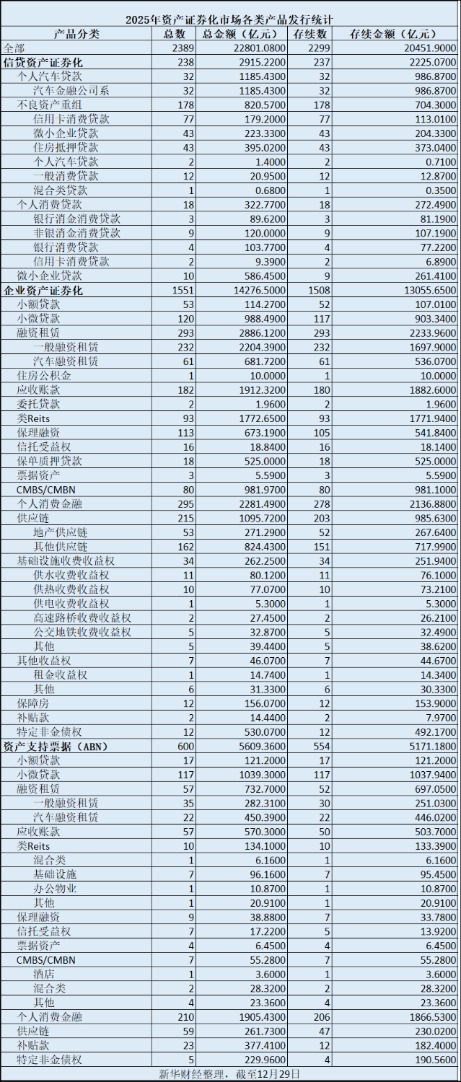
Core Insights - The asset securitization market in 2025 reached a record high with a total issuance of 22,801.08 billion yuan and 2,389 products, marking a significant structural transformation from credit-driven to entity service-oriented [1][3] Group 1: Market Overview - The market structure has evolved, with corporate asset-backed securities (ABS) dominating at 14,276.5 billion yuan, accounting for 62.6% of the total issuance [1][3] - Asset-backed notes (ABN) emerged as the fastest-growing segment, with an issuance of 5,609.36 billion yuan, representing 24.6% of the market [1][3] - Traditional credit ABS saw its market share decrease to 12.8% [1] Group 2: Product Breakdown - Corporate ABS issuance was primarily driven by traditional assets such as financing leases, receivables, and supply chain finance, while consumer finance and microloans reflected the recovery of the economy [3][4] - ABN's growth is attributed to a strong base of institutional investors and the flexible yet standardized product design, with personal consumption loans and micro-enterprise loans as core asset sources [4][8] - Credit ABS issuance totaled 2,915.22 billion yuan, with a notable increase in the restructuring of non-performing assets, which surged by 177.9% in the third quarter [5] Group 3: Market Dynamics - The asset securitization market is characterized by a "quarter-end rush" in issuance, indicating its integration into regular financial and capital management practices [6] - The development of the market is supported by favorable policies, strong demand from the real economy, and improved market liquidity [7][8] - The secondary market for ABS saw increased trading activity, with a quarterly transaction volume of 2,200.17 billion yuan in the fourth quarter, enhancing product liquidity and investment appeal [7] Group 4: Future Outlook - The focus is shifting from mere scale expansion to ecological construction and precise service, with an emphasis on product synergy and innovation [9] - The emergence of data asset ABS signifies a new frontier in the market, with potential growth driven by overcoming common industry challenges [9] - The market is expected to continue evolving, with corporate ABS expanding into intangible assets, ABN gaining recognition for its stable cash flows, and credit ABS focusing on non-performing asset restructuring [9]
结构融资:境外资产证券化市场回顾及热点洞察
Sou Hu Cai Jing· 2025-12-26 04:25
Group 1: Overview of the Overseas Asset Securitization Market - The overseas asset securitization market shows significant resilience and structural changes in 2025, influenced by multiple macro factors [1] - In the US, the issuance scale of asset securitization products reached approximately $1.7 trillion in 2024, accounting for 19% of the fixed income market, with MBS and ABS remaining the main products [1] - The European market is steadily recovering, with a 15% year-on-year growth in issuance scale for 2024, driven by the STS framework, which increased the compliance product share to 25%-30% [1] Group 2: Highlights of Asset-Backed Securities - Asset-backed securities (ABS) became a highlight in 2023, with a global issuance volume reaching a new high of €689 billion, frequently surpassing the sovereign rating "ceiling" [1] - International rating agencies like S&P and Fitch allow asset-backed securities to be rated up to 4-6 notches above sovereign ratings under specific conditions, emphasizing the importance of a sound judicial system, structural mitigation mechanisms, and collateral quality [1] - An example includes an asset-backed security issued by an Asian country receiving a AAA rating, exceeding its AA sovereign rating, showcasing the unique advantages of asset-backed securities in credit isolation and risk mitigation [1] Group 3: Cross-Border Real Estate Investment Trusts (REITs) - Hong Kong and Singapore REITs holding assets in China demonstrate the ability to navigate through cycles, attributed to a highly diversified portfolio covering various asset types such as offices, logistics, and data centers [2] - Successful strategies include flexible acquisition and exit mechanisms, a 50% leverage cap providing financing flexibility, and dynamic asset management strategies [2] - In contrast, failed cases often stem from single asset types, regional concentration, or governance issues, highlighting the importance of asset quality and risk control systems [2]

结构融资:境外资产证券化市场回顾及热点洞察(一)
Sou Hu Cai Jing· 2025-12-25 01:02
Market Overview - The US asset securitization market's share of the overall fixed income market has decreased from a peak of 38% in 2021 to approximately 19% in 2024, yet it remains a crucial component of the capital market [7][9]. - The market is divided into two main categories: mortgage-backed securities (MBS) and asset-backed securities (ABS), with issuance volumes fluctuating significantly due to macroeconomic and policy factors [7][11]. - Following a historical high in issuance during 2021-2022, the market saw a decline due to interest rate hikes, but began to recover gradually in 2023 [17]. - The European asset securitization market has a substantial existing scale, with issuance recovering in 2023, and is characterized by placed and retained issuance types, with the former's share increasing [18][19]. Market Hotspots - Asset-backed securities are gaining attention as a debt instrument backed by a pool of assets, favored by investors due to their dual recourse feature, with over thirty countries having issued such securities globally [25]. - The issuance volume of asset-backed securities is expected to reach a historical high in 2024, with Europe being the primary market [27]. - The STS (Simple, Transparent, and Standardized) framework has been instrumental in increasing the share of related products in the European market, rising from 1-2% to approximately 25-30% in recent years [26]. Market Insights - Cross-border REITs in Hong Kong and Singapore, which hold domestic real estate, enhance risk resilience through diversified investment portfolios across geographic locations and asset types [2][45]. - The asset preferences of REITs in both regions differ, and they possess mature project acquisition exit mechanisms, flexible financing models, and dynamic asset operation risk management [2]. - Some REITs face challenges due to single asset types and poor location, reflecting the impact of these factors on performance [2]. Market Outlook - The offshore structured financing market is witnessing innovative development trends, driven by blockchain and digitalization, with emerging asset securitization products like data center financing and private credit becoming new growth points [2]. - Overall, the offshore asset securitization market is gradually recovering amidst fluctuations, with innovative products and mature operational mechanisms driving sustained industry growth [2].

2025年结构融资:境外资产证券化市场回顾及热点洞察(一)-标普信评
Sou Hu Cai Jing· 2025-12-23 16:32
Market Overview - The global offshore asset securitization market is experiencing a differentiated recovery, with the US market remaining a significant component despite a decline in its share of the fixed income market compared to peak levels. As of Q3 2025, the issuance volume reached approximately $1.7 trillion, primarily backed by auto loans, credit cards, and student loans [1][2] - The European market has a substantial existing scale, with issuance recovering since 2023, totaling around €188.7 billion in the first half of 2025. The share of placement-type products is continuously increasing, with STS (Simple, Transparent, and Standardized) products becoming a key growth driver, focusing on consumer loans as the underlying assets [1][2] Market Hotspots - Asset-backed securities (ABS) are a core market hotspot, demonstrating strong resilience against risks. The global issuance volume for these products reached a historical high in 2024, with Europe being the primary market. The ability to surpass sovereign rating ceilings is a significant highlight, with major rating agencies allowing upgrades of up to six notches above sovereign ratings [2][3] - Cross-border REITs (Real Estate Investment Trusts) in Hong Kong and Singapore exhibit distinct characteristics and a diversified landscape. These products showcase strong cyclical resilience through diversified investment portfolios, mature acquisition and exit mechanisms, and flexible financing models. However, some products face challenges due to reliance on single asset types and regional structural risks, emphasizing the importance of asset quality and risk control [2][3] Market Insights - The future of the market will focus on innovative products and digital transformation. Emerging trends include the rise of new asset securitization products such as data centers and private credit, with blockchain technology driving digital upgrades in the industry. Overall, the offshore asset securitization market is gradually returning to stability after fluctuations, with high-quality underlying assets, robust risk control mechanisms, and flexible product designs becoming core competitive advantages [3]

学习规划建议每日问答丨怎样理解稳步发展期货、衍生品和资产证券化
Xin Hua She· 2025-12-21 06:28
Core Viewpoint - The Chinese government emphasizes the need to steadily develop futures, derivatives, and asset securitization as essential measures to establish a well-structured financial market system and accelerate the construction of a financial powerhouse, which will enhance financial product diversity, improve market completeness, and strengthen financial services for the real economy and risk management [1] Group 1: Derivatives Market - Derivatives, including futures, are crucial financial tools in modern markets, serving functions such as price discovery and risk management. In 2024, the trading volume of derivatives in China's interbank market is expected to exceed 230 trillion yuan [2] - Interest rate derivatives are primarily used for hedging and risk management, helping institutions mitigate risks associated with interest rate fluctuations. For instance, during a period of declining interest rates in 2024, institutions utilized interest rate swaps to prevent potential net value declines and asset sell-offs [2] - The development of the derivatives market in China is lagging, with the daily trading volume of interest rate derivatives compared to the outstanding balance of government bonds at only about 0.8%, significantly lower than the 8%-9% ratio seen in the US and Eurozone [2] Group 2: Regulatory and Market Development - To address inherent risks in economic and financial activities, there is a need for a more comprehensive understanding and improvement of the derivatives market, including optimizing regulatory approaches and allowing more qualified entities to access derivatives [3] - Strengthening regulatory capabilities is essential to avoid systemic risks, enhance transparency, and improve regulatory effectiveness while increasing tolerance for normal market fluctuations [3] - Financial institutions are encouraged to develop internal management systems tailored to derivatives business characteristics, improve hedge accounting, and build a workforce skilled in pricing, valuation, and risk control [3] Group 3: Asset Securitization - Asset securitization plays a vital role in revitalizing existing assets, stabilizing macro leverage ratios, optimizing asset-liability structures, and broadening financing channels. It can convert existing assets into liquid financial products, enhancing market depth and meeting investor demand [4] - Financial institutions can provide financing without expanding their balance sheets, which helps stabilize and reduce leverage, shifting the development model from debt-driven to asset-driven [4] - The asset securitization market in China has entered a normalization phase since 2014, with annual issuance reaching around 2 trillion yuan, but issues such as unclear underlying legal relationships and high issuance management costs hinder market depth [4] Group 4: Future Development of Asset Securitization - The asset securitization market has significant potential in China's economic transformation, necessitating a focus on serving key sectors of the real economy and enhancing market infrastructure for long-term healthy development [5] - There is a need to improve the legal framework and supporting arrangements for the market, ensuring clear rights and obligations among participants and optimizing issuance management mechanisms [5] - Efforts should be made to diversify investors and enhance the secondary market, including building a robust valuation system and improving liquidity in the secondary market [5]
怎样理解稳步发展期货、衍生品和资产证券化
Xin Lang Cai Jing· 2025-12-21 05:18
Group 1: Core Insights - The proposal from the Central Committee emphasizes the need to steadily develop futures, derivatives, and asset securitization as essential measures for establishing a well-structured financial market system and accelerating the construction of a financial powerhouse [1] - The derivatives market in China is projected to exceed 230 trillion yuan in trading volume by 2024, highlighting the importance of derivatives in price discovery and risk management [2] - The current development of the derivatives market in China is lagging, with the daily trading volume of interest rate derivatives being only about 0.8% of the outstanding government bonds, compared to 8%-9% for USD and EUR derivatives [2] Group 2: Derivatives Market Development - To enhance the derivatives market, it is crucial to optimize regulatory approaches, allowing more qualified entities like insurance companies and banks to access derivatives, thus diversifying participants and trading scenarios [3] - Strengthening regulatory capabilities is essential to avoid systemic risks, improve transparency, and enhance regulatory effectiveness [3] - Financial institutions should develop internal management systems tailored to derivatives business characteristics, improve hedge accounting, and build talent in pricing and risk control [3] Group 3: Asset Securitization - Asset securitization plays a vital role in revitalizing existing assets, stabilizing macro leverage ratios, optimizing asset-liability structures, and broadening financing channels [4] - The asset securitization market in China has entered a normalization phase since 2014, with annual issuance reaching around 2 trillion yuan, but faces challenges such as unclear underlying legal relationships and high issuance management costs [4] - There is significant potential for asset securitization to support the real economy, particularly in infrastructure, public utilities, and advanced manufacturing sectors [5] Group 4: Future Directions - The focus should be on serving key areas of the real economy, enhancing innovation in standards, financial products, and policy guidance [5] - It is necessary to improve the legal framework and supporting arrangements for the market, ensuring clear rights and obligations among participants [5] - Diversifying investors and enhancing the secondary market's liquidity are critical for the long-term healthy development of the asset securitization market [5]
学习规划建议每日问答 | 怎样理解稳步发展期货、衍生品和资产证券化
Xin Hua She· 2025-12-21 03:16
Group 1: Core Insights - The proposal from the Central Committee emphasizes the need to steadily develop futures, derivatives, and asset securitization as essential measures for establishing a well-structured financial market system and accelerating the construction of a strong financial nation [1] - The derivatives market in China is expected to exceed 230 trillion yuan in trading volume by 2024, highlighting the importance of derivatives in price discovery and risk management [2] - The current development of the derivatives market in China is lagging, with the daily trading volume of interest rate derivatives being only about 0.8% of the outstanding government bonds, compared to 8-9% for USD and EUR derivatives [2] Group 2: Derivatives Market Development - To enhance the derivatives market, it is crucial to optimize regulatory approaches, allowing more qualified entities like insurance companies and banks to engage in derivatives trading [3] - Strengthening regulatory capabilities is essential to avoid systemic risks, improve transparency, and enhance regulatory effectiveness [3] - Financial institutions should develop internal management systems tailored to derivatives business characteristics and improve talent development in pricing and risk control [3] Group 3: Asset Securitization - Asset securitization plays a vital role in revitalizing existing assets, stabilizing macro leverage ratios, optimizing asset-liability structures, and broadening financing channels [4] - The asset securitization market in China has entered a normalization phase since 2014, with annual issuance reaching around 2 trillion yuan, but faces challenges such as unclear legal relationships and high issuance costs [4][5] - To promote the long-term healthy development of the asset securitization market, it is necessary to focus on serving key sectors of the real economy and enhance the legal and regulatory framework [5]
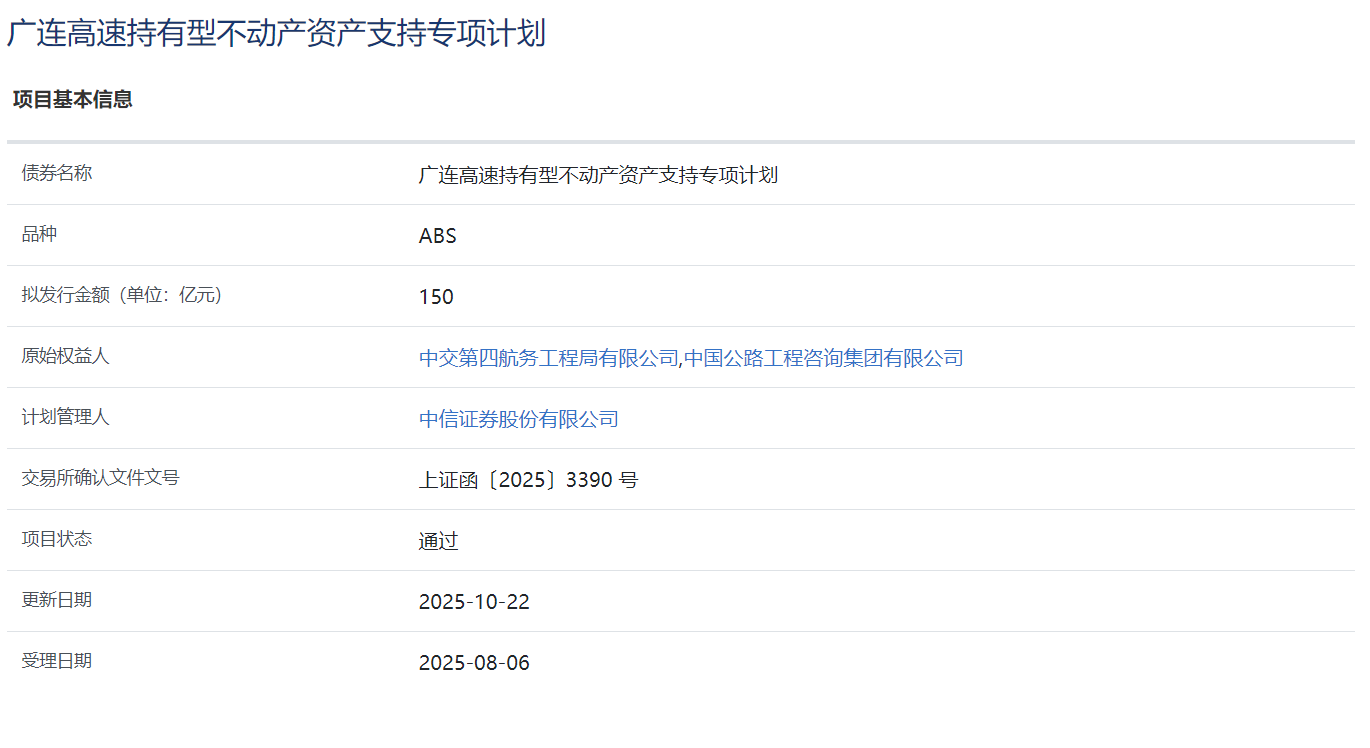
150亿广连高速项目!上交所发行全市场最大机构间REITs
2 1 Shi Ji Jing Ji Bao Dao· 2025-12-09 11:08
Core Viewpoint - The successful issuance of the Guanglian Expressway Real Estate Asset-Backed Securities (ABS) project, amounting to 15 billion yuan, marks a significant milestone as the largest single issuance and the first to receive approval from policy banks, showcasing a new paradigm for infrastructure financing in the Greater Bay Area [1][5][6]. Group 1: Project Overview - The Guanglian Expressway, connecting Guangzhou and Lianzhou, spans 231.7 kilometers and is a crucial part of Guangdong's highway network, enhancing strategic connectivity within the region [3]. - The project was officially accepted by the Shanghai Stock Exchange on August 6, 2025, and received approval on October 22, 2025, with CITIC Securities acting as the plan manager [3][4]. Group 2: Market Impact - The issuance of 15 billion yuan attracted over 10 core institutional investors, including insurance funds and asset management companies, indicating strong market confidence in the underlying asset quality [4]. - The project features an innovative performance assessment mechanism and liquidity support services, which are expected to enhance trading activity and pricing efficiency in the secondary market [4][5]. Group 3: Industry Trends - The market for holding-type real estate ABS has been expanding rapidly, with a total issuance of 22 projects amounting to 50.225 billion yuan by the end of November 2023, indicating a robust growth trajectory [8][9]. - The diverse asset classes within the ABS market, including commercial properties and infrastructure, provide a wide range of investment opportunities, contributing to the market's inclusivity [8][9]. Group 4: Future Outlook - Analysts believe that the holding-type real estate ABS market has significant growth potential, supported by favorable policies and a strong supply of quality projects, which could complement existing REITs structures [9].