金属制品

Search documents
——战略看多中游制造系列三:如何具象化和跟踪中游制造的价格?
Huachuang Securities· 2026-03-15 04:42
Group 1: Macro Overview - The midstream manufacturing sector is a key driver of economic stability, with 8 out of 10 tracked price indicators showing an upward trend this year[1] - The PPI weight of midstream manufacturing has increased by approximately 6 percentage points over the past decade to 41%[15] - Midstream manufacturing is expected to benefit from technological upgrades and global supply chain restructuring, marking a strategic era for the sector[10] Group 2: Price Tracking Indicators - In the computer and communication electronics sector, the price of DDR5 memory chips has risen by about 33% this year, while NAND Flash prices have also increased by 33%[1] - The price of battery-grade lithium carbonate has surged by approximately 34% this year, reflecting its significant cost share in lithium batteries[3] - The average price of air conditioners has increased by around 13% this year, with some manufacturers planning price hikes of 2% to 12% due to rising copper costs[3] Group 3: Industry-Specific Insights - The automotive manufacturing sector, which has a PPI weight of about 8.1%, is experiencing marginal improvements in pricing due to rising costs of chips and raw materials[5] - The steel price index has decreased by approximately 2% this year, while copper prices have risen by 2%[6] - The new shipbuilding price index has increased by 1% this year, indicating a slight recovery in the maritime sector[7]
金融工程日报:沪指震荡走低,锂电池概念领涨、风电股反复活跃-20260313
Guoxin Securities· 2026-03-13 15:35
- The report does not contain any quantitative models or factors for analysis[1][2][3]
油价上涨的影响:从行业成本到整体物价
East Money Securities· 2026-03-13 06:10
Impact of Rising Oil Prices - Since the outbreak of the Middle East conflict, international oil prices have surged, with both New York and Brent crude futures rising over 35% as of March 10, 2026[9][10] - Oil price increases may transmit through the industrial chain, affecting various sectors such as industry, agriculture, and services, leading to higher PPI and CPI indices[4][9] Industry Cost Impact Analysis - In the input-output table, 16 out of 42 industries are directly affected by rising oil prices, with the highest direct consumption coefficients in the petroleum refining and gas supply sectors[18] - For a 30% increase in oil prices, the cost impact exceeds 5% for gas supply (18%) and petroleum refining (17%)[22] - If oil prices rise by 50%, the cost impact exceeds 5% for gas supply (30%), petroleum refining (28%), and chemical products (6%)[22] Overall Price Level Effects - Under three scenarios of oil price increases (30%, 50%, and 100%), the PPI may rise by approximately 1.9%, 3.2%, and 6.3% respectively, potentially elevating the annual PPI growth rate to ranges of 0.9%-1.4%, 2.2%-2.7%, and 5.3%-5.8%[26] - Similarly, the CPI may increase by about 1.1%, 1.9%, and 3.7% under the same scenarios, raising the annual CPI growth rate to ranges of 1.1%-2.1%, 1.9%-2.9%, and 3.7%-4.7%[28]
行业调查 | 全球TOP10微膨胀金属网生产商排名及市场份额
QYResearch· 2026-03-13 01:16
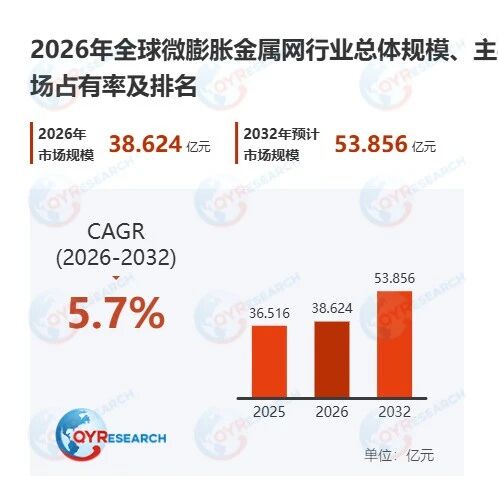
Core Viewpoint - The micro expanded metal mesh has emerged to address issues such as low forming precision, poor aperture uniformity, and low installation efficiency in traditional metal mesh, expanding its applications from basic protection to high-end manufacturing and precision filtration since its industrialization in the early 21st century [2]. Global Market Overview - The global micro expanded metal mesh market is projected to reach USD 790 million by 2032, with a compound annual growth rate (CAGR) of 5.7% over the coming years [3]. Industry Chain Analysis Upstream - Metal sheets, including stainless steel, carbon steel, copper, aluminum, and nickel alloys, serve as the fundamental raw materials for producing micro expanded metal mesh, providing essential properties such as strength, toughness, and corrosion resistance [7]. - Precision molds are utilized in the forming, stretching, punching, and expanding processes, ensuring high precision and consistency in the production of micro expanded metal mesh [8]. - Laser equipment allows for non-contact precision processing of metal sheets, enabling high-precision cutting, punching, and welding, which is crucial for producing micro expanded metal mesh with accurate dimensions and stable performance [9]. Downstream Applications - In the renewable energy sector, micro expanded metal mesh is used in lithium batteries, fuel cells, and photovoltaic systems, enhancing safety and efficiency during charge and discharge cycles [10]. - In the electronics and semiconductor industry, it serves as a high-precision functional component for heat dissipation, electromagnetic shielding, and filtration, ensuring stable operation of semiconductor devices [11]. - In aerospace applications, it is employed in components requiring lightweight, high strength, and thermal resistance, contributing to the reliability and safety of aircraft [12]. - In construction and civil applications, it is widely used for decoration, protection, ventilation, and filtration, meeting both structural and aesthetic needs [13]. Industry Policy Analysis - New policies in the steel industry mandate the adoption of clean production technologies, requiring micro expanded metal mesh production to comply with standards for pollution reduction and resource utilization [15]. Industry Development Trends - Precision and lightweight technology breakthroughs are expected, with aperture precision advancing to ±0.005mm, catering to high-end demands in semiconductor applications [16]. - The demand for customized services is increasing, with the share of customized services rising from 25% in 2020 to 42% by 2024, particularly in high-value sectors like renewable energy and aerospace [16]. - The domestic substitution in the semiconductor sector is accelerating, with a projected annual growth rate of 28% for electronic-grade micro expanded metal mesh, driven by the shift of chip production capacity to the Asia-Pacific region [16].

Omega Flex Q4 Earnings Fall Y/Y on Weak Housing Demand
ZACKS· 2026-03-10 18:21
Core Viewpoint - Omega Flex, Inc. has experienced a significant decline in both stock price and financial performance, primarily due to reduced demand linked to a slowdown in the housing market and increased operating expenses [1][9][11]. Financial Performance - For the fourth quarter of 2025, Omega Flex reported earnings per share of 34 cents, down from 46 cents in the same period of the previous year [1]. - Net sales for the fourth quarter totaled $25.2 million, a decrease of approximately 6.5% from $27 million in the same quarter of 2024 [2][6]. - The company's net income fell to $3.4 million from $4.7 million a year earlier, marking a 27.1% decline [2]. - For the full year 2025, net sales were $98.3 million, down from $101.7 million in 2024, representing a decrease of about 3.3% [3]. - Net income for 2025 was $14.8 million compared to $18 million in the previous year, a decline of 17.7%, with earnings per share dropping to $1.47 from $1.78 [3]. Sales Performance and Market Conditions - The revenue decline was primarily attributed to lower sales unit volumes, with management noting that the overall market environment remained under pressure [4][11]. - A significant factor contributing to reduced sales was the decline in housing starts, as Omega Flex products are heavily utilized in construction-related applications [5][11]. - The modest decrease in sales on a full-year basis masks a continued slowdown in end markets reliant on construction activity [6]. Profitability and Expense Pressures - The decline in profitability was more pronounced than the drop in revenues, driven by higher operating expenses related to product development, certification, and consulting activities [7][10]. - For the fourth quarter, net income decreased year over year, indicating that both lower volumes and elevated expenses negatively impacted operating performance [8][12]. - Increased investment in product development and certification efforts raised operating expenses, contributing to the larger percentage drop in net income compared to the smaller decline in sales [12].



通胀超预期背后:宏观物价线索的浮现:【宏观快评】2月通胀数据点评
Huachuang Securities· 2026-03-10 08:42
Group 1: Inflation Data Overview - February CPI increased from 0.2% to 1.3%, exceeding expectations of 0.9%, marking the highest level in three years[2] - Core CPI rose from 0.8% to 1.8%, with an average of 1.3% for January-February, the highest since 2020[2] - PPI narrowed its year-on-year decline from -1.4% to -0.9%, with expectations of -1.2%[2] Group 2: CPI and PPI Drivers - Core CPI's unexpected rise was primarily driven by competitive service prices, contributing approximately 0.26 percentage points to the 0.3 percentage point seasonal increase[3] - PPI's 0.4% month-on-month increase was significantly above the expected 0.1%, driven by input factors from oil and non-ferrous metals, contributing about 0.11 and 0.36 percentage points respectively[5][15] - The ongoing improvement in midstream manufacturing supply and demand has led to a sustained price increase, with PPI in this sector rising approximately 0.4%[6] Group 3: Price Trends and Market Implications - CPI's month-on-month increase of 1% was supported by significant price hikes in travel and entertainment services, as well as durable goods like automobiles and gold[2] - The average month-on-month core CPI for January-February was 0.5%, significantly higher than the past five-year average of 0.2%[3] - The potential for a positive shift in overall price levels is indicated, with government reports suggesting a move from negative to positive price growth this year[6][16] Group 4: Risks and Observations - The ongoing geopolitical uncertainties in the Middle East pose risks to inflation trends[6] - The observed price increases in competitive service sectors may indicate a recovery potential, as these prices have been relatively low since 2022[4][11]
连续八年全国第一,宁波何以NB?
吴晓波频道· 2026-03-08 00:30
Core Viewpoint - Ningbo, despite its low profile compared to other cities, is a manufacturing powerhouse with a strong foundation in specialized manufacturing, evidenced by its status as the city with the highest number of national manufacturing champions for eight consecutive years [8][9]. Group 1: Manufacturing Strength - Ningbo has the largest port in the world, Ningbo-Zhoushan Port, with a cargo throughput exceeding 1.4 billion tons last year, ranking first globally for 15 years [7]. - The city's GDP reached 1.6 trillion yuan, ranking 12th among Chinese cities and second in Zhejiang province [7]. - Ningbo is home to 11 companies listed in the Hurun China 500, ranking 10th among all cities [7]. - The number of high-tech enterprises in Ningbo exceeds 10,000, maintaining the highest growth rate in Zhejiang for four consecutive years [7]. Group 2: Specialized Manufacturing Champions - Ningbo has a significant number of national manufacturing champions, which are defined as companies that focus on specific manufacturing sectors with advanced technology and a leading market share globally [8]. - These champions play a crucial role in the global supply chain, often operating in niche markets that are not widely recognized but are essential for various industries [9][17]. Group 3: Innovation and R&D - Over 90% of R&D platforms, talent, and investment in Ningbo come from enterprises, with more than 80% of invention patents generated by these companies [25]. - The local government supports innovation through platforms like the Yongjiang Laboratory and various industry funds to enhance competitiveness [26][31]. Group 4: Industrial Ecosystem and Collaboration - Ningbo's industrial clusters provide a complete local supply chain, which reduces R&D and production costs, fostering deep specialization in key technologies [23]. - The collaboration among leading enterprises drives the transformation and upgrading of local industries, with many companies acting as "chain masters" to support smaller firms [24]. Group 5: Challenges and Future Plans - Ningbo faces structural challenges with a lack of large-scale leading enterprises, which limits its ability to compete with other major cities in the Yangtze River Delta [38]. - The local government aims to develop a "361" modern industrial system by 2027, targeting three trillion-level industrial clusters and six hundred billion-level clusters [34]. - Efforts are underway to attract leading enterprises and enhance the robotics industry, with several local companies already recognized among the top in China for robotics components [39][40].






A股行业中观景气跟踪月报(2026年3月):HALO交易情绪浓厚,涨价继续扩散-20260304
Shenwan Hongyuan Securities· 2026-03-04 07:44
Group 1 - The report indicates that the industrial sector is experiencing high growth in volume and price, particularly in non-ferrous metals and transportation equipment manufacturing, while sectors like coal mining and pharmaceuticals are showing signs of improvement from lower levels [5][6] - The manufacturing PMI for February 2026 is reported at 49.0%, a decrease of 0.3 percentage points, while the non-manufacturing business activity index increased to 49.5%, up by 0.1 percentage points [6][10] - Consumer confidence has recovered to a near two-year high, with service consumption outperforming goods consumption, particularly in the automotive and home appliance sectors [6][10] Group 2 - In the advanced manufacturing sector, prices for new energy products are showing divergence, with strong sales in engineering machinery and heavy trucks, supported by favorable policies [6] - The report highlights that the banking sector's non-performing loan ratio is stable at 1.496%, with net interest margins remaining consistent, indicating a stable financial environment [6] - The energy sector is experiencing a rebound in oil and coal prices due to geopolitical risks and supply constraints, with significant increases in precious metals and strategic minor metals prices [6][9]
银宝山新:二级市场股价波动受多重因素影响
Zheng Quan Ri Bao· 2026-02-27 12:43
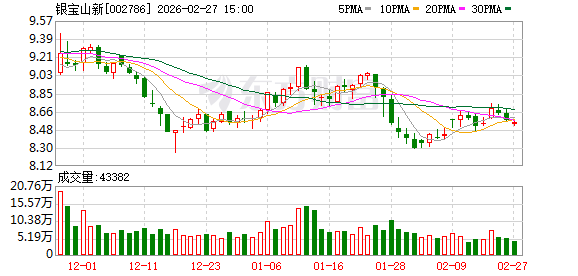
Group 1 - The company, Yinbao Shanjin, stated that the fluctuations in its stock price in the secondary market are influenced by multiple factors including the macroeconomic environment, industry policies, and market sentiment [2]

银龙股份:关于调整2026年限制性股票激励计划激励对象名单及授予权益数量的公告
Zheng Quan Ri Bao· 2026-02-27 12:42
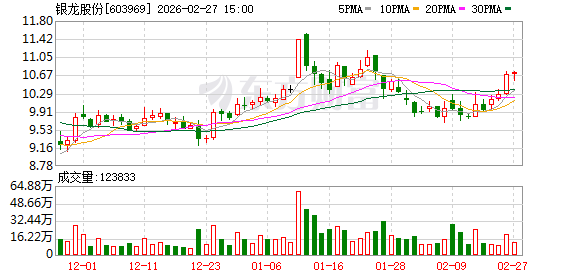
Core Viewpoint - Silver Dragon Co., Ltd. announced adjustments to its 2026 restricted stock incentive plan, including changes to the list of incentive recipients and the number of shares to be granted [2] Group 1 - The fifth board of directors of Silver Dragon will hold its 23rd meeting on February 27, 2026, to review the adjustments to the incentive plan [2] - The number of incentive recipients has been reduced from 378 to 373 [2] - The total number of restricted shares to be granted has been adjusted from 14.469 million shares to 14.412 million shares [2]