GPU芯片

Search documents
最全梳理!壁仞科技上市,市值狂飙至900亿,揭秘背后资本版图丨创投智库
证券时报· 2026-01-02 03:03
Core Viewpoint - The article discusses the successful IPO of Birun Technology, highlighting its rapid stock price increase and the significant investments made in the domestic GPU sector, marking a milestone for Chinese chip startups [1][4]. Group 1: Company Overview - Birun Technology was founded in September 2019 by Zhang Wen, a former president of SenseTime, and has since aimed to compete with industry giants like NVIDIA [4][6]. - The company has raised over 300 billion yuan in investments across various rounds, with significant backing from venture capital firms [4][30]. Group 2: Investment and Financing - The first round of financing in December 2019 raised $15 million, with a pre-investment valuation of $110 million [8]. - By mid-2020, Birun Technology completed four financing rounds, raising approximately 2.9 billion yuan, with a pre-investment valuation soaring to 6.06 billion yuan [11][12]. - The company has attracted major investors, including Gree Group and Hillhouse Capital, which have played crucial roles in its growth and development [14][16]. Group 3: Financial Performance - Birun Technology's revenue has shown steady growth, with figures of approximately 49,900 yuan in 2022, 6.203 million yuan in 2023, and projected 34 million yuan in 2024, although it lags behind competitors like Moore Threads and Muxi [18][21]. - The company has completed a total of 18.8 billion yuan in financing from 2021 to 2024, while its competitors raised significantly more during the same period [22]. Group 4: Market Position and Challenges - Despite the successful fundraising, Birun Technology faces challenges in the competitive GPU market, particularly against NVIDIA, which reported a global revenue of $130.5 billion for the fiscal year 2025, dwarfing the combined revenue of Birun and its competitors [30]. - The article emphasizes that while the IPO is a significant milestone, it is not the end goal, and strategic planning and product innovation will be essential for future success [30].

多款高端 AI 芯片实现量产,港股“GPU 第一股”壁仞科技开年挂牌:市值破千亿、首日涨幅领跑市场
AI前线· 2026-01-02 02:59
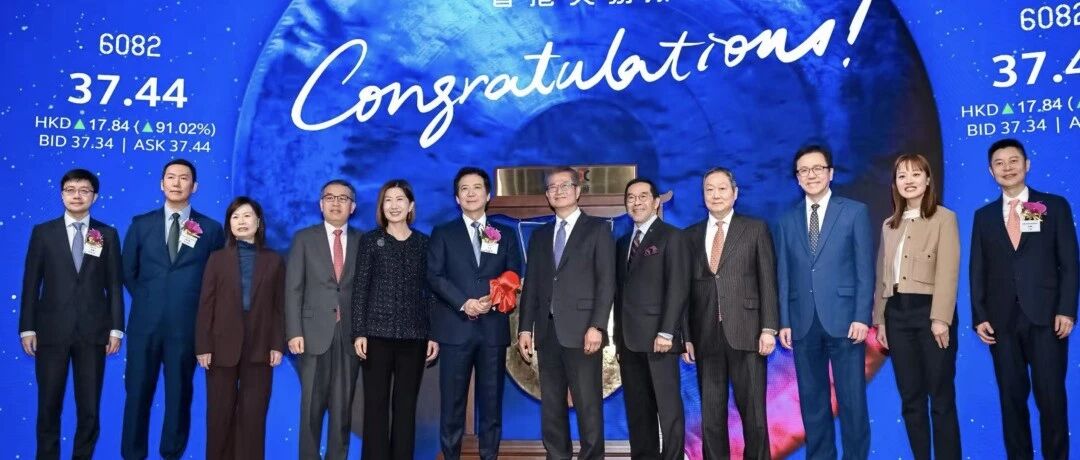
Core Viewpoint - The article highlights the successful IPO of Wallen Technology, a leading GPU company in Shanghai, marking a significant milestone in the Hong Kong stock market for 2026 and representing the largest IPO since the implementation of the 18C regulations [2]. Group 1: IPO Performance - Wallen Technology's stock price surged on its debut, opening at HKD 35.70, an increase of 82.14% from the issue price of HKD 19.60, and reaching a market capitalization of approximately HKD 1002 billion [2][3]. - The company received over 2300 times oversubscription during the IPO, indicating strong market interest in the domestic GPU sector and AI computing infrastructure [4]. Group 2: Company Overview - Founded in 2019, Wallen Technology focuses on high-performance general-purpose GPUs and intelligent computing systems, targeting data center applications rather than consumer-grade GPUs [4][6]. - The company emphasizes a design philosophy of "high computing density + general programmability," aiming to provide high floating-point computing power and bandwidth to meet the demands of AI model training [6]. Group 3: Financial Performance - Wallen Technology has incurred cumulative losses exceeding RMB 6.3 billion since its inception, with significant losses reported in recent years: RMB 1.474 billion in 2022, RMB 1.744 billion in 2023, and RMB 1.538 billion in 2024 [8][11]. - The company's R&D expenses have been substantial, accounting for approximately 79.8% of total operating expenses in 2022, with expectations for further increases in R&D investment [12]. Group 4: Product Development - Wallen Technology has successfully launched three GPGPU products, with the BR106 aimed at data centers and the BR110 targeting edge scenarios, emphasizing energy efficiency [10]. - The company has developed its own GPU architecture, which includes critical components such as computing units and interconnects, to ensure long-term competitiveness and autonomy [6]. Group 5: Leadership and Funding - The founder and CEO, Zhang Wen, has a diverse background in finance and technology, having previously held key positions in notable companies before establishing Wallen Technology [15][16]. - Wallen Technology has completed multiple rounds of financing, with its valuation reaching RMB 20.915 billion after the latest funding round, reflecting market confidence in its long-term potential in the high-end GPU sector [18].
DeepSeek一夜爆火、Labubu引爆全球抢购潮、“史诗级”外卖大战……2025年中国十大商业事件全盘点
硬AI· 2025-12-29 14:24
Core Viewpoint - The year 2025 marks a transformative period for Chinese business, driven by technological advancements and strategic market maneuvers, including DeepSeek's cost paradigm shift in AI, the establishment of a "stabilization fund" by state-owned enterprises, and fierce competition in various sectors like food delivery and consumer products [2][3][4]. Group 1: AI and Technology - DeepSeek's R1 model demonstrated a significant cost advantage, achieving comparable performance to OpenAI's models at a fraction of the cost, leading to a reevaluation of AI asset values globally [10]. - The Chinese stock market reacted positively to the implications of DeepSeek's success, with the Nasdaq China Golden Dragon Index rising over 4% shortly after [10]. - The launch of L3 autonomous driving vehicles in China signifies a major milestone in the commercialization of advanced driving technologies, with expectations of a market size exceeding 1 trillion yuan by 2030 [49][51]. Group 2: Market Stability Measures - In response to external economic pressures, the "national team" intervened in the stock market by establishing a "stabilization fund," which included significant investments from state-owned enterprises to restore market confidence [12][14][18]. - The People's Bank of China supported these efforts by promising sufficient liquidity to stabilize the market, reinforcing the government's commitment to maintaining financial security [14][18]. Group 3: Consumer and Service Sector Developments - JD.com entered the food delivery market, intensifying competition with Alibaba and Meituan, leading to aggressive pricing strategies and significant order volume growth [26][30]. - Pop Mart's Labubu character achieved global popularity, resulting in a revenue surge of 170%-175% in Q1 2025, with notable growth in international markets [20][22]. - The competition in the food delivery sector is characterized by substantial subsidies and promotional offers, indicating a shift towards efficiency and market share acquisition among major players [28][30]. Group 4: Capital Market Movements - The collective IPO efforts of China's "four little dragons" in the GPU sector highlight a significant moment for domestic chip manufacturers, with substantial market valuations and growth expectations [52][54]. - The stock prices of Pop Mart surged over 200% in the first half of 2025, reflecting strong market interest and future growth potential, despite a subsequent correction [22][25]. Group 5: Breakthroughs in Energy and Aerospace - China achieved significant milestones in nuclear fusion research, with advancements in plasma physics and the development of the next-generation fusion energy experimental device [58][59]. - The successful test flights of reusable rockets by both private and state-owned enterprises mark a new era in China's commercial space industry, aiming for cost reductions and increased launch frequency [60][63].





DeepSeek一夜爆火、Labubu引爆全球抢购潮、“史诗级”外卖大战……2025年中国十大商业事件全盘点
华尔街见闻· 2025-12-29 10:24
Core Insights - The year 2025 is marked as a transformative year in business, driven by significant advancements in AI and technology, particularly highlighted by DeepSeek's cost-effective AI model that challenges existing market paradigms [1][3][4]. Group 1: AI and Technology Developments - DeepSeek's R1 model, launched on January 20, 2025, achieved performance comparable to OpenAI's models at a fraction of the cost, using only 2,000 GPUs and approximately $600,000 in training expenses, less than one-tenth of OpenAI's costs [5][8]. - The market reacted dramatically to DeepSeek's success, leading to a significant drop in Nvidia's stock, with a loss of nearly $600 billion in market value, marking a historic event in the stock market [10][12]. - The Chinese tech sector saw a resurgence, with the Nasdaq China Golden Dragon Index rising over 4% shortly after DeepSeek's impact, indicating a shift in investor focus towards Chinese tech companies [11][12]. Group 2: Market Dynamics and Competition - The entry of JD.com into the food delivery market initiated a fierce competition with Alibaba and Meituan, leading to aggressive subsidy wars and a new competitive landscape in the industry [24][27]. - The battle for market share in food delivery is characterized by significant discounts and promotional offers, with Meituan experiencing record order volumes amid the competition [29]. Group 3: Innovations in Consumer Products - Pop Mart's Labubu character gained global popularity, leading to a 170%-175% year-on-year revenue increase in Q1 2025, with significant growth in international markets [20][23]. - The stock price of Pop Mart surged over 200% in the first half of 2025, reflecting strong market interest and investment confidence in the brand's potential [20][23]. Group 4: Regulatory and Economic Responses - In response to external economic pressures, the Chinese government implemented a "stabilization fund" strategy to support the capital market, demonstrating a proactive approach to maintain market confidence [15][17]. - The People's Bank of China provided liquidity support to stabilize the market, showcasing a coordinated effort to mitigate the impact of geopolitical tensions on the economy [15][17]. Group 5: Advancements in Autonomous Driving and GPU Technology - China officially approved L3 autonomous driving vehicles for commercial use, marking a significant milestone in the automotive industry and setting the stage for a market expected to exceed 1.2 trillion yuan by 2030 [40][41]. - The emergence of domestic GPU manufacturers, referred to as the "Four Little Dragons," is reshaping the semiconductor landscape, with significant IPO activity and competitive differentiation among companies [42][44].

天数智芯率先闯过“量产死亡峡谷”,通过港股聆讯只是开始
智通财经网· 2025-12-25 08:24
Core Viewpoint - TianShu ZhiXin is set to officially list on the Hong Kong Stock Exchange in January 2026, joining other domestic GPU companies in a competitive market for computing power [1][4]. Group 1: Company Overview - TianShu ZhiXin is recognized as a "breakthrough player" in the mass production of general-purpose GPUs, having successfully delivered 7nm high-performance GPU chips to data centers [4][5]. - The company has achieved significant revenue growth, with a year-on-year increase of over 60% in 2023 and GPU shipments exceeding 50,000 units [5][14]. - It has established a strong customer base, serving over 290 enterprises across various sectors, including finance, healthcare, and education, with more than 900 actual deployment scenarios [7][8]. Group 2: Market Position and Strategy - TianShu ZhiXin's unique value proposition lies in its focus on mass production and delivery rather than just technological narratives, positioning it as a leader in the GPU market [4][10]. - The company has adopted a "user-centric" approach, emphasizing usability and practicality, which has made its products highly favored among customers [10][12]. - Its product matrix includes the TianYuan series for training and the ZhiKai series for inference, providing comprehensive computing power support from model development to deployment [8][10]. Group 3: Financial Performance - Revenue surged from 189 million yuan in 2022 to 540 million yuan in 2024, with a compound annual growth rate of 68.8% [14]. - The company is the only domestic GPU firm with a self-sustaining cash flow capability, driven by its substantial production scale and revenue growth [18]. - The growth trajectory is supported by a strong focus on actual shipment volumes and customer retention rates, marking a shift from traditional valuation models that emphasize R&D investments [12][18]. Group 4: Industry Implications - The case of TianShu ZhiXin highlights a critical perspective for investors in hard technology: the importance of focusing on clear profit paths and expanding shipment capabilities rather than just ambitious technological narratives [17][18]. - The company's success in commercializing GPU technology serves as a model for the industry, demonstrating the necessity of transitioning from chip design to commercial delivery [19].
港股GPU第一股来了,壁仞科技能否给港股带来造富盛筵?
Ge Long Hui· 2025-12-22 11:25
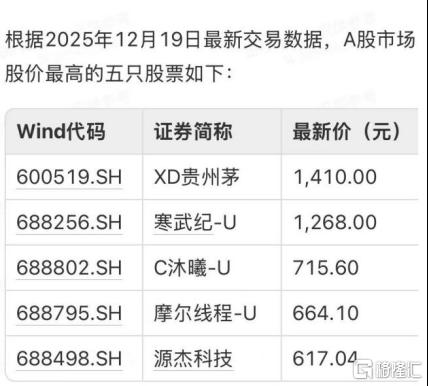
Core Viewpoint - The recent market performance of companies like Moore Threads and Muxi Co. signals a significant shift in the valuation system for high-end GPU companies, distinguishing them from traditional computing chip firms [1] Group 1: High-End GPU Valuation Logic - A completely independent valuation track for high-end GPUs is forming in the A-share market, as evidenced by the dramatic price increase of Cambrian Technology, which rose nearly 30 times from its low of 54 yuan to a peak of 1596 yuan [3] - The market's perception of general-purpose GPUs has evolved, with the listings of Moore Threads and Muxi providing a clearer understanding of their valuation, further validating the premium associated with computing power [3][4] - The top four high-priced stocks in A-shares now include Kweichow Moutai, Cambrian Technology, Moore Threads, and Muxi, indicating a significant shift in market sentiment towards high-end GPU assets [3] Group 2: Unique Characteristics of High-End GPUs - High-end GPUs meet five unique conditions that contribute to their distinct pricing logic, including the essential role of GPUs in large model training, limited supply, high migration costs, and their strategic importance in national policies [5][6] - The demand for computing power continues to rise, reinforcing the narrative of scarcity in the GPU market, which in turn drives up asset premiums and attracts more investment [6] Group 3: Wall Street's Perspective on Wall Street Technology - Wall Street's pricing logic for Wall Street technology becomes clearer with the upcoming IPO of Birun Technology, which, like Moore Threads and Muxi, focuses on the general-purpose GPU sector [8] - Birun Technology has established a competitive advantage through its GPGPU architecture, successfully developing and mass-producing chips like BR106 and BR110, and has a robust software ecosystem to support its products [10][11] Group 4: Commercialization and Financial Performance - Birun Technology's revenue has rapidly increased from 499,000 yuan in 2022 to 337 million yuan in 2024, indicating a strong growth trajectory in high-demand sectors [11] - The company has a clear growth path with approximately 822 million yuan in hand orders and a product roadmap that includes the commercial launch of the BR20X series in 2026 [13] Group 5: Market Conditions and Investor Sentiment - The Hong Kong stock market has seen a resurgence, with the Hang Seng Index rising about 23% and the Hang Seng Tech Index increasing approximately 37% since 2025, creating a favorable environment for tech IPOs [15] - Birun Technology's IPO is expected to attract significant interest, as evidenced by the participation of 23 major cornerstone investors and a high subscription rate of about 64% [17][18]
摩尔,沐曦,壁仞和天数!“国产GPU四小龙”齐聚IPO
Hua Er Jie Jian Wen· 2025-12-22 10:05
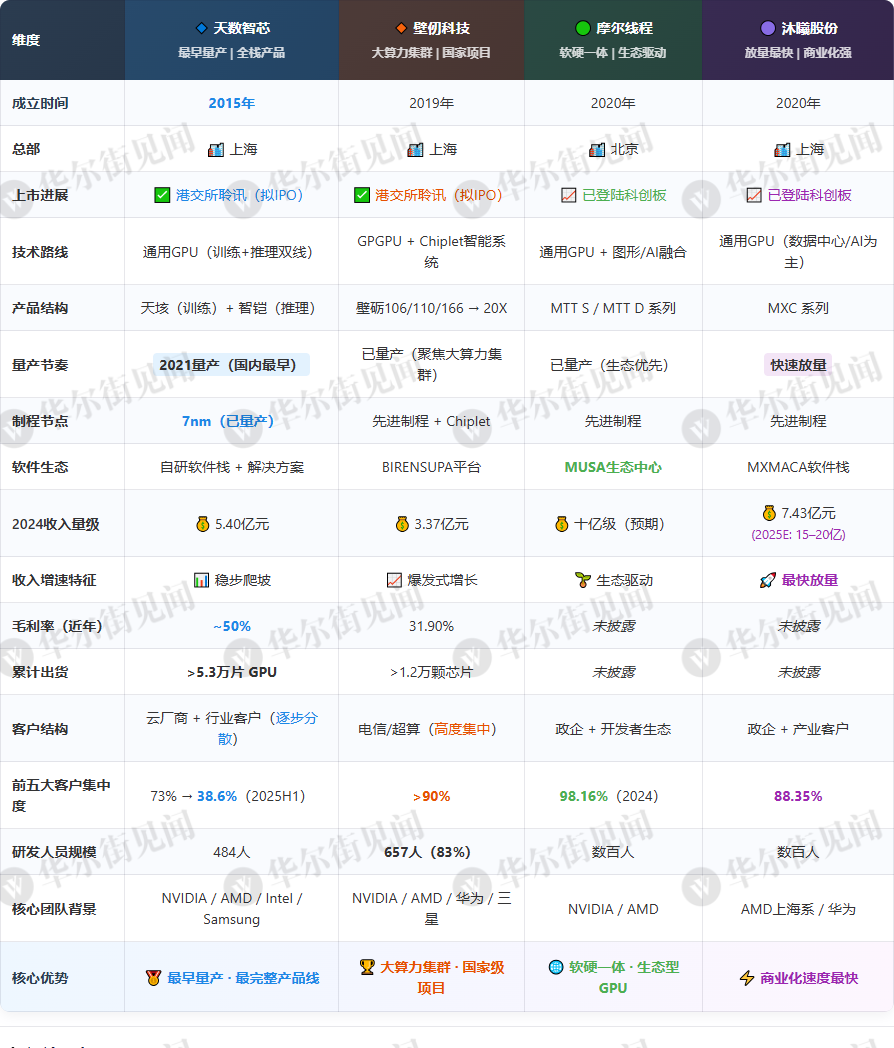
Core Viewpoint - The Chinese GPU industry is experiencing a significant breakthrough with the emergence of four key players, known as the "Four Little Dragons," each adopting distinct strategies to capture market share in the competitive landscape of global computing power [1][2]. Group 1: Company Strategies and Market Position - TianShuZhiXin leverages its first-mover advantage with a complete product line, focusing on both training and inference GPUs, achieving a cumulative shipment of over 53,000 units [4][7]. - MoErTianCheng emphasizes an "ecosystem-first" strategy with its MUSA architecture, aiming to bridge B-end and C-end markets, and has achieved a market valuation exceeding 300 billion yuan [1][8]. - MuXi Co. has rapidly commercialized its products, becoming the first among the four to achieve quarterly profitability, with a market valuation of 281.4 billion yuan [2][14]. - BiRan Technology, backed by state capital, focuses on large-scale cluster deployment and has established partnerships with major telecom operators, showcasing its capabilities in delivering high-reliability products [2][10]. Group 2: Financial Performance and Growth - TianShuZhiXin's revenue for the first half of 2025 reached 324 million yuan, surpassing its total revenue for 2023, with a significant reduction in customer concentration from 94.2% to 38.6% [5][7]. - MoErTianCheng anticipates a revenue of up to 1.498 billion yuan in 2025, with a projected year-on-year growth rate exceeding 240% and a gross margin of around 70% [8][9]. - MuXi Co. reported a revenue increase of 453.52% in the first nine months of 2025 compared to the same period in 2024, with a notable reduction in losses [14][15]. - BiRan Technology is projected to achieve a revenue of 337 million yuan in 2024, with a staggering compound annual growth rate of 2500% [10][12]. Group 3: Product Development and Technological Advancements - TianShuZhiXin's product strategy includes two mature lines, TianGai for training and ZhiKai for inference, covering a wide range of AI model applications [4][7]. - MoErTianCheng has launched four generations of GPUs based on its MUSA architecture, achieving performance metrics comparable to international standards [8][9]. - MuXi Co. is rapidly iterating its product lines, with plans for the XiYun C600 chip to enter risk production by the end of the year, and its flagship XiYun C700 targeting competition with NVIDIA's H100 [14][15].
首块L3级自动驾驶牌照发布;摩尔线程发布新一代GPU架构|盘前情报
2 1 Shi Ji Jing Ji Bao Dao· 2025-12-22 00:40
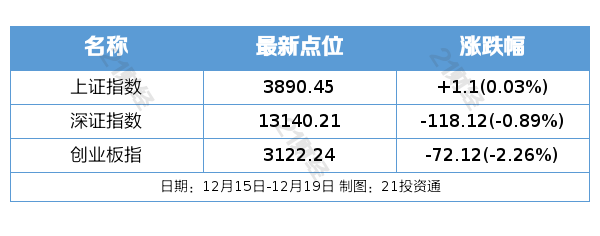
Market Performance - A-shares showed mixed performance from December 15 to December 19, with the Shanghai Composite Index closing at 3890.45 points, up 0.03%, while the Shenzhen Component Index fell 0.89% to 13140.21 points, and the ChiNext Index dropped 2.26% to 3122.24 points [1][2] - Over 54% of stocks in the A-share market rose during the week, with 107 stocks gaining over 15% and 31 stocks declining more than 15% [1] International Market Trends - The New York stock market indices rose on December 19, with the Dow Jones Industrial Average increasing by 183.04 points to 48134.89 points (up 0.38%), the S&P 500 rising by 59.74 points to 6834.50 points (up 0.88%), and the Nasdaq Composite gaining 301.26 points to 23307.62 points (up 1.31%) [3][4] - European stock indices also saw gains, with the FTSE 100 closing at 9897.42 points (up 0.61%), the CAC 40 at 8151.38 points (up 0.01%), and the DAX at 24288.40 points (up 0.37%) [3][4] - International oil prices experienced slight increases, with WTI crude oil futures rising by 51 cents to $56.66 per barrel (up 0.91%) and Brent crude oil futures increasing by 65 cents to $60.47 per barrel (up 1.09%) [3][4] Regulatory Developments - The National Development and Reform Commission, along with other regulatory bodies, released the "Internet Platform Pricing Behavior Rules" to enhance price regulation and protect consumer rights in the platform economy [5] - The National Internet Information Office and the China Securities Regulatory Commission are intensifying efforts to combat false information in the capital market, warning that spreading such information will lead to legal consequences [6] Automotive Industry Advancements - Changan Automobile received the first official license plate for L3-level autonomous driving, marking a significant milestone in the development of intelligent connected vehicles in China [6][7] - The Ministry of Industry and Information Technology granted the first batch of L3-level conditional autonomous driving vehicle licenses, allowing companies like Changan and BAIC to conduct road trials in designated areas [6][7] Technology Sector Developments - Moore Threads unveiled its new GPU architecture "Huagang," which supports full precision computing and is designed for large-scale computing clusters, with plans to launch high-performance AI chips in the coming year [8] - The AI infrastructure investment is expected to grow, with the global computing chip market expanding, benefiting hardware suppliers in the industry [8] Financial Sector Initiatives - The People's Bank of China and other financial authorities in Fujian Province are implementing a plan to enhance financial support for technology innovation and strategic emerging industries, aiming for a 10% annual growth in technology-related loans by 2025-2027 [9] Scientific Breakthroughs - Researchers at Shanghai Jiao Tong University achieved a breakthrough in the field of optical computing chips, which could support large-scale semantic media generation models, addressing the performance gap in traditional chip architectures [10] Commodity Market Insights - International silver prices reached a new high, with a year-to-date increase of 132.11%, significantly outpacing gold prices [11] Investment Strategies - Tianfeng Securities suggests focusing on three main investment directions: breakthroughs in AI technology, economic recovery, and undervalued assets benefiting from AI trends [12] - Huaxi Securities indicates that conditions for a "spring rally" are accumulating, recommending investments in sectors supported by industrial policies and consumer stimulus [13]
陈维良造芯五年打造国产GPU标杆 沐曦股份营收12亿创3000亿造富神话
Chang Jiang Shang Bao· 2025-12-21 23:26
Core Viewpoint - The company, Muxi Co., Ltd., has rapidly gained attention in the GPU market, achieving a market capitalization exceeding 300 billion yuan shortly after its IPO, despite currently operating at a loss [2][8]. Company Overview - Muxi Co., Ltd. was founded by Chen Weiliang, a former AMD executive, who aimed to fill the gap in the domestic GPU market [3][4]. - The company has positioned itself as the "Chinese version of AMD," focusing on high-performance general-purpose GPU computing [2][3]. Financial Performance - On its first trading day, Muxi's stock price surged nearly 7 times, closing at 829.90 yuan per share, and later settled at 715.6 yuan, still reflecting a nearly 6-fold increase from the issue price [2][8]. - For the first three quarters of 2025, Muxi reported revenues of 1.236 billion yuan, with a net loss of 346 million yuan, marking a 55.79% reduction in losses year-on-year [2][7]. Product Development - Muxi's first intelligent computing inference chip, Xisi N100, was successfully mass-produced in April 2023, marking a significant milestone in the company's journey [6]. - The company launched the Xiyun C500 series in 2024, which significantly improved its market competitiveness, contributing to 97.87% of revenue in the first quarter of 2025 [7]. Market Strategy - Muxi has chosen to focus on the B-end data center market rather than the competitive consumer graphics card market, adopting a "compatibility + self-research" technology route [4][6]. - The company has engaged in extensive fundraising efforts, attracting over 120 institutional investors prior to its IPO [8]. Future Outlook - Muxi has set a target to achieve breakeven by 2026, acknowledging the capital and technology-intensive nature of the GPU industry [9].

观察| 国产GPU四小龙,谁是“真龙”?
未可知人工智能研究院· 2025-12-18 10:02
Group 1 - The high valuation of Muxi is driven by a combination of technology, team expertise, market timing, and policy catalysts, rather than being coincidental [35] - The "Four Dragons of Domestic GPU" each have distinct strategies, indicating that competition is not merely homogeneous [25][32] - The recent wave of AI company IPOs signifies a shift in the industry from "storytelling" to "result verification" [33] - Current conditions present both opportunities and risks; stakeholders should understand the underlying logic of valuations and avoid being swayed by emotions [34] Group 2 - Muxi's market capitalization reached 332 billion, with a significant first-day price increase, reflecting investor enthusiasm [6][34] - The team behind Muxi, including founder Chen Weiliang and co-founders Peng Li and Yang Jian, possesses extensive experience in GPU design, which is crucial for the company's success [13][17] - The U.S. chip export restrictions have created a pressing demand for domestic GPU solutions, leading to a surge in orders for Muxi [22][23] Group 3 - The four domestic GPU companies—Muxi, Moer, Birran, and Suiruan—each focus on different market segments and technological approaches, akin to various martial arts styles [25][32] - The investment strategy of top-tier firms like Sequoia emphasizes "certainty" over mere potential, focusing on the team's track record rather than just the technology [28][29] - The current landscape of AI infrastructure investment reflects a growing recognition of the importance of foundational technologies over application-level innovations [33]