
云计算

Search documents
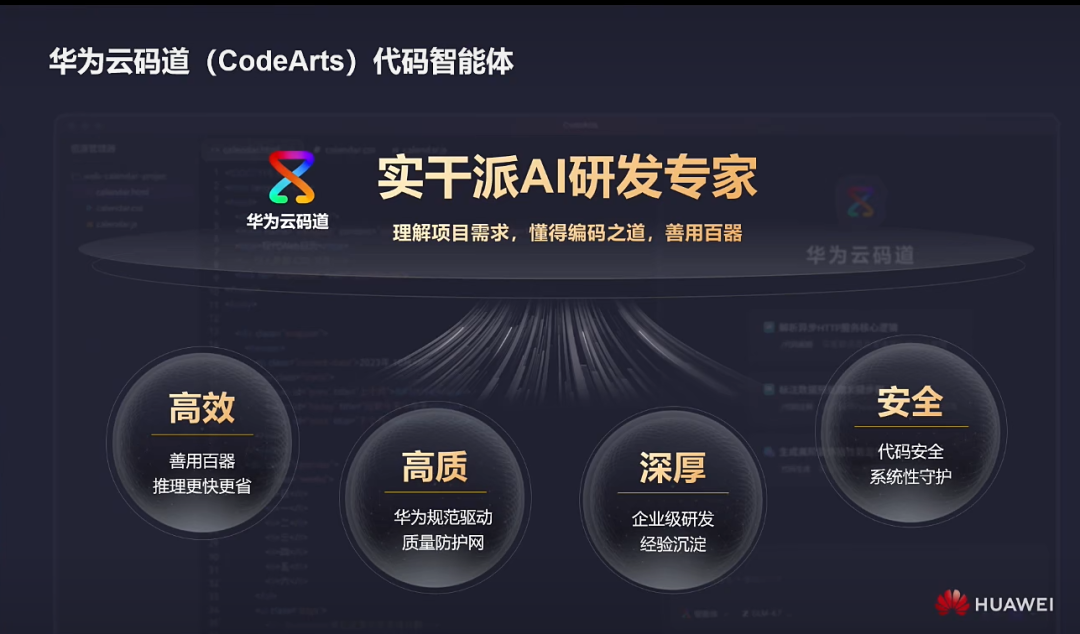
代码“神器”!华为云,AI大消息
Zhong Guo Ji Jin Bao· 2026-02-26 13:02
Core Viewpoint - Huawei Cloud CodeArts has officially launched its public beta, aiming to create a self-controlled domestic AI programming foundation [1] Group 1: Product Overview - Huawei Cloud CodeArts has entered public testing, attracting over 15,000 participants, including developers and enterprise users [3] - The product integrates open-source models such as GLM-5.0 and DeepSeek-V3.2, along with Huawei's proprietary models, and offers a dedicated model for the ArkTS language [3][6] - It represents a shift in AI programming from early code completion tools to a full-process intelligent agent model [4][6] Group 2: Features and Benefits - Huawei Cloud CodeArts provides advanced AI programming technologies, including code generation, knowledge Q&A, unit test case generation, expert skills, code library indexing, and specification-driven development [7] - The code library indexing feature allows for the vectorization and indexing of code snippets and documents, improving semantic matching and reducing inference iterations, leading to a 30% token saving for equivalent tasks [7] - The platform aims to empower small and medium enterprises and startup teams to utilize enterprise-level AI development capabilities with zero barriers, promoting rapid innovation [7] Group 3: Case Study - Shenzhen Today Talent Information Technology Co., Ltd. reported a significant improvement in code quality after using Huawei Cloud CodeArts, achieving 100% code compliance and a tenfold increase in monthly code output efficiency [9] - The product reduced the product launch cycle from two weeks to just half a day, allowing the development team to focus on enhancing employee skills [9] Group 4: Development and Compliance - Huawei Cloud CodeArts leverages Huawei's extensive R&D experience and a vast code repository to enhance code quality, compliance, and project feasibility [10] - It includes a comprehensive set of skills for demand management, system design, software development, testing, and deployment, enabling developers to use AI capabilities without barriers [13] - The platform emphasizes high-quality code generation in accordance with Huawei's Clean Code standards, ensuring compliance and project viability [13]

Azure遭反垄断调查 微软日本负责人强调合规运营
智通财经网· 2026-02-26 11:58
Core Viewpoint - Microsoft is under investigation by Japan's antitrust regulators regarding potential anti-competitive practices related to its Azure cloud services, specifically concerning software licensing that may restrict customer choice of competing cloud services [1][2]. Group 1: Investigation Details - The Japan Fair Trade Commission is examining whether Microsoft has imposed unreasonable "additional fees" for running its software on competitors' platforms, thereby raising costs for customers who do not use Azure [1][2]. - The investigation focuses on Microsoft's software licensing practices, which may violate Japan's antitrust laws by excluding competitors and interfering with trade [2]. Group 2: Market Context - Japan is the second-largest economy in Asia, crucial for Microsoft in its competition against giants like Amazon AWS and Google Cloud [2]. - Microsoft plans to invest approximately $2.9 billion over the next two years to enhance its AI and cloud computing infrastructure in Japan [2]. Group 3: Regulatory Trends - The investigation reflects a global trend of increased scrutiny on large tech companies regarding "vendor lock-in" practices, which could harm market competition and raise long-term costs for digital transformation [2][3]. - Japan's antitrust regulators are taking a firmer stance against perceived monopolistic behaviors of U.S. tech companies, aligning with similar actions taken by the EU and U.S. [3]. Group 4: Market Projections - The Japanese cloud computing market is projected to reach 19 trillion yen (approximately $121 billion) by 2029, nearly doubling from 2024 levels, indicating significant growth potential [3]. - The Japan Fair Trade Commission aims to ensure a fair and orderly competitive environment during this critical growth period for the cloud market [3].

亚马逊投资建数据中心;lululemon进军波兰;Valentino任命首席营
Sou Hu Cai Jing· 2026-02-26 11:31
Investment Dynamics - Amazon announced a $12 billion investment to build its first data center campus in Louisiana, in collaboration with Stack Infrastructure, which includes a $400 million investment in local water infrastructure upgrades. The project is expected to create 540 direct full-time jobs and 1,710 related jobs [3] - eBay plans to acquire Etsy's second-hand fashion social platform Depop for approximately $1.2 billion in cash, with the deal expected to close in Q2 2026, pending regulatory approval. This acquisition aims to enhance eBay's C2C offerings and allow Etsy to focus on its core handmade market [6] - Lululemon will open its 100th store in the EMEA region in Warsaw, Poland, on March 13, marking its official entry into the Polish market. The brand plans to enter six new markets in 2026, the highest number in a single year in its history [9] - PepsiCo's Alvalle brand launched a new line of ready-to-eat vegetable soups made from 100% Spanish natural ingredients, with plans to expand into Portugal and other Western European markets [12][13] - Moncler Group reported a 1% year-over-year revenue increase to €3.13 billion for 2025, with a strong fourth quarter growth of 7%. The brand's performance reflects a clear strategy and resilience in a volatile environment [16] - Brunello Cucinelli's revenue grew by 11.5% in 2025, with a net profit of €142 million, slightly above expectations. The brand's success is attributed to the ongoing trend of "quiet luxury" and strong performance in Asia [19] - OTB Group's net sales decreased by 5.9% to €1.6 billion in 2025, with a notable performance from Maison Margiela, which saw an 8.4% sales increase. The group demonstrated resilience despite global uncertainties [22] Personnel Dynamics - Valentino appointed Liran Peterzil as the new Chief Marketing Officer, effective March 2, to oversee global brand strategy and marketing efforts [24] - Saint Laurent appointed Johnny Coca as the creative director for accessories, aiming to enhance the brand's accessory offerings and overall profitability [27] - J.Crew's menswear creative director Brendon Babenzien is leaving to focus on his own brand, Noah, which may create a strategic gap in J.Crew's menswear direction [30]



比互联网泡沫还猛!科技巨头2万亿美元豪赌AI,资本强度前所未见
Hua Er Jie Jian Wen· 2026-02-26 10:36
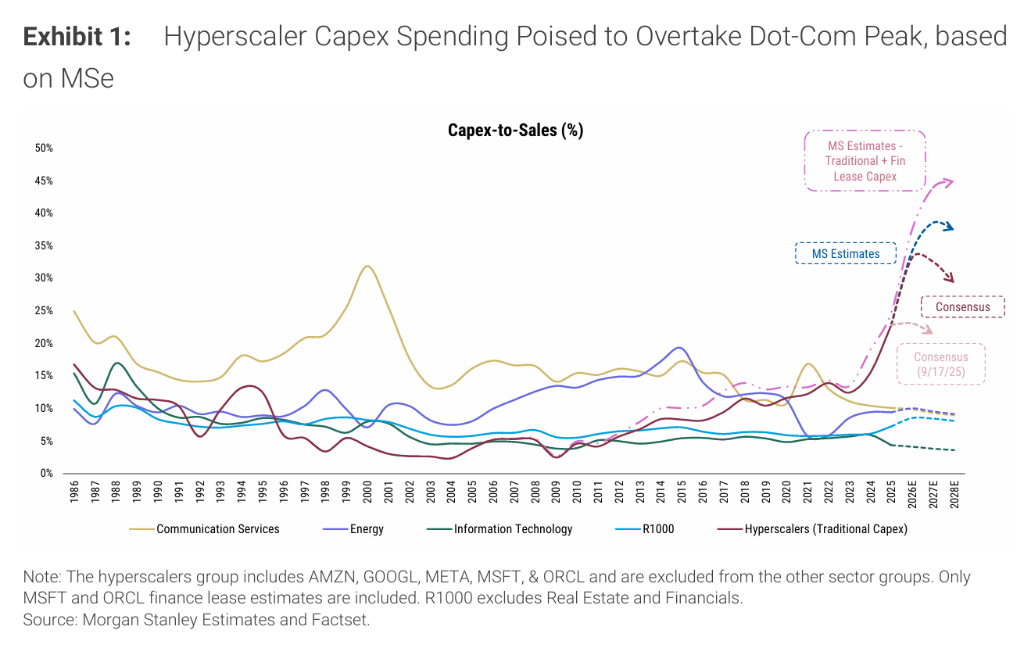
Core Insights - The investment wave in AI infrastructure is pushing tech giants into an unprecedented capital-intensive cycle, with hyperscalers like Amazon, Google, Meta, Microsoft, and Oracle expected to exceed historical capital expenditure peaks from the internet bubble era [1][4]. Capital Expenditure Trends - Morgan Stanley forecasts that the capital expenditure to sales ratio for these hyperscalers will reach 34%, 39%, and 37% from 2026 to 2028, surpassing the internet bubble peak of approximately 32% [1][4]. - Including financing leases, this ratio could rise to 38%, 44%, and 45% during the same period [1][7]. - The total capital expenditure for these companies is projected to exceed $2 trillion over the next three years, accounting for about 40% of the total capital expenditure of Russell 1000 index constituents [1]. Revenue Adjustments - Despite the significant increase in capital expenditure, revenue forecasts have not seen a corresponding rise, leading to a decline in free cash flow (FCF) expectations for hyperscalers [3][10]. - Over the past six months, capital expenditure expectations for 2026 and 2027 have been raised by over $630 billion, while revenue expectations have only seen limited adjustments [3][10]. Financing Leases Impact - The use of financing leases has significantly inflated the actual investment scale, with total commitments for future leases exceeding $660 billion among the five companies [13]. - For instance, Oracle's capital expenditure to sales ratio could rise dramatically from 75% to over 100% when including financing leases [15]. Sector Performance Disparity - Semiconductor companies have emerged as the biggest beneficiaries of the current investment cycle, with their revenue expectations rising by approximately 60%, compared to only 8% for hyperscalers [3][17]. - The market has shown a preference for semiconductor firms, with stock prices increasing significantly more than those of hyperscalers since December 2023 [17]. Future Outlook - Analysts believe that while companies like Meta, Google, and Amazon are leveraging AI investments to enhance user engagement and monetization, the substantial capital expenditures will lead to increased depreciation costs, putting pressure on profit margins if sales do not keep pace [18].



AI交易失速后,高盛研判:科技巨头或在下半年反攻
Jin Shi Shu Ju· 2026-02-26 07:27
2026年伊始,AI交易走势颠簸,但高盛表示,因市场轮动而受挫的超大市值科技股,可能在年内晚些 时候迎来转机。 "七巨头"股票此前一直是AI交易的核心推动力量,但随后表现却落后于标普500指数。高盛预计,AI带 来的收益将继续从超大市值公司向更广泛范围扩散,但分析师指出,3个催化因素可能在2026年下半年 重新激活Meta(META.O)、微软(MSFT.O)、亚马逊(AMZN.O)和Alphabet(GOOGL.O)的市场领导地位。 分析师表示:"短期内,超大规模云服务商的回报分化仍将持续,但我们看到,今年晚些时候可能出现 拐点的3个催化因素。" AI收入增长加快 企业披露的AI相关收入若出现增长,将有助于缓解市场对过度支出的担忧。 分析师表示:"AI相关收入的加速增长,将强化投资者对持续投资支出最终回报以及超大规模云服务商 长期盈利潜力的信心。" 微软因云业务增长疲软而下跌,亚马逊因给出的销售指引与预期一致而走低,而Meta则因强劲的收入 展望以及广告业务的稳健表现而大涨。 AI支出增长放缓 高盛预计,AI资本开支增速将在2026年见顶,随后放缓,这将使投资者能够更好地评估公司的盈利潜 力。 目前,超大规 ...
CoreWeave接近达成85亿美元“AI芯片+Meta合同”担保融资
Hua Er Jie Jian Wen· 2026-02-25 16:33
Group 1 - CoreWeave is seeking a new round of large-scale debt financing amounting to $8.5 billion to strengthen its position in the increasingly competitive AI infrastructure market [1] - The financing will be secured against the company's AI chips and a cloud service procurement contract with Meta Platforms, with an expected interest rate of around 6%, significantly lower than previous financing costs [1] - This new debt is anticipated to receive an A- rating from credit rating agencies, marking CoreWeave's first formally rated chip-secured debt and enhancing its creditworthiness in the capital markets [1] Group 2 - CoreWeave plans to release its financial report this week and is continuously expanding its debt financing to compete for market share against established cloud service providers like Amazon, Microsoft, and Google [2] - The use of the Meta cloud service contract as collateral highlights the deepening relationship between leading tech companies and AI infrastructure providers, providing a stronger credit backing for CoreWeave's debt [2]
美股异动丨CoreWeave涨超4%,拟融资约85亿美元支持扩建AI算力基础设施
Ge Long Hui· 2026-02-25 14:42
Group 1 - CoreWeave (CRWV.US) shares rose over 4%, reaching $103.28 [1] - The company plans to raise approximately $8.5 billion from multiple banks to expand its cloud computing and computing power infrastructure for Meta Platforms [1] - Major institutions involved in the financing include Morgan Stanley and MUFG [1] Group 2 - Despite being rated at a speculative level, the loan is expected to receive an investment-grade rating due to Meta's "blue-chip" credit quality, which could significantly lower financing costs [1]

6670亿美元狂潮!巨头AI开支逼近顶点,自由现金流或触底反弹
Hua Er Jie Jian Wen· 2026-02-25 13:58
Core Insights - The capital expenditure driven by artificial intelligence is reshaping the balance sheets of large tech companies, with projected capital expenditures for hyperscale cloud companies nearing $667 billion in 2026, accounting for approximately 92% of their operating cash flow, leading to a significant reduction in stock buybacks and a drop in free cash flow yield to historical lows [1][2][3] Group 1: Capital Expenditure Trends - Hyperscale cloud companies are expected to have a record capital expenditure of $667 billion in 2026, with a year-on-year growth rate of about 62%, slightly lower than the 73% increase in 2025, indicating a historical rarity in absolute scale [2] - Market expectations for capital expenditures have been continuously revised upward, with analysts increasing the consensus forecast for 2026 capital expenditures by $127 billion and for 2027 by $162 billion since the fourth quarter earnings season, reflecting strong confidence in the sustainability of AI investments [2] Group 2: Impact on Shareholder Returns - The surge in capital expenditures is directly impacting shareholder returns, with a projected 15% decline in total stock buybacks for hyperscale cloud companies in 2025, and the proportion of buybacks in cash flow dropping from 43% at the beginning of 2023 to approximately 16% currently, a decline of over 60% [3] - This shift indicates a clear prioritization of capital allocation from shareholder returns to infrastructure development during the peak of the AI investment cycle, posing significant pressure on investors reliant on buybacks for earnings per share growth and stock performance [3] Group 3: Future Outlook and Valuation - Goldman Sachs anticipates that the growth rate of capital expenditures for hyperscale cloud companies will begin to slow in the second half of 2026, with year-on-year growth expected to be around 70% to 75%, while quarterly growth will show a noticeable deceleration [4] - The anticipated slowdown in capital expenditure growth will provide visibility for investors regarding the potential bottoming out of free cash flow, allowing for a return to valuation based on earnings, with current trading at a 24 times forward P/E ratio, placing it in the 14th percentile over the past decade [5]
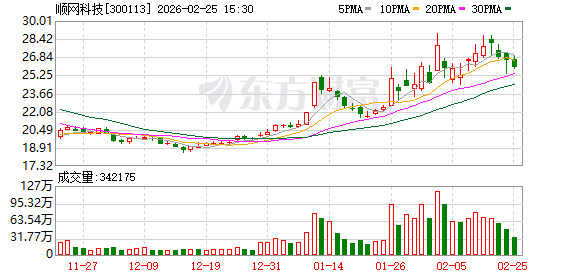
顺网科技:公司推出了AI云电脑,内置多类AI基础应用,覆盖图片/视频/音乐生成、编程辅助等应用
Mei Ri Jing Ji Xin Wen· 2026-02-25 13:17
Group 1 - The company is leveraging its edge computing capabilities to delve into the AI sector, launching an AI cloud computer that includes various AI applications such as image/video/music generation and programming assistance, allowing users to access a "cloud AI all-in-one machine" without complex deployment [2] - The company has built an AI infrastructure platform that integrates computing power, models, and intelligent agent engines, with intelligent agents evolving from single agents to autonomous multi-agents, exploring applications in healthcare and intelligent customer service, and plans to empower more industries in the future [2]

阿里云集齐四大顶尖开源模型 进一步推动AI应用爆发
Zheng Quan Ri Bao Wang· 2026-02-25 11:59
Core Insights - Alibaba Cloud has launched a new Coding Plan that includes four top open-source model APIs: Qwen3.5, GLM-5, MiniMax M2.5, and Kimi K2.5, allowing users to switch between models freely and enjoy higher token limits and stability [1][2][3] - The AI Agent market in China is projected to exceed 3.3 trillion yuan by 2028, indicating a significant growth potential for AI applications [2] - Alibaba Cloud's unique model commercial strategy, which aggregates top open-source AI models, enhances its competitive edge in the cloud and AI sectors [2][4] Model Features - Qwen3.5 boasts a total of 397 billion parameters with only 17 billion activated, achieving high efficiency and cost-effectiveness [1] - GLM-5 is the flagship model from Zhiyu, experiencing high demand for its API services [1] - MiniMax M2.5 is designed specifically for agent scenarios, excelling in advanced Excel processing and deep research tasks [1] - Kimi K2.5 shows significant improvements in programming and agent capabilities [1] Market Position - As of 2025, Alibaba Cloud is expected to capture 36% of the Chinese cloud market, significantly outpacing its competitors [4] - The integration of multiple models into a single platform simplifies the development process for developers and small startups, enhancing research and development efficiency [4] Cost Efficiency - The Coding Plan Lite offers up to 18,000 requests per month for new users at a cost of only 7.9 yuan, while the Pro plan allows for 90,000 requests at 39.9 yuan, significantly reducing costs for high-frequency coding scenarios [3] - This pricing strategy addresses the rising computational costs associated with AI agents, making it easier for developers to innovate and deploy applications [3]
