
纺织制造

Search documents
2026年纺织服装行业投资策略:整固蓄势,挖掘新消费,看好全球制造
Shenwan Hongyuan Securities· 2025-11-18 01:48
Investment Strategy Overview - The report emphasizes the stabilization of global tariff negotiations, which does not alter the core competitiveness of global manufacturing, and highlights optimism towards two major industrial chains and a price increase cycle [3][4]. Industry Performance Review - As of November 14, 2025, the SW textile and apparel index has increased by 16.9%, ranking 17th in relative performance across the market. The manufacturing sector shows higher certainty compared to brands still in recovery [4][8]. - Domestic demand is at a low point in 2025 but is expected to recover in 2026-2027, focusing on the characteristics of young consumer groups to explore high-growth areas in new consumption [4][21]. New Consumption Trends - High-performance outdoor apparel is identified as a growth area with low penetration and high potential, with the market size projected to reach 102.7 billion yuan in 2024, growing by 17% year-on-year [4][33]. - Discount retail is highlighted as a scarce high-growth area within the consumption sector, with rapid expansion in urban outlets and hard discount specialty stores [4][46]. - The personal care and cleaning market, particularly wet wipes, is noted for its rapid growth and increasing necessity among young consumers, with a market size in China expected to reach 100 billion yuan [4][62]. - The sleep economy is emerging as a significant market, with explosive growth in household textile products, driven by young consumers' acceptance [4][20]. - The report discusses Nike's innovation cycle, which is expected to benefit from inventory replenishment and product innovation, similar to Adidas's recovery cycle [4][20]. - The Australian wool price increase cycle is anticipated due to supply contraction and demand highlights, with potential market space comparable to previous high points in 2011 and 2018 [4][20]. - The healthcare material upgrade cycle presents broad replacement opportunities for overseas non-woven fabrics [4][20]. Global Manufacturing Insights - The report notes that the resolution of tariff variables is expected to lead to a new growth phase for leading companies [4][27]. - The textile industry has undergone a pressure test for external demand, with recent tariff negotiations expected to boost export chain expectations for 2026 [4][26]. Investment Recommendations - The report suggests focusing on high-growth new consumption areas and the competitive strength of global manufacturing as key investment strategies [4][27].





8连板!孚日股份提示风险:股票价格已严重偏离基本面
Sou Hu Cai Jing· 2025-11-17 15:36
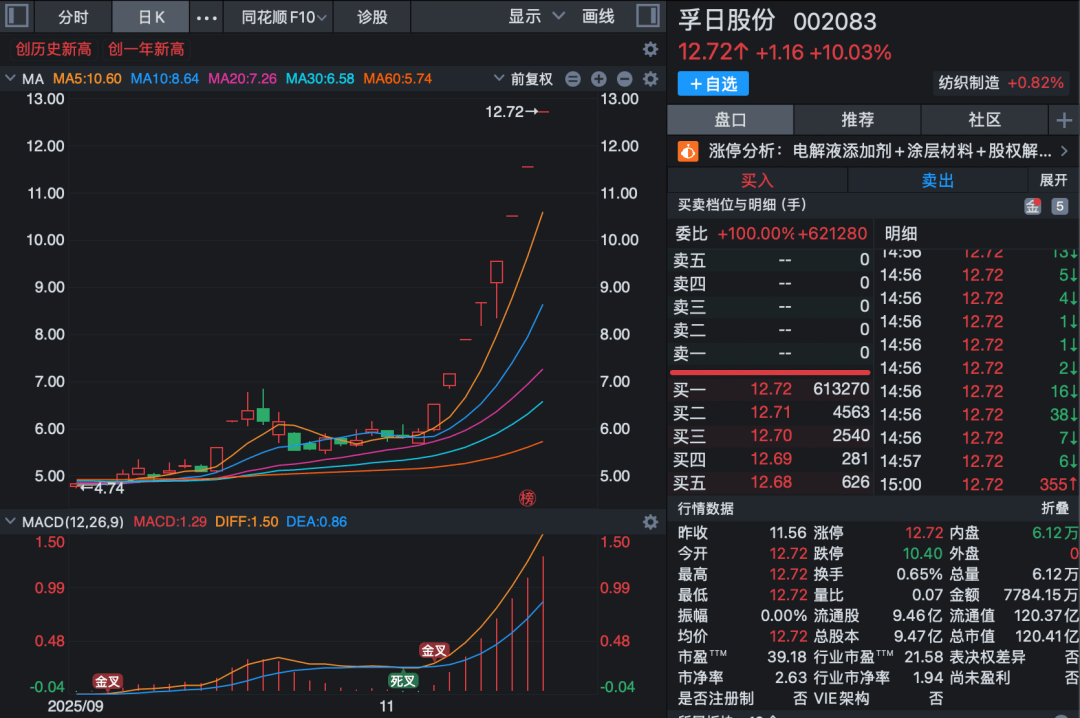
8连板孚日股份(002083)11月17日披露公司股价严重异常波动的公告称,公司子公司山东孚日新能源材料有限公司(简称"孚日新能源")于2021年投资建 设了锂电池电解液添加剂项目,2025年前三季度孚日新能源营业收入16839.81万元,占公司前三季度营业收入的4.38%,收入占公司主营业务收入比例较 小,对公司业绩影响有限。 孚日新能源目前暂无扩产计划,对公司其他业务布局不产生重大影响。公司股票价格自11月3日至11月17日累计涨幅达112.35%,已严重偏离公司基本面, 可能存在非理性炒作,交易风险大,存在短期下跌的风险。 | 分时 | 日 K | 同花顺F10~ | 诊股 | 品示 | 画线 | | 孚日股份 002083 | | | | | --- | --- | --- | --- | --- | --- | --- | --- | --- | --- | --- | | 创历史新高 | 创一年新高 | | | | | | 12.72↑ +1.16 +10.03% | | | | | | | > MA MA5:10.60 MA10:8.64 MA20:7.26 MA30:6.58 MA60:5.7 ...


嘉麟杰:公司具备满足欧洲客户需求的轻便保暖、抗起球等功能性面料产品
Zheng Quan Ri Bao Zhi Sheng· 2025-11-17 11:39
Core Viewpoint - The company is focused on high-end outdoor functional fabrics and apparel, with a commitment to expanding its market presence in Europe [1] Group 1 - The company serves over 50 countries and regions, including the European Union, through direct and indirect clients [1] - The company offers functional fabric products that meet European customer demands, such as lightweight warmth, pilling resistance, anti-static properties, and breathability [1] - The company plans to continue its efforts to explore the European market further [1]

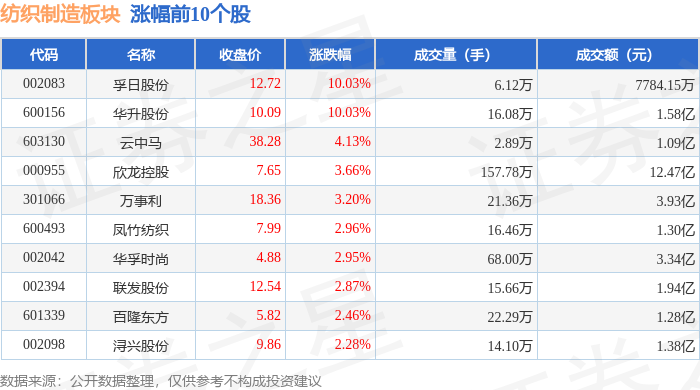
纺织制造板块11月17日涨1.13%,孚日股份领涨,主力资金净流出7398.22万元
Zheng Xing Xing Ye Ri Bao· 2025-11-17 08:49
| 代码 | 名称 | 收盘价 | 涨跌幅 | 成交量(手) | 成交额(元) | | --- | --- | --- | --- | --- | --- | | 002083 | 幸日股份 | 12.72 | 10.03% | 6.12万 | > 7784.15万 | | 600156 | रून में सितंबर के | 10.09 | 10.03% | 16.08万 | 1.58亿 | | 603130 | 后书 | 38.28 | 4.13% | 2.89万 | 260'T | | 000955 | 欣龙控股 | 7.65 | 3.66% | 157.78万 | 12.47亿 | | 301066 | 万事利 | 18.36 | 3.20% | 21.36万 | 3.93亿 | | 600493 | 凤竹纺织 | 7.99 | 2.96% | 16.46万 | 1.30亿 | | 002042 | 华罗时尚 | 4.88 | 2.95% | 68.00万 | 3.34亿 | | 002394 | 联发股份 | 12.54 | 2.87% | 15.66万 | 1.94亿 | | 665109 | ...
纺织服装行业2025年三季报总结:品牌复苏方向明确,制造端关注订单修复
Shenwan Hongyuan Securities· 2025-11-17 07:15
Investment Rating - The report maintains a positive outlook on the textile and apparel industry, indicating a "Buy" rating for the sector in 2025 [2][5]. Core Insights - The report highlights a clear recovery direction for brands, with a focus on order restoration in the manufacturing sector. The domestic demand is showing a steady recovery, while external demand is under short-term pressure due to export declines [4][5]. - The retail performance of brands has been improving since the third quarter, with monthly growth rates gradually increasing from a low of 1.8% in July to 6.3% in October. The fourth quarter is expected to continue this trend due to seasonal demand and consumption promotion policies [5][13]. Summary by Sections 1. Industry Overview - Domestic demand is on a steady recovery path, with retail sales in the textile and apparel sector growing by 3.5% year-on-year to 1205.3 billion yuan from January to October 2025. The overall retail sales for the same period increased by 4.3% to 41.2 trillion yuan [4][13]. - Export pressures are evident, with textile and apparel exports in October 2025 amounting to $22.26 billion, a year-on-year decline of 12.6% [4][16]. 2. Hong Kong Sports Sector - The sports sector experienced a slight weakening in sales in Q3 2025, with brands like Anta and FILA showing low single-digit growth. However, other brands saw growth rates between 45-50% [4][24]. - Li Ning's overall sales decreased in Q3, while its youth brand maintained double-digit growth. Xtep showed stable performance with low single-digit growth in its main brand [4][24]. 3. Textile Manufacturing - The manufacturing sector faced disruptions due to tariffs in Q3 2025, with companies like Huayi and Yueyuan reporting revenue declines of 0.3% and 6.1%, respectively. However, a gradual recovery is expected as tariff impacts stabilize [4][29]. - The upstream textile sector showed steady growth, with companies like Weixing and Xin'ao reporting revenue increases of 1% year-on-year [4][29]. 4. Men's and Women's Apparel - Men's apparel showed stable revenue growth, but increased marketing and channel expansion costs pressured profits. Women's apparel is showing signs of recovery, with brands like Ge Li Si experiencing significant profit improvements [4][22]. - The report notes that women's apparel companies generally saw single-digit revenue declines, but the rate of decline has narrowed compared to 2024 [4][22]. 5. Children's Apparel - Children's apparel brands reported steady revenue growth, but increased expenses led to weaker profit performance. Companies like Semir and Jiama reported revenue growth of 5% and 3%, respectively, but faced significant profit declines [4][22]. 6. Home Textiles - The home textile sector showed varied performance, with brands like Luolai and Shuixing exceeding expectations due to successful product launches. Luolai's revenue grew by 6% year-on-year, while Shuixing's grew by 11% [4][22]. 7. Investment Analysis - The report suggests that improving domestic demand is a key investment theme for 2025, with a focus on high-quality domestic brands and recovery opportunities in the textile manufacturing sector. Recommended stocks include sports brands like Bosideng, Anta, and Li Ning, as well as home textile companies like Luolai and Shuixing [4][5].
新澳股份跌2.06%,成交额4547.58万元,主力资金净流出553.86万元
Xin Lang Cai Jing· 2025-11-17 02:20
Core Points - New Australia Co., Ltd. experienced a stock price decline of 2.06% on November 17, trading at 8.10 yuan per share with a market capitalization of 5.915 billion yuan [1] - The company has seen a year-to-date stock price increase of 20.72%, with a 35.45% rise over the past 60 days [1] - As of September 30, the company reported a revenue of 3.894 billion yuan for the first nine months of 2025, reflecting a year-on-year growth of 0.60% [2] Financial Performance - The company’s main business revenue composition includes: fine wool yarn 56.11%, cashmere 30.77%, wool tops 11.87%, modified processing, dyeing and finishing, and cashmere processing 0.78%, and others 0.48% [1] - The net profit attributable to the parent company for the same period was 377 million yuan, showing a year-on-year increase of 1.98% [2] Shareholder Information - As of September 30, the number of shareholders increased by 8.80% to 16,000, with an average of 44,965 circulating shares per person, a decrease of 8.09% [2] - Since its A-share listing, the company has distributed a total of 1.372 billion yuan in dividends, with 643 million yuan distributed over the past three years [3]
滚动更新丨A股三大指数集体低开,军工股大幅高开
Di Yi Cai Jing· 2025-11-17 01:44
盘面上,军工装备、纺织制造板块走高,黄金、航运、免税概念板块低迷。 09:30 水产板块集体高开,国联水产、中水渔业、东方海洋、好当家、天马科技竞价涨停,大湖股份、獐子岛、百洋股份涨幅靠前。 09:28 宁德时代低开近4%,据公告,公司重要股东、联合创始人黄世霖因自身资金需求,拟通过询价转让方式出让公司4563.24万股股 份,占公司总股本的1%。 09:25 A股开盘丨三大指数集体低开 09:15 人民币对美元中间价报7.0816,调升9个基点。前一交易日中间价报7.0825。 09:00 国内商品期货开盘,集运欧线主力合约涨超6%,焦炭涨超1%。沪银跌超3%,沪金、甲醇跌超2%。 08:41 10年期日本国债收益率上涨2个基点,至1.720%,为2008年6月以来的最高水平。 沪指低开0.05%,深成指低开0.12%,创业板指低开0.46%。 | 代码 | 名称 | 两日图 | 现价 | 涨跌 | 涨跌幅 | | --- | --- | --- | --- | --- | --- | | 000001 | 上证指数 | Am | 3988.56c | -1.94 | -0.05% | | 399001 | ...

山西证券研究早观点-20251117
Shanxi Securities· 2025-11-17 01:23
Market Overview - The domestic market indices showed a decline, with the Shanghai Composite Index closing at 3,990.49, down 0.97%, and the Shenzhen Component Index at 13,216.03, down 1.93% [2] Industry Commentary - The non-bank financial sector is experiencing a positive trend, with the capital market's dual opening deepening and broker fundamentals improving [4][7] - The China Securities Regulatory Commission (CSRC) emphasizes the importance of risk prevention and high-quality development while planning more substantial opening measures for the capital market [7] - Brokerages have seen significant improvements in performance in Q3 2025, with expectations for steady growth through both external and internal development strategies [7] Company Performance Yuanyuan Group - In Q3 2025, Yuanyuan Group reported revenues of $6.017 billion, a year-on-year decrease of 1.0%, and a net profit of $279 million, down 16.0% [6][9] - The company maintains its profit forecast for 2025-2027, expecting revenues of $8.135 billion, $8.588 billion, and $9.051 billion, with corresponding net profits of $353 million, $380 million, and $411 million [9] Huace Navigation - Huace Navigation reported a revenue of $2.618 billion in Q1-Q3 2025, reflecting a year-on-year increase of 15.47%, with a net profit of $493 million [11] - The manufacturing business saw a revenue of $4.232 billion, up 2.3%, with a production capacity utilization rate of 93% [11] Investment Recommendations - The report suggests focusing on investment opportunities in the brokerage sector due to improving fundamentals and potential for growth [7] - For Yuanyuan Group, the recommendation is to maintain a "Buy-A" rating based on its stable profit forecasts and market positioning [9] - The report highlights the importance of companies with technological barriers and clinical implementation capabilities in the brain-computer interface sector, suggesting a "Buy-A" rating for key players [15]
华泰证券A股策略:沿着高性价比方向布局
Zheng Quan Shi Bao Wang· 2025-11-17 00:13
Core Viewpoint - The recent report from Huatai Securities indicates that the A-share market is experiencing a period of fluctuation, with increased investor caution and a focus on when the "main upward wave" will form [1] Market Conditions - The A-share market is currently in a state of oscillation, with investors adopting a wait-and-see approach [1] - There is a need for cumulative forces for the market to break through, considering A-share earnings elasticity, policy direction, and overseas influences [1] Key Focus Areas - Future attention will be on Nvidia's earnings report, the Politburo meeting, and the evolution of the A-share capacity cycle [1] Investment Opportunities - Short-term rebound logic exists for low-position sectors, with potential for performance improvement [1] - Specific areas to watch include: 1. The AI industry chain, which has seen a decrease in crowding to the lowest level since July, focusing on Hang Seng Technology, domestic computing power, AI edge computing, and application sectors [1] 2. Low-position sectors such as engineering machinery, textile manufacturing, photovoltaic equipment, general equipment, railway and highway, building materials, and consumer goods, which show potential for performance improvement [1] 3. Within the lithium battery industry chain, attention can be directed towards fluorochemical sectors that are relatively less heated [1]

华泰证券:市场走势或仍以震荡为主,沿高性价比方向布局
Mei Ri Jing Ji Xin Wen· 2025-11-16 15:17
Core Viewpoint - The report from Huatai Securities indicates that short-term uncertainties persist, leading to a market trend characterized by fluctuations. However, there is a shift towards a balanced "barbell" investment structure due to rapid changes in market focus [1] Group 1: Market Focus - The high cost-performance mainline remains one of the market's focal points, with the AI industry chain's congestion level dropping to its lowest since July. Attention is drawn to low-positioned targets in sectors such as Hang Seng Technology, domestic computing power, AI edge applications, and related fields [1] - There are opportunities for left-side positioning in sectors with performance improvement at low levels, including engineering machinery, textile manufacturing, photovoltaic equipment, general equipment, rail and road, building materials, and certain mass consumer sectors [1] Group 2: Investment Opportunities - Given the impact of domestic and international uncertainties, there are still potential investment opportunities in banks and certain cyclical dividend stocks [1]