
预制菜

Search documents
预制菜概念下跌2.36%,5股主力资金净流出超5000万元
Zheng Quan Shi Bao Wang· 2025-12-04 09:31
Group 1 - The pre-made food concept sector experienced a decline of 2.36%, ranking among the top losers in the market, with companies like Zhongshui Fishery, Tongqing Building, and Haixin Food hitting the daily limit down [1] - Major stocks within the pre-made food sector that saw significant declines include Haixin Food (-9.96%), Tongqing Building (-10.01%), and Guolian Aquatic Products (-7.58%) [2][3] - Conversely, stocks that performed well included Shuangqiang Technology (+10.01%), Guangbai Co. (+3.65%), and Haodangjia (+2.74%) [1][5] Group 2 - The pre-made food sector faced a net outflow of 1.095 billion yuan, with 71 stocks experiencing net outflows, and five stocks seeing outflows exceeding 50 million yuan [2] - Haixin Food led the outflow with a net outflow of 338 million yuan, followed by Tongqing Building and Guolian Aquatic Products with net outflows of 103 million yuan and 92 million yuan, respectively [2][3] - Stocks with the highest net inflows included Guangbai Co. (116 million yuan), Shuangqiang Technology (40 million yuan), and Tianma Technology (33 million yuan) [5]




上市公司“花式送礼” 提质增利才是回报股东“王道”丨热点即阅
Sou Hu Cai Jing· 2025-12-04 09:01
Core Viewpoint - The article discusses the recent trend of companies offering physical gifts to shareholders as a form of "dividend," questioning whether this truly benefits shareholders or merely masks underlying business performance issues [1] Group 1: Company Actions - Qianwei Yangchun announced that individual shareholders holding over 100 shares can receive a gift package of prepared dishes valued at 200 yuan, while corporate shareholders can receive three packages [1] - This follows a similar initiative by Emei Mountain A, which offered free admission tickets to shareholders holding 500 shares, indicating a growing trend among listed companies to engage in "physical dividends" [1] Group 2: Market Reaction - The market responded positively to Emei Mountain A's announcement, resulting in a trading halt due to a surge in stock price, suggesting that investors are receptive to these creative promotional strategies [1] Group 3: Shareholder Expectations - The article argues that shareholders primarily seek capital appreciation through solid business growth, stable cash dividends, and sustained stock price increases, rather than small gifts [1] - It emphasizes that while occasional perks can enhance shareholder relations, relying on such tactics as a primary means to attract investors is misguided and detracts from core business performance [1]

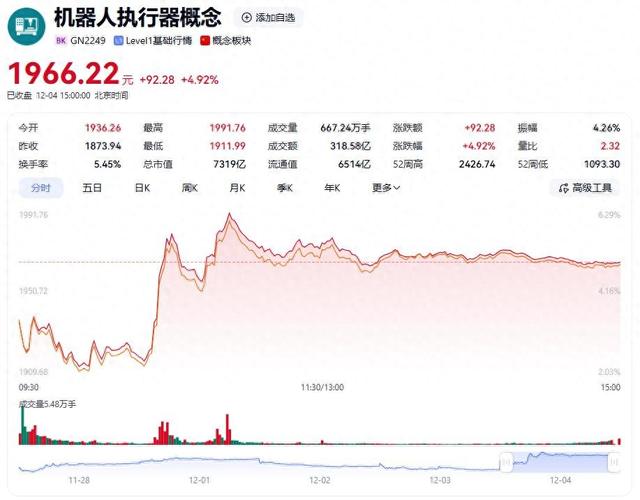
创业板指涨1.01%,两市成交额缩量超千亿,机器人执行器概念股大涨
Guan Cha Zhe Wang· 2025-12-04 07:41
Market Performance - The A-share market showed mixed results on December 4, with the Shanghai Composite Index down by 0.06% to 3875.39 points, while the Shenzhen Component Index rose by 0.40% to 13006.72 points, and the ChiNext Index increased by 1.01% to 3067.48 points [1] - The total trading volume in the Shanghai and Shenzhen markets was 1.55 trillion, a decrease of 121 billion compared to the previous day [1] - Out of 1455 stocks that rose, 3878 stocks fell, with 39 stocks hitting the daily limit up and 26 stocks hitting the daily limit down [1] Sector Performance - Leading sectors included aerospace, reducers, semiconductors, energy metals, and national defense and military industry, which saw significant gains [1] - Conversely, sectors such as prepared dishes, dairy products, seafood, food and beverage, precious metals, and retail experienced notable declines [1] Individual Stock Highlights - Stocks related to robotic actuators surged, with companies like Ruineng Technology and Junya Technology hitting the daily limit up, along with over ten other stocks [1] - In the consumer sector, there was a notable adjustment, with companies like Tongqilou and Haixin Food hitting the daily limit down [1]


快讯!三大重大利好加持!A股战术性回撤后将迎来快速反扑!
Sou Hu Cai Jing· 2025-12-03 17:03
Market Overview - A-shares experienced a week-long rebound but showed signs of adjustment today, with the index briefly surpassing 3900 points before retreating, yet remaining above the five-day moving average [1] - Trading volume decreased from 290 billion to approximately 280 billion, returning to a low level of 1.6 trillion [1] - Over 3700 stocks declined, indicating a growing loss effect in the market [1] Sector Performance - The strongest performing sectors today included pharmaceutical retail, local stocks from Fujian, and defensive consumer sectors like tourism and prepared dishes, which are not the recent focus of institutional investors [3] - The lithium battery sector led declines, indicating a potential weakening trend as it broke below the 30-day moving average, affecting cyclical theme stocks negatively [3] - Technology stocks, particularly those related to artificial intelligence, also showed weakness, suggesting a lack of clear market direction [3] Economic Indicators - Recent PMI data indicated economic weakness, which is a significant concern for the capital market, necessitating strong economic stabilization measures from policymakers [5] - The absence of policy intervention following the PMI release suggests a potential waiting strategy from authorities before implementing new measures [5][7] Future Expectations - Upcoming meetings, including the Central Political Bureau and Central Economic Work Conference, are expected to release favorable policies aimed at stabilizing the economy [7][14] - Market sentiment may remain bullish leading up to these meetings, with expectations that any positive news could further support stock prices [7][14] Global Influences - The anticipation of a potential interest rate cut by the Federal Reserve has increased, with predictions of a 25 basis point reduction due to a weak labor market [9][10] - A Fed rate cut could enhance the attractiveness of Chinese assets, as evidenced by recent rebounds in Chinese concept stocks and the Nasdaq Golden Dragon Index [10] - The Fed's actions may also provide the People's Bank of China with more room for monetary policy adjustments, potentially leading to further easing measures [10][11] Conclusion - The current market adjustment may be a temporary setback, with expectations of a rebound as the market prepares for upcoming policy announcements and potential global monetary easing [14]

好当家等预制菜概念股:12.3部分涨停,多股上涨
Sou Hu Cai Jing· 2025-12-03 07:12
Core Viewpoint - On December 3rd, certain pre-made meal concept stocks in the A-share market showed strong performance, indicating a growing interest and potential in this sector [1] Group 1: Stock Performance - Companies such as Haodangjia, Hebai Group, Haixin Food, Jinzi Ham, Tongqinglou, and Shuangqiang Technology reached their daily limit up [1] - Xianyin Food increased by over 5%, while Yike Food rose nearly 3% [1]


A股部分预制菜概念股走强,金字火腿、同庆楼等涨停
Ge Long Hui· 2025-12-03 06:09
格隆汇12月3日|A股市场部分预制菜概念股走强,其中,好当家、合百集团、海欣食品、金字火腿、 同庆楼、双枪科技涨停,西安饮食涨超5%,益客食品涨近3%。 ...

潍坊民营经济贡献全市超八成投资税收
Qi Lu Wan Bao· 2025-12-03 05:33
Core Insights - The government of Weifang has implemented a series of policies to promote the high-quality development of the private economy, which has significantly enhanced the overall strength, vitality, and competitiveness of private enterprises since the 14th Five-Year Plan [1][2] Group 1: Economic Scale and Contribution - Weifang's private economy consists of over 1.464 million market entities, accounting for 10.2% of the province, with an increase of 310,000 entities since 2020, representing a year-on-year growth of 26.8% [1] - The private sector contributes over 80% of the city's investment, tax revenue, and imports and exports, with 99.2% of market entities being private, and the private economy accounting for 63% of the GDP [1] Group 2: Enterprise Strength and Industry Support - There are 410,000 private enterprises in Weifang, with significant growth among key companies such as Hongrun, Goer, and Haomai, and over 95% of the 1,459 manufacturing champions and specialized small giants being private [2] - Weifang ranks third in the province for the number of private enterprises in the top 500 and second for those in the manufacturing sector [2] Group 3: Technological Innovation and Development - The number of high-tech private enterprises and registered technology-based SMEs in Weifang exceeds 2,100 and 3,600 respectively, with 952 provincial-level innovation platforms mostly led by private enterprises [2] - The contribution of high-tech industries to the city's output value increased from 52.26% in 2020 to 61.39%, surpassing the provincial average by 6.18 percentage points [2] Group 4: Social Contributions and Employment - Private enterprises in Weifang play a significant role in social contributions, particularly in job creation, providing over 90% of employment opportunities in the city [3] - The local government has prioritized the development of the private economy, implementing various supportive measures to enhance service and guarantee for private enterprises [3][4] Group 5: Policy Environment and Investment - The government has introduced 20 policies to boost the private economy and 30 policies to assist enterprises, addressing barriers to market access and resource acquisition [3] - Private investment in Weifang accounts for 83.9%, leading the province by 20.94 percentage points, with continuous top rankings in investment attraction indicators for four consecutive years [3][4] Group 6: Business Ecosystem and Service Quality - Weifang has a robust industrial ecosystem with 18 private enterprises generating over 10 billion yuan in revenue, and 25 national champions in specific sectors [4] - The local government has initiated a reform project to optimize the business environment, achieving significant improvements in service quality and efficiency for enterprises [4][5] Group 7: Entrepreneurial Atmosphere - High-profile events and initiatives have been organized to honor and engage entrepreneurs, fostering a supportive environment for private enterprises [5][6] - The local government emphasizes respect and support for private enterprises, enhancing their political and social standing [6]

南农晨读 | 银杏鎏金时
Nan Fang Nong Cun Bao· 2025-12-03 03:03
Group 1 - The core viewpoint of the article emphasizes the integration of agriculture and industrialization through the development of the prepared food industry, particularly in the Guangdong-Hong Kong-Macao Greater Bay Area [4][5][6][8] - The "first garden" of prepared food in the Greater Bay Area (Zhaoqing) is highlighted for its scale, speed, and the establishment of a new system and model that reshapes the regional industrial ecosystem and value chain [6][7][8] Group 2 - The article discusses the upcoming promotional event for agricultural products in the Greater Bay Area, aimed at efficiently promoting local advantages and brands to national buyers [14][15][16] - The event will feature various activities such as signing ceremonies, professional buyer listening sessions, and product tasting areas to enhance the effectiveness of the promotion [17][18] Group 3 - The article mentions the upcoming 52nd Pig Industry Conference in Guangzhou, scheduled for December 11-13, 2025, which aims to enhance the market system for the pig industry [20][21] - The conference is expected to be a significant event for the pig farming sector, focusing on improving quality and market strategies [20][21] Group 4 - The article reports on the financial performance of the company "霸王茶姬" (BaWang Tea Princess), which achieved a 75% increase in overseas GMV for the third quarter of 2025, reaching a total GMV of 7.93 billion yuan [35][36][37] - The company also reported a net income of 3.208 billion yuan and an adjusted net profit of 503 million yuan for the same period [38][39]

上市以来首次未进行现金分红!“油条第一股”送股东油条,千味央厨称不是为去库存
Sou Hu Cai Jing· 2025-12-03 01:37
Core Viewpoint - The company, Qianwei Yangchu (千味央厨), is conducting a shareholder reward activity from December 2 to December 16, offering gift packages valued at 200 yuan to shareholders holding 100 shares or more, which includes products like fried dough sticks and egg tarts [1][3][10] Group 1: Shareholder Reward Activity - The company announced a shareholder reward activity to express gratitude for long-term support, allowing individual shareholders to claim one gift package and institutional shareholders to claim three [1][5] - The total estimated value of the gift packages is approximately 1.9 million yuan, with a maximum of 9,409 packages to be distributed based on the number of shareholders [5][10] - This is the first time the company has conducted a product giveaway as a form of dividend since its listing, having previously issued cash dividends annually [9][10] Group 2: Financial Performance and Context - The company reported a net profit decline of 32.57% to 83.69 million yuan in 2024, with a revenue increase of 1.00% to 1.378 billion yuan in the first three quarters of the year [12] - Despite the increase in revenue, the net profit has been under pressure, and the company has not issued cash dividends this year, leading to speculation about the purpose of the product giveaway [10][12] - The company clarified that the products offered are fresh and comply with national quality standards, denying any intention to clear inventory through this giveaway [11][12]

预制菜理应是“明白菜”
Jing Ji Ri Bao· 2025-12-03 00:01
Core Viewpoint - The entry of a well-known company into the prepared food market has sparked discussions about transparency in this sector, highlighting consumer dissatisfaction with the lack of information regarding the nature of prepared dishes [1] Group 1: Consumer Sentiment - Many consumers do not reject prepared foods but are concerned about the transparency of information, expressing disappointment over the difference between expectations of freshly cooked meals and the reality of reheated dishes [1] - The perception of freshness and sensory experience associated with "freshly cooked" meals remains important for some consumers, despite the acceptance of prepared foods by others if they are tasty, of good quality, and reasonably priced [1] Group 2: Industry Standards and Challenges - The lack of national standards for prepared foods leads to a lack of unified definitions and classification, creating ambiguity that some businesses exploit [2] - There is a deficiency in a comprehensive traceability system within the prepared food industry, making it difficult for consumers to access key information such as ingredient sources, processing methods, and production dates [2] - Some businesses take advantage of the vagueness in the definition of prepared foods to evade disclosure obligations, contributing to market disorder [2] Group 3: Recommendations for Improvement - Stakeholders should take proactive measures to address transparency issues and build consumer trust through clear and timely standards that meet the needs of both manufacturers and consumers [3] - Regulatory bodies need to enhance oversight of the prepared food industry, focusing on manufacturers with high complaint rates and imposing severe penalties for illegal activities throughout the production and processing chain [3] - Prepared food manufacturers must ensure the freshness, safety, and health of ingredients, while restaurant businesses should clearly indicate whether meals are prepared and set reasonable prices, respecting consumer rights to information and choice [3]