休闲食品

Search documents
休闲食品板块12月19日涨2.45%,元祖股份领涨,主力资金净流出6642.63万元
Zheng Xing Xing Ye Ri Bao· 2025-12-19 09:02
Core Viewpoint - The leisure food sector experienced a rise of 2.45% on December 19, with Yuanzu Co. leading the gains [1] Group 1: Market Performance - On December 19, the Shanghai Composite Index closed at 3890.45, up 0.36% [1] - The Shenzhen Component Index closed at 13140.22, up 0.66% [1] Group 2: Capital Flow - The leisure food sector saw a net outflow of 66.4263 million yuan from main funds, while retail investors contributed a net inflow of 51.0104 million yuan [2] - Speculative funds recorded a net inflow of 15.416 million yuan into the leisure food sector [2]


溜溜果园获证监会备案通知书 拟于香港联合交易所上市
Xin Lang Cai Jing· 2025-12-19 08:24
Core Points - The China Securities Regulatory Commission (CSRC) has issued a notice confirming the registration of Liuliu Fruit Garden Group Co., Ltd.'s overseas issuance and the "full circulation" of its unlisted shares in China [1] - The company plans to issue up to 19,362,400 overseas listed ordinary shares and list them on the Hong Kong Stock Exchange [2] - A total of 67,347,108 unlisted shares held by 10 shareholders will be converted into overseas listed shares for trading on the Hong Kong Stock Exchange [2][3] Registration Details - The overseas issuance scale is set at a maximum of 19,362,400 shares [2] - The shareholders involved in the "full circulation" include notable names such as Yang Fan with 25,568,359 shares and Anhui Jurun Investment Co., Ltd. with 24,600,000 shares [3] - The CSRC requires the company to report any significant events through its management information system until the overseas issuance is completed [2] Compliance and Validity - The registration is valid for 12 months from the date of the notice; if the company does not complete the issuance within this period, it must update its registration materials [2] - The notice emphasizes that the registration does not imply any judgment or guarantee regarding the investment value or returns for investors [2]
煌上煌涨2.18%,成交额3227.13万元,主力资金净流入112.47万元
Xin Lang Cai Jing· 2025-12-19 03:17
Core Insights - The stock price of Jiangxi Huangshanghuang Group Food Co., Ltd. increased by 2.18% to 12.19 CNY per share, with a market capitalization of 6.821 billion CNY [1] - The company has seen a year-to-date stock price increase of 44.77%, with a recent 5-day increase of 3.57% [1] - For the period from January to September 2025, the company reported a revenue of 1.379 billion CNY, a year-on-year decrease of 5.08%, while net profit attributable to shareholders increased by 28.59% to 101 million CNY [2] Company Overview - Jiangxi Huangshanghuang Group Food Co., Ltd. was established on April 1, 1999, and went public on September 5, 2012 [1] - The company specializes in the development, production, and sales of marinated meat products and ready-to-eat cold dishes [1] - The revenue composition includes fresh products (60.71%), rice products (31.67%), slaughter processing (4.12%), packaging products (1.97%), and other services (1.49%) [1] Shareholder and Market Data - As of December 10, 2025, the number of shareholders is 33,300, a decrease of 1.05% from the previous period [2] - The average number of circulating shares per shareholder is 15,362, an increase of 1.06% [2] - The company has distributed a total of 518 million CNY in dividends since its A-share listing, with 169 million CNY distributed in the last three years [3]

24股获推荐 海光信息目标价涨幅超70%丨券商评级观察
2 1 Shi Ji Jing Ji Bao Dao· 2025-12-19 01:45
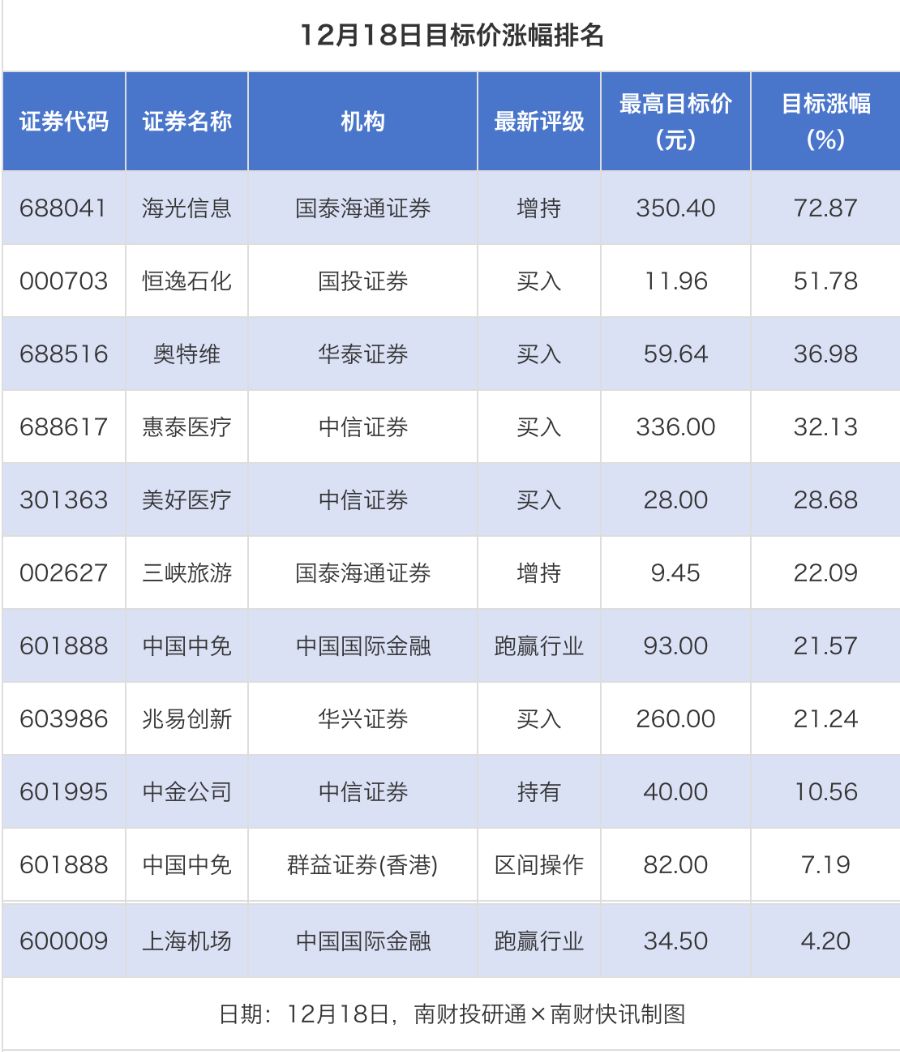
Core Insights - On December 18, 2023, brokerage firms set target prices for listed companies, with notable increases for Haiguang Information, Hengyi Petrochemical, and Aotwei, showing target price increases of 72.87%, 51.78%, and 36.98% respectively, across the semiconductor, refining and trading, and photovoltaic equipment industries [1][2]. Group 1: Target Price Increases - Haiguang Information (688041) received a target price of 350.40 yuan, reflecting a target increase of 72.87% from its latest closing price [2]. - Hengyi Petrochemical (000703) has a target price of 11.96 yuan, indicating a target increase of 51.78% [2]. - Aotwei (688516) was assigned a target price of 59.64 yuan, with a target increase of 36.98% [2]. Group 2: Brokerage Recommendations - A total of 24 listed companies received brokerage recommendations on December 18, with Zhongjin Company, Yanjin Food, and China Duty Free each receiving two recommendations [4]. - Zhongjin Company (601995) had a closing price of 36.18 yuan and received recommendations from 2 brokerages [6]. - Yanjin Food (002847) closed at 71.02 yuan, also with 2 brokerage recommendations [6]. - China Duty Free (601888) had a closing price of 76.50 yuan and received 2 recommendations [6]. Group 3: Initial Coverage Ratings - On December 18, brokerages provided 8 initial coverage ratings, with Sanxia Tourism receiving an "Accumulate" rating from Guotai Junan Securities [8]. - Libat (605167), Times New Materials (600458), and Xinyangfeng (000902) received "Accumulate" and "Buy" ratings from Dongbei Securities [8]. - Nami Technology (688690) was rated "Accumulate" by Western Securities [8].





“湖南辣味”多举措破局掘金千亿市场
Zhong Guo Chan Ye Jing Ji Xin Xi Wang· 2025-12-18 23:41
Core Insights - The spicy snack industry in Hunan, particularly in Pingjiang County, is thriving, with over 100 companies and an annual output value exceeding 20 billion yuan, accounting for one-third of the national market [1] - The retail sales of spicy snacks in China are projected to grow at an annual rate of 9.6%, reaching 273.7 billion yuan by 2026, driven by marketing innovations and health trends [1] - The emergence of social media challenges, such as "spicy eating challenges," has significantly boosted brand visibility and sales, exemplified by the brand "缺牙齿" which saw a monthly sales increase from 1,000 to 20,000 units after a viral video [1] Industry Developments - The online revenue share for brands has increased from 20% to 40%, with a nearly 60% repurchase rate, indicating a shift in consumer behavior towards online shopping [2] - The popularity of low-fat, low-calorie konjac products is rising, with over 50 competitors in the market; however, some brands like 南江桥 are focusing on niche markets such as dried konjac to avoid direct competition [2] - 南江桥's sales of dried konjac reached over 10 million yuan in December 2023, marking its entry into the "billion club" within its first full year of operation [2] Infrastructure and Production - The 麻辣王子辣条产业园 in Pingjiang is one of the largest and most automated production bases in the spicy snack industry, with an expected annual output value of 3 billion yuan, potentially reaching 9 billion yuan upon full completion [3] - The local government is promoting the leisure food industry as a leading sector, aiming to establish Pingjiang as the "capital of spicy snacks" in China, focusing on high-quality development and breaking away from homogeneous competition [3] Market Collaboration - The collaboration between retail channels like "零食很忙" and spicy snack brands is evolving into a tightly integrated "production and sales community," allowing for customized products and shared sales data to quickly respond to consumer trends [4]
推动千亿魔芋赛道爆发,卫龙美味成“最受关注魔芋企业”,产品心智渗透率达78%
2 1 Shi Ji Jing Ji Bao Dao· 2025-12-18 12:13
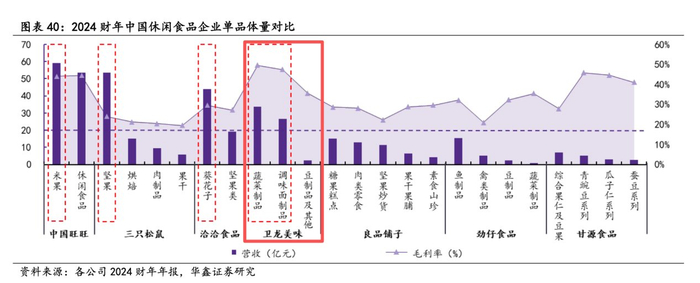
Core Insights - The core focus of the article is on the rapid growth and market dominance of the company Wei Long in the konjac food industry, particularly through its flagship product, "Konjac Shuang" [1][2][20]. Company Overview - Wei Long was established in 1999 and went public in 2022, becoming the first "spicy strip" stock in Hong Kong [2]. - The company pioneered the konjac snack category in China with the introduction of "Konjac Shuang" in 2014, which has since become the highest-selling konjac product in the country, with a production volume exceeding 100,000 tons and sales surpassing 3 billion yuan in 2024 [2][20]. Market Position - Wei Long holds a market share of over 60% in the konjac product segment, making it the leading company in the industry [2]. - The company has successfully established itself as the only publicly listed snack food company with two core products each generating over 2.5 billion yuan in sales [2]. Consumer Insights - The most popular konjac product among consumers is "spicy konjac tripe," with Wei Long being the most recognized brand, achieving a mention frequency of 51 times per month [1]. - The brand's mental penetration rate in the "Konjac Shuang" category is reported to be 78%, indicating strong brand recognition and consumer loyalty [4][12]. Product Characteristics - "Konjac Shuang" is characterized by its low-fat, low-calorie, and high dietary fiber content, making it appealing for health-conscious consumers [9][12]. - The company uses high-quality konjac sourced from Yunnan, ensuring superior product quality through direct partnerships with local farmers [12]. Marketing Strategy - Wei Long actively engages in brand building and consumer interaction, exemplified by its participation in the first "Konjac Superfood Launch Conference" to promote the health benefits of konjac [13][14]. - The company has leveraged social media and collaborations with popular brands like Pizza Hut and KFC to enhance consumer engagement and meet diverse consumer needs [15]. Industry Growth - The konjac industry in China is projected to grow significantly, with an estimated total output value of 32 billion yuan in 2024 and a potential increase to 45 billion yuan by 2030, reflecting a compound annual growth rate of 11.8% [17]. - Wei Long's revenue from konjac products has increased from 298 million yuan in 2018 to 3.37 billion yuan in 2024, marking an elevenfold growth over six years [16][20]. Future Outlook - The company is positioned to benefit from the expanding konjac market, with expectations of continued revenue growth and market expansion [20]. - Wei Long's market capitalization has reached approximately 26 billion HKD, reflecting a 53% increase year-on-year, indicating strong investor confidence in the company's growth potential [20].
盐津铺子联名农心推出“辛辣豆腐”系列新品
Bei Jing Shang Bao· 2025-12-18 10:35
Core Viewpoint - Salted Fish (002847) has partnered with Nongshim to launch a new product line called "Spicy Tofu," which combines the classic flavor of Nongshim's Shin Ramyeon with innovative processing techniques to create a unique snack experience [1] Group 1: Product Innovation - The new "Spicy Tofu" series integrates the rich broth flavor of Shin Ramyeon into tofu snacks, aiming to replicate authentic Korean spicy taste [1] - Real mushroom particles are added to enhance the texture and flavor experience of the snack [1]
盐津铺子(002847):激励与回购并行,目标务实分享成果
GOLDEN SUN SECURITIES· 2025-12-18 09:21
Investment Rating - The report maintains a "Buy" rating for the company [4][6]. Core Insights - The company has launched a restricted stock incentive plan and a share repurchase plan, aiming to grant 3 million shares at a price of 35.18 CNY per share, which represents 1.1% of the total share capital. The profit targets for the years 2026-2028 are set at no less than 8.5 billion, 10.0 billion, and 12.5 billion CNY, with trigger values of 7.65 billion, 9.0 billion, and 11.25 billion CNY respectively [1][2]. - The company is focusing on three major growth areas: Chinese-flavored snacks, healthy high-protein snacks, and healthy sweet snacks. It aims to leverage its "Big Demon King" brand to enhance its market presence [3][4]. Financial Performance - The projected revenue for 2025-2027 is 59.5 billion, 68.7 billion, and 78.4 billion CNY, reflecting year-on-year growth rates of 12.1%, 15.5%, and 14.2% respectively. The net profit for the same period is expected to be 7.9 billion, 9.1 billion, and 11.1 billion CNY, with growth rates of 23.6%, 15.1%, and 22.2% respectively [4][5]. - The earnings per share (EPS) for 2025 is projected at 2.90 CNY, with a price-to-earnings (P/E) ratio of 24.4 [5][6]. Strategic Initiatives - The company is actively pursuing brand development and channel expansion, with a strategic shift back to traditional retail channels while also enhancing its supply chain by establishing its own production capabilities [3][4]. - The management has set relatively low profit targets for 2026 to allow for flexibility in performance assessment, indicating confidence in long-term growth despite current cost pressures [2][4].
休闲食品板块12月18日涨0.78%,来伊份领涨,主力资金净流入9978.57万元
Zheng Xing Xing Ye Ri Bao· 2025-12-18 09:07
Group 1 - The leisure food sector increased by 0.78% compared to the previous trading day, with Laiyifen leading the gains [1] - The Shanghai Composite Index closed at 3876.37, up by 0.16%, while the Shenzhen Component Index closed at 13053.98, down by 1.29% [1] - A table detailing the individual stock performance within the leisure food sector was provided [1] Group 2 - The net inflow of main funds into the leisure food sector was 99.7857 million yuan, while retail funds saw a net inflow of 10.4 million yuan [2] - The sector experienced a net outflow of 204 million yuan from speculative funds [2] - A table showing the fund flow for individual stocks in the leisure food sector was included [2]

中金2026年展望 | 食品饮料:筑底接近尾声,聚焦高质量增长
中金点睛· 2025-12-17 23:54
Core Viewpoint - The food and beverage industry is experiencing a new normal with a weak overall consumption environment, emphasizing high quality-price ratios, functionality, health, and emotional consumption trends. The liquor industry continues to face weak demand, while snacks and beverages show better performance. The industry is expected to maintain a weak recovery with strong differentiation, relying on product innovation, fragmented channel layouts, and expanding consumer demographics [2][3][10]. Liquor Industry - The liquor industry is undergoing significant adjustments due to weak demand and new regulations, with expectations for a turning point in the first half of 2026 as the supply-demand balance improves. The impact of policies on demand is expected to weaken, leading to a gradual recovery in consumption [6][7]. - The strategic focus of liquor companies has shifted from inventory pressure to exploring new growth areas, such as targeting younger consumers and embracing new retail channels. This shift is expected to lead to a clearer upward trend in financial reports by 2026 [8][9]. - High-end liquor is anticipated to lead the overall recovery, benefiting from brand loyalty and the resumption of business activities. The mid-range segment may face challenges but is also expected to see some recovery [9]. Snack and Beverage Industry - The overall demand for snacks is stabilizing at a low level, with a focus on quality-price ratios and emotional value. The snack industry is expected to continue expanding, particularly in channels like bulk snacks and membership supermarkets [11][12]. - The beverage industry is benefiting from health trends, with a notable increase in demand for low-sugar and functional drinks. The market for instant retail is also growing, with significant sales increases in snack brands through platforms like Meituan [21][22]. - The competition in the beverage sector is expected to remain intense, but price competition is easing, allowing for improved profit margins for leading companies [22][23]. Dairy and Frozen Food Industry - The dairy industry is experiencing a recovery in operational performance, with expectations for improved profitability as raw milk prices stabilize. The demand for liquid milk is projected to stabilize in 2026, with a potential turning point in the raw milk supply-demand balance [33][34][37]. - The frozen food industry is facing pressure from weak demand but is seeing a stabilization in competition. Companies are focusing on product innovation and new channel development to improve profitability [42][43]. Condiments and Health Products - The condiment industry is expected to see stable demand in 2025, with a focus on product upgrades and innovation from leading companies. The overall competitive landscape is anticipated to become less aggressive as inventory levels normalize [44][48]. - The health product sector is experiencing a shift towards online sales and long-tail brand growth. Leading brands are expected to stabilize their market share through channel expansion and product diversification [55][56].