
Internet

Search documents
阿里巴巴申请公布大型语言模型训练相关专利
Qi Cha Cha· 2026-02-13 09:53
专利摘要显示,本发明实施例中,通过获取多个初始采样数据,初始采样数据包括图像、图像的辅助文 本信息以及图像的标准审核结果;根据每个初始采用数据生成思维链数据,并确定思维链数据集合;根 据思维链数据集合对基础大型语言模型进行全量微调,确定中间大型语言模型;根据中间大型语言模型 以及多个所述初始采样数据,迭代生成多个中间思维链数据;进而根据预先设置的奖励函数,确定各所 述中间思维链数据的奖励数值;最后采用组相对策略优化算法GRPO对所述中间大型语言模型进行强化 学习,确定目标大型语言模型。通过上述方法,可以提高大型语言模型的可解释性和审核精度。 企查查APP显示,近日,阿里巴巴(中国)有限公司申请公布"一种基于思维链训练大型语言模型的方 法、装置和设备"专利。 (原标题:阿里巴巴申请公布大型语言模型训练相关专利) ...

China's Baidu adds OpenClaw AI into search app for 700 million users ahead of Lunar New Year
CNBC· 2026-02-13 08:03
Group 1 - Baidu plans to integrate the AI tool OpenClaw into its main smartphone app, allowing users to perform tasks like scheduling and organizing files directly through the app [1] - OpenClaw has gained popularity for its task automation capabilities, previously accessible only via chat apps like WhatsApp and Telegram [2] - Baidu reports 700 million monthly active users for its search app and is expanding OpenClaw's functionalities to its e-commerce and other services [3] Group 2 - The rollout of OpenClaw's capabilities coincides with the upcoming Lunar New Year holiday, as Chinese tech companies aim to attract new users and monetize their AI investments [3]



腾讯研究院2026年新春书单:值得读的10本书
腾讯研究院· 2026-02-13 07:03
Core Insights - The article emphasizes the transformative impact of artificial intelligence (AI) on daily life, highlighting its role in various creative and decision-making processes while also addressing the existential questions it raises for humanity [1] Group 1: Book Recommendations - The article presents a unique book recommendation format where AI characterizes five contemporary individuals and suggests books based on their identities and philosophical cores [2] - The recommended books include "要有光" by 梁鸿, which explores the psychological crises faced by youth in contemporary China, emphasizing the importance of understanding and listening to their struggles [4] - "文字的力量" by 马丁·普赫纳 examines the historical significance of literature and its role in shaping civilization, arguing that literature is a powerful tool for societal change [6][7] - "匠人" by 理查德·桑内特 redefines the concept of craftsmanship in the digital age, advocating for a return to the intrinsic joy of doing work well, beyond mere efficiency [9][10] - "系统之美" by 德内拉·梅多斯 offers insights into systems thinking, emphasizing the interconnectedness of events and the importance of understanding systemic structures to address complex issues [11][12] - "即使以最微弱的光" by 崔恩荣 delves into the emotional struggles of East Asian women, portraying their resilience in the face of societal pressures [13][15] - "生命3.0" by 迈克斯·泰格马克 discusses the implications of AI on human existence and the ethical considerations of its development [17][18] - "AI之镜" by 香农·瓦洛尔 critiques the limitations of AI as a reflection of past data, urging a reevaluation of how technology can enhance human values and growth [19][20] - "AI文明史·前史" by 张笑宇 presents a philosophical exploration of AI's evolution, warning against the potential dangers of unregulated technological advancement [23][24] - "苏格拉底的方法" by 沃德·法恩斯沃斯 revives the Socratic method as a means to combat cognitive closure in the age of AI [25][26] - "AI群星闪耀时" by 清华大学刘知远团队 provides a historical perspective on AI, emphasizing the philosophical and humanistic aspects of its development [27][28]


2026年度策略系列报告:中美AI产业或将再度向上
Huafu Securities· 2026-02-13 06:48
Group 1 - The core narrative of the report indicates that the AI industry in China and the US is in a transitional phase, moving from "upstream selling shovels" and "new technology demand" to "empowering the entire industry" [9][10] - Three types of companies are identified as potential beneficiaries of the technology revolution: 1) upstream core technology and equipment suppliers, 2) companies corresponding to new demands generated by new technologies, and 3) companies applying new technologies to existing industries for empowerment [2][30] - The report emphasizes that the current market for the AI industry in China is still primarily driven by valuation rather than performance, indicating that it has not yet entered the second phase of performance-driven growth [15][20] Group 2 - The report outlines a methodology based on three dimensions: macro narrative, stock price drivers, and financial screening, to identify companies that may benefit from the AI wave [21][24] - Revenue growth is highlighted as a leading indicator of whether a company is benefiting from the technology revolution, typically preceding profit jumps by about one quarter [74][77] - The report notes that two operational strategies can cause revenue signals to fail: transitioning to new technology businesses and making early investments, which may delay profit realization [82][86] Group 3 - Historical comparisons are made between the US internet revolution (1985-2005) and the mobile internet cycle in China (2007-2015), illustrating how valuation and profit transitions have occurred in past technology revolutions [32][43] - The report discusses the importance of cash flow and advance payments as more comprehensive and forward-looking indicators compared to revenue alone, aiding in the identification of companies with potential profit inflection points [74][80] - The analysis of representative companies from both the US and China during previous technology cycles shows that stock price movements often align with the phases of valuation expansion and profit realization [51][62]
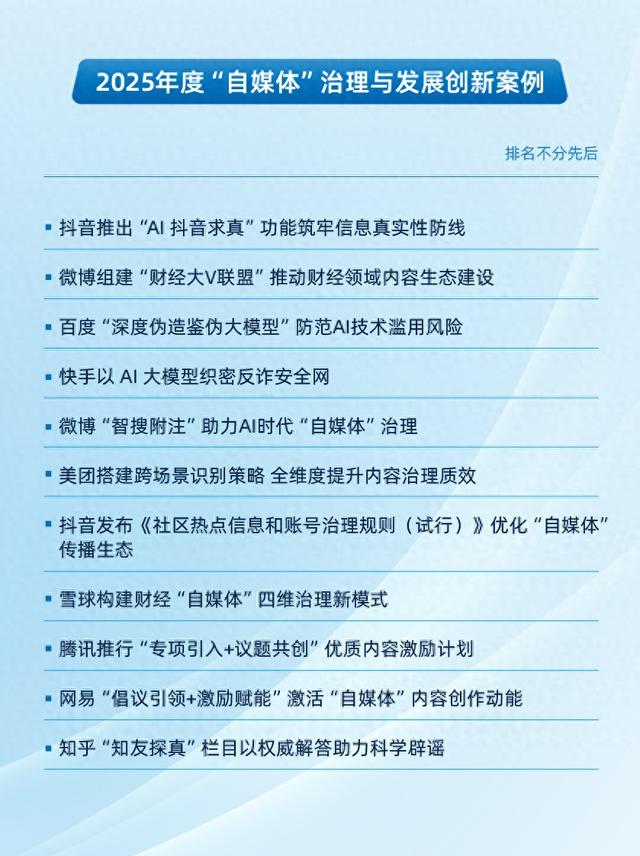
2025年度“自媒体”治理与发展创新案例发布
Bei Jing Ri Bao Ke Hu Duan· 2026-02-13 05:37
Core Insights - The 2025 Annual "Self-Media" Governance and Development Summary Evaluation Meeting was held to summarize industry self-regulation efforts and explore multi-party governance strategies in the self-media sector [1][2] - Key representatives from major self-media platforms shared innovative practices and highlighted the importance of using advanced technologies for governance [1][2] Group 1: Governance and Development Strategies - The meeting emphasized the establishment of a professional committee and focused governance in key areas to enhance self-regulation [1] - Platforms like Douyin, Weibo, Baidu, and Tencent News presented their innovative measures for managing misinformation and promoting quality content [1][2] - Douyin built a misinformation governance system through "AI Douyin Seeking Truth," focusing on content production tracing, interception during dissemination, and proactive fact-checking [1][2] Group 2: Innovative Case Studies - The 2025 Annual "Self-Media" Governance and Development Innovation Cases included 11 examples from 9 platforms, showcasing a broader range of governance methods compared to the previous year [2] - New characteristics in platform governance were identified, including the shift from case-based to scalable mechanisms, the use of AI for precise governance, and diverse incentives for quality content production [2] - Notable innovations included Weibo's "Finance Big V Alliance," Baidu's "Deep Forgery Detection Model," and Tencent's comprehensive training for self-media creators [2][4] Group 3: Future Directions - The Beijing Internet Administration emphasized the need for political guidance, industry self-regulation, innovative governance, and a focus on high-quality development to foster a healthy self-media ecosystem [2][3] - The association aims to create a governance model that promotes policy discussion, problem-solving, and ecological co-construction in the self-media sector [3]




春节,正在搬进手机里
Xin Jing Bao· 2026-02-13 05:00
Group 1 - The core idea of the articles is that the Spring Festival has transformed into a major battleground for internet platforms, with companies like Alibaba, Tencent, and Baidu launching significant cash red envelope initiatives to engage users [2][3][5] - Alibaba initiated a "Please Guest Plan" with a budget of 3 billion yuan, while Tencent and Baidu launched red envelope campaigns of 1 billion yuan and 500 million yuan respectively [1] - The mobile phone has become the central hub for Spring Festival activities, shifting from traditional family gatherings to digital interactions, where users compete in speed and the size of red envelopes [5][12] Group 2 - During the Spring Festival, users open an average of 8.3 apps daily, which is nearly 2 more than usual, indicating a significant increase in mobile app engagement [12] - Payment transactions during the 2025 Spring Festival reached 9.78 trillion yuan, with a 24.5% increase in transaction volume and a 15% increase in transaction value compared to the previous year [17] - The peak transaction moment occurred at midnight on New Year's Eve, with 4.045 billion transactions processed simultaneously, showcasing the massive scale of digital engagement during the festival [19][21] Group 3 - The total mobile internet access traffic during the 2025 Spring Festival was 660.3 million TB, reflecting a 9.9% increase compared to the previous year [22] - Video and voice greetings have become mainstream, replacing traditional methods of visiting relatives, with AI also contributing by generating customized greeting videos [23][26] - The essence of the Spring Festival remains intact, but it has been redefined through technology, with digital interactions and social media becoming the new norm for expressing emotions and maintaining connections [26]

微信“服务号”图标悄悄更新,变蓝色“双菱形”
猿大侠· 2026-02-13 04:11
值得一提的是,在前段时间,微信"公众号"的官方图标已先行灰度变更,由"书本"样式改为"叶 片"样式。 IT之家 2 月 12 日消息,据多位读者投稿及IT之家实测,微信"服务号"的官方图标悄悄变更, 由红 色的"购物袋 + 小票"样式变为浅蓝色"双菱形"。 | | 软媒 企业邮箱 一般网 | | | --- | --- | --- | | | 服务号 | | | 8 | TERP PRISZEN | | | | | IT : % www.ithome.com | | | 服务号 | | | | 与机械:100%中值。 | | 不过需要注意的是, 目前这一变更还处于灰度阶段 ,并不是所有用户都能立即看到全新的"双菱 形"图标,需要等待官方逐步推送。 ...

焦点|狂撒红包 大厂血拼全民AI入口
Guang Zhou Ri Bao· 2026-02-13 03:18
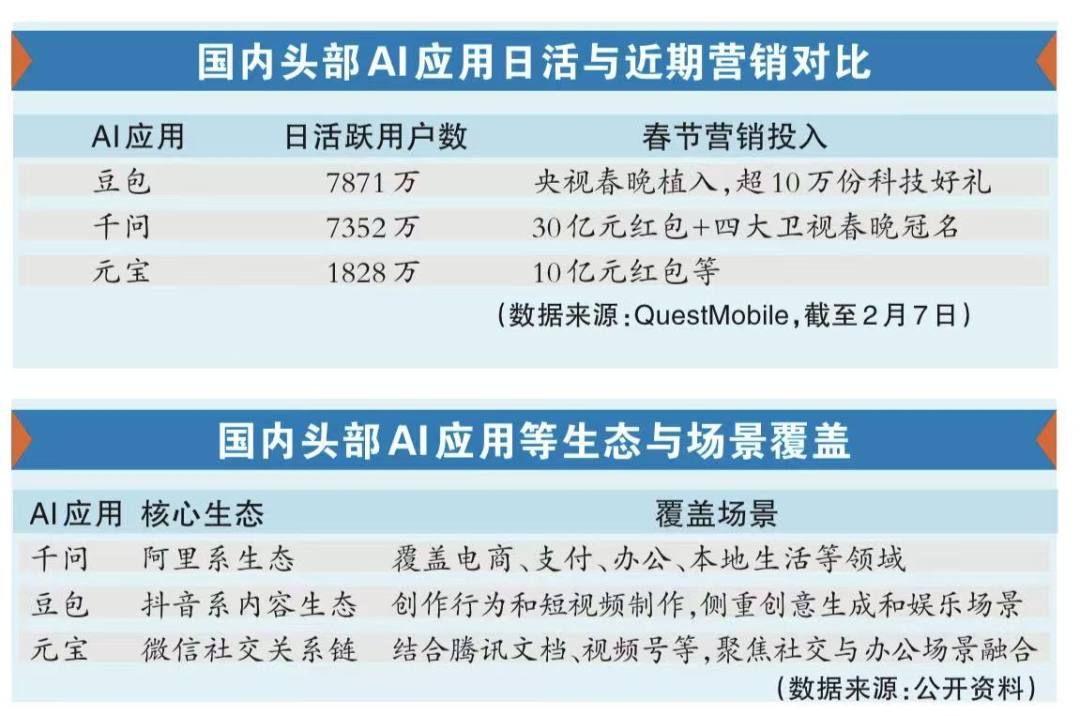
Core Insights - The Chinese internet landscape is witnessing a significant transformation as major companies like Tencent, Alibaba, and Baidu engage in an AI-driven competition for user engagement during the Spring Festival, with a total investment exceeding 45 billion yuan in AI red envelopes [1][4][15] - This competition is not merely about cash giveaways but represents a strategic positioning for the next generation of traffic super entry points, focusing on integrating AI into various consumer scenarios [1][10][15] Group 1: Company Strategies - Tencent launched a 10 billion yuan cash red envelope initiative and introduced a new AI social feature called "Yuanbao Pai," aiming to create a collaborative social space [2][3] - Alibaba's Qianwen app initiated a 30 billion yuan "treat" campaign, integrating AI into its ecosystem across multiple platforms like Taobao and Alipay, and secured naming rights for four local TV stations' Spring Festival galas [2][3] - ByteDance's Doubao maintained a low-profile strategy, focusing on its existing user base while investing in AI interactions during the CCTV Spring Festival gala [3][4] Group 2: User Engagement and Growth - The competition has led to significant increases in daily active users (DAU) for these AI applications, with Qianwen's DAU surging by 727.7% to 58.48 million on the first day of its campaign, while Yuanbao's DAU increased by 2.1 times to 23.99 million [5][7] - The overall user engagement reflects a shift from traditional promotional methods to AI-driven interactions, with companies aiming to embed AI into everyday consumer activities [9][10] Group 3: Market Trends and Future Implications - The Spring Festival serves as a critical period for AI products to penetrate the market, particularly among underrepresented demographics such as older users and those in lower-tier cities [4][15] - The competition is seen as a pivotal moment in the transition from mobile internet to AI internet, with companies vying for long-term user loyalty and establishing AI as an integral part of daily life [15][18] - The effectiveness of these AI applications will ultimately depend on their ability to provide practical solutions and integrate seamlessly into existing user ecosystems [9][15][18]
OpenClaw首个官方电商插件落地:百度优选Skill,补齐智能体“交易决策”拼图
Cai Jing Wang· 2026-02-13 02:52
Core Insights - Baidu's official e-commerce Skill has been launched on ClawHub, marking the first official e-commerce capability plugin in the OpenClaw ecosystem [1] - The Skill integrates Baidu's product knowledge graph with CPS supply chain capabilities, enabling agents to perform comprehensive e-commerce tasks from product search to decision-making [1] Summary by Sections Product Features - The Skill will offer five core modules: CPS product library search, SPU cross-platform price comparison, multi-product parameter comparison and reputation summary, authoritative consumer rankings, covering major categories like electronics, home appliances, and home goods [1] - Users can install the Skill via ClawHub command line for immediate use, allowing natural language commands to drive complex searches within the OpenClaw interactive environment [1] User Experience - The launch aims to provide ordinary users with an intelligent shopping experience where they can achieve "ask and get" results [1] - It also supports developers and e-commerce practitioners in quickly integrating these capabilities into shopping robots and operational tools [1] Future Developments - Future updates will include price monitoring, personalized recommendations, and multi-modal search capabilities [1]
中国互联网:AI 赢家的轮动格局-腾讯与阿里对比分析-China Internet The AI winners merry-go-round - comparing Tencent and Alibaba
2026-02-13 02:18
Summary of China Internet Sector Conference Call Industry Overview - The China Internet sector has had a lackluster start to 2026, with KWEB remaining flat year-to-date. AI advancements continue to influence investor preferences within the sector, particularly with Alibaba outperforming due to its Qwen agentic services, while Tencent has lagged behind [1][2]. Key Companies Discussed Tencent - Tencent's share price reflects investor concerns regarding its AI model and chatbot development. The company has shown solid returns on investment (ROI) from AI in its advertising and gaming sectors, trading at a projected 14-15x PE for 2027, indicating a favorable risk-reward scenario as earnings compound [3][8]. - Recent issues with the Yuanbao Party highlight challenges in AI development within WeChat, which faces higher quality standards compared to other platforms. Despite this, Tencent's advertising business remains robust, with strong growth in Video Accounts and digital ads [3][85]. - The company is perceived to be behind in AI model development, which has negatively impacted its valuation multiples. However, the potential for recovery exists as the company continues to innovate and improve its AI capabilities [57][59]. Alibaba - Alibaba's sentiment peaked during the launch of Qwen agentic services, which positions the company favorably in the domestic market. The use of red packet promotions to stimulate online shopping behavior is seen as a more logical strategy compared to incentivizing information retrieval [4][9]. - Concerns remain regarding Alibaba's ability to demonstrate that its AI initiatives can drive significant growth in gross merchandise volume (GMV) and customer retention. The combination of a top-tier AI model, strong growth in Alicloud revenues (30-40%), and a solid GPU development program makes Alibaba an attractive investment [4][9]. - The regulatory environment remains a concern, with ongoing investigations into other companies in the sector contributing to cautious sentiment among investors [4][55]. AI and Chatbot Wars - The competition among major Chinese internet platforms, including Tencent, Alibaba, Bytedance, and Baidu, has intensified with the introduction of red packet promotions aimed at boosting AI chatbot adoption. This strategy indicates that AI capabilities alone are insufficient for consumer-facing applications [2][19]. - Recent data suggests that while user acquisition for AI chatbots has increased due to promotional efforts, daily engagement metrics have not shown significant improvement, raising questions about long-term user retention and behavior change [17][24]. - The effectiveness of cash incentives in driving user engagement with AI chatbots is debated, with comparisons drawn to past successes in online payment adoption [20][21]. Regulatory Environment - The regulatory landscape for the China Internet sector has shifted, with increased scrutiny and investigations affecting investor sentiment. The potential for stricter enforcement of e-commerce taxes and other regulations has raised concerns about future growth prospects [4][55]. - Despite these challenges, recent stock pullbacks may improve the risk-reward profile for investors in the sector, particularly for Tencent and Alibaba [56]. Investment Implications - Both Tencent and Alibaba present distinct investment opportunities, with Tencent focusing on steady earnings and AI ROI, while Alibaba emphasizes faster model development and long-term AI optionality. The current market environment favors companies that can demonstrate tangible AI success and consumer engagement [7][28]. - The ongoing debate among investors regarding the costs and benefits of AI investments will likely influence stock performance in the near term, with a shift towards favoring companies that can deliver visible earnings impacts [28][100].