电子信息制造

Search documents
影响市场重大事件:三部门发文,加快先进计算、5G-A、工业互联网、人工智能在电子信息制造业中的规模化应用
Mei Ri Jing Ji Xin Wen· 2025-05-27 11:41
Group 1 - The Ministry of Industry and Information Technology, National Development and Reform Commission, and National Data Bureau issued a plan to accelerate the large-scale application of advanced computing, 5G-A, industrial internet, and artificial intelligence in the electronic information manufacturing industry [1] - The plan emphasizes the construction of new information infrastructure and the integration of network, data, computing power, and algorithms [1] Group 2 - Shanghai's Development and Reform Commission released a three-year action plan to promote the development of the rehabilitation assistive devices industry, focusing on integrating AI, smart sensing, and brain-computer interface technologies [2] - The plan aims to support the research and development of key products such as nursing robots and virtual reality rehabilitation training devices, with a target of implementing 10 key technology projects by 2027 [2] Group 3 - The Shenzhen Stock Exchange announced the successful listing of the first private venture capital "Science and Technology Innovation Bond" in the interbank market, aimed at funding projects in AI, digital economy, and other strategic emerging industries [5] - This bond issuance sets new records in terms of total scale and issuance period compared to similar projects [5] Group 4 - The Beijing Municipal Economic and Information Technology Bureau issued an action plan to promote high-level opening of the biopharmaceutical industry, including the establishment of an international pharmaceutical innovation park [8] - The plan encourages foreign investment and aims to facilitate the development of key projects in the biopharmaceutical sector [8] Group 5 - The National Tobacco Monopoly Administration announced measures to strengthen electronic cigarette regulation, addressing the complexities of the current market and increasing scrutiny on exports and illegal products [10] - The administration aims to enhance the regulatory framework and promote industry standardization [10] Group 6 - The State Administration for Market Regulation emphasized the importance of anti-monopoly and fair competition measures to promote a unified national market [11] - The agency aims to ensure that market order is maintained while balancing development and safety [11]
三部门:加强新型信息基础设施建设 加快人工智能等在电子信息制造业中的规模化应用
智通财经网· 2025-05-27 11:06
Core Viewpoint - The Ministry of Industry and Information Technology, along with other departments, has released the "Digital Transformation Implementation Plan for the Electronic Information Manufacturing Industry," emphasizing the need to strengthen new information infrastructure and promote the integration of advanced computing, AI, and industrial internet technologies in the sector [1][3]. Overall Requirements - The plan aims to enhance the digitalization, networking, and intelligence levels of the electronic information manufacturing industry, fostering new growth points and supporting the construction of a modern industrial system by 2027 [4][5]. Key Tasks - Accelerate the application of core digital technologies, focusing on breakthroughs in critical technologies such as high-precision industrial control and intelligent equipment integration [6][8]. - Promote the value release of data elements and encourage the establishment of data management systems within enterprises [8][9]. - Strengthen the role of advanced computing and AI in enhancing productivity and optimizing processes across the industry [8][9]. Infrastructure Development - The plan emphasizes the construction of a reliable and high-performance new information infrastructure, integrating advanced computing, 5G, and AI technologies to empower the electronic information manufacturing sector [16][17]. Standardization and Security - Establish a comprehensive standard system for digital transformation in the electronic information manufacturing industry, focusing on data management and security governance [17][19]. Service Support - Foster the development of digital transformation service providers to enhance the overall service supply level and support the digital transformation of the electronic information manufacturing industry [20][21]. Implementation Strategy - The plan outlines a coordinated approach involving government, industry, and academia to ensure the effective implementation of digital transformation policies and projects [23][24].
海内外千余企业机构齐聚西洽会 签约百余个重大项目
Zhong Guo Xin Wen Wang· 2025-05-22 18:21
Group 1 - The 7th China Western International Investment and Trade Fair (West Expo) opened in Chongqing, featuring 124 major project signings with a total investment amount exceeding 200 billion RMB [1] - The West Expo is one of the most influential investment events in Western China, attracting over 1,300 enterprises and institutions from 39 countries and regions, with Thailand as the guest country and Hong Kong as a newly established guest city [1] - The signed projects aim to gather global quality resources and promote the implementation of leading projects in the western region, with nearly 160 billion RMB in contracts for key industries such as intelligent connected new energy vehicles and advanced materials [1] Group 2 - The West Expo consists of two main parts: exhibition displays and thematic activities, covering an exhibition area of 110,000 square meters [2] - A total of 34 activities will be held during the conference, including themes on productive services supporting modern industrial development and foreign investment activities [2]
郴州产业大变身!传统矿业转型,新兴产业崛起,咋做到的?
Sou Hu Cai Jing· 2025-05-21 21:40
Group 1: Core Industry Transformation - The mining industry in Chenzhou is transitioning from traditional methods to green and efficient practices, focusing on environmental protection and resource utilization [2] - Companies are investing in eco-friendly technologies and establishing circular economy chains to recycle waste materials, which reduces production costs and enhances economic benefits [2] Group 2: Cultural and Tourism Development - Chenzhou's rich natural scenery and cultural heritage have laid a strong foundation for the growth of the cultural tourism industry, with increased investments and successful tourism events enhancing its reputation [5] - Rural areas are benefiting from tourism, with local communities developing agritourism and promoting regional products, leading to improved incomes and living conditions for residents [5] Group 3: Modern Agriculture Advancement - Significant achievements in modern agriculture have been made, with local specialties like ice sugar oranges and peppers being cultivated, alongside the promotion of advanced planting techniques [6] - The establishment of standardized planting bases and processing facilities has created a complete industrial chain, increasing product value and ensuring farmers' economic returns [6] Group 4: Electronic Information Industry Growth - The electronic information industry in Chenzhou is emerging, supported by government efforts to create industrial parks that attract numerous companies [9] - Collaboration among enterprises and with academic institutions is enhancing technological innovation and competitiveness, leading to job creation and economic structure improvement [9] Group 5: New Energy Potential - Chenzhou has abundant renewable energy resources, with ongoing projects in wind and solar power that reduce reliance on traditional energy and lower carbon emissions [9] - The development of the new energy sector is fostering advancements in related industries, including equipment manufacturing and maintenance services, contributing to a complete industrial chain [9] Group 6: Policy Support and Guidance - The Chenzhou government has implemented various strategies to promote industrial growth, including special funds for emerging industries and subsidies for transitioning companies [12] - Policies prioritizing land allocation and talent attraction are facilitating business operations, optimizing the industrial environment for sustainable economic growth [12]


多项关键指标增速加快——我国数字产业开局良好
Jing Ji Ri Bao· 2025-05-19 22:00
Core Insights - The digital industry in China achieved a business revenue of 8.5 trillion yuan in the first quarter, marking a year-on-year growth of 9.4%, with manufacturing and services growing by 10.4% and 8.2% respectively [1] - The total profit of the digital industry reached 572.1 billion yuan, reflecting a year-on-year increase of 7.0% [1] - The growth of the digital industry supports the government's "Four Stabilities" initiative, which aims to stabilize employment, enterprises, markets, and expectations [1] Industry Performance - Digital manufacturing experienced rapid growth due to electronic product subsidies, increased demand for AI terminals, and accelerated investment in AI infrastructure projects [2] - The production of integrated circuits and optoelectronic devices grew by 6% and 3.5% year-on-year respectively [2] - Fixed asset investment in the computer, communication, and other electronic equipment manufacturing sectors increased by 10.5% year-on-year [2] Regional Analysis - 24 provinces reported positive growth in digital industry revenue, with 10 provinces achieving double-digit growth [2] - Eastern and central regions grew by 10.2% and 9.7% respectively, with significant improvements compared to the previous year [2] - The top ten provinces in digital industry revenue accounted for 6.8 trillion yuan, or 80.7% of the national total, contributing 90.8% to the overall growth [2] Sector-Specific Insights - The electronic information manufacturing sector saw an increase of 11.5% in added value, with electronic product exports growing by 5.8% [3] - The domestic smartphone shipment volume increased by 3.3%, marking seven consecutive quarters of growth [3] - The software industry generated 3.1 trillion yuan in revenue, reflecting a year-on-year growth of 10.6% [3] Technological Advancements - AI technology is driving overall industry upgrades, with a notable increase in the shipment of AI-enabled devices [4] - Companies are integrating large models into key manufacturing processes, enhancing efficiency in production, product experience, and after-sales service [4] - The rapid development of AI applications is reshaping lifestyles and work patterns across various sectors [4] Consumer Experience Enhancement - Digital technologies, such as AR, are improving consumer experiences on e-commerce platforms, leading to increased digital consumption [5] - The implementation of AR features in apps has significantly aided consumer decision-making, with over 30% of users benefiting daily [5] - Investment in cutting-edge digital technologies is essential for fostering new and future industries [5]
南京115家企业入围2025年江苏省先进级智能工厂名单
Nan Jing Ri Bao· 2025-05-18 01:25
Group 1 - Jiangsu Province announced the list of advanced smart factories for 2025, with a total of 1,807 enterprises included, among which 115 are from Nanjing [1] - Smart factories are crucial for the digital transformation and upgrading of the manufacturing industry, enhancing competitiveness and sustainable development [1] - The "National Smart Factory Gradient Cultivation Action" was launched at the 2024 World Intelligent Manufacturing Conference, aiming to establish a gradient cultivation system from basic to leading smart factories [1] Group 2 - Nanjing Automobile Forging Co., Ltd. has significantly improved automation and information levels, achieving an annual per capita production of over 170 tons and sales revenue exceeding 2.2 million yuan, three times the average level in China's forging industry [2] - Yangzi Petrochemical has implemented a "ground-air linkage" inspection system using various intelligent robots to enhance safety perception and predictive capabilities in production [2] - China Electronics Technology Group Corporation No. 14 Research Institute has developed the "Rui Zhi" industrial software brand, serving over 1,000 enterprises across 15 industries, promoting high-quality digital transformation [3] Group 3 - Nanjing Steel, China Electronics Technology Group Corporation No. 14 Research Institute, and other companies were included in the first batch of national excellent smart factory projects, with Nanjing leading the province with five entries [3] - The Nanjing Industrial and Information Technology Bureau plans to accelerate the promotion and exploration of smart factories, focusing on gradient cultivation from basic to leading levels [3]
中国供应链发展全景视图与趋势展望
China Securities· 2025-05-16 07:20
Policy Framework - China has established a comprehensive supply chain security policy system since 2012, covering both macro and industry-specific levels[2] - The government emphasizes self-control and efficiency in supply chains, with significant tax incentives for high-tech enterprises and support for digital transformation of SMEs[2] Economic Impact - In 2024, China's total import and export volume is projected to reach $6.16 trillion, maintaining its position as the world's largest trading nation[3] - China's manufacturing output accounts for 31.6% of global production, significantly surpassing the combined output of the second to fifth largest manufacturing countries[45] Supply Chain Dynamics - China's reliance on Europe and the U.S. has decreased, while deepening cooperation with Japan and South Korea, and forming a mutual dependency with ASEAN[3] - High-value industries still exhibit a pattern of strong assembly capabilities but weak core technologies, indicating a need for further development in high-end sectors[3] Strategic Initiatives - Short-term strategies focus on cost control, technological innovation, and market diversification to mitigate external shocks[3] - Long-term goals include building overseas supply chain networks and optimizing global industrial layouts to enhance resilience[3] Financial Support - The government has implemented various financial policies to support supply chain financing, including tailored financing strategies for SMEs[22] - In 2025, the central government's science and technology expenditure is planned to increase by 10% to approximately $63.5 billion, focusing on foundational research and strategic technology tasks[21]
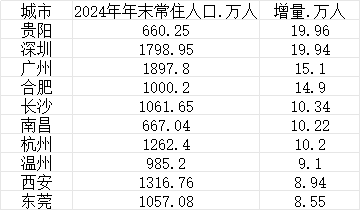
2024年十大人口增长最多的城市,贵阳位居第一
Di Yi Cai Jing· 2025-05-15 09:53
Core Insights - The article highlights the population growth trends in various Chinese cities, with a focus on the top cities that experienced significant increases in their resident populations in 2024, despite a national decline in population. Population Growth Analysis - A total of 12 cities saw a resident population increase of over 80,000 last year, with the top ten cities being Guiyang, Shenzhen, Guangzhou, Hefei, Changsha, Nanchang, Hangzhou, Wenzhou, Xi'an, and Dongguan. The first seven cities each had an increase of over 100,000 residents [1][2] - Guiyang led the population growth with an increase of 199,600 residents, marking a growth rate of 3.12%. This city has consistently added over 100,000 residents annually for four consecutive years [3][4] - Shenzhen and Guangzhou followed, with increases of 199,400 and 151,000 residents, respectively, indicating strong population attraction in these metropolitan areas [4] Economic and Industrial Factors - Guiyang's rapid population growth is attributed to its economic development and industrial support, particularly in sectors like electronic information manufacturing and digital economy, which have been bolstered by local government strategies [3][4] - Hefei has also seen significant growth, with a population of 10 million by the end of 2024, driven by its burgeoning electric vehicle industry, which produced over 1.35 million units last year [8] - The article notes that the population growth in eastern coastal cities like Shenzhen and Guangzhou is complemented by the industrial upgrades and economic transformations in these regions, which attract talent and labor [5][7] Regional Trends - Among the top ten cities for population growth, five are located in the central and western regions of China, including provincial capitals like Guiyang, Hefei, Changsha, Nanchang, and Xi'an. This reflects a broader trend of urbanization and industrialization in these areas [7][8] - The article emphasizes that the provincial capitals serve as economic, cultural, and political centers, which enhances their ability to attract resources and talent [7] - In addition to the top cities, other cities like Jinan and Qingdao also experienced notable population increases, indicating a wider trend of urban growth across various regions [6]
威海不断优化营商环境,民营经济发展呈现良好态势
Qi Lu Wan Bao Wang· 2025-05-14 14:29
Core Viewpoint - Weihai City is actively promoting the high-quality development of the private economy by optimizing the business environment and implementing supportive policies, resulting in significant growth in private enterprises and investments. Group 1: Economic Growth and Statistics - In the first quarter of this year, Weihai registered 11,000 new private market entities, bringing the total to 456,000 [1] - The revenue of private industrial enterprises increased by 3.9%, while the revenue of private service enterprises grew by 15.3% [1] - Private investment rose by 13.2%, exceeding the provincial average by 7.7 percentage points, with private investment accounting for 75.4% of fixed asset investment, ranking second in the province [1] - The total import and export volume of private enterprises reached 27.7 billion yuan, making up 59.6% of the total, with exports of 23.47 billion yuan, a year-on-year increase of 4.5% [1] Group 2: Policy Support and Communication Platforms - Various communication platforms such as "Enterprise Visits" and "Weihai Entrepreneurs Day" have been established to facilitate dialogue between the government and private enterprises, addressing over 620 enterprise demands since 2024 [2] - The city has launched a credit service platform for contract performance, winning the "Most Commercially Valuable Award" at the first National Credit Management Innovation Capability Competition [2] Group 3: Investment and Project Development - Focused on eight major industrial clusters and ten industrial chains, Weihai supports private enterprises in extending to high-end value chains, with four private enterprises recognized as provincial "leading enterprises" [3] - A total of 951 projects are included in the municipal private investment project library, with an expected investment of over 105 billion yuan in 2024 [3] - 31 projects have been successfully signed with a total contract value of 3.63 billion yuan, with one project recognized as a typical case for revitalizing existing assets [3] Group 4: Legal and Regulatory Environment - The city has reduced the frequency of enterprise inspections by 27.8% through integrated regulatory services, minimizing disruptions to normal business operations [5] - A new model for intellectual property protection has been established, significantly reducing case processing times by 70% [5] - The establishment of the province's first Enterprise Credit Mediation Committee aims to resolve disputes at an early stage, contributing to a decrease in civil case filings [6] Group 5: Future Directions and Enhancements - Weihai is committed to enhancing the business environment by implementing the national negative list for market access and reducing institutional transaction costs for enterprises [7] - The city aims to strengthen legal protections for private enterprises by promoting the implementation of the National Private Economy Promotion Law and the provincial regulations [8]
专访中山大学李善民:重视广东国资国企引领力量,优化现代化产业生态布局
2 1 Shi Ji Jing Ji Bao Dao· 2025-05-14 07:03
Core Insights - The Guangdong provincial government emphasizes the importance of state-owned enterprises (SOEs) in enhancing the manufacturing sector and building a modern industrial system, with a focus on optimizing industrial layout and promoting new productive forces [1][2] - As of 2024, the total assets of provincial enterprises in Guangdong reached 2.73 trillion yuan, with total profits of 38.783 billion yuan, marking increases of 37.8% and 57.2% respectively since 2020 [1] - The strategic emerging industries accounted for 21.8% of the revenue of provincial enterprises in 2024, indicating a significant shift towards high-tech and sustainable sectors [1] Group 1: SOE Reform and Development - The new round of SOE reform in Guangdong focuses on enhancing core functions and competitiveness, emphasizing the need for targeted reforms based on the specific characteristics of different enterprises [5][6] - The reform aims to improve corporate governance and decision-making efficiency, with a focus on establishing a modern governance structure that balances party leadership and operational independence [7][8] - Market-oriented mechanisms are being introduced to stimulate internal motivation within SOEs, including performance-based compensation systems and flexible management practices [8][10] Group 2: Industrial Ecosystem and Collaboration - Guangdong's SOEs are expected to play a leading role in the development of strategic emerging industries, leveraging their strengths to foster collaboration with private enterprises [11][18] - Establishing industry ecosystem platforms is crucial for resource sharing and collaboration, allowing private enterprises to benefit from SOE resources and expertise [19][20] - The promotion of mixed-ownership reforms is seen as a pathway to deepen integration between SOEs and private enterprises, enhancing overall market competitiveness [18][19] Group 3: Challenges and Strategic Adjustments - The ongoing professional restructuring of SOEs is essential for optimizing resource allocation and enhancing competitiveness, particularly in response to the demands of modern industrial development [13][15] - Balancing various stakeholder interests during restructuring poses significant challenges, necessitating a market-oriented approach to ensure effective resource utilization [14][15] - The establishment of "chain leader" enterprises is vital for driving the development of entire industrial chains, with examples like Xingfa Aluminum demonstrating effective resource integration and collaboration [16][17]