护肤品

Search documents
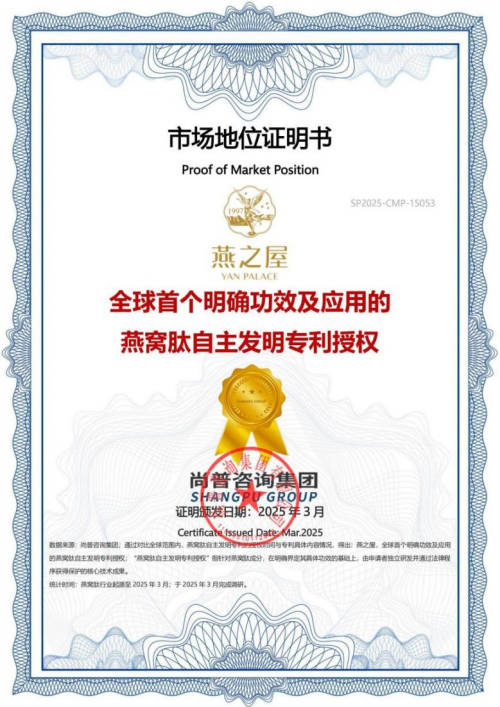
燕之屋获得“全球首个明确功效及应用的燕窝肽自主发明专利授权”认证
Zhong Guo Shi Pin Wang· 2025-05-11 13:44
Core Viewpoint - Yan Zhi Wu has received the "world's first patent authorization for the efficacy and application of bird's nest peptides," marking a significant advancement in the industry and establishing a benchmark for scientific validation and industrial transformation [1][11]. Group 1: Patent and Technology - The patent granted to Yan Zhi Wu is for a method of preparing bird's nest peptides that promote cell repair and provide high moisturizing and whitening effects (Patent No: ZL 2022 11398048.3) [1][4]. - The patented technology clarifies the enzymatic hydrolysis process of bird's nest peptides, revealing their properties such as moisturizing, whitening, and antioxidant effects, thus overcoming the industry's previous limitations of vague components and effects [3][4]. - The enzymatic hydrolysis process involves precise control to produce small molecular peptides with an average molecular weight of less than 1000 Da, enhancing the bioavailability of active ingredients [3][4]. Group 2: Research and Development - Yan Zhi Wu established a bird's nest peptide research center in January 2022, focusing on enzymatic technology, active ingredient research, and product development, achieving significant breakthroughs published in international journals [4]. - The company has received multiple industry awards, including the "Bird's Nest Peptide - Industry Innovation Award" in 2023, recognizing its contributions to the development of the bird's nest industry [4][5]. - In 2024, Yan Zhi Wu's bird's nest peptides were awarded the "Top 10 Chinese Innovative Raw Materials" and "Chinese Ace Ingredient Award," further solidifying its leadership in the field [4][8]. Group 3: Product Development - In 2022, Yan Zhi Wu launched its skincare brand "YAN PALACE," featuring small molecular bird's nest peptides as core ingredients, developing products like multi-effect facial masks and essence [8]. - The company was recognized by Frost & Sullivan as the "pioneer of bird's nest peptide skincare products" based on comparative research of Chinese skincare products [8][11]. - Yan Zhi Wu aims to provide healthier skincare experiences for women, promoting the concept of "bird's nest peptides advocating a new skin ecology" [8][9].

2025年中国男士护肤品行业概览:细分市场崛起,解锁男性护肤新蓝海(精华版)
Tou Bao Yan Jiu Yuan· 2025-05-09 12:23
Investment Rating - The report does not explicitly provide an investment rating for the men's skincare industry in China. Core Insights - The men's skincare market in China is rapidly growing, with a market size of approximately 170 billion yuan in 2024, representing a year-on-year growth of 17%. It is projected to reach 292 billion yuan by 2029, indicating significant potential for expansion [4][35][36]. Summary by Sections Industry Overview - The skincare market in China is characterized by diversification, precision, and technological advancement. The market is expected to grow from approximately 3,635 billion yuan in 2024 to 4,337 billion yuan by 2028, driven by e-commerce innovations, technological advancements, and a growing demand for natural ingredients [3][29][31]. Men's Skincare Market Insights - The men's skincare market is expanding due to changing social perceptions and increasing awareness among men regarding skincare. The market is diversifying with a variety of products, and the demand for functional products is on the rise. The market is expected to see a significant increase in high-end products [4][35][36]. Market Size - The men's skincare market in China is projected to grow to approximately 170 billion yuan in 2024, with a year-on-year growth rate of 17%. The market is expected to reach 292 billion yuan by 2029, with significant growth in categories such as masks and sunscreens [4][35][36]. Product Efficacy - The primary focus of men's skincare products is on moisturizing, cleansing, and oil control. The market is evolving towards more specialized and personalized products, with innovations in technology and formulation [38][40]. Brand Performance - In the online sales channels for men's skincare, platforms like Taobao and Douyin lead in sales. While foreign brands dominate the market, domestic brands are experiencing rapid growth, indicating a potential shift in the competitive landscape [5][35]. Consumer Demographics - The consumer base for men's skincare products is diverse, with a significant portion of male consumers aged 18-35 developing systematic skincare habits. The market is also seeing a rise in demand from older male consumers for advanced skincare solutions [35][43][46]. Development Trends - The market is witnessing a trend towards younger consumers, with an increasing number of males starting to use skincare products at a younger age. The popularity of natural ingredients is also on the rise, driven by the values of the younger generation [52][56].
618前,最会提问的主持人张泉灵拷问中国胶原蛋白
FBeauty未来迹· 2025-05-09 09:20
Core Viewpoint - The article discusses the competitive landscape of the collagen market in China, highlighting the success of domestic brand Chuangfukang, which has maintained stable prices for 23 years despite technological advancements and market pressures [2][5][14]. Market Background - The collagen market is on the brink of a "second explosion," with projections indicating that by 2027, the overall market size in China will reach 173.8 billion yuan [3]. - The rise of recombinant collagen has significantly contributed to market growth, with domestic companies breaking international barriers in collagen technology [3][5]. - The article emphasizes the importance of scientific communication in addressing consumer skepticism regarding price increases in collagen products [5][24]. Technological Breakthroughs - Chuangfukang, under Chuang'er Biotechnology, has made significant advancements in collagen extraction technology, reducing costs from 2,000 to 7,000 yuan per gram for imported collagen to a fraction of that for domestic products [3][12][19]. - The company has achieved FDA certification for its raw materials and has expanded its market reach to Europe, the U.S., and South Korea [3][5]. Challenges in Communication - The article identifies three main issues in the scientific communication of collagen products: homogenized messaging, lack of cost transparency, and a disconnect in consumer understanding of the medical benefits of collagen [5][24]. - Chuangfukang's low profile in the market has hindered broader consumer awareness of its technological breakthroughs [5][24]. Marketing and Consumer Engagement - The collaboration with the advertising agency Shizhi Xiang aims to address consumer concerns about pricing and technology through direct dialogue and transparency [6][8][24]. - The marketing strategy focuses on establishing trust through third-party validation and addressing sensitive pricing issues directly [24][26]. Brand Positioning - Chuangfukang's commitment to not raising prices for over two decades reflects its philosophy of making technological innovations accessible to a broader audience [14][19]. - The brand has achieved a high customer loyalty rate, with a 50% repurchase rate, attributed to its competitive pricing and product quality [20][22]. Conclusion - The article concludes that Chuangfukang's journey exemplifies the potential of domestic brands to innovate and maintain ethical pricing in a competitive market, emphasizing the need for effective communication strategies to enhance consumer trust and brand image [24][28].


贝泰妮(300957):战略调整持续,护肤彩妆双轮助力复苏
Shenwan Hongyuan Securities· 2025-05-05 10:11
Investment Rating - The report maintains a "Buy" rating for the company [1] Core Views - The company has released its 2024 annual report and Q1 2025 quarterly report, with performance slightly below market expectations. 2024 revenue was 5.736 billion yuan, a year-on-year increase of 3.87%, while net profit attributable to shareholders was 503 million yuan, a year-on-year decline of 33.53% [4][6] - In Q1 2025, revenue was 949 million yuan, a year-on-year decline of 13.51%, and net profit attributable to shareholders was 28 million yuan, a year-on-year decline of 83.97% [4][6] - The company plans to focus on brand building, member operations, and overall collaborative growth in 2025, with a strategic emphasis on sensitive skin products [6] Financial Data and Profit Forecast - The company’s total revenue for 2024 is projected at 5.736 billion yuan, with a forecasted revenue of 6.281 billion yuan for 2025, representing a year-on-year growth rate of 9.5% [5] - The net profit attributable to shareholders is expected to be 667 million yuan in 2025, with a projected growth rate of 32.6% [5] - The gross profit margin for 2024 was 73.7%, with an expected margin of 74.9% in 2025 [5] Operational Insights - The company’s skincare segment showed resilience despite pressure, with skincare revenue at 4.801 billion yuan in 2024, a year-on-year decline of 1.42% [6] - The makeup segment experienced significant growth, with revenue increasing by 226.51% to 551 million yuan, accounting for 9.60% of total revenue [6] - Online sales channels drove overall resilience, with revenue from online channels reaching 3.912 billion yuan, a year-on-year increase of 10.13% [6] Strategic Focus - The company is deepening its "Sensitive Skin PLUS" strategy, focusing on core products that enhance brand value and sales [6] - The brand matrix includes various sub-brands targeting specific demographics, such as infants and anti-aging products, to achieve precise market coverage [6] - The organizational restructuring is expected to bring positive changes, with a focus on high-end and mass-market segments [6]
九死一生的创业路:闪烁的“品牌人格化”生存笔记
混沌学园· 2025-04-30 12:00
" 如果有一天 PMPM 偏偏消失了,会有一群消费者为它的消失而落泪。 " " 这是我们坚持做下去的动力。 " 时垠集团创始人、 CEO 闪烁在混沌创新大课上讲道。 闪烁,前宝洁中国品牌总监, 2019 年创立时垠集团,旗下有三个护肤品牌: PMPM 偏偏、 DXV (定效维)和 NodOff 。 其中, PMPM 成立的第一 年就打造出 10 个爆品, 3 个登顶天猫类目 TOP1 ,短短 4 年销售额 40 亿,用户数突破 1000 万。 上个月,闪烁在混沌创新大课上分享了时垠的人格化品牌的构建方法论 ——"10 个外显因子 ""2 个价值传递 ""1 个内核选择 " 。 以下为课程精华笔记。 授课老师 | 闪烁 时垠集团创始人、董事长兼 CEO ,混沌学园三期校友 非常感谢各位在周六早上九点与我在混沌相聚,今天我将分享两个 " 思辨 " :一是创始人的个人使命对企业到底有何意义?特别是在如今流量竞争白热化 的时代,它是否仍具价值?二是我将坦诚分享一个独家方法论,叫做人格化品牌是如何诞生与成长的? 接下来,我们进入第一个环节,探讨创始人的个人使命对企业发展,尤其是对初创企业是否有意义? 为什么时垠在短短几 ...
丸美生物(603983):大单品持续高增,双品牌业绩亮眼
Shenwan Hongyuan Securities· 2025-04-29 13:43
Investment Rating - The report upgrades the investment rating to "Buy" for the company [1]. Core Insights - The company has shown strong performance with significant revenue growth driven by key products and brand strategies [6][5]. - The financial outlook remains positive with projected revenue and profit growth over the next few years [5][6]. - The company is focusing on optimizing its marketing strategies and enhancing product offerings to capture market share [6]. Financial Data and Profit Forecast - Total revenue for 2024 is projected at 2,970 million, with a year-on-year growth of 33.4% [5]. - The net profit attributable to the parent company for 2024 is expected to be 342 million, reflecting a growth of 31.7% [5]. - The gross margin for 2024 is forecasted at 73.7%, an increase of 3.01 percentage points compared to the previous year [6]. - The company anticipates a net profit of 438 million in 2025, with a year-on-year growth of 28.2% [5]. Revenue Breakdown - Revenue from eye care products reached 689 million, a year-on-year increase of 60.78% [6]. - Skincare products generated 1,125 million, growing by 21.60% year-on-year [6]. - The main brand, Marubi, achieved revenue of 2,055 million, up 31.69% year-on-year, while the sub-brand, Lianhuo, saw a 40.72% increase [6]. Marketing Strategy - The company is enhancing its marketing efforts around key products, participating in major online promotional events, and leveraging social media for brand engagement [6]. - The focus on big-ticket items and targeted marketing campaigns has resulted in significant brand visibility and consumer connection [6].

贝泰妮(300957):2024年年报、2025年一季报点评:营收稳健增长,利润略有承压
Minsheng Securities· 2025-04-29 07:24
Investment Rating - The report maintains a "Recommended" rating for the company, with a target price based on projected earnings growth and valuation metrics [4][5]. Core Insights - The company reported a revenue of 5.736 billion yuan for 2024, reflecting a year-on-year growth of 3.87%. However, the net profit attributable to shareholders decreased by 33.53% to 503 million yuan [2][5]. - The main revenue source is the brand "Winona," which saw a revenue decline of 5.45% to 4.909 billion yuan, while "Winona Baby" and "Aikeman" experienced significant growth of 34.03% and 65.59%, respectively [2][4]. - The gross margin for 2024 was 73.74%, with a slight decrease of 0.16 percentage points year-on-year. The net profit margin decreased by 4.93 percentage points to 8.77% [3][4]. Financial Performance Summary - Revenue projections for 2025, 2026, and 2027 are 6.285 billion yuan, 7.153 billion yuan, and 8.146 billion yuan, respectively, with growth rates of 9.6%, 13.8%, and 13.9% [5][7]. - The net profit attributable to shareholders is expected to recover to 700 million yuan in 2025, with a growth rate of 39.2%, followed by 856 million yuan in 2026 and 1.059 billion yuan in 2027 [5][7]. - The report indicates an increase in operating expenses, with sales, management, and R&D expense ratios rising significantly in recent quarters [3][4]. Brand Strategy and Market Position - The company is expanding its market presence with a multi-brand strategy, focusing on the main brand "Winona" and introducing new products in the sensitive skin segment [4]. - The launch of the "Winona 2.0" strategy aims to enhance brand positioning and product offerings, which is expected to drive long-term growth [4][5].
【产业升级】迪仕艾普DCEXPORT战略布局中药材上游,携手湖南九境堂共建“可溯源原料生态圈”
Cai Fu Zai Xian· 2025-04-27 03:34
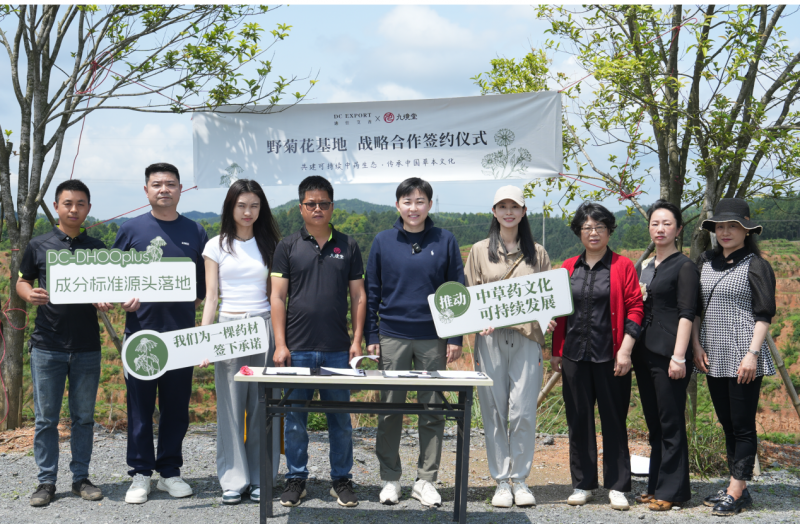
Core Viewpoint - The collaboration between DCEXPORT and Hunan Jiujingtang aims to modernize traditional Chinese herbal medicine cultivation and establish a traceability system for skincare ingredients, emphasizing a new approach to public welfare that benefits the country, industry, and consumers [1][3]. Group 1: Strategic Collaboration - DCEXPORT and Hunan Jiujingtang have signed a strategic cooperation agreement to focus on standardized cultivation of Chinese herbal medicine, building a traceability system for raw materials, and implementing a public welfare program to support farmers [1]. - The partnership is not merely a publicity stunt but a systematic approach to create long-term value for the country, industry, and consumers [3]. Group 2: Product Development - Through collaboration with Beijing Forestry University, a wild chrysanthemum with a Linarin content of 5.32% has been developed, significantly exceeding the Chinese Pharmacopoeia standard of 0.8%, making it a key ingredient in DCEXPORT's skincare system [2]. - The skincare products will ensure that every ingredient is traceable from breeding to extraction, promoting the idea that "natural does not equal effective, effective must also be credible" [4]. Group 3: Societal Impact - The initiative aims to transform barren land into medicinal herb bases, addressing employment issues for left-behind women and the elderly, thereby revitalizing land and retaining population [4]. - The project seeks to elevate traditional Chinese medicine skincare from vague concepts to standardized and transparent practices, integrating ancient medicinal properties with modern technology [4]. Group 4: Consumer Trust - The company emphasizes the importance of consumer awareness regarding the origins of skincare ingredients, highlighting the meticulous process from seed selection to manual harvesting [6]. - The initiative aims to build a "moat" for the Chinese skincare industry, fostering long-term trust with consumers through transparency and quality assurance [6].
干货分享!2025年中国功能性护肤品行业发展概况及未来投资前景分析报告(智研咨询)
Sou Hu Cai Jing· 2025-04-23 00:06
Industry Overview - The functional skincare market has become a dominant segment within the broader skincare industry, driven by increasing consumer awareness of skin issues and ingredient research [3][5] - Functional skincare products are designed for individuals with specific skin concerns, including whitening, anti-aging, sun protection, and hydration, often containing medicinal ingredients [1][5] Market Growth - The global functional skincare market is projected to grow from $35.3 billion in 2016 to $168 billion by 2024, while the Chinese market is expected to increase from 7.42 billion yuan to 48 billion yuan in the same period [5] - The demand for functional skincare products is fueled by the rise of ingredient-conscious consumers, sensitive skin populations, and post-aesthetic treatment recovery needs [3][5] Product Categories - Functional skincare products encompass three main categories: dermatological skincare, efficacy-driven skincare, and medical-grade skincare, with "pharmaceutical cosmetics" falling under dermatological skincare [5] - Professional skincare products are further divided into patch-based and non-patch-based forms, with patch-based products, such as masks, projected to grow from 2.38 billion yuan in 2017 to 19.34 billion yuan by 2024 [5] Industry Leaders - Companies like Huaxi Biological, Beitaini, and Juzhi Biological are recognized as industry leaders, driving development through innovation [9] Consumer Trends - The evolution of functional skincare reflects a dual pursuit of beauty and health, highlighting a growing consumer awareness of personal skincare needs [11]

披着国货外衣,在中国大赚特赚,这些潜伏的美国货,你知道几个?
Sou Hu Cai Jing· 2025-04-13 00:59
Group 1 - The US-China trade war has escalated, with the US increasing tariffs on Chinese products from an initial 34% to 145% [1] - Despite the trade tensions, many American-owned brands disguised as domestic products are thriving in the Chinese market [4] - Harbin Beer, often mistaken as a local brand, was acquired by the American company Anheuser-Busch in 2004 [3][8] Group 2 - Yida chewing gum, popular in China, is owned by the American company Wrigley, which entered the Chinese market in 1996 [11] - Other Wrigley products, such as Green Arrow, are also American brands that perform well in China [14] - Shuanghui Group, known for its hot dogs, was sold to American firms in 2007, with significant ownership by American investor Rothschild [18][22] Group 3 - Jinlongyu, a leading cooking oil brand in China, is part of the "Yihai Kerry" group, which is a joint venture involving the American company ADM [23][25][27] - Dabao, a well-known Chinese skincare brand, was acquired by Johnson & Johnson in 2008, despite its Chinese branding [29][33] - Procter & Gamble, an American company, owns several brands in China, including Head & Shoulders and Pampers, which are often perceived as domestic products [35]