低空经济

Search documents
天府新区低空经济公司投运 将从基础网络等五大维度发力
Sou Hu Cai Jing· 2026-01-28 11:27
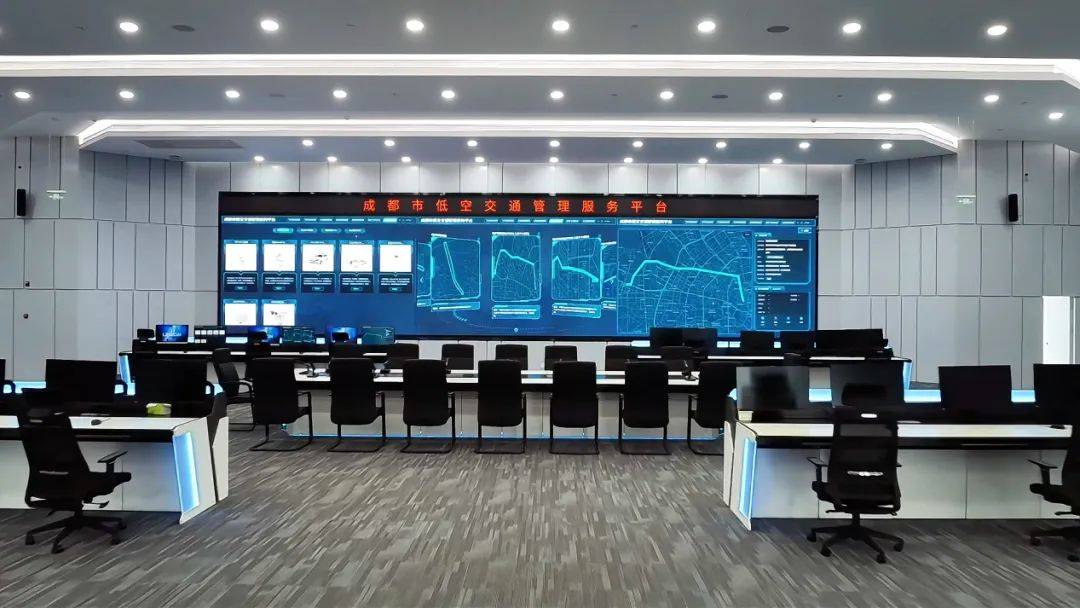
天府新区低空验证基地是新区低空经济发展的核心基础设施,用地近300亩,聚焦eVTOL(电动垂直起降飞行器)、无人机、直升机以及轻型固定翼飞机 等低空飞行器,开展测试验证、展销研学、场景示范、综合保障等全链条服务,主要建设测试验证中心、展销研学中心、场景示范中心、综合保障中心 等。 基地还配套空域协调、气象保障、数据监测等一站式服务,精准解决企业异地测试成本高、效率低等痛点,既是低空产品技术迭代的重要支撑,也是新区 构建低空经济安全保障体系的关键载体,将打造西部领先的低空综合测试验证公共服务平台。 基于此,低空经济公司将加快基地软硬件设施建设,完善测试验证配套服务体系,同步联动新区低空交通管理服务平台,为基地争取专属测试空域并实现 高效调度。公司将对接气象、航管等部门搭建一体化保障机制,解决企业测试核心诉求;联合科研院所、链主企业共建标准化测试验证体系,提升基地专 业服务能力。"我们还将以市场化思维开展基地运营,吸引低空雷达、无人机等领域企业入驻开展测试,推动基地从基础测试向技术研发、成果转化延 伸,打造集测试、认证、孵化于一体的标杆性测试验证平台。"低空经济公司相关负责人表示。 成都市低空交通管理服务平台 图 ...

贵州两会观察:山地贵州如何发展“低空经济”
Zhong Guo Xin Wen Wang· 2026-01-28 11:24
Core Viewpoint - The Guizhou provincial government is focusing on the development of low-altitude economy, including manufacturing of low-altitude flying vehicles, power systems, and aviation components, with projects like EHang Intelligent being prioritized for production [1] Group 1: Low-altitude Economic Development - Guizhou is leveraging its mountainous terrain and data-driven development to foster a new path for high-quality growth in low-altitude economy, integrating digital economy with unique local scenarios [2] - Since 2025, Guizhou has been systematically developing low-altitude economy, successfully testing eVTOL cross-city transport routes and offering low-altitude tourism services over scenic spots like the Huangguoshu Waterfall [2] - The province has a robust aviation equipment manufacturing technology support system, benefiting from historical "three-line construction," which provides a solid foundation for innovative development [2] Group 2: Infrastructure and Logistics - The development of diversified combinations such as "low-altitude + mountain logistics" and "low-altitude + mountain tourism" is gaining momentum, with suggestions to build standardized take-off and landing points in key areas [3] - A proposal to establish a "low-altitude equipment industry chain collaborative alliance" aims to integrate leading enterprises with upstream and downstream companies, universities, and research institutions for coordinated development [3] - The construction of a smart, three-dimensional modern logistics system is envisioned, utilizing drones for transporting medicines and emergency supplies, thereby addressing transportation bottlenecks and accumulating experience in low-altitude intelligent logistics [3] Group 3: Talent and Policy Support - Strengthening talent development is crucial, with recommendations to attract high-end talent through scientific and doctoral workstations, and to implement specialized training for low-altitude economy [4] - The "Guizhou Province Low-altitude Economy High-quality Development Three-Year Action Plan (2025-2027)" provides a detailed roadmap for the province's low-altitude economic growth [4] - The combination of successful project implementations and supportive policies is expected to empower Guizhou's low-altitude economy for significant advancement [4]
10万亿元投资背后的国资央企产业跃迁
Xin Hua Wang· 2026-01-28 10:37
Group 1 - The core investment of over 10 trillion yuan by central enterprises since the "14th Five-Year Plan" reflects their commitment to transitioning the industrial system towards high value-added and high-tech sectors, with the proportion of strategic emerging industries in total investment rising from 22% to over 40% [1] - By 2025, central enterprises are expected to invest 2.5 trillion yuan in strategic emerging industries, accounting for 41.8% of total investment, with a revenue scale exceeding 12 trillion yuan, achieving a consistent annual growth of 1 trillion yuan [2] - The focus on developing emerging industries is seen as a key strategic initiative, with plans for a new work document to guide central enterprises in cultivating new pillar industries and optimizing the overall layout of state-owned economy [2] Group 2 - Central enterprises are leading the upgrade of traditional industries, with initiatives including the establishment of 70 excellent smart factories and the promotion of AI applications across key sectors such as energy and manufacturing [3] - Enhancing the resilience of industrial and supply chains is a primary focus, with actions taken to ensure the safety of critical industries related to national security and public welfare [4] - The State-owned Assets Supervision and Administration Commission (SASAC) aims to create competitive industrial clusters in emerging fields such as renewable energy, aerospace, and quantum technology, emphasizing a strategy of concentration in investment and structural optimization [6]
2026赚钱新趋势:这些赛道正在悄悄崛起
Sou Hu Cai Jing· 2026-01-28 08:01
Group 1 - The aging population is not a burden but a major consumer force, with over 300 million elderly individuals possessing significant spending potential driven by their savings and desire for quality of life [2] - The digital divide presents both a challenge and a lucrative market opportunity, as services that help the elderly navigate technology are in high demand, leading to profitable business models [3] - Government policies are aligning with commercial interests, promoting community-based elderly care and smart health solutions, creating sustainable business models for those who understand the elderly market [4] Group 2 - The emergence of "prompt engineers" as a new profession highlights the importance of effectively utilizing AI tools for content creation and marketing, leading to significant cost savings for businesses [5] - AI-driven operations are revolutionizing content management for small and medium enterprises, allowing them to leverage AI for marketing and customer engagement without the need for large teams [6] - The ability to create personal brands using AI tools is transforming individual content creators into efficient operators, enabling them to manage multiple accounts and revenue streams [7] Group 3 - Blockchain technology is evolving beyond cryptocurrency, allowing for fractional ownership of assets like real estate and art, making investment opportunities accessible to the general public [9] - Personal data is becoming a new form of digital asset, with platforms enabling users to monetize their data by sharing it with companies for compensation [10] - A new investment logic is emerging that focuses on long-term value and real asset participation rather than short-term speculation, requiring a deeper understanding of technology and risk management [11] Group 4 - The low-altitude economy is transitioning from concept to reality, with eVTOL aircraft and drone services becoming viable business opportunities, particularly in logistics and surveillance [12] - The commercialization of space is creating new opportunities for entrepreneurs, such as custom space memorabilia and zero-gravity experiences, as costs decrease and accessibility increases [13] - Entering the space industry requires technical knowledge and compliance awareness, but offers high barriers to entry and potential for significant profits [14] Group 5 - Major platforms like Douyin, Alibaba, and Tencent are providing infrastructure, while smaller service providers are thriving by offering niche services that cater to specific consumer needs [15] - Individuals can leverage their skills in specific areas and utilize SaaS tools to create profitable ventures, emphasizing the importance of specialization and resourcefulness [16] - The fundamental human needs for health, respect, companionship, and value realization remain constant, and businesses that address these needs will have lasting viability [17]

低空经济公司正式投运!天府新区低空经济发展迈入新阶段
Sou Hu Cai Jing· 2026-01-28 05:04
Core Insights - Sichuan Tianfu Low-altitude Economic Industry Investment Development Co., Ltd. officially commenced operations on January 26, focusing on the development of low-altitude economic industries in Tianfu New Area [1] - The company aims to establish a robust foundation for high-quality development in the low-altitude economy through five dimensions: basic network, application ecology, industrial cluster, financial support, and innovative environment [1] Group 1: Low-altitude Power Industrial Park - The Low-altitude Power Industrial Park is located in the Tianfu New Area Aviation Power Science and Technology Innovation Zone, covering approximately 3,000 acres [1] - The park will focus on five major industries: aviation engines, drones, avionics, and control systems, with an emphasis on turbine engines, fixed-wing drones, and 3D additive manufacturing [1] - The park's layout will include a "one core and five zones" functional structure, with the core being a technology innovation hub led by a national laboratory [1] Group 2: Integration of Policies and Industry - The company will integrate provincial, municipal, and district-level policy benefits to provide full-cycle support for enterprises, promoting deep integration of industry, academia, and research [2] - The focus will be on accelerating the landing of signed projects and enhancing project continuity capabilities, creating a structured project development framework [2] - The goal is to establish a low-altitude power industrial cluster in Southwest China, attracting key projects to strengthen the industry chain [2] Group 3: Low-altitude Verification Base - The Tianfu New Area Low-altitude Verification Base is a core infrastructure for low-altitude economic development, covering nearly 300 acres [3] - The base will focus on testing and validating eVTOLs, drones, helicopters, and light fixed-wing aircraft, providing comprehensive services including testing centers and scenario demonstration [3] - The company plans to enhance the base's facilities and services, aiming to create a leading public service platform for low-altitude testing and verification in the western region [3] Group 4: Policy and Strategic Development - Low-altitude economy has been highlighted in government work reports for 2024 and 2025 as a key strategic emerging industry [5] - The National Development and Reform Commission has outlined a development guideline for low-altitude economy, emphasizing a phased approach to applications and risk control [5] - The company will respond to the call for establishing Chengdu as a comprehensive pilot for low-altitude economy, focusing on infrastructure and application expansion [5]
图解政府工作报告2:改革创新 展现自贸港新气象
Hai Nan Ri Bao· 2026-01-28 04:11
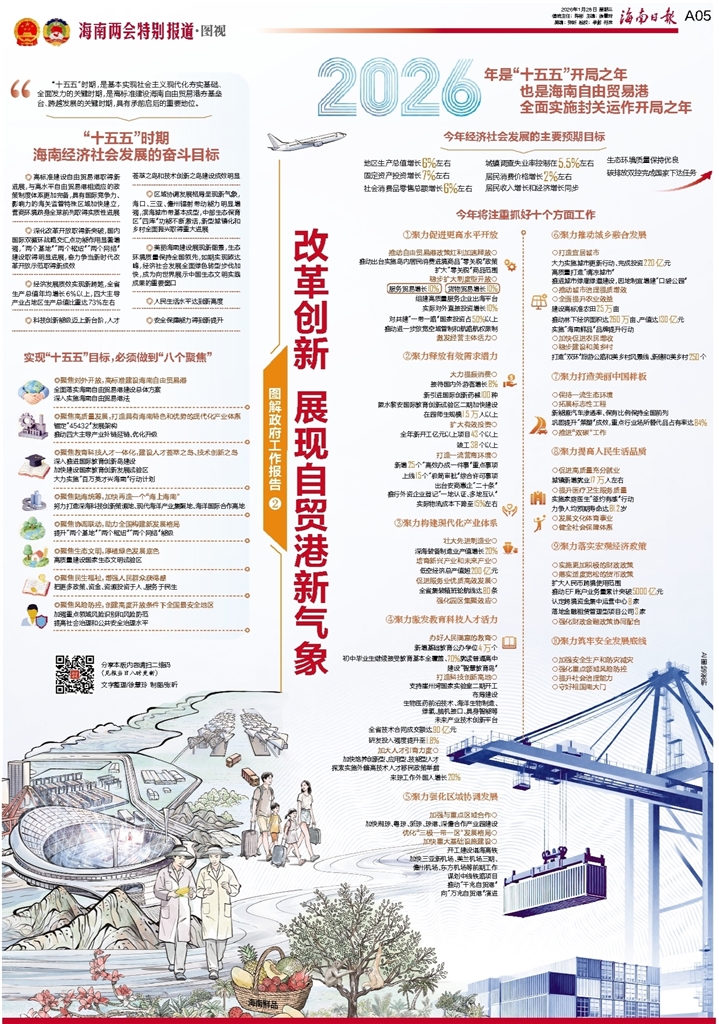
AI图绘/张昕 "十五五"时期,是基本实现社会主义现代化夯实基础、全面发力的关键时期,是高标准建设海南自 由贸易港夯基垒台、跨越发展的关键时期,具有承前启后的重要地位。 "十五五"时期 海南经济社会发展的奋斗目标 ◎高标准建设自由贸易港取得新进展,与高水平自由贸易港相适应的政策制度体系更加完备,具有 国际竞争力、影响力的海关监管特殊区域加快建立,营商环境跻身全球前列取得实质性进展 ◎深化改革开放取得新突破,国内国际双循环战略交汇点功能作用显著增强,"两个基地""两个枢 纽""两个网络"建设取得明显进展,奋力争当新时代改革开放示范取得新成效 ◎经济发展质效实现新跨越,全省生产总值年均增长6%以上,四大主导产业占地区生产总值比重 达73%左右 ◎科技创新能级迈上新台阶,人才荟萃之岛和技术创新之岛建设成效明显 ◎区域协调发展格局呈现新气象,海口、三亚、儋州辐射带动能力明显增强,滨海城市带基本成 型,中部生态保育区"四库"功能不断激活,新型城镇化和乡村全面振兴取得重大进展 ◎美丽海南建设展现新图景,生态环境质量保持全国领先,如期实现碳达峰,经济社会发展全面绿 色转型步伐加快,成为向世界展示中国生态文明实践成果的重要窗 ...
地方两会图景:从政府报告里看甘肃开局之年高质量发展
Zhong Guo Fa Zhan Wang· 2026-01-28 04:00
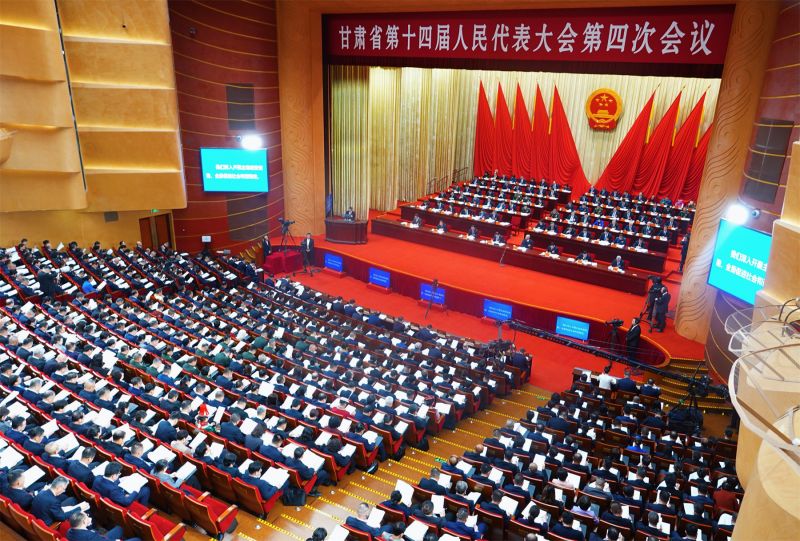
Core Viewpoint - Gansu Province aims for high-quality development in 2026, setting a GDP growth target of approximately 5.5% and ensuring grain production remains above 13 million tons, while focusing on ecological governance and public welfare projects [1][3]. Economic Development - Gansu will enhance traditional industries such as non-ferrous metallurgy, petrochemicals, and equipment manufacturing, while also fostering new sectors like data centers, biomedicine, and commercial aerospace [3]. - Investment and consumption will be key drivers, with significant infrastructure projects including multiple railway constructions and airport developments planned [3]. Cultural and Tourism Development - Gansu will leverage its historical and natural resources to enhance cultural heritage protection and promote deep integration of culture and tourism, aiming for a year-round development model [4]. Regional Coordination - Lanzhou is positioned as a core city to drive technological innovation and industrial renewal, with the "Lan-Bai" economic circle expected to stimulate growth in surrounding areas [5]. - The Hexi Corridor economic belt will focus on green growth through renewable energy and modern agriculture, while the southeastern region will emphasize industrial and cultural tourism [5][6]. Ecological Protection - Gansu will prioritize ecological protection, with ongoing efforts in the Qilian Mountains and key ecological projects, aiming to complete 12.65 million acres of land greening [7]. - The government has outlined ten public welfare projects for 2026, including educational support and healthcare initiatives, to improve the quality of life for residents [7][8].
早盘直击|今日行情关注
申万宏源证券上海北京西路营业部· 2026-01-28 02:45
Core Viewpoint - The market is currently experiencing a narrow range of fluctuations, with a divergence in individual stock performances, indicating a potential shift from theme-driven to fundamental-driven market dynamics, while technology growth remains the main focus [1] Group 1: Market Overview - The index continued to fluctuate within a narrow range, with over 3,400 stocks declining and only about 1,900 stocks rising, indicating a significant divergence in stock performance [1] - The total trading volume on Tuesday was 2.9 trillion yuan, which is more than a 10% decrease compared to Monday, reflecting a notable contraction in market activity [1] - Since the end of the continuous rise on January 13, the index has entered a period of adjustment, characterized by a relatively mild overall adjustment range [1] Group 2: Future Outlook - The market is expected to shift from theme-driven momentum to a focus on fundamentals, with technology growth remaining the primary driver [1] - The main driving factors for the spring market are anticipated to be an increase in market risk appetite, with future hotspots likely to be technology growth sectors supported by fundamentals [1] - Key sectors to watch include semiconductors, batteries, AI hardware, and innovative pharmaceuticals, which are expected to benefit from this shift [1] Group 3: Hot Sectors - In January, technology and raw material price increases are expected to dominate, with a strong likelihood of technology growth sectors outperforming [2] - Short-term catalysts such as commercial aerospace, brain-computer interfaces, and low-altitude economy are expected to maintain investor interest [2] - The rise in raw material prices, particularly in small metals, energy metals, and new chemical materials, is seen as a derivative opportunity from the technology investment boom [2] Group 4: Specific Trends - The trend in AI hardware is firmly established, with a continuous increase in the token usage of major AI models, indicating a peak in AI applications expected by 2026 [2] - The domestic production of robots and their integration into daily life is a confirmed trend for 2026, with opportunities arising in sensors, controllers, and dexterous hands [2] - The trend towards semiconductor localization is ongoing, with a focus on semiconductor equipment, wafer manufacturing, semiconductor materials, and IC design [2] - The demand for new energy materials is rapidly increasing due to domestic and overseas energy storage needs, with signs of supply shortages and price increases expected to continue until 2026 [2] - Innovative pharmaceuticals are entering a recovery phase after nearly four years of adjustment, with positive net profit growth for four consecutive quarters since Q3 2024, and a fundamental turning point expected in 2025 [2]

全国首个“万亿城区”诞生 深圳南山“为什么能”?
Xin Hua She· 2026-01-28 02:31
Group 1 - Nanshan District in Shenzhen is set to become the first district in China with a GDP exceeding 1 trillion yuan by 2025, contributing approximately 25% to Shenzhen's overall economy despite occupying only 10% of its land area [1] - The strategic emerging industries in Nanshan account for 60% of its economic output, with over 200 listed companies, showcasing its robust economic dynamism [1][2] - The software and internet industry in Nanshan is projected to generate over 900 billion yuan in revenue by 2025, reinforcing its competitive advantage in industrial clustering [2] Group 2 - The continuous optimization of the business environment is a key factor in Nanshan's development as a "trillion district," with local government initiatives supporting startups and innovation [3][4] - The number of business entities in Nanshan has grown from 530,000 in 2020 to over 600,000 by 2025, and the number of listed companies increased from approximately 180 to 218 during the same period [4] - Nanshan's government has implemented a "six-in-one" action plan to support entrepreneurs, providing comprehensive services to facilitate innovation and entrepreneurship [3] Group 3 - Nanshan is focusing on industrial upgrades and the development of smart, green, and healthy industries, with plans to enhance its hardware support through projects like the Honghuailing Industrial Park [6] - The establishment of a regional venture capital fund with a target size of 50.45 billion yuan aims to support the development of new productive forces in the Guangdong-Hong Kong-Macao Greater Bay Area [7] - Nanshan's foreign trade import and export volume exceeded 900 billion yuan in 2025, highlighting its role as a significant player in international trade [9]
行稳致远开新局丨连续领跑37年,“再造一个新广东”底气何在?
Yang Guang Wang· 2026-01-28 01:56
Core Viewpoint - Guangdong is leveraging its strengths in innovation and infrastructure to drive economic growth and development, particularly in the context of the "14th Five-Year Plan" and the upcoming "15th Five-Year Plan" [2][28]. Economic Development - Guangdong's GDP has crossed significant milestones, reaching 14 trillion yuan by 2025, maintaining its position as the top economy in China for 37 consecutive years [6][14]. - The province's trade volume reached 9.49 trillion yuan in 2025, marking a 4.4% year-on-year increase, contributing 24.1% to the national foreign trade growth [21]. Innovation and Technology - Guangdong has established over 10 major national scientific research infrastructures, ranking third in the country, to enhance original innovation capabilities [13]. - R&D expenditure in Guangdong increased from 380 billion yuan in 2021 to 535 billion yuan by 2025, with the province leading in various innovation metrics for nine consecutive years [14]. Low-altitude Economy - The low-altitude economy in Guangdong is rapidly developing, with over 15,000 related enterprises and a market share of 95% for consumer drones [9]. - The province is working towards creating a comprehensive low-altitude economic network, facilitating applications in logistics and tourism [7][9]. Regional Integration - The construction of major infrastructure like the Hong Kong-Zhuhai-Macao Bridge has significantly improved connectivity within the Guangdong-Hong Kong-Macao Greater Bay Area, creating a "one-hour living circle" [15][17]. - Guangdong is enhancing regulatory alignment and cooperation with Hong Kong and Macao, facilitating smoother cross-border operations and business activities [17][21]. Agricultural Modernization - The "Hundred Counties, Thousand Towns, and Ten Thousand Villages" initiative is being implemented to promote high-quality agricultural development, with local specialties like the Jin You fruit significantly boosting farmers' incomes [22][23]. - Technological advancements in agriculture are attracting younger generations back to rural areas, transforming traditional farming practices [22][24]. Future Outlook - Guangdong aims for an average GDP growth of around 5% annually over the next five years, focusing on high-quality development and improved regional coordination [28]. - The province is positioned to capitalize on the "dual-zone" effect, enhancing its role in global supply chains through deeper cooperation with Hong Kong and Macao in various sectors [27][28].