AI

Search documents
海外市场持续动荡,A股如何应对?十大券商策略来了
Sou Hu Cai Jing· 2026-02-01 11:56
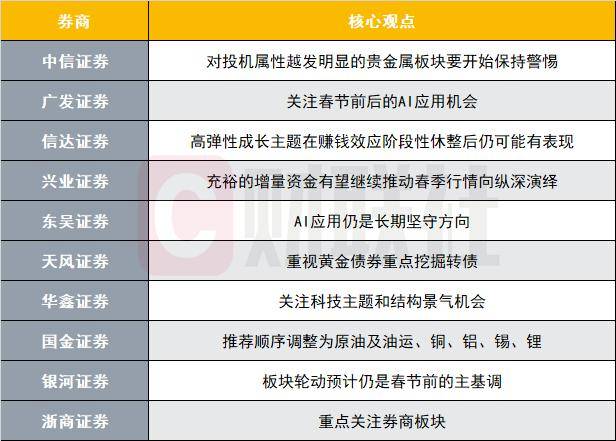
Group 1: Precious Metals and Market Trends - The precious metals sector is showing increasing speculative attributes, warranting caution [2] - The current market is experiencing a style shift from small-cap to large-cap stocks and from themes to quality [2] - The overall trend indicates a potential for profit margin recovery in cyclical sectors, driven by a shift in Chinese policy from expansion to quality improvement [2] Group 2: AI and Technology Opportunities - There is a focus on AI applications and energy storage as key growth areas, with expectations for recovery in lithium battery materials and storage sectors [3] - The AI industry remains a long-term focus, with significant policy support and market optimism surrounding its applications [5] - The technology theme, including AI applications and structural recovery opportunities, is highlighted as a key area for investment [7] Group 3: Spring Market Dynamics - The spring market is expected to continue its upward trend, supported by ample liquidity and positive domestic fundamentals [5] - High elasticity growth themes may still perform well after a phase of profit-taking, with potential for further gains in February [4] - Sector rotation is anticipated to be a dominant theme leading up to the Spring Festival, with a focus on structural opportunities [9] Group 4: Commodity Recommendations - A recommendation has been made to adjust the order of investment focus to include crude oil, copper, aluminum, tin, and lithium, reflecting a shift towards industrial pricing [8] - The emphasis on physical assets is expected to strengthen, with a focus on sectors like chemicals and consumer goods benefiting from domestic recovery [8] Group 5: Market Sentiment and Future Outlook - The market sentiment remains cautious but optimistic, with expectations for continued support from domestic policies and liquidity [5][6] - The potential for structural recovery in manufacturing and resource sectors is noted, with clear paths for profit recovery [9] - The upcoming credit and inflation data in January may provide additional positive signals for the market [4]




基础化工行业研究:多产品涨价,继续看好大化工板块投资机会
SINOLINK SECURITIES· 2026-02-01 10:34
Investment Rating - The report maintains a positive outlook on the chemical industry, suggesting to focus on leading companies and those experiencing price increases from the bottom [2][3] Core Insights - The chemical market experienced fluctuations, with the Shenwan Chemical Index declining by 0.86%, underperforming the CSI 300 Index by 0.94%. However, price increases were noted in various products, including dyes and para-nitrochlorobenzene, driven by the cancellation of export tax rebates, which accelerated export activities [2] - The AI industry shows strong demand, positively impacting the entire supply chain. Notable performances include ASML's Q4 results, which exceeded expectations, and SK Hynix's Q4 operating profit doubling year-on-year, marking the strongest performance in history [2] - The real estate sector is stabilizing as the "three red lines" policy ends, indicating a healthier market moving forward [2][3] Summary by Sections Chemical Market Overview - The chemical market saw a mixed performance, with the Shenwan Chemical Index down 0.86% while the CSI 300 Index rose 0.08%. The textile chemical products sector led gains with a 14.33% increase [11][12] - Key price movements included a rise in disperse dyes to an average of 19 CNY/kg and reactive dyes to 23 CNY/kg, reflecting a 5.56% and 4.55% increase respectively [3][29] AI Industry Developments - The AI sector is witnessing robust growth, with major players like ByteDance and Alibaba planning to launch new AI models around the Spring Festival, and significant investments in AI and cloud computing expected to rise from 380 billion CNY to 480 billion CNY over the next three years [2][4] Real Estate Sector Changes - The end of the "three red lines" policy is expected to lead to a more stable and resilient real estate market, as risks from the previous cycle are gradually cleared [3][4] Price Trends in Key Chemical Products - The report highlights significant price increases in various chemical products, with disperse dyes and reactive dyes showing notable upward trends due to rising raw material costs and limited supply [29][30] - The report also notes that the PA66 market is experiencing upward pressure, with prices rising to 14,954 CNY/ton, reflecting a 0.48% increase [33][34]
2026全球IPO展望:资本流向、市场选择与估值范式 | 氪睿研究院
Sou Hu Cai Jing· 2026-02-01 09:23
Core Insights - The global IPO market is showing signs of recovery in 2026, with an increase in listing projects across multiple exchanges, particularly in AI, hard technology, energy, and advanced manufacturing sectors, indicating a potential restoration of risk appetite in capital markets [1][2] - However, this IPO wave does not align with typical characteristics of past cyclical recoveries, as the types of companies successfully pursuing IPOs have significantly changed [2][4] Changes in Company Types - Companies that can successfully advance to IPOs are now concentrated in a few high-capital-density industries with long investment cycles and strong policy connections, while many light-asset and narrative-driven companies remain outside the listing doors [2][4] Shifts in IPO Pricing Logic - The pricing logic for IPOs is shifting from a focus on "growth potential" to prioritizing strategic necessity, cash flow verifiability, and long-term capital sustainability due to high interest rates and geopolitical factors [3][11] - This indicates a transition of IPOs from a "market reward mechanism" to a strategic asset selection and pricing mechanism [4][15] Strategic IPOs - A new category of "strategic IPOs" is emerging, characterized by companies that are critical to industry chains, have capital-intensive operations with verifiable cash flow paths, and are closely tied to national development goals or global industrial patterns [12][14] - The existence of these companies is deemed essential, leading to a higher threshold for IPO eligibility, as capital markets now differentiate between "replaceable product innovation" and "irreplaceable system capabilities" [14][15] Market Differentiation - The 2026 IPO landscape is not a uniform recovery but rather a highly differentiated and selective return, with capital becoming more concentrated and cautious [4][16] - Different markets are pricing entirely different types of assets, reflecting their unique industrial structures, policy goals, and capital systems [17][18] Regional Insights - In the U.S. market, IPOs are focused on "future infrastructure" pricing, with companies embedded in national or global systems receiving significant premiums [20][21] - In China, IPOs serve as an extension of industrial policy rather than a reflection of market sentiment, with a focus on companies that align with long-term industrial frameworks [21][22] - Emerging markets like India are selling long-term options based on population and digital penetration, with a different pricing logic compared to the U.S. and China [22][29] Conclusion - The 2026 IPO market represents a structural reset rather than a mere emotional recovery, emphasizing the need for companies to demonstrate long-term viability and strategic importance to be recognized as worthy of public capital [75][81]

Here’s What Analysts Are Saying About The Western Union Company (WU)
Insider Monkey· 2026-02-01 07:38
Core Insights - Artificial intelligence (AI) is identified as the greatest investment opportunity of the current era, with a strong emphasis on the urgency to invest now [1][13] - The energy demands of AI technologies are significant, with data centers consuming as much energy as small cities, leading to concerns about power grid capacity and rising electricity prices [2][3] Investment Opportunity - A specific company is highlighted as a critical player in the AI energy sector, owning essential energy infrastructure assets that are poised to benefit from the increasing energy demands of AI [3][7] - This company is not a chipmaker or cloud platform but is positioned as a "toll booth" operator in the AI energy boom, collecting fees from energy exports and benefiting from the onshoring trend driven by tariffs [5][6] Financial Position - The company is noted for being debt-free and holding a significant cash reserve, amounting to nearly one-third of its market capitalization, which positions it favorably compared to other energy firms burdened by debt [8][10] - It also has a substantial equity stake in another AI-related company, providing investors with indirect exposure to multiple growth opportunities without the associated premium costs [9] Market Trends - The article discusses the broader trends of AI, energy, tariffs, and onshoring, indicating that this company is strategically aligned with these developments [6][14] - The influx of talent into the AI sector is expected to drive continuous innovation and advancements, reinforcing the potential for growth in AI investments [12] Future Outlook - The company is positioned at the heart of America's next-generation power strategy, particularly in nuclear energy, which is seen as a clean and reliable power source for the future [7][14] - The potential for significant returns is emphasized, with projections suggesting a possible 100% return within 12 to 24 months for investors who act quickly [15][19]


X @Bloomberg
Bloomberg· 2026-01-31 00:38
Nvidia’s negotiations to invest as much as $100 billion in ChatGPT maker OpenAI have broken down, the Wall Street Journal reported, exposing a potential rift between two of the most powerful companies in the AI industry https://t.co/QtiXI9xBCN ...

FRMI INVESTOR REMINDER: Fermi Inc. Investors Have Until March 6, 2026 To Seek Lead Plaintiff Role - Contact Kirby McInerney LLP
Globenewswire· 2026-01-30 23:00
Core Viewpoint - A class action lawsuit has been filed against Fermi Inc. for allegedly misleading investors regarding tenant demand and funding commitments for its Project Matador campus, leading to significant financial losses for shareholders [4]. Group 1: Lawsuit Details - The lawsuit is on behalf of investors who purchased securities from September 28, 2025, to December 11, 2025, alleging that Fermi overstated tenant demand and the reliance on a single tenant's funding for Project Matador [4]. - The lawsuit claims there was a significant risk that the primary tenant would terminate its funding commitment, which ultimately occurred [4]. Group 2: Financial Impact - Fermi began trading on NASDAQ at $21.00 per share on October 1, 2025, but after the announcement of the termination of a $150 million funding agreement on December 12, 2025, the share price dropped by $5.16, or approximately 33.8%, closing at $10.09 [5].


Web3行业的转型执行者:从传统金融转型至挖矿,再到AI人工智能
国投证券(香港)· 2026-01-30 14:05
Core Insights - The report highlights the transformation of traditional financial companies into AI data centers and GPU cloud service providers, particularly in the context of cryptocurrency mining companies like Hut 8 and IREN Limited transitioning to AI services due to declining Bitcoin profits and increasing AI computing demands [1] - CANG.US has successfully transitioned to a Web3 mining company while simultaneously initiating AI development, recognized for its strong execution capabilities and high operational efficiency [1][2] - The company has adopted a financing model based on "electricity loans," using Bitcoin as collateral to secure funding for electricity payments, with a competitive interest rate of approximately 7.5% [1] Company Transformation - CANG.US, originally an automotive finance service platform, transitioned to Bitcoin mining by divesting all its China-based operations by May 2025, retaining only a minor used car export service [2] - The company invested $256 million in acquiring second-hand Antminer S19 XP series mining machines, achieving a total hash rate of 50 EH, ranking it among the top Bitcoin mining companies globally [2][3] - The mining equipment is distributed globally, with approximately 60% located in the U.S. and the remainder in countries like Paraguay and Oman, demonstrating a strategic focus on cost-effective and readily available mining technology [2] Bitcoin Mining Operations - CANG.US's mining operations rely heavily on electricity costs, which constitute the largest expense, with a cash cost of $81,072 per Bitcoin as of Q3 [3] - The company has implemented a pricing mechanism in its electricity contracts to protect against low theoretical returns, ensuring operational sustainability [3] - The mining business is characterized by a simple model where profitability is primarily influenced by Bitcoin prices and electricity costs, with the company focusing on cost control and waiting for price increases to secure profits [3] AI Transition Strategy - The company is advancing its transition from Bitcoin mining to AI, having initiated several pilot projects in AI computing and green energy in Q4 2025, with a focus on developing AI business in 2026 [9] - The strategic plan includes a three-step approach, maintaining Bitcoin mining as a foundational business while simultaneously investing in AI [9] Financial and Financing Situation - Significant changes in the balance sheet include a reduction in other receivables due to asset disposals and an increase in long-term receivables reflecting the fair value of Bitcoin collateral [10] - The financing structure is centered around electricity loans, with a long-term debt of $400 million, and the company employs a dual leverage strategy based on computing power and operations [12] Shareholder Structure and Governance - The shareholder structure is relatively dispersed, with significant holdings by early investors and new strategic partners, while the largest voting rights are held by Enduring Wealth Capital Limited (EWCL) [13][14] - The company has a dual-class share structure to ensure control remains with experienced industry players, facilitating the transition to new business areas [14]

帮主郑重:1月A股深V收官!2月震荡行情,这3个方向闭眼抄作业?
Sou Hu Cai Jing· 2026-01-30 13:37
Group 1 - The overall performance of the A-share market in January showed a 3.76% increase in the Shanghai Composite Index, stabilizing above 4100 points despite significant volatility [3] - The market experienced a deep V-shaped reversal, indicating strong resilience, with a notable rebound after an early morning drop [3] - Key factors for the market's recovery included the absence of panic selling in broad-based ETFs and the strength of technology and agriculture sectors [3][4] Group 2 - February is expected to be a volatile month with structural opportunities rather than broad market rallies, as performance will depend on earnings rather than just speculation [4] - Focus areas for investment include the external demand cycle, particularly in manufacturing sectors like electrical equipment and engineering machinery, which are benefiting from global recovery [4] - The AI industry is highlighted as a key investment area, with a shift towards focusing on companies with actual performance in critical segments like computing power and storage [4] - Traditional industries such as chemicals are also noted for potential gains due to improved competitive dynamics and pricing power [4] - Practical advice for February includes maintaining a position of 30-50% in the market, with key support levels identified around 4090-4100 points for potential buying opportunities [4]

复盘AI大厂的2025年:4.5亿存量搏杀下的生死突围
Mei Ri Jing Ji Xin Wen· 2026-01-30 07:30
Group 1 - The core viewpoint of the article highlights that four major AI companies—Tencent, Baidu, ByteDance, and Alibaba—are collectively launching initiatives during the Spring Festival, including red envelope promotions, gala collaborations, and new features, reflecting the competitive landscape of the AI industry by 2025 [1] Group 2 - The article notes that there is a significant differentiation in the user landscape of domestic AI applications by 2025, as revealed by exclusive data from QuestMobile [1] - It raises questions about whether the marketing strategies effective in the mobile internet era will still hold relevance in the AI era [1]



AI视频的“1毛钱战争”与“万亿生意”
创业邦· 2026-01-30 06:07
Core Insights - The article discusses the rapid evolution of AI video technology, highlighting the competitive landscape between companies like ByteDance's Jimo AI and Kuaishou's Keling AI, which are racing to innovate and capture market share in the burgeoning AI video sector [5][11][12]. Group 1: AI Video Technology Advancements - AI video technology is iterating quickly, with companies releasing new models and features at an unprecedented pace, such as PixVerse's project that generates videos based on user prompts and Runway's Gen 4.5 model that mimics professional cinematography [5][7]. - The competition is fierce, with companies like Jimo AI and Keling AI undergoing multiple iterations of their core products, indicating a "gold rush" mentality in the AI video space [9][11]. - The advancements in AI video capabilities are expected to extend beyond short videos to include longer formats like dramas and films, potentially leading to a significant market explosion [9][11]. Group 2: Differentiation in Product Strategy - Jimo AI focuses on optimizing its multi-modal model, Seedance, which supports various content types, while Keling AI emphasizes refining its video generation model for better user experience [16][20]. - The two companies have adopted different approaches: Jimo aims for technological breakthroughs, while Keling prioritizes product innovation and user control features [22][31]. - Jimo's strategy has resulted in a much larger user base, with 20.37 million monthly active users compared to Keling's 4.5 million, showcasing the effectiveness of its approach [28]. Group 3: Financial Performance and Market Position - Keling AI's revenue is primarily driven by professional creator subscriptions, with a projected annual revenue of 1 billion yuan, while Jimo AI has yet to break the 100 million yuan mark in annual recurring revenue [37][39]. - The article notes that Keling's business model is more focused on immediate revenue generation, while Jimo is investing heavily in long-term growth potential [32][41]. - Jimo's aggressive pricing strategy, with video generation costs as low as 0.1-0.19 yuan per video, contrasts sharply with Keling's higher costs, which can reach 1.25-1.5 yuan per video [44]. Group 4: Challenges and Future Outlook - Despite the rapid advancements, the AI video generation market faces challenges, including high production costs and low user retention rates for some products [35][33]. - The article suggests that while Keling has established a solid user base, the long-term potential for Jimo could be significantly larger, with estimates suggesting a market size ten times that of its current operations [41][42]. - The future of AI video generation remains uncertain, with both companies navigating different strategies to capture market share and adapt to evolving consumer needs [50].