专用设备

Search documents
股东户数降幅榜:34股最新股东户数降逾一成
Zheng Quan Shi Bao Wang· 2025-12-31 09:07
证券时报•数据宝对上一期(12月10日)筹码集中股监测显示,这些股12月1日以来平均上涨0.27%,走势弱于同期沪指表现(上涨2.06%),其中, 30%的筹码集中股相对大盘获超额收益。 上期股东户数降逾一成个股中,久之洋涨幅最高,12月1日以来累计上涨58.86%,涨幅居前的还有北京君正、新金路等。 34股最新股东户数降逾一成 证券时报•数据宝统计显示,共有974只个股公布了12月20日股东户数,与上期(12月10日)相比,股东户数下降的有575只。其中股东户数降幅超 一成的有34只。 股东户数降幅最多的是福蓉科技,截至12月20日最新股东户数为61763户,较12月10日下降25.72%,筹码集中以来该股累计下跌19.44%,累计换 手率为78.15%,其间主力资金净流出2.72亿元。 (原标题:股东户数降幅榜:34股最新股东户数降逾一成) 974只股公布截至12月20日最新股东户数,相比上期股东户数下降的有575只,降幅居前的是福蓉科技、福晶科技、力聚热能等。 投资者除了在定期报告中获得股东信息数据外,还可以在交易所互动平台上通过提问方式了解部分公司更及时(每月10日、20日、月末)的股东 户数信息。以 ...


德固特涨0.04%,成交额6170.82万元,今日主力净流入-47.71万
Xin Lang Cai Jing· 2025-12-31 08:22
Core Viewpoint - The company, Qingdao Degute Energy Equipment Co., Ltd., is focusing on energy-saving and environmental protection equipment, with significant advancements in carbon neutrality, waste treatment, and hydrogen energy sectors, benefiting from the depreciation of the RMB. Group 1: Company Overview - Qingdao Degute was established on April 5, 2004, and went public on March 3, 2021, specializing in the design, manufacturing, and sales of energy-saving and customized equipment [8] - The company's main business revenue composition includes energy-saving heat exchange equipment (76.84%), equipment maintenance and modification (8.40%), and other environmental protection equipment (5.27%) [8] Group 2: Technological Advancements - The company has developed a high-temperature air preheater for gasification, which can increase production by 45% and save fuel by 9.3%-13.2% while reducing carbon emissions [2] - The company has entered the hydrogen energy production sector, providing energy-saving heat exchange and storage equipment, and possesses the design qualifications for pressure vessels [2] Group 3: Market Position and Recognition - The company has been recognized as a "specialized, refined, distinctive, and innovative" small giant enterprise, which is a prestigious title for small and medium-sized enterprises in China [3] - As of the 2024 annual report, overseas revenue accounts for 59.28% of total revenue, benefiting from the depreciation of the RMB [4] Group 4: Financial Performance - For the period from January to September 2025, the company reported a revenue of 382 million yuan, a year-on-year decrease of 9.29%, and a net profit attributable to shareholders of 72.26 million yuan, down 26.39% year-on-year [9] - The company has distributed a total of 87.67 million yuan in dividends since its A-share listing, with 67.67 million yuan distributed in the last three years [10]
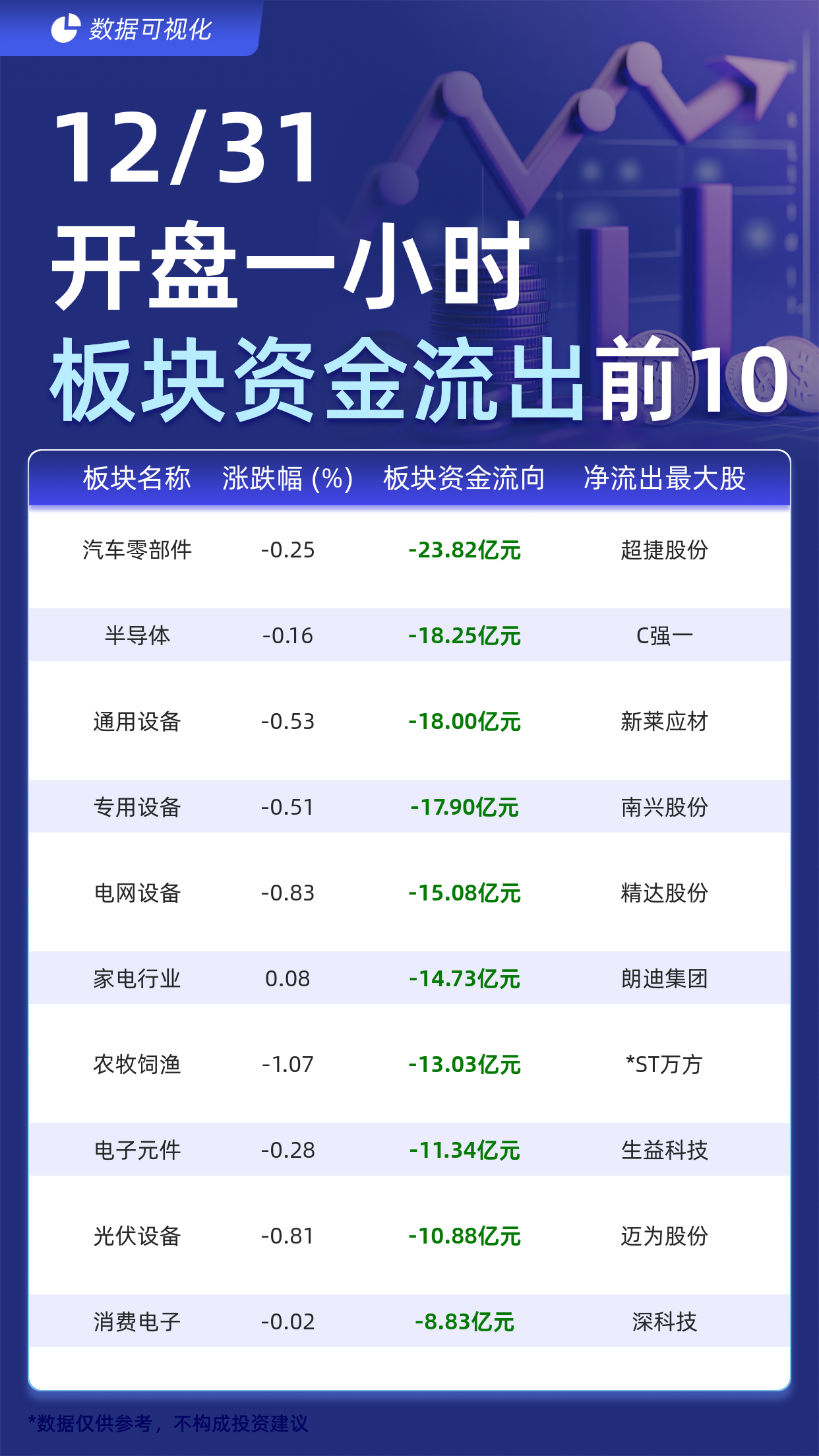
主力板块资金流出前10:汽车零部件流出23.82亿元、半导体流出18.25亿元
Jin Rong Jie· 2025-12-31 02:42
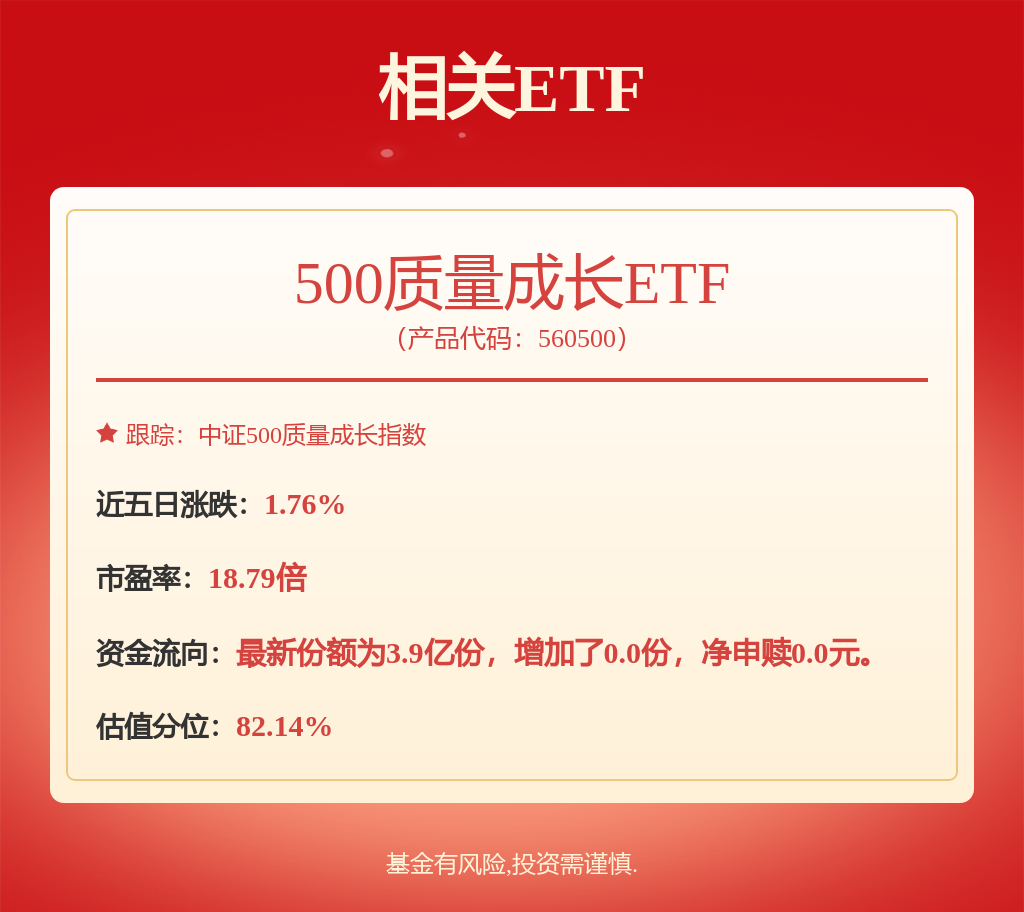
Core Viewpoint - The main market experienced a net outflow of 20.086 billion yuan in principal funds as of December 31, with significant withdrawals across various sectors [1]. Group 1: Sector Performance - The top ten sectors with the largest net outflows include: - Automotive Parts: -2.382 billion yuan [2] - Semiconductors: -1.825 billion yuan [2] - General Equipment: -1.800 billion yuan [2] - Specialized Equipment: -1.790 billion yuan [2] - Power Grid Equipment: -1.508 billion yuan [2] - Home Appliances: -1.473 billion yuan [2] - Agriculture, Animal Husbandry, and Fishery: -1.303 billion yuan [3] - Electronic Components: -1.134 billion yuan [3] - Photovoltaic Equipment: -1.088 billion yuan [3] - Consumer Electronics: -0.883 billion yuan [3]
机器学习因子选股月报(2026年1月)-20251231
Southwest Securities· 2025-12-31 02:04
Quantitative Models and Construction Methods 1. Model Name: GAN_GRU - **Model Construction Idea**: The GAN_GRU model combines Generative Adversarial Networks (GAN) for feature generation and Gated Recurrent Unit (GRU) for time-series feature encoding to construct a stock selection factor[4][13][14] - **Model Construction Process**: 1. **GAN Component**: - The generator (G) learns the real data distribution and generates realistic samples from random noise \( z \) (Gaussian or uniform distribution). The generator's loss function is: $$ L_{G} = -\mathbb{E}_{z\sim P_{z}(z)}[\log(D(G(z)))] $$ where \( D(G(z)) \) represents the discriminator's probability of classifying generated data as real[24][25][26] - The discriminator (D) distinguishes real data from generated data. Its loss function is: $$ L_{D} = -\mathbb{E}_{x\sim P_{data}(x)}[\log D(x)] - \mathbb{E}_{z\sim P_{z}(z)}[\log(1-D(G(z)))] $$ where \( D(x) \) is the probability of real data being classified as real, and \( D(G(z)) \) is the probability of generated data being classified as real[27][29][30] - GAN training alternates between optimizing \( G \) and \( D \) until convergence[30] 2. **GRU Component**: - Two GRU layers (GRU(128, 128)) are used to encode time-series features, followed by a Multi-Layer Perceptron (MLP) with layers (256, 64, 64) to predict returns. The final output \( pRet \) is used as the stock selection factor[22] 3. **Feature Input and Processing**: - Input features include 18 price-volume characteristics (e.g., closing price, turnover, etc.) sampled over the past 400 days, with a shape of \( 40 \times 18 \) (40 days of features)[18][19][37] - Features undergo outlier removal, standardization, and cross-sectional normalization[18] 4. **Training Details**: - Training-validation split: 80%-20% - Semi-annual rolling training (June 30 and December 31 each year) - Hyperparameters: batch size equals the number of stocks, Adam optimizer, learning rate \( 1e-4 \), IC loss function, early stopping (10 rounds), max training rounds (50)[18] 5. **Stock Selection**: - Stocks are filtered to exclude ST stocks and those listed for less than six months[18] - **Model Evaluation**: The GAN_GRU model effectively captures price-volume time-series features and demonstrates strong predictive power for stock returns[4][13][22] --- Model Backtesting Results 1. GAN_GRU Model - **IC Mean**: 0.1119*** (2019-2025)[4][41] - **ICIR (non-annualized)**: 0.89[42] - **Turnover Rate**: 0.83X[42] - **Recent IC**: 0.0331*** (December 2025)[4][41] - **1-Year IC Mean**: 0.0669***[4][41] - **Annualized Return**: 37.40%[42] - **Annualized Volatility**: 23.39%[42] - **IR**: 1.60[42] - **Maximum Drawdown**: 27.29%[42] - **Annualized Excess Return**: 22.42%[4][42] --- Quantitative Factors and Construction Methods 1. Factor Name: GAN_GRU Factor - **Factor Construction Idea**: The GAN_GRU factor is derived from the GAN_GRU model, leveraging GAN for price-volume feature generation and GRU for time-series encoding[4][13][14] - **Factor Construction Process**: - The GAN generator processes raw price-volume time-series features (\( Input\_Shape = 40 \times 18 \)) and outputs transformed features with the same shape (\( Input\_Shape = 40 \times 18 \))[37] - The GRU component encodes these features into a predictive factor for stock selection[22] - The factor undergoes industry and market capitalization neutralization and standardization[22] - **Factor Evaluation**: The GAN_GRU factor demonstrates robust performance across various industries and time periods, with significant IC values and excess returns[4][41] --- Factor Backtesting Results 1. GAN_GRU Factor - **IC Mean**: 0.1119*** (2019-2025)[4][41] - **ICIR (non-annualized)**: 0.89[42] - **Turnover Rate**: 0.83X[42] - **Recent IC**: 0.0331*** (December 2025)[4][41] - **1-Year IC Mean**: 0.0669***[4][41] - **Annualized Return**: 37.40%[42] - **Annualized Volatility**: 23.39%[42] - **IR**: 1.60[42] - **Maximum Drawdown**: 27.29%[42] - **Annualized Excess Return**: 22.42%[4][42] 2. Industry-Specific Performance - **Top 5 Industries by Recent IC (October 2025)**: - Social Services: 0.4243*** - Coal: 0.2643*** - Environmental Protection: 0.2262*** - Retail: 0.1888*** - Steel: 0.1812***[4][41][42] - **Top 5 Industries by 1-Year IC Mean**: - Social Services: 0.1303*** - Steel: 0.1154*** - Non-Bank Financials: 0.1157*** - Retail: 0.1067*** - Building Materials: 0.1017***[4][41][42] 3. Industry-Specific Excess Returns - **Top 5 Industries by December 2025 Excess Returns**: - Banking: 4.30% - Real Estate: 3.51% - Environmental Protection: 2.18% - Retail: 1.76% - Machinery: 1.71%[2][45] - **Top 5 Industries by 1-Year Average Excess Returns**: - Banking: 2.12% - Real Estate: 1.93% - Environmental Protection: 1.50% - Retail: 1.46% - Machinery: 1.23%[2][46]



博时宏观观点:风险偏好上行,成长有色有望占优
Xin Lang Cai Jing· 2025-12-30 10:53
Group 1: Global Economic Overview - The US Q3 2025 GDP growth rate is 4.3%, significantly above market expectations, with consumer resilience and AI investments contributing one-third of this year's growth [10] - Japan has passed a large-scale fiscal budget plan for 2026, leading to a rapid increase in Japanese bond yields to 2.11%, which has exerted some pressure on the US dollar index due to yen appreciation [10] - The domestic industrial profit decline has widened in November, with a slight month-on-month increase in profit margins after adjusting for high base effects, but still weaker than seasonal trends [10] Group 2: Market Strategy - The bond market experienced narrow fluctuations from December 22 to 26, with a steepening curve; liquidity easing has improved short-term performance, while long-term remains volatile due to concerns about the post-year-end market [11] - The A-share market has seen a continuous rebound due to the resolution of structural differentiation and positive signals from the Central Economic Work Conference, alongside a strengthening yuan [11] - The Hong Kong stock market is currently in a phase of benefiting from liquidity while facing weak fundamentals, with the improvement of the price level in 2026 being crucial [11] Group 3: Sector-Specific Insights - The alcohol beverage and black metallurgy industries are dragging down overall profit growth, while the recovery in export growth is benefiting sectors like computer communications, automotive, electrical machinery, and specialized equipment [10] - The technology growth sector is expected to outperform as the crowding effect eases, although further recovery in PPI and profits is still awaited [11] - The oil market is under pressure due to weak demand, continuous supply release, and inventory accumulation [12]
机器人执行器概念爆发,13位基金经理发生任职变动
Sou Hu Cai Jing· 2025-12-30 09:09
Market Performance - On December 30, A-shares showed mixed performance with the Shanghai Composite Index closing flat at 3965.12 points, the Shenzhen Component Index rising by 0.49% to 13604.07 points, and the ChiNext Index increasing by 0.63% to 3242.90 points [1] Fund Manager Changes - On December 30, a total of 13 fund managers experienced changes in their positions, with 640 fund products having manager changes in the past 30 days [3] - One fund manager left due to a job change, managing two funds during their tenure [3] - Tianhong Fund's Wang Fan managed assets totaling 254 million yuan, with the highest return of 17.84% on the Tianhong Yongyu Balanced Pension Fund over 3 years and 193 days [3] New Fund Managers - On December 30, 24 fund products announced new fund managers, involving 12 fund managers [4] - Baiying Fund's Cai Dan manages assets of 2.597 billion yuan, with the highest return of 103.05% on the Baiying CSI A100 Index Enhanced Fund over 8 years and 149 days [4] Fund Research Activity - In the past month (November 30 to December 30), Huaxia Fund conducted the most company research, engaging with 42 listed companies, followed by Southern Fund, Bosera Fund, and Huitianfu Fund with 37, 34, and 32 companies respectively [6] - The most researched industry was specialized equipment with 155 instances, followed by computer equipment with 111 instances [6] Recent Fund Research Focus - In the last week (December 23 to December 30), the most researched company was Pulite, a plastic products company, with 28 fund institutions participating in the research [7] - Other companies with significant research attention included Nord Shares, Xiangyu Medical, and Desai Xiwai, with 23, 22, and 22 fund institutions respectively [7]




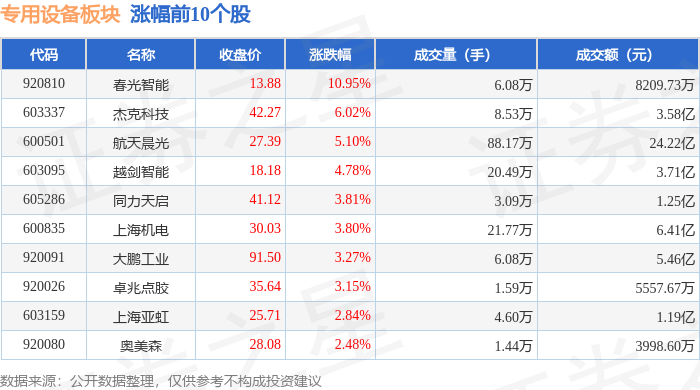
专用设备板块12月30日涨0.28%,春光智能领涨,主力资金净流出1.08亿元
Zheng Xing Xing Ye Ri Bao· 2025-12-30 09:08
Core Viewpoint - The specialized equipment sector experienced a slight increase of 0.28% on December 30, with Springlight Intelligent leading the gains, while the overall market showed mixed results with the Shanghai Composite Index closing at 3965.12, unchanged, and the Shenzhen Component Index rising by 0.49% [1]. Group 1: Sector Performance - The specialized equipment sector saw notable individual stock performances, with Springlight Intelligent closing at 13.88, up by 10.95%, and a trading volume of 60,800 shares, amounting to a transaction value of 82.1 million yuan [1]. - Other significant gainers included Jack Technology, which rose by 6.02% to 42.27, and Aerospace Morning Light, which increased by 5.10% to 27.39, with transaction values of 358 million yuan and 2.422 billion yuan respectively [1]. Group 2: Capital Flow - On the same day, the specialized equipment sector experienced a net outflow of 108 million yuan from institutional investors and 112 million yuan from speculative funds, while retail investors contributed a net inflow of 220 million yuan [2]. - The capital flow data indicates that Aerospace Morning Light had a net inflow of 343 million yuan from institutional investors, while Springlight Intelligent also saw a significant net inflow of 12.23 million yuan [3].
天奇股份:连续两日股价涨幅偏离值累计达21.15%,正推进定增
Xin Lang Cai Jing· 2025-12-30 08:59
Core Viewpoint - The stock of Tianqi Co., Ltd. experienced an abnormal fluctuation with a cumulative closing price increase of 21.15% over two consecutive trading days on December 29 and 30, 2025 [1] Group 1: Stock Performance - The stock price deviation indicates significant volatility, which may attract investor attention [1] - The company has confirmed that there are no major changes in its recent operations or external environment [1] Group 2: Corporate Actions - Tianqi Co., Ltd. is in the process of issuing A-shares to specific investors for the year 2025, which requires approval from the shareholders' meeting, Shenzhen Stock Exchange, and registration with the China Securities Regulatory Commission [1] - The issuance of A-shares carries uncertainties that could impact future capital structure and funding [1]

天永智能:拟将部分募投项目结项,4044.46万元节余资金拟永久补充流动资金
2 1 Shi Ji Jing Ji Bao Dao· 2025-12-30 08:43
Core Viewpoint - Tianyong Intelligent announced the completion of the fundraising project related to the "New Energy Vehicle Motor Battery Assembly Testing Line and Automation Equipment Construction Project" and plans to use the surplus funds for working capital [1] Group 1: Project Completion - The board of directors approved the conclusion of the fundraising project, which has been implemented and is in a usable state as of December 26, 2025 [1] - The total surplus fundraising amount is 40.4446 million yuan, which includes 3.7859 million yuan for contracts signed but pending payment [1] Group 2: Fund Allocation - The entire surplus amount will be permanently allocated to supplement working capital for daily operations and business development [1] - Following the transfer of these funds, the company will cancel the related fundraising special account [1]

李迅雷:2026年中国经济展望
Sou Hu Cai Jing· 2025-12-30 04:45
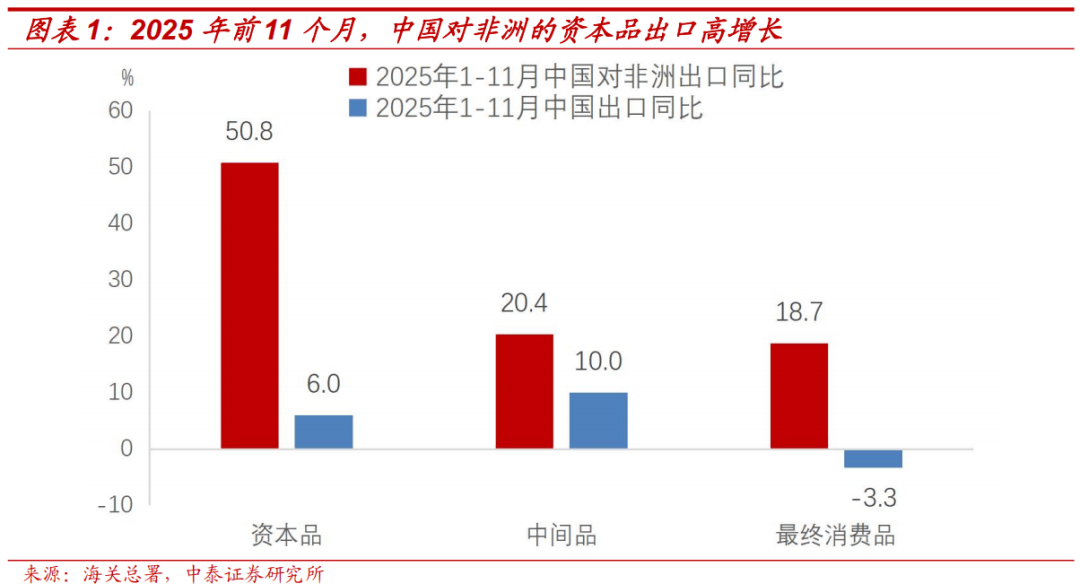
Core Viewpoint - The GDP growth target for 2026 is expected to remain around 5%, with macro policies aimed at promoting consumption and expanding investment to ensure a good start for the 14th Five-Year Plan [6][1]. Export Performance - China's exports showed resilience in 2025, with nominal year-on-year growth of 5.4% in USD terms and 6.2% in RMB terms for the first 11 months [7]. - The strong export performance is attributed to factors such as transshipment trade, increased capital goods exports driven by Chinese companies going abroad, and the delayed impact of US tariffs on global trade [8][10]. - For 2026, it is projected that China's exports will continue to grow by 3.4% year-on-year, supported by stable US-China tariffs and cost advantages [10][31]. Manufacturing Investment - Manufacturing investment in China is expected to recover slightly in 2026, with a year-on-year growth of around 2%, up from approximately 1% in 2025 [2][57]. - The recovery is supported by resilient exports and continued policy support for advanced manufacturing, particularly in the context of national security and technological development [49][57]. - Factors such as "strong supply and weak demand" and "anti-involution" expectations have negatively impacted manufacturing investment in 2025, but these conditions are expected to improve [39][40]. Real Estate Sector - The direct drag of the real estate sector on the economy is expected to weaken in 2026, with a projected year-on-year decline in commercial housing sales area of about 5% [59]. - Real estate investment is anticipated to decline by approximately 11% year-on-year in 2026, an improvement from a 16% decline in 2025, indicating a reduced direct impact on the economy [63][58]. - Policies are being implemented to mitigate the risks associated with a weakening real estate sector, including measures to support housing demand and improve the financial health of real estate companies [63][66]. Consumption and Investment Expansion - Expanding domestic demand is identified as a crucial path to achieving the 5% GDP growth target in 2026, with a focus on promoting consumption and investment [66]. - The government is expected to maintain support for consumption through special bonds, with funding levels likely to remain at least equal to the 300 billion RMB allocated in 2025 [67][72]. - Infrastructure investment is projected to rebound to around 8% year-on-year in 2026, supported by previously announced policies and a focus on major projects [4][66].