
乘用车

Search documents
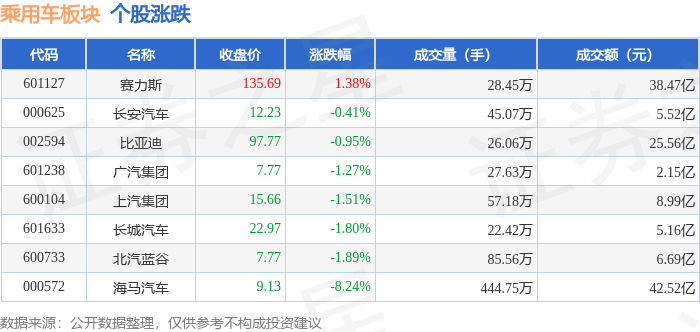
乘用车板块11月12日跌0.83%,海马汽车领跌,主力资金净流出9.87亿元
Zheng Xing Xing Ye Ri Bao· 2025-11-12 08:42
Core Insights - The passenger car sector experienced a decline of 0.83% on November 12, with Haima Automobile leading the drop [1] - The Shanghai Composite Index closed at 4000.14, down 0.07%, while the Shenzhen Component Index closed at 13240.62, down 0.36% [1] Passenger Car Sector Performance - The closing prices and percentage changes for key companies in the passenger car sector are as follows: - Seres: 135.69, +1.38% - Changan Automobile: 12.23, -0.41% - BYD: 97.77, -0.95% - GAC Group: 7.77, -1.27% - SAIC Motor: 15.66, -1.51% - Great Wall Motors: 22.97, -1.80% - BAIC Blue Valley: 7.77, -1.89% - Haima Automobile: 9.13, -8.24% [1] Capital Flow Analysis - The passenger car sector saw a net outflow of 9.87 billion yuan from main funds, while retail funds had a net inflow of 8.42 billion yuan [1] - The detailed capital flow for selected companies is as follows: - Seres: Main funds net inflow of 60.73 million yuan, retail net outflow of 95.10 million yuan - Great Wall Motors: Main funds net inflow of 53.74 million yuan, retail net outflow of 37.67 million yuan - GAC Group: Main funds net outflow of 23.12 million yuan, retail net inflow of 21.17 million yuan - Changan Automobile: Main funds net outflow of 66.99 million yuan, retail net inflow of 63.71 million yuan - BAIC Blue Valley: Main funds net outflow of 1.27 billion yuan, retail net inflow of 78.36 million yuan - SAIC Motor: Main funds net outflow of 210 million yuan, retail net inflow of 147 million yuan - Haima Automobile: Main funds net outflow of 275 million yuan, retail net inflow of 412 million yuan - BYD: Main funds net outflow of 400 million yuan, retail net inflow of 253 million yuan [2]







汽车行业2025年三季报综述:乘用车业绩分化,商用车高景气有望持续
CHINA DRAGON SECURITIES· 2025-11-12 08:16
Investment Rating - The report maintains a "Recommended" investment rating for the automotive industry [2] Core Insights - The automotive sector has shown a significant performance divergence between passenger vehicles and commercial vehicles, with the latter expected to maintain high growth momentum [1][5] - The passenger vehicle segment experienced a revenue increase of 7.4% year-on-year in Q3 2025, while the sales volume grew by 14.4%, indicating a price war impact with an average price decrease of 0.99 million yuan per vehicle [5][37] - The commercial vehicle sector has seen a notable recovery in sales since June 2025, driven by government fiscal improvements and overseas demand, leading to a valuation recovery in the sector [5][15] Summary by Sections Passenger Vehicles - The passenger vehicle market maintained a high level of activity in Q3 2025, with wholesale sales reaching 7.53 million units, a year-on-year increase of 13.7% [23] - The segment's revenue for Q3 2025 was 557.7 billion yuan, with a notable performance difference among manufacturers, driven by new product launches and a shift towards higher-end models [37][44] - The profitability of the passenger vehicle sector showed a decline, with a net profit of 9.49 billion yuan in Q3 2025, down 25.1% year-on-year, primarily due to pressure on leading manufacturers like BYD [41][44] Commercial Vehicles - The commercial vehicle sector, particularly buses and heavy trucks, has shown significant improvement, with Q3 2025 revenues increasing by 30.6% year-on-year for buses and 26.9% for heavy trucks [6][15] - The heavy truck segment's net profit reached 3.84 billion yuan in Q3 2025, reflecting a 55.3% increase year-on-year, supported by favorable government policies and demand recovery [6][15] Auto Parts - The auto parts sector reported a revenue increase of 10.4% year-on-year in Q3 2025, with a net profit growth of 22.6%, indicating effective cost control and efficiency improvements [5][6] - Nearly 80% of auto parts companies achieved revenue growth in Q3 2025, driven by strong demand from the automotive production side [5][6] Investment Recommendations - The report suggests focusing on companies in strong product cycles, such as Great Wall Motors, Seres, and SAIC Motor, as well as key suppliers in the auto parts sector like Joyson Electronics and Desay SV [5][6][7]



中观景气 11月第3期:科技制造景气延续,地产内需仍偏弱
GUOTAI HAITONG SECURITIES· 2025-11-12 06:41
Downstream Consumption - Real estate sales have seen an expanded decline, with a year-on-year decrease of 41.4% in the transaction area of commercial housing in 30 major cities as of November 9 [7] - In October 2025, nationwide retail sales of passenger cars decreased by 0.8% year-on-year, primarily due to the high base effect from the second half of 2024 and tightening of trade-in policies [8] - The price of live pigs has turned downward, with a week-on-week decrease of 3.1%, while domestic staple grain prices continue to rise [10] Technology & Manufacturing - The electronic industry continues to maintain high prosperity, with the average spot price of DRAM memory reaching $3.336, up 2.2% week-on-week, driven by AI infrastructure demand [20] - Semiconductor sales in China reached $18.69 billion in September 2025, reflecting a year-on-year increase of 15.0% [22] - The lithium battery industry is experiencing significant growth, with the price of lithium hexafluorophosphate rising by 13.0% week-on-week as of November 7 [45] Upstream Resources - Coal prices have surged, with the price of Q5500 thermal coal at Qinhuangdao port reaching 817 yuan per ton, up 6.1% week-on-week, marking a new high for the year [46] - International metal prices have declined, with SHFE copper and aluminum prices at 85,900 yuan and 21,600 yuan per ton, respectively, reflecting a week-on-week decrease of 1.2% and an increase of 1.5% [50] Logistics and Passenger Flow - Passenger demand has decreased on a month-on-month basis, with subway passenger volume down 1.9% week-on-week but up 3.4% year-on-year [59] - Freight logistics demand has also declined, with nationwide highway truck traffic down 2.1% week-on-week, while railway freight volume increased by 3.9% [62] - Port throughput has shown fluctuations, with container throughput at 6.809 million TEUs, up 1.4% week-on-week [65]
长城汽车跌2.01%,成交额3.10亿元,主力资金净流入986.80万元
Xin Lang Zheng Quan· 2025-11-12 05:30
Core Viewpoint - Great Wall Motors' stock has experienced a decline of 11.44% year-to-date, with a recent drop of 2.01% on November 12, 2023, indicating potential challenges in the automotive market [1][2]. Financial Performance - For the period from January to September 2025, Great Wall Motors reported a revenue of 153.58 billion yuan, reflecting a year-on-year growth of 7.96%. However, the net profit attributable to shareholders decreased by 17.20% to 8.64 billion yuan [2]. - Cumulative cash dividends since the A-share listing amount to 34.70 billion yuan, with 8.95 billion yuan distributed over the last three years [3]. Shareholder and Market Activity - As of September 30, 2025, the number of shareholders decreased by 22.95% to 137,500, with an average of 0 shares per shareholder [2]. - The stock's trading activity on November 12 showed a net inflow of 9.87 million yuan from main funds, with significant buying and selling from large orders [1]. Company Overview - Great Wall Motors, established on June 12, 2001, and listed on September 28, 2011, is primarily engaged in the production and sale of automobiles and auto parts. The main revenue sources include vehicle sales (86.37%), spare parts sales (6.65%), and other services [1]. - The company operates within the automotive sector, specifically in the passenger vehicle segment, and is associated with concepts such as shared economy, smart vehicles, and Huawei [1]. Institutional Holdings - As of September 30, 2025, major shareholders include China Securities Finance Corporation and Hong Kong Central Clearing Limited, with notable reductions in holdings among several institutional investors [3].
交银国际每日晨报-20251112
BOCOM International· 2025-11-12 02:21
Group 1: Technology Sector - Global technology stocks have experienced increased volatility, with the MSCI Information Technology Index rising by 5.6% from October 11 to November 10, outperforming the MSCI Global Index which increased by 3.4% [1] - The valuation of US technology stocks remains high, with the Shenyin Wanguo Electronics and Semiconductor Indexes showing a month-on-month price-to-earnings ratio change of -10% and +13% respectively [1] - Storage prices are expected to continue rising, with strong DRAM prices anticipated to last at least until Q3 2026, and NAND prices expected to remain robust until at least Q3 2026, an extension from previous expectations of H1 2026 [1] Group 2: Semiconductor Industry - In September, China's semiconductor manufacturing equipment imports reached $5.76 billion, marking a year-on-year increase of 35%, continuing a trend of significant growth for four consecutive months [2] - TSMC reported a 17% year-on-year revenue growth in October, indicating strong performance in the semiconductor sector [2] - Investment recommendations suggest focusing on domestic semiconductor equipment and core targets for domestic substitution, as AI infrastructure construction in both overseas and mainland China is expected to continue growing rapidly through 2026 [2] Group 3: Automotive Sector - In October, retail sales of passenger vehicles in China slightly decreased by 0.8% year-on-year, totaling 2.24 million units, while cumulative sales from January to October increased by 7.9% year-on-year to 19.25 million units [3][6] - The penetration rate of new energy vehicles (NEVs) reached 57.2% in October, with domestic brands increasing their market share to 70.8% in the NEV segment [3][6] - Passenger vehicle exports continued to show strong growth, with a total of 568,000 units exported in October, representing a year-on-year increase of 27.7% [4][6] - The share of new energy passenger vehicle exports rose to 44.2%, with 250,000 units exported, reflecting a year-on-year increase of 104% [4][6] - Investment insights suggest that the adjustment of new energy vehicle purchase tax exemptions in 2026 may stimulate consumer purchases towards the end of the year, maintaining high sales momentum [6]

晨会纪要:2025年第193期-20251112
Guohai Securities· 2025-11-12 00:34
Group 1: Baidu Group (9888.HK) - Baidu Group is leveraging its strong internet foundation to build a competitive barrier through a full-stack AI approach, leading the domestic market share in AI cloud services [3][4] - The online marketing business is transitioning from a CPC model to a CPS model, with AI search expected to enhance profitability in the long term, projecting revenues of 623.91, 592.72, and 598.64 billion yuan for 2025, 2026, and 2027 respectively [4][5] - The AI cloud business is positioned as a new profit center, with a leading market share and expected revenues of 273.25, 327.90, and 386.92 billion yuan for 2025, 2026, and 2027 respectively [5][6] - The Robotaxi business is anticipated to grow significantly, with expected revenues of 138.32, 159.07, and 174.97 billion yuan for 2025, 2026, and 2027 respectively [7][8] - Overall revenue projections for Baidu Group are 1309.73, 1356.68, and 1443.07 billion yuan for 2025, 2026, and 2027, with corresponding non-HKFRS net profits of 166.00, 198.64, and 235.48 billion yuan [8] Group 2: Seres (601127) - Seres has successfully listed H shares, with a total of 108,619,000 shares issued, accelerating its globalization strategy [10][11] - In Q3 2025, Seres achieved revenue of 481.33 billion yuan, a year-on-year increase of 15.75% and a quarter-on-quarter increase of 11.28% [11][12] - The company’s gross margin improved to 29.95% in Q3 2025, with a focus on high-end vehicle sales and new product launches [11][12] - The IPO proceeds will primarily fund R&D, marketing, and operational expenses, enhancing Seres' competitive edge [13] Group 3: Duolingo (DUOL) - Duolingo reported Q3 2025 revenue of $270 million, a year-on-year increase of 41%, but has lowered its Q4 guidance due to potential user growth slowdown [14][15] - Monthly active users reached 135 million, with a year-on-year growth of 20%, indicating a trend of slowing user growth [15][16] - The strategic focus has shifted towards long-term user growth, which may impact short-term revenue and profit [16][17] - Revenue projections for Duolingo are $1.031 billion, $1.265 billion, and $1.509 billion for 2025, 2026, and 2027 respectively [18] Group 4: Hua Hong Semiconductor (01347) - Hua Hong Semiconductor reported Q3 2025 revenue of $635 million, a year-on-year increase of 20.7%, driven by ASP optimization and increased wafer shipments [19][20] - The company’s gross margin improved to 13.5%, exceeding market expectations, with a focus on high-margin technology platforms [20][21] - Revenue projections for Hua Hong Semiconductor are $2.400 billion, $3.029 billion, and $3.348 billion for 2025, 2026, and 2027 respectively [22] Group 5: Royal Technology (603181) - Royal Technology launched an employee stock ownership plan to enhance employee engagement and align interests with long-term company goals [24][25] - The company reported Q3 2025 revenue of 626 million yuan, with a year-on-year increase of 0.12 million yuan, indicating stable operations [28][29] - Revenue projections for Royal Technology are 2.502 billion, 3.048 billion, and 3.556 billion yuan for 2025, 2026, and 2027 respectively [31] Group 6: New Asia Strong (603155) - New Asia Strong reported a revenue decline of 19.05% year-on-year for the first three quarters of 2025, with a focus on electronic-grade chemicals to drive growth [32][33] - The company’s gross margin improved in Q3 2025, but overall performance remains under pressure due to declining product prices [33][34] - The company is expanding its electronic-grade chemical product offerings, which are expected to contribute positively to future growth [36] Group 7: Meihua Medical (301363) - Meihua Medical achieved Q3 2025 revenue of 462 million yuan, marking a 3% year-on-year increase, with a focus on stable growth in core business areas [38][39] - The company is expanding into new markets, including weight loss injection pens and brain-machine interfaces, leveraging its existing manufacturing capabilities [40][41] - Revenue projections for Meihua Medical are 1.7 billion, 2.1 billion, and 2.5 billion yuan for 2025, 2026, and 2027 respectively [41] Group 8: Automotive Industry - The automotive industry saw a 15.8% year-on-year increase in wholesale sales in Q3 2025, with significant growth in passenger and commercial vehicle segments [42][43] - The overall automotive industry revenue reached 10,585.5 billion yuan, with a net profit of 404.1 billion yuan, indicating robust performance [42][43] - The passenger vehicle segment experienced profit declines, highlighting a trend of increasing competition and performance differentiation among manufacturers [43][44]



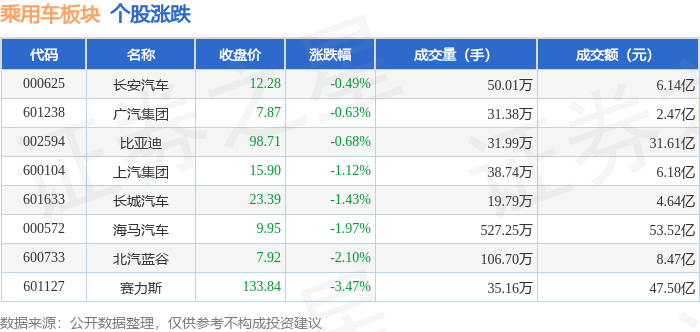
乘用车板块11月11日跌1.43%,赛力斯领跌,主力资金净流出20.48亿元
Zheng Xing Xing Ye Ri Bao· 2025-11-11 08:37
Market Overview - The passenger car sector experienced a decline of 1.43% on November 11, with Seres leading the drop [1] - The Shanghai Composite Index closed at 4002.76, down 0.39%, while the Shenzhen Component Index closed at 13289.0, down 1.03% [1] Individual Stock Performance - Changan Automobile closed at 12.28, down 0.49% with a trading volume of 500,100 shares and a turnover of 614 million yuan [1] - GAC Group closed at 7.87, down 0.63% with a trading volume of 313,800 shares and a turnover of 247 million yuan [1] - BYD closed at 98.71, down 0.68% with a trading volume of 319,900 shares and a turnover of 3.161 billion yuan [1] - SAIC Motor closed at 15.90, down 1.12% with a trading volume of 387,400 shares and a turnover of 618 million yuan [1] - Great Wall Motors closed at 23.39, down 1.43% with a trading volume of 197,900 shares and a turnover of 464 million yuan [1] - Haima Automobile closed at 9.95, down 1.97% with a trading volume of 5,272,500 shares and a turnover of 5.352 billion yuan [1] - BAIC Blue Valley closed at 7.92, down 2.10% with a trading volume of 1,067,000 shares and a turnover of 847 million yuan [1] - Seres closed at 133.84, down 3.47% with a trading volume of 351,600 shares and a turnover of 4.75 billion yuan [1] Capital Flow Analysis - The passenger car sector saw a net outflow of 2.048 billion yuan from institutional investors, while retail investors had a net inflow of 1.411 billion yuan [1] - Among individual stocks, Great Wall Motors had a net inflow of 37.614 million yuan from institutional investors, while GAC Group saw a net outflow of 8.811 million yuan [2] - BYD experienced a net outflow of 4.35 billion yuan from institutional investors, with retail investors contributing a net inflow of 303 million yuan [2] - Seres faced a significant net outflow of 1.029 billion yuan from institutional investors, while retail investors had a net inflow of 630 million yuan [2]
今年10月中国品牌乘用车销量为214.8万辆
Bei Jing Shang Bao· 2025-11-11 06:47
北京商报讯(记者 刘晓梦)11月11日,中国汽车工业协会发布的数据显示,今年10月中国品牌乘用车 销量为214.8万辆,同比增长11.2%;销量占有率为72.5%,同比上升2.4个百分点。 ...
海马汽车涨2.56%,成交额13.45亿元,主力资金净流入4682.16万元
Xin Lang Cai Jing· 2025-11-11 01:58
Core Viewpoint - Haima Automobile's stock has seen significant growth this year, with a year-to-date increase of 149.04%, driven by strong trading activity and market interest [1][2]. Group 1: Stock Performance - As of November 11, Haima Automobile's stock price reached 10.41 CNY per share, with a trading volume of 1.345 billion CNY and a turnover rate of 8.15%, resulting in a total market capitalization of 17.121 billion CNY [1]. - The stock has experienced a 30.29% increase over the past five trading days, a 76.44% increase over the past 20 days, and a 122.91% increase over the past 60 days [1]. - The company has appeared on the "Dragon and Tiger List" 10 times this year, with the most recent appearance on November 10, where it recorded a net buy of -195 million CNY [1]. Group 2: Financial Performance - For the period from January to September 2025, Haima Automobile reported a revenue of 1.274 billion CNY, reflecting a year-on-year growth of 17.53%. However, the net profit attributable to the parent company was -74.437 million CNY, a decrease of 232.68% compared to the previous year [2]. - The company has not distributed any dividends in the last three years, with a total payout of 153 million CNY since its A-share listing [3]. Group 3: Shareholder Information - As of October 31, the number of shareholders for Haima Automobile was 101,900, a decrease of 12.19% from the previous period, while the average circulating shares per person increased by 13.88% to 16,119 shares [2]. - The third-largest circulating shareholder is Hong Kong Central Clearing Limited, holding 25.3185 million shares, which is an increase of 9.4238 million shares from the previous period [3].
今年前10个月乘用车厂商批发量同比增长12.3%
Bei Jing Shang Bao· 2025-11-10 09:01
(文章来源:北京商报) 北京商报讯(记者刘晓梦)11月10日,中国汽车流通协会乘用车市场信息联席分会发布的数据显示,今 年前10个月,全国乘用车厂商批发2377万辆,同比增长12.3%。其中,今年10月全国乘用车厂商批发 293.2万辆,同比增长7.6%,环比增长4.9%。 ...