
房地产业

Search documents
日本银行开始卖房后,房价又跌了45%!
Sou Hu Cai Jing· 2025-11-15 18:11
Core Insights - The large-scale sale of properties by banks signals a deeper market crisis rather than a recovery, indicating a significant downturn in the real estate market [1][4][8] Group 1: Market Conditions - The number of properties being sold by banks is staggering, with Sichuan Agricultural Credit selling 24,800 properties, Guangdong Agricultural Credit 12,300, and Liaoning Agricultural Credit 11,300, alongside large banks holding significant amounts of foreclosed properties [2] - In the first half of 2025, the national volume of foreclosed residential transactions reached 51,000 units, with average transaction prices dropping by 7.83% year-on-year, leading to a trend of "price for volume" in many cities [2] Group 2: Impact on Property Prices - The aggressive selling by banks creates a panic in the market, as properties in the same neighborhood are listed at significantly lower prices, leading to a downward spiral in property values [4] - In a specific case, a property that was originally valued at 1.8 million is now being auctioned starting at 1.2 million, reflecting a drastic decline in perceived value [8] Group 3: Historical Context - Historical parallels are drawn with Japan's real estate market collapse in the 1990s, where a similar pattern of rapid price increases followed by a crash led to significant financial distress for homeowners [6][8] - The lesson from Japan's experience highlights the potential for a similar fate in China, especially in cities experiencing population decline and economic stagnation [8]


居民财富配置转型:解锁消费增长与产业创新路径
Jing Ji Guan Cha Wang· 2025-11-14 16:27
Group 1 - The core viewpoint of the article emphasizes the need to increase household consumption and promote technological and industrial innovation, which requires support from the capital market and a shift in household wealth allocation towards risk financial assets [2][3][16] Group 2 - The decline in household consumption growth is linked to the decrease in property income growth, with retail sales growth falling to 3% in September 2025, indicating ongoing pressure on consumption [3] - From 2021 to 2024, urban residents' property income growth dropped from 10.2% to 2.2%, further declining to 1.7% in the first three quarters of 2025 [3] - The overall decline in household wealth, driven by a 33% drop in the CSI 300 index and a 13.5% decrease in housing prices, has exerted downward pressure on consumption [3][8] Group 3 - The structure of household wealth is heavily skewed towards real estate, with property accounting for approximately 60% of total household assets, significantly higher than in the US and other developed countries [6][12] - The proportion of financial assets held in low-risk investments exceeds 80%, limiting the potential for generating property income [9][11] Group 4 - The article suggests that the current asset allocation structure poses challenges for household wealth and consumption, particularly as property values decline and the demand for real estate decreases [8][24] - It highlights the need for a shift towards risk financial assets to stabilize and increase property income growth, thereby promoting household consumption [16][24] Group 5 - Recommendations for improving the situation include enhancing the profitability of listed companies, increasing household investment in risk financial assets, reducing market volatility, and stabilizing the real estate market [16][20][22] - The article stresses that a transition in household asset allocation will require a concerted effort and may take 10 to 20 years to achieve [24]

中国宝安股价涨5.09%,南方基金旗下1只基金位居十大流通股东,持有2625.68万股浮盈赚取1470.38万元
Xin Lang Cai Jing· 2025-11-13 03:26
Group 1 - China Baoan's stock increased by 5.09%, reaching 11.57 CNY per share, with a trading volume of 510 million CNY and a turnover rate of 1.74%, resulting in a total market capitalization of 29.842 billion CNY [1] - The company, founded on October 8, 1990, and listed on June 25, 1991, is based in Shenzhen, Guangdong Province, and its main business areas include high-tech industry, biomedicine, and real estate investment [1] - The revenue composition of China Baoan is as follows: high-tech industry 79.55%, biomedicine 18.37%, other industries 1.41%, and real estate 0.67% [1] Group 2 - Among the top ten circulating shareholders of China Baoan, a fund under Southern Fund holds a position, specifically the Southern CSI 500 ETF (510500), which reduced its holdings by 522,200 shares in the third quarter, now holding 26.2568 million shares, accounting for 1.02% of circulating shares [2] - The Southern CSI 500 ETF has a current scale of 140.098 billion CNY, with a year-to-date return of 28.42%, ranking 1847 out of 4216 in its category, and a one-year return of 17.38%, ranking 2269 out of 3951 [2] Group 3 - The fund manager of Southern CSI 500 ETF is Luo Wenjie, who has a cumulative tenure of 12 years and 209 days, with the fund's total asset size at 170.445 billion CNY [3] - During his tenure, the best fund return was 150.16%, while the worst return was -47.6% [3]

居民存款大增,钱却贬值了!房子、黄金靠不住,怎么“抗贬值”?
Sou Hu Cai Jing· 2025-11-12 10:46
Core Insights - The significant increase in household deposits in China, amounting to 12.73 trillion yuan in the first three quarters of 2025, reflects a cautious outlook among residents due to slowing economic recovery and weakened corporate profitability [2][4] - Despite a stable Consumer Price Index (CPI) with a year-on-year decrease of 0.3%, the real purchasing power is diminishing due to excessive money supply, leading to hidden devaluation of currency [2][7] Group 1: Household Deposits and Economic Context - The total increase in RMB deposits reached 22.71 trillion yuan, with household deposits accounting for over half, averaging nearly 9,000 yuan per person [5] - The growth rate of M2 at 8.4% significantly outpaces the growth of disposable income, indicating that the expansion of money supply dilutes the value of currency [5][7] - The low interest rates on savings, with three-year fixed rates dropping below 2%, result in negligible or negative real returns for depositors [7] Group 2: Real Estate Market Trends - The real estate market has seen a reversal, with the average price of second-hand homes in Beijing dropping from 43,000 yuan per square meter at the beginning of the year to 41,800 yuan by November [9] - Nationwide, the average price of second-hand residential properties fell by 0.34% month-on-month and 3.21% year-on-year, indicating a significant decline in market activity [9] Group 3: Investment Landscape - Gold has lost its appeal as a safe-haven asset, with prices fluctuating and high transaction fees eroding potential profits for individual investors [11] - The stock market, while experiencing some gains, has become highly volatile, with many retail investors facing losses due to rapid price changes in various sectors [13] - The digital yuan, despite its growing adoption, does not provide additional value protection against inflation, serving primarily as a more convenient payment method [15][16] Group 4: Economic Resilience - The increase in household savings reflects a collective caution among families regarding future economic conditions, contributing to a soft landing for the Chinese economy [18] - This cautious behavior, while indicative of underlying economic challenges, prevents the situation from escalating into a systemic crisis, showcasing the resilience of the Chinese economy [18]
昨天这个信号出乎意料,货币放水迎来风云突变
Sou Hu Cai Jing· 2025-11-12 07:24
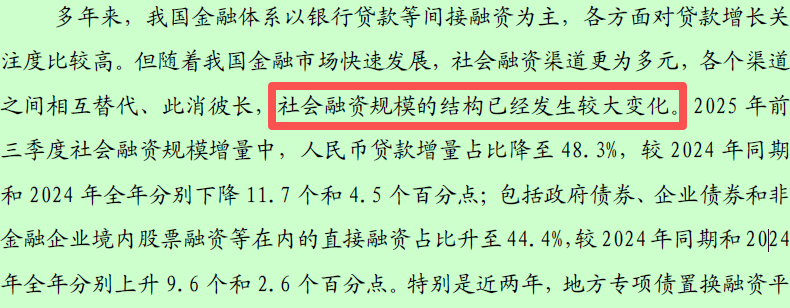
Core Viewpoint - The People's Bank of China (PBOC) has indicated a significant change in the structure of financing in its third-quarter monetary policy report, which is crucial for understanding the dynamics of the housing market and investment strategies. Group 1: Financing Structure Changes - The financing structure in China is shifting from primarily loan-based financing to direct financing through bonds, with loans now accounting for less than 50% of new financing in the third quarter of 2023 [9][14]. - This change implies that the traditional view of using M2 growth as an indicator for housing prices is no longer valid, as the increase in M2 may not correlate with housing market dynamics [13][14]. Group 2: Implications for Housing Market - The report emphasizes that the increase in M2 is largely driven by bond issuance, which does not directly contribute to housing market liquidity, leading to a potential scenario where M2 can grow while housing prices decline [14][18]. - The only reliable indicator for predicting housing market trends remains the growth in household loans, as these directly translate into purchasing power for the housing market [15][18]. Group 3: Economic and Stock Market Analysis - For broader economic and stock market analysis, the focus should be on social financing (社融) and M2, as these metrics provide a comprehensive view of the financial landscape [11]. - The report suggests that the shift towards direct financing will primarily affect economic indicators and stock market performance, rather than the housing market [18].
专访余永定:三方面发力促进房地产业趋稳回升,确保上下游产业链稳定
Zhong Guo Jing Ying Bao· 2025-11-12 07:10
Core Viewpoint - The real estate industry is crucial for economic stability and public welfare, with recent policies aimed at promoting high-quality development and addressing housing needs for various demographics [1][3]. Group 1: Industry Development - The "14th Five-Year Plan" emphasizes the need for a new development model in real estate, focusing on improving the systems for property development, financing, and sales [1]. - Historical trends from countries like Japan, the U.S., and the U.K. show that real estate markets undergo multiple cycles of fluctuation before stabilizing, indicating a potential long-term recovery path for China's real estate sector [3]. Group 2: Current Challenges - The Chinese real estate market has not experienced significant issues with mortgage defaults at the national level, but there are concerns about potential defaults by developers leading to increased non-performing loans in banks [4]. - The real estate industry is interconnected with various sectors, and prolonged instability could adversely affect the survival and development of upstream companies [5]. Group 3: Policy Recommendations - Macro-control policies should focus on stabilizing asset prices, injecting liquidity into the short-term money market, and providing capital through state-owned enterprises [5]. - Recent government measures include "guaranteeing delivery" of projects, relaxing purchase restrictions, and extending financing for existing projects, which have shown signs of effectiveness in stabilizing the market [5].

泸州老窖集团商业投资公司增资至5亿元
Mei Ri Jing Ji Xin Wen· 2025-11-12 02:55
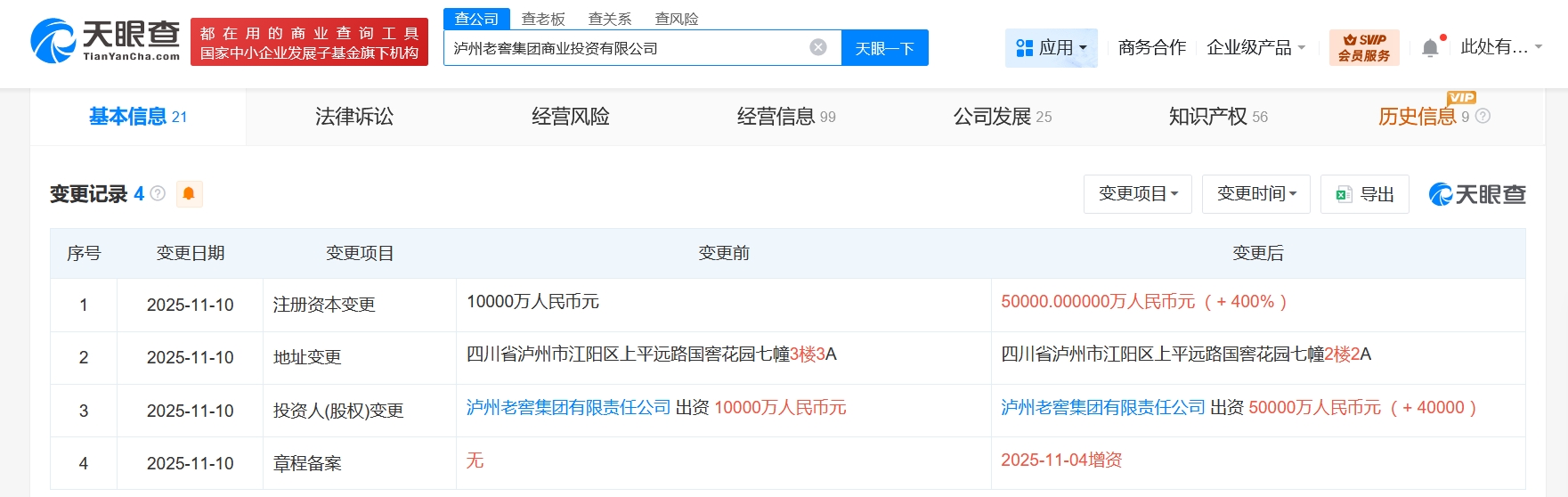
Core Insights - The article highlights significant capital increases for Luzhou Laojiao Group's commercial investment subsidiary, indicating a strategic expansion in its business operations [1] Company Developments - Luzhou Laojiao Group Commercial Investment Co., Ltd. has increased its registered capital from 100 million RMB to 500 million RMB, marking a 400% increase [1] - The company was established on April 18, 2025, and is fully owned by Luzhou Laojiao Group Co., Ltd. [1] - Recent changes also occurred in Luzhou Laojiao Capital Holdings Co., Ltd., with its registered capital rising from approximately 1.53 billion RMB to about 2.03 billion RMB, reflecting a 33% increase [1] Business Scope - The business scope of Luzhou Laojiao Group Commercial Investment includes real estate development, construction engineering, liquor business, investment activities with self-owned funds, park management services, non-residential real estate leasing, housing leasing, and business agency services [1]

泰达股份:11月11日召开董事会会议
Mei Ri Jing Ji Xin Wen· 2025-11-11 10:50
Group 1 - The company, Teda Co., Ltd. (SZ 000652), held a temporary board meeting on November 11, 2025, to discuss the reappointment of the accounting firm for the fiscal year 2025 [1] - For the first half of 2025, Teda's revenue composition was as follows: wholesale industry accounted for 89.05%, environmental management for 9.89%, construction for 0.44%, textile and apparel for 0.37%, and real estate for 0.26% [1] - As of the report date, Teda's market capitalization was 6.5 billion yuan [1]

央行:完善房地产金融基础性制度,助力构建房地产发展新模式
Sou Hu Cai Jing· 2025-11-11 09:36
(本文来自第一财经) 央行发布2025年第三季度中国货币政策执行报告,下一阶段,构建多层次、多元化养老金融体系,支持 银发经济高质量发展,助力积极应对人口老龄化国家战略实施。强化金融支持提振和扩大消费作用,扩 大消费领域金融供给,研究实施支持个人修复信用的政策措施,挖掘释放消费潜力。着力推动保障性住 房再贷款等金融政策措施落地见效,完善房地产金融基础性制度,助力构建房地产发展新模式。 ...
2025年上半年迪拜GDP增长4.4%
Shang Wu Bu Wang Zhan· 2025-11-11 03:15
Core Insights - Dubai's GDP grew by 4.4% in the first half of 2025, reaching 241 billion dirhams, driven primarily by trade, transportation, and tourism [1] Economic Growth by Sector - The construction sector experienced a growth of 8.5% [1] - The real estate sector saw a growth of 7% [1] - The financial and insurance sector grew by 6.7% [1] - The information and communication sector increased by 5.3% [1] - The health and social work activities sector was the fastest-growing, with a remarkable growth of 20% [1]