
电子信息

Search documents
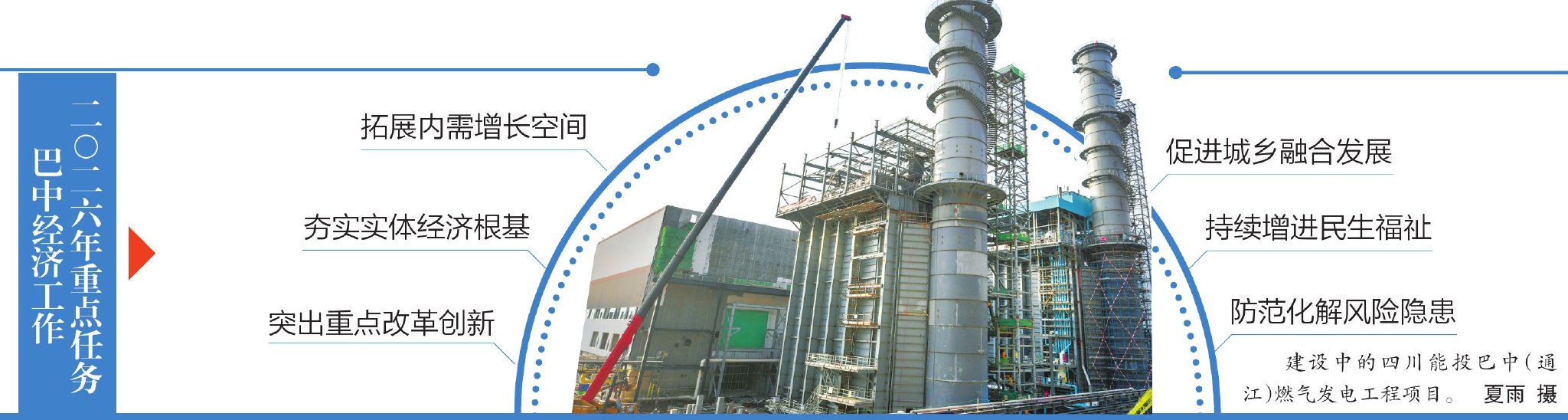
巴中画定今年经济发展“施工图”
Xin Lang Cai Jing· 2026-01-19 22:17
Core Viewpoint - The Ba Zhong Municipal Economic Work Conference emphasizes the necessity of maintaining a relatively fast economic growth rate despite the small economic scale, setting ambitious targets for 2026, including a focus on expanding domestic demand and enhancing the industrial foundation [1][2]. Group 1: Domestic Demand Expansion - Ba Zhong prioritizes expanding domestic demand as a key task for the year, focusing on boosting consumption and effective investment as core strategies [2]. - In the first three quarters of 2025, Ba Zhong achieved a total retail sales of consumer goods amounting to 40.362 billion yuan, reflecting a year-on-year growth of 6.7% [2]. - The city plans to implement special actions to stimulate consumption, innovate consumption formats, and enhance the consumption environment, including a series of promotional activities [2]. Group 2: Strengthening the Real Economy - Ba Zhong aims to solidify its industrial foundation by focusing on key industries such as energy and chemicals, advanced materials, electronic information, food and beverage, and healthcare [3][4]. - The city is leveraging its natural gas reserves of 1.4 trillion cubic meters and shale oil resources of approximately 2.5 billion tons to develop the energy and chemical industry [3]. - A sodium-ion battery industry park is being established, with over 1,500 acres allocated for development, aiming to attract leading companies in the sector [4]. Group 3: Urban-Rural Integration and Social Welfare - The city is committed to enhancing urban-rural integration and improving the well-being of its residents, with a focus on modernizing agriculture and rural areas [5][6]. - Plans include the development of a modern urban area in the Mengzi River section, featuring parks and recreational facilities [6]. - Initiatives to boost employment, improve education and healthcare, and enhance cultural services are being prioritized to elevate the quality of life for residents [7].

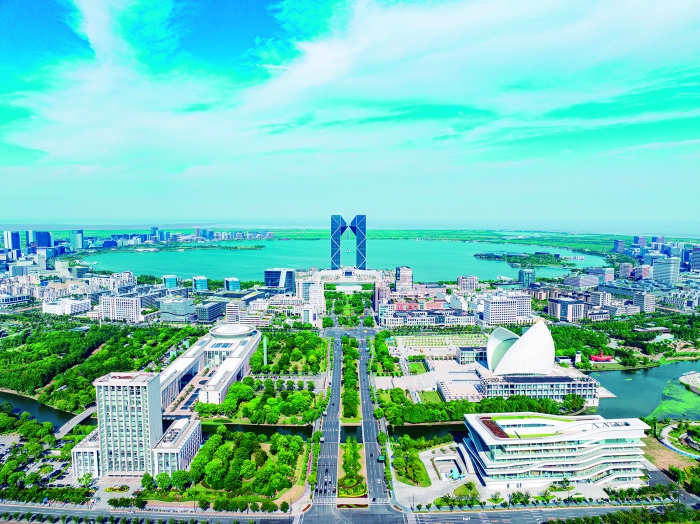
上海未来五年怎么干? 加快建设“五个中心” 打好城市转型升级攻坚战
Shang Hai Zheng Quan Bao· 2026-01-19 18:45
Core Viewpoint - The "15th Five-Year Plan" for Shanghai emphasizes enhancing the city's role as a global economic and financial center, focusing on high-quality development and the construction of a modern industrial system [2][4][6]. Group 1: Five Centers Development - The plan outlines the construction of "five centers" as a key strategy for Shanghai's modernization, which includes enhancing its international economic, financial, trade, shipping, and technological innovation centers [6][7]. - Specific initiatives include building a world-class high-end industrial cluster, establishing a global RMB asset allocation center, and enhancing the city's trade hub functions [6][9]. Group 2: Economic and Social Development Goals - The main goals for the "15th Five-Year" period include achieving significant high-quality development, elevating urban core functions, and enhancing social civilization levels [4][5]. - By 2035, Shanghai aims to double its per capita GDP compared to 2020 and fully upgrade the functions of the "five centers" to reach international leading levels [4][5]. Group 3: Modern Industrial System - The plan emphasizes the importance of maintaining a reasonable proportion of manufacturing within Shanghai's economy, identifying it as a foundation for the city's international economic status [8]. - It outlines a modern industrial system framework categorized into traditional, leading, emerging pillar, and future industries, aiming for a robust manufacturing backbone [8][10]. Group 4: High-End Service Industry - The development of high-end service industries is highlighted as crucial for enhancing Shanghai's international influence, with specific measures to strengthen the global supply chain and trade hub functions [9]. - The plan also includes fostering world-class enterprises as a dedicated task, providing guidance for the growth of large, medium, and small enterprises [9].
签约重磅项目 发布机会清单
Xin Lang Cai Jing· 2026-01-19 18:12
Group 1 - Chengdu and the Yangtze River Delta have initiated a series of cooperative agreements, including three industrial parks in Wuhou District, Pidu District, and Jintang County, which will collaborate with innovation platforms, research institutes, and industry associations from the Yangtze River Delta to build an industrial synergy and talent cultivation platform [1] - Six key industrial projects from the Yangtze River Delta have been signed, covering areas such as low-altitude economy, artificial intelligence, biomedicine, and advanced energy [1] - The establishment of an innovation collaborative platform between the Zhongke Yangtze River Delta Artificial Intelligence Innovation Center and Wuhou District aims to support cross-regional joint research and achievement transformation, facilitating the orderly flow of talent, technology, and data [1] Group 2 - A comprehensive job fair was held, featuring over 100 key employers from Chengdu focusing on cutting-edge fields such as artificial intelligence, software and information services, advanced energy, and new materials, releasing more than 600 quality job positions with the highest annual salary reaching 1.5 million [1] - Chengdu Jinyang High-tech Development Co., Ltd. is seeking software architects and product managers, emphasizing the importance of talent from the electronic information industry in Hangzhou for overcoming technical bottlenecks [2] - The job fair showcased 147 local products, creating an immersive interactive experience, and included a "talent achievement exhibition" displaying high-level talent innovation outcomes alongside cultural and culinary showcases from the region [2]
2025年广东高技术产品出口同比增长15%
Zhong Guo Xin Wen Wang· 2026-01-19 09:34
Core Insights - Guangdong's high-tech product exports are projected to reach 1.14 trillion yuan by 2025, marking a 15% year-on-year increase and surpassing the trillion yuan milestone for the first time [1] - Key high-tech products driving this growth include lithium batteries, measuring instruments, medical devices, machine tools, 3D printers, and automotive parts, which account for approximately 30% of the national export share in these categories [1] - The province's bonded logistics imports and exports are expected to reach 1.93 trillion yuan in 2025, reflecting a 9.1% year-on-year growth, which is 4.7 percentage points higher than the overall foreign trade growth rate [1] Group 1 - The construction of comprehensive bonded zones in Guangdong has made significant progress, with imports and exports projected at 945.57 billion yuan in 2025, a 9.5% increase year-on-year, exceeding the provincial foreign trade growth rate by 5.1 percentage points [2] - The Guangdong Free Trade Zone is expected to see imports and exports of 815.25 billion yuan in 2025, representing a 13.3% year-on-year growth, which is 8.9 percentage points higher than the overall foreign trade growth rate [2] - The Hengqin area of the Guangdong Free Trade Zone is accelerating the integration of the Guangdong-Macao industry, focusing on "four new" industries, with a year-on-year growth of 150% in imports and exports [2] Group 2 - Guangdong's foreign trade imports have maintained a year-on-year growth for 13 consecutive months, with a projected growth of 7.9% in 2025, ranking first among major foreign trade provinces in the country [2] - The large-scale market potential continues to be released, providing a source of vitality for the high-quality development of Guangdong's foreign trade and offering global opportunities to share the Guangdong market [2] - Despite the complex and severe external environment with increasing uncertainties, the fundamental strengths, advantages, and potential of Guangdong's foreign trade remain unchanged [2]
富士深耕河南再“加码”
Huan Qiu Wang· 2026-01-19 08:58
Group 1 - The core point of the article highlights the establishment of Henan Hongchuang Technology Co., Ltd., a joint venture between Foxconn and a local state-owned enterprise, which aims to enhance the electronic information industry in Henan province [1] - The registered capital of Henan Hongchuang Technology Co., Ltd. is 2 billion yuan, and it is expected to focus on the precision production and manufacturing of high-end electronic products, with operations anticipated to commence in the second quarter of this year [1] - Foxconn's expansion project in Zhengzhou includes the construction of two new buildings with a total area of approximately 100,000 square meters, aimed at optimizing production layout, with an expected completion date in May [2] Group 2 - The expansion project and the establishment of the joint venture are described as a "dual engine" driving the development of the electronic information industry in Zhengzhou, providing both stability and new growth [2] - The new dormitory area for Foxconn employees is also under construction, designed to include modern amenities and expected to be completed by 2027 [2] - In the first 11 months of 2025, the Zhengzhou Xinzheng Comprehensive Bonded Zone achieved an import and export value exceeding 420 billion yuan, reflecting a nearly 17% year-on-year growth, underscoring Foxconn's significant role in regional trade and industrial development [2]
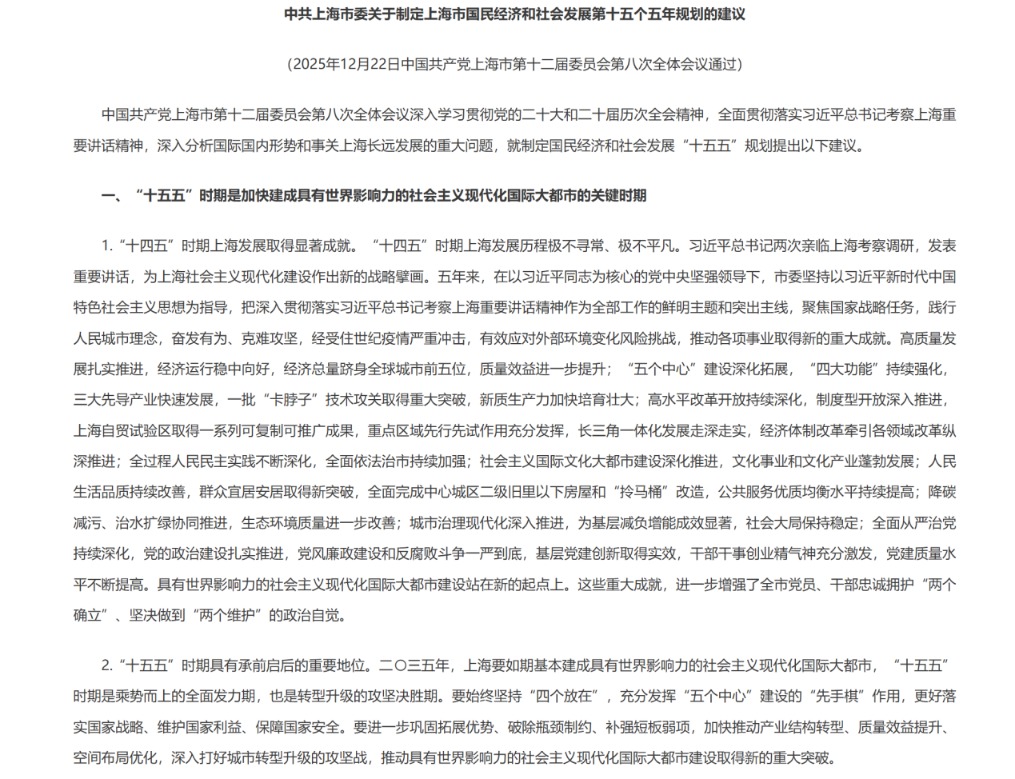
构建“2+3+6+6”体系 上海市“十五五”规划确立产业布局新航线
Zhong Guo Jing Ying Bao· 2026-01-19 08:51
Core Viewpoint - Shanghai aims to accelerate the construction of "five centers" to enhance its urban capability and core competitiveness, marking the "14th Five-Year Plan" period as crucial for becoming a globally influential socialist modern metropolis by 2035 [3][4]. Group 1: Five Centers - The "five centers" include international economic, financial, trade, shipping, and technological innovation centers, which are deemed essential for Shanghai's modernization efforts [4]. - The plan emphasizes innovation-driven development and the importance of a coordinated approach between central and local governments to enhance global resource allocation and technological innovation [4]. Group 2: Industrial Structure - Shanghai will implement a "2+3+6+6" industrial structure, focusing on the digital and green transformation of traditional industries and accelerating the development of integrated circuits, biomedicine, and artificial intelligence [4]. - The city aims to establish six emerging pillar industry clusters in electronic information, life health, automotive, high-end equipment, advanced materials, and fashion consumer goods [4]. Group 3: Regional Coordination - The plan calls for higher quality integration of the Yangtze River Delta region, emphasizing cross-regional collaboration in technological and industrial innovation [5]. - By 2035, the functions of the "five centers" are expected to be fully upgraded, with key development indicators reaching international leading levels, and per capita GDP projected to double compared to 2020 [5].
又一位!“量子物理新星自美回国”
Guan Cha Zhe Wang· 2026-01-19 08:41
【文/观察者网 张菁娟】据香港英文媒体《南华早报》19日报道,深耕量子传感与精密测量领域十余年 的物理学家由成龙已离开美国,于本月全职加盟位于四川成都的电子科技大学,担任教授一职。 报道称,由成龙此前任职于美国路易斯安那州立大学,是量子物理领域冉冉升起的科研新星。 虽然电子科技大学公开师资名单中暂未更新其任职信息,但他的谷歌学术个人主页已明确将这所高校列 为当前任职单位。 报道称,由成龙此次归国后,将加入电子科技大学量子物理与工程实验室。该实验室成立于2023年,旨 在助力国家研发高密度、高精度量子光子器件,推动量子测量领域的科研进程。 电子科技大学始建于1956年,是中国顶尖的工科院校之一,在电子学、信息技术与通信领域的研究实力 雄厚,为中国国防和科技产业培养了大量专业人才。 此前,美国政府泛化"国家安全"概念,以所谓"外交政策利益"为借口,将多家中国实体列入出口管 制"实体清单",其中就包括中国电子科技集团旗下多个研究所。 博士毕业后,他留校进入该校量子光子学实验室从事博士后研究工作,并于2023年晋升为助理研究教 授。 在学术研究期间,由成龙不仅深耕理论与实验探索,还与美国国家标准与技术研究院(NIST ...

智能工厂发展报告
中国信通院· 2026-01-19 08:26
Investment Rating - The report does not explicitly provide an investment rating for the industry Core Insights - The report highlights the significant progress in the development of smart factories in China, with over 15 leading smart factories, more than 500 excellent smart factories, and over 35,000 basic smart factories established, indicating a robust growth trend in the sector [9][10] - The evolution of smart factories is characterized by five core directions: expansion of factory construction, innovation in R&D design paradigms, upgrading of production capabilities, optimization of production management, and advancement in operational management [10][41] - The report emphasizes the need for the manufacturing industry to transition from quantity-driven growth to quality-driven improvements, addressing the challenges posed by global economic slowdowns and changing market demands [17][18] Summary by Sections Overall Trends - The report identifies four main drivers for the transformation of smart factories: industrial upgrades, changing market demands, technological advancements, and international cooperation [17][19] - It outlines a future vision for smart factories that includes the integration of AI across all manufacturing processes, leading to autonomous decision-making and enhanced collaboration within the manufacturing ecosystem [20][41] Industry Practices - The report describes a four-tiered system for cultivating smart factories, which includes basic, advanced, excellent, and leading levels, aimed at promoting digital transformation in manufacturing [41][42] - It notes that over 90% of manufacturing sectors are now covered by smart factory initiatives, with a focus on enhancing traditional industries and empowering consumer-driven sectors [50][49] Regional Development - The report discusses the regional disparities in smart factory development, with eastern regions leading and central regions making breakthroughs, highlighting the importance of localized strategies [12][49] Technology and Industry - The report emphasizes the need for a deep integration of technology and manufacturing systems, advocating for a shift towards a more resilient and intelligent industrial foundation [12][53] Future Outlook - The report envisions a next-generation smart manufacturing landscape characterized by autonomous manufacturing, ecological collaboration, and a focus on sustainability [12][41]
上海“十五五”三大先导产业关键词:全产业链整体突破、全栈创新
Di Yi Cai Jing· 2026-01-19 07:19
Core Viewpoint - Shanghai aims to build a world-class high-end industrial cluster by establishing a modern industrial system characterized by "2+3+6+6" during the 14th Five-Year Plan period, focusing on advanced manufacturing as the backbone [1][2]. Group 1: Modern Industrial System - The "2" in the "2+3+6+6" system refers to the digital and green transformation of traditional industries [1]. - The "3" represents the acceleration of three leading industries: integrated circuits, biomedicine, and artificial intelligence [1][2]. - The first "6" indicates the development of six emerging pillar industries: next-generation electronic information, intelligent connected new energy vehicles, high-end equipment, advanced materials, new energy and green low-carbon products, and fashion consumer goods [1]. - The second "6" focuses on six future industry fields: future manufacturing, future information, future materials, future energy, future space, and future health [1]. Group 2: Traditional Industries and Performance - Shanghai's traditional industries exhibit strong support, high efficiency, and high-tech characteristics, with a revenue profit margin of 6.2% in 2024, surpassing the national average by 0.8 percentage points [3]. - Nearly one-third of Shanghai's traditional industries are classified as strategic emerging industries, and they hold a significant share in international markets [3]. - Approximately 70% of Shanghai's traditional industries are technology-intensive, indicating a robust technological foundation [3]. Group 3: Leading Industries and Innovations - The integrated circuit industry aims for an overall breakthrough, focusing on building a secure and controllable local industrial ecosystem [4]. - The artificial intelligence sector is set to expand its innovation chain from application layers to foundational frameworks, core algorithms, and computing chips [4]. - By 2025, the artificial intelligence industry in Shanghai is expected to exceed 550 billion yuan, with a growth rate of over 30% [5].
5年跨过4个千亿级台阶,济南“十四五”规划圆满收官
Qi Lu Wan Bao· 2026-01-19 06:42
Core Insights - The report highlights the significant achievements and future goals of Jinan City, emphasizing the completion of the "14th Five-Year Plan" by 2025, marking a pivotal period of development for the city [1] Economic Development - Jinan's GDP is projected to surpass four trillion yuan over five years, maintaining its position among the top 20 cities in China, with six districts achieving over one hundred billion yuan in GDP [1] - The average annual growth rate of general public budget revenue is 3.9%, with 45 major projects exceeding one billion yuan implemented [1] - The industrial economy has seen a historic leap, with revenues from large-scale industrial enterprises exceeding one trillion yuan, and key industries such as electronics, automotive, and steel each surpassing one hundred billion yuan [1] Innovation and Technology - Jinan has accelerated the cultivation of new productive forces, with the number of high-tech enterprises exceeding 7,000 and R&D expenditure as a percentage of GDP rising from 2.62% to 3% [2] - The city ranks 27th in the global research city list by Nature magazine, improving by 30 places since 2021 [2] - The establishment of the Quantum National Laboratory and the increase in national and provincial key laboratories from 5 to 20 and 98 to 126, respectively, highlight Jinan's commitment to innovation [2] Infrastructure and Urban Development - The city has received approval for its overall land spatial planning, enhancing its urban carrying capacity [3] - Major infrastructure projects include the operation of eight rail transit lines and the construction of 900 kilometers of urban roads, contributing to a comprehensive transportation network [3] - The area for centralized heating has increased by 10 million square meters, and the city has improved its flood prevention capabilities [3] Social Welfare and Quality of Life - Jinan has made significant strides in rural revitalization, with continuous growth in grain planting area and total output, and a rural water supply rate of 99% [4] - The city has implemented 103 livelihood projects, with fiscal spending on social welfare consistently around 80% [4] - The healthcare system has expanded with over 750 new medical institutions, and the average life expectancy is projected to reach 81 years [4] Environmental Sustainability - Jinan has achieved notable progress in ecological civilization, with energy consumption per unit of GDP expected to decrease by 26% and water consumption by 29% [5] - The city has completed tasks related to rainwater and sewage systems, and the proportion of good-quality water bodies has remained at 100% for five consecutive years [5] - The construction of parks and the restoration of historical mining sites reflect Jinan's commitment to environmental protection [5] Governance and Safety - The city has improved its governance modernity, effectively managing the impacts of the pandemic while ensuring economic and social development [6] - Jinan has been recognized as a national model city for legal governance and has made significant progress in social stability and safety measures [6]