人工智能

Search documents
600万无人配送订单,43家硬科技企业,美团尝试构建AI的“物理底座” | 电厂
Xin Lang Cai Jing· 2026-03-31 12:53
Core Insights - The technology sector is shifting focus from "token economics" to "AI infrastructure" as highlighted by NVIDIA's founder Jensen Huang, who emphasizes the growing demand for computing power and the emergence of "physical AI" as the next wave of artificial intelligence [1][14] - Meituan's CEO Wang Xing asserts that the digitalization of the physical world will be a crucial foundation for AI, positioning Meituan as a connector between offline business and the online world [2][12] Investment Strategy - Meituan has invested in over 40 hard-tech companies across five core sectors, including foundational computing, large models, embodied intelligence, smart hardware, and autonomous driving, with 28 of these companies becoming unicorns and 7 going public [5][17] - The company began its strategic investments in hard technology as early as 2018, acquiring a drone company and shifting its focus from consumer internet to hard tech [5][18] AI Integration - Meituan views AI's value as extending beyond generating intelligent dialogue to executing real-world tasks, emphasizing the importance of integrating AI into the physical world [4][16] - The company has maintained a high investment ratio in hard technology, reaching 64% in 2022, and has consistently kept this figure above 50% in subsequent years [18] Unique Positioning - Meituan's extensive network, covering over 2,800 cities and counties in China, provides a unique training ground for AI, enabling the collection of vast amounts of local life data [7][20] - The company has established strategic partnerships with firms like Galaxy General to develop robotic solutions for various sectors, showcasing its ability to leverage real-world scenarios for AI training [21][25] Technological Advancements - Meituan's investment in companies like Hesai Technology has led to the integration of advanced technologies such as solid-state LiDAR into its logistics operations, enhancing the capabilities of its delivery drones [22][24] - The company has successfully completed millions of orders using its autonomous vehicles and drones, demonstrating the practical application of its technological investments [25][27] Future Outlook - Meituan's strategy is aggressive, focusing on enhancing its AI capabilities to help businesses understand and transform the physical world, thereby creating a robust foundation for AI to thrive [12][27] - The company aims to build a comprehensive AI infrastructure that allows for real-world task execution, positioning itself as a leader in the next technological revolution [1][27]



大厂数据护城河打破!上交全开源Search Agent OpenSeeker登场
机器之心· 2026-03-31 12:19
Core Insights - OpenSeeker, developed by a research team from Shanghai Jiao Tong University, is the first fully open-source deep search agent with complete training data, breaking the data monopoly held by large companies [2][28]. - The model demonstrates that high-quality data synthesis can achieve state-of-the-art (SOTA) performance without relying on extensive computational resources [2][28]. Group 1: Model Development - OpenSeeker utilizes a unique high-quality data synthesis approach to overcome the data bottleneck typically faced by large enterprises [6][28]. - The model requires only 11.7k synthetic samples for a single round of supervised fine-tuning (SFT) to achieve competitive results on various benchmarks [17][28]. Group 2: Training Methodology - The training of deep search agents hinges on two critical aspects: creating challenging question-answer tasks and generating high-quality solution trajectories [7][8]. - OpenSeeker employs a fact-based question construction method using real web structures to ensure the model engages in genuine multi-hop reasoning [9][10][11]. - A dynamic denoising trajectory synthesis method is introduced to enhance core information extraction in noisy environments [12][15]. Group 3: Performance Metrics - OpenSeeker achieved a score of 48.4% on the BrowseComp-ZH leaderboard, surpassing Alibaba's Tongyi DeepResearch, which scored 46.7% after extensive training [17][18]. - The model's performance across multiple benchmarks includes 29.5 on BrowseComp, 48.4 on BrowseComp-ZH, 74.0 on xbench, and 59.4 on WideSearch [18]. Group 4: Data Quality and Challenges - The synthetic data generated by OpenSeeker presents a significantly higher difficulty level compared to existing benchmarks, with an average of 46.35 tool calls per trajectory and an average token length of 76.1k [25][20]. - In controlled data volume comparisons, OpenSeeker's data quality is notably superior to that of Alibaba's models, maintaining a significant advantage across various metrics [20][21]. Group 5: Community Impact - The open-source release of OpenSeeker is seen as a pivotal moment for advancing the field, providing researchers with a solid foundation for exploring next-generation search agents [24][28]. - The community response highlights the importance of data transparency and the ability to innovate without the constraints of data gatekeeping [26][29].

「锦秋Grow」生态入驻指南|附视频
锦秋集· 2026-03-31 11:38
Core Viewpoint - The launch of "Jinqiu Grow V1.0" marks the establishment of an AI-native post-investment empowerment platform designed for Jinqiu's portfolio companies, aiming to streamline resource connections, talent recruitment, branding, and community building into a low-friction system that enables sustainable, scalable, and repeatable post-investment services [1][2]. Group 1: Jinqiu Grow Ecosystem - "Jinqiu Grow" seeks to connect with partners in cloud services/models, recruitment, brand marketing, media, and global investment and financing [2]. - Joining "Jinqiu Grow" allows direct access to over 80 portfolio companies that are pioneers in hard technology and AI, creating a high-frequency innovation environment [2]. - The ecosystem focuses on cutting-edge areas such as AI applications, embodied intelligence, smart hardware, and computing power technology, with a high density of growth and rapid decision-making processes [2]. Group 2: Partner Onboarding Process - The onboarding process for potential ecosystem partners includes several steps: visiting the official website, registering an account, accessing a dedicated workspace, browsing real collaboration needs from portfolio companies, and submitting partnership proposals [4]. - The platform emphasizes a smooth onboarding experience to facilitate collaboration and growth among partners [4]. Group 3: Jinqiu Fund Overview - Jinqiu Fund, established in 2022, focuses on early-stage investments in companies that drive industrial transformation and expand human capabilities [6]. - The fund has disclosed investments in various companies, including Yushu Technology, Momenta, and others, indicating a diverse portfolio in the tech sector [6].

谷歌前研究员:仅靠规模化无法实现AGI
阿尔法工场研究院· 2026-03-31 11:18
Core Insights - François Chollet, a prominent figure in AI and the creator of Keras, emphasizes the importance of understanding AI as a tool for empowerment and encourages individuals to leverage AI knowledge to enhance their capabilities and navigate the ongoing transformation in various fields [2]. Group 1: Definition and Goals of AGI - François defines AGI as a system that can understand and master new problems with human-like efficiency and minimal training data, contrasting it with the automation of economic tasks [2]. - He predicts that the realization of AGI will first involve automating most economic work before achieving the more efficient learning definition he proposes [2]. Group 2: Limitations of Current AI Paradigms - The current reliance on deep learning and large language models (LLMs) is effective but not optimal, as it depends heavily on vast amounts of training data for pattern matching [2]. - In fields requiring formal verification of reward signals, such as coding and mathematics, current AI shows strong performance, while in less verifiable areas like writing, progress is slow or stagnant [2]. - François's research lab, NIA, aims to explore a fundamentally different AI research paradigm through program synthesis, focusing on high data efficiency and model optimality [2]. Group 3: Predictions on AGI Technology and Timeline - François believes that the "fluid intelligence engine" for AGI will be a compact codebase, potentially under 10,000 lines, but will require a vast knowledge base to operate effectively [3]. - He forecasts that AGI could be achieved around 2030, coinciding with the release of Arc-AGI versions 6 or 7, based on current progress and investment levels [3]. Group 4: Recommendations for Researchers and Entrepreneurs - François encourages diversification in AI research, suggesting that the current focus on LLMs is counterproductive and advocating for exploration of alternative paths like genetic algorithms and state space models [4]. - He highlights that a successful AI system must be capable of self-improvement and expansion without continuous direct intervention from human engineers, which is a core advantage of deep learning [4].

美股三大期指齐涨;英伟达逼近技术性熊市;美国油价已涨35%;标普全球:美股“大调整”可能还未到来|美股盘前
Mei Ri Jing Ji Xin Wen· 2026-03-31 10:45
Group 1 - US stock index futures are up, with Dow futures rising by 0.90%, S&P 500 futures by 0.87%, and Nasdaq futures by 0.81% [1] - Chinese concept stocks in the US show mixed performance, with Baidu up 0.7% while companies like BeiGene, Alibaba, JD.com, and NIO are down by 0.1%, 0.5%, 0.8%, and 2% respectively [2] - The average gasoline price in the US has surpassed $4 per gallon, reaching $4.018, the highest since August 2022, with a 35% increase since late February due to military actions against Iran [2] Group 2 - Nvidia is nearing a technical bear market, with its forward P/E ratio dropping to 19.6, the lowest since early 2019, and its stock down nearly 20% from its October 2025 high, closing at $165.17 after a 1.40% drop [3] - UBS shares are up over 4% in pre-market trading as Swiss lawmakers indicate plans to reduce capital requirements for the bank, with specific terms yet to be determined [3] - Goldman Sachs maintains a bullish outlook on gold, predicting prices could reach $5,400 per ounce by the end of 2026, citing ongoing central bank purchases and anticipated interest rate cuts in the US [4] Group 3 - Significant AI spending by tech giants is facing major obstacles, with rising oil prices potentially forcing companies to adjust their spending plans, which could lead to a substantial market correction [5] - Uber has increased its stake in WeRide to 5.82%, with the stock rising over 6% in pre-market trading following this announcement [4]


“AI 会拿走我的工作吗?” 教父 Hinton 这次只回了一个字:会
AI科技大本营· 2026-03-31 09:58
Core Viewpoint - AI is expected to be capable of performing nearly all intellectual tasks currently done by humans on computers within the next 20 years, raising concerns about preparedness among companies, governments, and political systems [2][4][23]. Group 1: AI's Impact on Employment - Geoffrey Hinton asserts that AI will take jobs, indicating a significant shift in the workforce landscape as general artificial intelligence becomes capable of outperforming humans in various intellectual tasks [4][23]. - The transition may not lead to simple job displacement; instead, it could result in a transformation of roles where humans and AI collaborate [11][22]. Group 2: AI in Healthcare - AI's integration into healthcare is hindered not just by technology but also by institutional conservatism, which may delay its adoption despite its potential to enhance service delivery [10][15]. - Hinton acknowledges that while AI has made significant strides in medical imaging, it has not replaced radiologists but rather augmented their capabilities, leading to increased overall service demand [11][13]. Group 3: AI in Education - AI has the potential to revolutionize education by providing personalized learning experiences, allowing students to learn at their own pace and according to their interests [16][18]. - Hinton argues that the current perception of AI in education as "cheating" is misguided, as AI can enhance learning rather than detract from it [21][22]. Group 4: AI's Understanding Mechanism - The understanding of language by AI is likened to protein folding rather than mere logical translation, emphasizing the complexity of how AI processes and interprets information [34][39]. - Hinton explains that modern AI models operate by transforming words into a set of features that interact contextually, which is essential for generating coherent responses [33][39]. Group 5: Ethical and Legal Considerations - There is a pressing need for clear legal accountability for AI systems, especially those deployed without adequate testing, as they can pose risks to users [41]. - Hinton highlights the importance of a political system that genuinely considers the implications of AI on employment and societal well-being, contrasting it with the current corporate focus on profit [44][45].

京东卷出新高度!硬刚「复杂指令」长时长、自由态数字人直播终于丝滑了
机器之心· 2026-03-31 09:00
Core Viewpoint - The article emphasizes that the AI industry is entering the "Agent" era, but there is a significant challenge in creating a dynamic "body" for AI agents, which is crucial for effective human interaction [1][2]. Group 1: Technological Innovations - JD's digital human models, JoyStreamer and JoyStreamer-Flash, have addressed long-standing issues such as weak text command control, multi-modal signal conflicts, and insufficient long-duration generation capabilities, achieving real-time interactive digital human generation [3]. - The JoyStreamer series demonstrates a significant leap in performance, moving beyond static reporting to executing complex actions and maintaining lip-sync with audio even during dynamic movements [5][6]. - The dual-teacher DMD (Distribution Matching Distillation) post-training approach allows the digital human model to inherit text controllability without additional training data, effectively balancing text and audio signals [10][14][15]. Group 2: Performance and Evaluation - JoyStreamer has shown superior performance in subjective GSB scoring compared to mainstream SOTA closed-source models, achieving scores of 1.36 and 1.73 in key dimensions such as text adherence and lip-sync accuracy [18]. - The model's ability to support over 30 seconds of long video generation while maintaining identity stability and smooth actions addresses the challenge of "identity drift" in AI-generated content [16]. Group 3: Commercial Applications - The breakthrough in long-duration, real-time interactive technology positions JD's digital humans as a core component of e-commerce live streaming, enhancing user engagement and interaction [20][21]. - JD has made its digital human capabilities accessible to small and medium-sized businesses for free, allowing them to create customized digital avatars that closely resemble real human hosts [22][23]. - The "live streaming room replication" feature enables merchants to convert successful live streams into reusable digital assets, significantly improving their operational efficiency [23]. Group 4: Competitive Landscape - JD's approach to AI development emphasizes efficiency, cost, and performance balance, contrasting with the prevalent "compute power arms race" in the industry [27]. - The integration of AI technology into JD's extensive supply chain across various business scenarios enhances its competitive edge, leveraging real-time feedback from thousands of merchants to drive continuous improvement [28][29].


【宏观经济】一周要闻回顾(2026年3月25日-3月31日)
乘联分会· 2026-03-31 08:21
Core Insights - China's e-commerce sector showed stable growth in January and February 2026, with digital consumption improving and industrial e-commerce driving digital transformation [3] - The "Silk Road E-commerce" initiative enhanced global brand effects and achieved a strong start for high-quality development [3] E-commerce Development - Digital consumption remained active, with national online retail sales of goods and services increasing by 9.2% year-on-year in January and February [5] - Notable growth in smart products was observed, with smart glasses and window-cleaning robots seeing increases of 183.5% and 130.8% respectively [5] - The tourism and catering sectors experienced significant online retail growth, with increases of 36.1% and 27.3% respectively [5] Industrial E-commerce - Industrial e-commerce facilitated enterprise connections and deepened digital empowerment for industrial transformation [5] - Online retail of agricultural products grew by 17.6%, while industrial e-commerce transactions for metals and industrial goods increased by 63.8% and 8.8% respectively [5] - The logistics and AI sectors benefited from industrial e-commerce, with daily express delivery volumes exceeding 590 million packages in January [5] Silk Road E-commerce - The "Silk Road E-commerce" initiative linked domestic and international markets, showcasing products from Central Asia and ASEAN countries [6] - Key e-commerce import platforms reported a 7.6% increase in global product sales, with Icelandic salmon, Thai durian, and Brazilian beef seeing growth rates of 510.9%, 443.6%, and 156% respectively [6] Power Market Transactions - In January and February 2026, the total electricity market transaction volume reached 11,925 billion kilowatt-hours, marking a year-on-year increase of 25.5% [8] - Intra-provincial transactions accounted for 9,543 billion kilowatt-hours, up 29.2%, while inter-provincial transactions reached 2,382 billion kilowatt-hours, increasing by 12.7% [8] Industrial Profit Growth - Profits of large-scale industrial enterprises totaled 10,245.6 billion yuan in January and February, reflecting a year-on-year growth of 15.2% [11] - The manufacturing sector saw profits rise by 18.9%, while the mining industry reported a profit increase of 9.9% [11] - Notable profit growth was recorded in the computer and electronic equipment manufacturing sector, which saw a 200% increase [12] Purchasing Managers' Index (PMI) - The manufacturing PMI for March 2026 was reported at 50.4%, indicating a recovery in manufacturing activity [15] - The production index rose to 51.4%, and the new orders index increased to 51.6%, suggesting improved market demand [17][18] - The non-manufacturing PMI was at 50.1%, indicating a slight improvement in the non-manufacturing sector [21]

APPLE Intelligence国内意外上线又撤回,1499飞天茅台首次调价,电动两轮车要涨价了
新财富· 2026-03-31 08:12
Key Points Summary Group 1: Economic Indicators - The manufacturing PMI for March rose to 50.4%, indicating a return to the expansion zone after a month in contraction, with a 1.4 percentage point increase from the previous month [2] - Large enterprises reported a PMI of 51.6%, while medium and small enterprises showed PMIs of 49.0% and 49.3%, respectively, with small enterprises experiencing the most significant rebound of 4.0 percentage points [2] Group 2: Price Adjustments - Kweichow Moutai announced a price increase for its core product, with the ex-factory price rising from 1169 yuan to 1269 yuan per bottle, an increase of approximately 8.55%, and the retail price from 1499 yuan to 1539 yuan, an increase of about 2.67% [3] - Multiple electric two-wheeler brands plan to raise prices by 200 to 300 yuan starting in April due to significant increases in raw material costs, particularly lithium battery components, which account for 40%-55% of the vehicle's cost [7] Group 3: Technological Developments - The successful launch of the Lijian No. 2 rocket marks a significant breakthrough in China's commercial space sector, with a payload capacity of 12 tons to low Earth orbit and a production efficiency improvement of 40% [4] - Xiaomi has initiated a recruitment drive for AI talent, with a budget of 16 billion yuan for AI research and development this year, focusing on various AI-related projects [12] - The 10,000th general-purpose humanoid robot from Zhiyuan was officially launched, achieving a tenfold increase in production scale within 15 months [13] Group 4: Market Regulations - The Nasdaq announced a new "fast track" mechanism for the Nasdaq 100 index, allowing eligible new stocks to be included as early as the 15th trading day, significantly reducing the previous waiting period [6] Group 5: Global Economic Context - Federal Reserve Chairman Jerome Powell signaled a dovish stance, indicating a preference to maintain interest rates amid energy shocks from geopolitical tensions, while cautioning about potential inflationary pressures [5] - South Korea is considering implementing public driving restrictions for the first time in 35 years if oil prices exceed $120 per barrel, as part of emergency preparations for potential crises in the Middle East [8] Group 6: Market Trends - A significant drop in memory prices was observed, with the price of mainstream 16GB DDR5 memory modules falling from 1000 yuan to around 700 yuan, attributed to large holders liquidating their inventory [9]




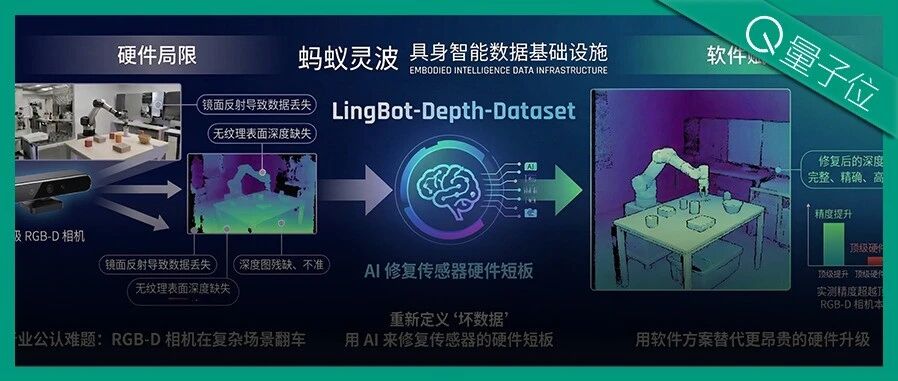
2700GB高质量数据,训出空间智能SOTA,背后秘诀全栈开源
量子位· 2026-03-31 03:06
Core Viewpoint - The article emphasizes that the limitation of spatial intelligence in robotics is primarily due to insufficient data, which affects the generalization ability of models, leading to reliance on hardware solutions [1][2]. Group 1: Data Challenges in Robotics - The lack of reliable data sources has historically forced the industry to compensate by enhancing hardware capabilities, particularly in the use of RGB-D cameras for spatial perception [3][4]. - RGB-D cameras, while popular, face significant challenges in accurately perceiving environments, especially in the presence of reflective or transparent surfaces, which can lead to erroneous data [5][6][9]. Group 2: Introduction of LingBot-Depth-Dataset - Ant Group's LingBot-Depth-Dataset has been introduced as a solution to the data scarcity issue, comprising 2.71TB of data with 3 million pairs of labeled RGB-D data, including real and synthetic data from various environments [11][13][20]. - The dataset's diverse data distribution, collected from multiple depth cameras, enhances its applicability for training models in different scenarios, thus improving generalization [18][19]. Group 3: Advancements in Spatial Intelligence - The deployment of LingBot-Depth has enabled robots to effectively grasp transparent and reflective objects, a task previously deemed challenging [22]. - Following this, Ant Group has released additional models like LingBot-VLA and LingBot-World, which integrate visual, linguistic, and action capabilities, further advancing the field of embodied intelligence [24][25][28]. Group 4: Software vs. Hardware in AI Development - The article highlights a shift in focus within the industry towards prioritizing data and algorithm architecture over merely increasing the number and cost of sensors, as seen in the autonomous driving sector [30][31]. - This approach suggests that enhancing spatial intelligence through software methods can lead to more effective and cost-efficient solutions in robotics, aligning with the broader trend of prioritizing data-driven advancements [29][31].