农产品种植

Search documents
大宗农产品之八:若原油价格上涨,如何影响农产品价格?
GF SECURITIES· 2026-03-01 14:46
Investment Rating - The industry rating is "Buy" [4] Core Insights - The report explores how rising crude oil prices impact agricultural product prices, highlighting the interconnectedness of energy and agricultural markets. It identifies three main transmission mechanisms: the influence of crude oil prices on agricultural input costs, the effect of crude oil substitutes on raw material prices, and the impact on natural rubber prices through synthetic rubber alternatives [2][8][9]. Summary by Sections 1. Introduction - Since 2000, precious metals, base metals, energy, and agricultural products have shown a pattern of correlated price increases during specific periods [15]. 2. Crude Oil and Agricultural Prices - Crude oil prices exhibit synchronous fluctuations with agricultural prices, with a significant correlation observed since 2000 [20][22]. 3. Transmission Mechanisms - **Mechanism One**: Crude oil prices affect the costs of agricultural inputs like fertilizers and pesticides, which are closely linked to oil prices. For instance, nitrogen fertilizers rely on natural gas, which is tied to crude oil prices, while potash and phosphate fertilizers are also influenced by oil-derived chemical products [37][41]. - **Mechanism Two**: The prices of crude oil substitutes, such as ethanol and biodiesel, impact the demand for agricultural products like corn and sugarcane. For example, the price of fuel ethanol is closely related to crude oil prices, affecting the industrial demand for corn in the U.S. and sugarcane in Brazil [45][75]. - **Mechanism Three**: Crude oil prices influence the prices of synthetic rubber, which in turn affects natural rubber prices. The cost of synthetic rubber is significantly determined by the price of its precursor, butadiene, which is derived from crude oil [78][81]. 4. Current Agricultural Price Outlook - The report anticipates a bullish trend for corn and rubber prices due to rising crude oil prices, while soybean prices are expected to remain stable with fluctuations driven by weather and trade policies [9][8]. 5. Investment Recommendations - The report suggests focusing on the agricultural product supply chain, as rising agricultural prices will enhance profitability for producers, benefiting upstream sectors like seed and land resources. Key companies to watch include Longping High-Tech, Denghai Seeds, and Hainan Rubber [9][8].
南美天气或有溢价空间,美豆偏强震荡延续
Guo Xin Qi Huo· 2026-02-27 11:15
1. Report Industry Investment Rating There is no information about the report industry investment rating in the provided content. 2. Core Viewpoints of the Report - In March, there is still room for premium speculation on the weather in South American soybean production areas. The rainfall in central and northern Brazil may affect the harvesting progress, while the drought in southern Brazil and most parts of Argentina will also attract market attention. Although Brazil has a clear expectation of a bumper soybean harvest, the quality is worrying. There is a possibility of a downward adjustment in the soybean production of Brazil and Argentina in the next month. Due to the decline in Brazilian farmers' planting income, the downward space for the premium of Brazilian soybeans is limited [3][32][102]. - In March, the US soybean market enters the resonance period of the old and new crop years. The export and crushing demand of the old crop year are still the focus of the market. At present, US soybean exports have completed 80% of the USDA's estimate, so the possibility of the USDA further reducing US soybean exports has decreased. Due to the significant increase in purchases from non - Chinese regions, there is a possibility of an upward adjustment in US soybean exports in the future. In addition, the further development of China - US economic and trade relations will also boost US soybeans. Relatively speaking, the crushing demand remains good. The tight inventory situation of US soybeans may continue. The market still has differences on the increase in the planting area of US soybeans in the new year. In the future, due to the recovery of export demand, the growth of US soybean inventory is limited, which will boost US soybeans. In the short term, CBOT soybeans are oscillating around 1150 cents per bushel, and there is a possibility of rising to 1200 cents per bushel [4][56][105]. - In March, the supply gap of domestic soybean meal narrows, but there may be a regional and structural mismatch. Although the domestic pig - raising profit continues to be in a loss, the demand for soybean meal does not change much, which makes the spot inventory of soybean meal decline steadily. Due to the expected arrival of imported soybeans in China and the higher inventory of domestic soybean meal than in the same period of 2025, the spot basis of soybean meal may be weaker than that in the same period of last year. Due to the uncertainty of customs policies and domestic imported soybean auction policies, the domestic soybean meal spot in March remains firm, and the basis of soybean meal remains at a high level. The domestic soybean meal market is still affected by the impact of import costs. In March, CBOT soybeans oscillate strongly, there is still a possibility of weather premium in South America, and the tight supply of US soybeans still supports US soybeans. The domestic soybean meal market may maintain a strong oscillation. The main contract should focus on whether it can effectively break through 2850 yuan per ton. If not, it will still oscillate between 2750 yuan per ton and 2850 yuan per ton. In March, the domestic rapeseed meal market faces policy changes. Once the China - US economic and trade relations ease, the supply of rapeseed meal may increase, and the price difference between soybean meal and rapeseed meal is expected to widen. Attention should be paid to policy changes [5][79][106]. 3. Summary According to Relevant Catalogs 3.1 Market Review - In February, CBOT soybeans rose significantly. At the beginning of the month, US President Donald Trump posted on social media that in a phone call with Chinese leaders, the two countries discussed increasing soybean imports to 20 million tons this year. The concerns about US soybean exports were alleviated, and the futures price stopped falling and rebounded sharply. In addition, the expected benefits of the US biodiesel policy for soybean oil also boosted US soybeans. At the same time, heavy rainfall in the Brazilian soybean production area and drought in the Argentine soybean production area promoted the price of US soybeans. Affected by this, the domestic soybean meal market rose slightly, but the increase was far less than that of US soybeans. At the beginning of the month, the low - level oscillation of domestic soybean meal was due to the decline in the premium of Brazilian soybeans, which offset part of the increase in US soybeans. On the other hand, the gradual increase in domestic imported soybeans narrowed the previously estimated supply gap, which alleviated the market's concerns about supply. Around the Spring Festival, with the rise of US soybeans and the news of domestic customs clearance and the resumption of imported soybean auctions, domestic soybean meal rose sharply. In contrast, the domestic rapeseed meal market was slightly stronger than the soybean meal market. The tight supply pattern of domestic rapeseed meal supported the rapeseed meal market. However, after the Spring Festival, the rapeseed meal market oscillated at a high level, and the market's expectation of the improvement of China - Canada trade relations increased, which suppressed the rapeseed meal market [9]. - In February 2026, the prices of major domestic and foreign oilseeds and oils showed different trends. For example, the price of US soybeans increased by 7.94%, the price of US soybean meal increased by 6.96%, and the price of US soybean oil increased by 13.08%. While the price of Malaysian palm oil decreased by 4.40%, and the price of domestic palm oil decreased by 2.44% [12]. 3.2 Protein Meal 3.2.1 Brazil: Abundant Soybean Harvest with Weather Risks - Various institutions have raised their estimates of Brazil's soybean production to over 180 million tons. However, the soybean production areas in Brazil still face weather problems. The southern part of Brazil is threatened by high - temperature and little - rain, while the northern, northeastern, and southeastern regions are affected by heavy rainfall, with frequent disasters such as waterlogging and landslides. The soybean harvest in Rio Grande do Sul may face the risk of a poor harvest, and crop experts have lowered the expected soybean production in Brazil by 1 million tons to 178 million tons [15]. - As of February 21, 2026, the soybean harvest progress in Brazil was 32.3%, lower than the same period last year and the five - year average. The harvest progress in Mato Grosso is faster than in previous years, but heavy rainfall has slowed it down, and the quality of soybeans has been affected. The harvest progress in Paraná is significantly slower than in previous years. Future rainfall may continue to affect the harvest progress and quality [18]. - In February 2026, Brazil's soybean export volume was estimated to be 10.69 million tons, still an increase of 9.9% compared with February last year. Brazil is facing the problem of delayed harvesting, and rainfall also delays port cargo transportation. In addition, there are logistics bottlenecks and port disruptions due to protests [23]. - Since mid - January, the premium of Brazilian soybeans has fallen from a high level. Recently, the appreciation of the Brazilian real has made the planting profit of Brazilian soybeans poor, and farmers' reluctance to sell has increased, suppressing the downward trend of the premium of Brazilian soybeans [25]. 3.2.2 Argentina: Risk of Soybean Yield Reduction - Various institutions estimate that Argentina's soybean production in the 2025/2026 season is between 48 million and 49 million tons. The rainfall in the Argentine agricultural production area is sporadic, and the drought situation cannot be significantly alleviated, which may lead to a decline in crop ratings and a reduction in soybean production [29]. 3.2.3 US Soybeans: Tight Inventory and Uncertain Planting Area - As of the week of February 12, the US soybean sales have completed 82.53% of the USDA's estimate for the 2025/2026 season. Although the export sales are significantly lower than the same period last year, the sales progress meets expectations. However, the export shipment progress is slow, and the real export in the future may still change. Non - Chinese regions' purchases of US soybeans have increased significantly [35][37]. - The US Supreme Court's ruling on tariffs and the US government's subsequent tariff measures may affect China's soybean imports from the US. As the proportion of US soybean export sales exceeds 80%, the probability of the USDA further reducing exports has decreased. If China's purchases increase in the future, there is a possibility of an upward adjustment in exports [43]. - In January, the soybean crushing volume of NOPA member enterprises was 6.03 million tons, the highest in the same period in history. The soybean crushing demand in the US remains strong, and the crushing profit has continued to recover since 2026 [45]. - The USDA estimates that the US soybean planting area in 2026 will increase to 85 million acres, but there are still differences in the market. Historically, the soybean planting intention in March is often lower than the estimate in the February outlook forum. Assuming normal weather conditions, the US soybean production in the 2026/2027 season is expected to increase, and the export and crushing volume will also increase, but the overall growth of inventory is limited, which will support the price of US soybeans [49][55]. 3.2.4 Domestic Soybean Meal: Narrowing Supply Gap with Uncertainties - As of February 24, the procurement progress of soybean shipments in different months is different. From February to April, China will receive 7 million tons of Brazilian and Argentine soybeans. However, the customs clearance time may increase, which may affect the arrival volume in March. Although the total supply of imported soybeans may be higher than in the same period last year, there may be regional structural shortages [57][61]. - The domestic soybean crushing profit has declined significantly. In March, the domestic soybean monthly crushing volume may be between 6.5 million and 7 million tons. The current domestic soybean meal inventory is at a high level in the same period in the past five years, and the unexecuted contracts are also at a high level. Due to the possible decline in the overall crushing volume in March, the soybean meal inventory will decline steadily [63][67]. - Although the domestic soybean meal inventory is high, the demand has not decreased. However, if the loss of pig - raising continues to expand, the demand for soybean meal may decline. In March, the supply of soybean meal is less than the demand, and the inventory will decline steadily. The domestic soybean meal may show a pattern of near - strong and far - weak, spot - strong and futures - weak, and the basis may remain firm [69][75]. - Considering the fluctuations of CBOT soybeans and the relatively strong premium of Brazilian soybeans, the theoretical cost of domestic soybean meal M2605 is between 2750 yuan per ton and 2950 yuan per ton when the crushing profit is zero. The domestic soybean meal market may maintain a strong oscillation, and attention should be paid to whether the main contract can break through 2850 yuan per ton [77][81]. 3.2.5 Domestic Rapeseed Meal: Awaiting Policy Changes - On March 9, the final anti - dumping ruling on Canadian rapeseed in China will be announced. The market speculates that the comprehensive tax rate may be reduced. After March, the supply of Canadian rapeseed and rapeseed meal in China is expected to gradually increase [82]. - The domestic rapeseed crushing profit is very high, especially for Canadian rapeseed. After the rapeseed arrives at the port and clears customs, the domestic rapeseed crushing volume is expected to increase significantly [83]. - The current domestic rapeseed meal inventory is at a low level, and the unexecuted contracts are also significantly lower than in the same period last year. Due to the poor import of Canadian rapeseed and rapeseed meal in the second half of 2025, the demand for domestic rapeseed meal has declined significantly. In March, the demand for rapeseed meal may recover. If the import of rapeseed meal recovers, the demand is expected to return to normal [88][90]. - If the China - Canada economic and trade relations ease and the import of Canadian rapeseed is smooth, the price difference between soybean meal and rapeseed meal is expected to widen [97][100]. 3.3 Conclusion and Operational Suggestions - The international protein meal market in March still has weather - related speculation opportunities. The production of soybeans in Brazil and Argentina may be adjusted downward, and the premium of Brazilian soybeans has limited downward space. The US soybean market is in the resonance period of the old and new crop years. The export and crushing demand of the old crop year are good, and the growth of inventory is limited, which will support the price of US soybeans. The domestic soybean meal supply gap narrows, but there may be a regional and structural mismatch. The basis remains at a high level, and the market may maintain a strong oscillation. The domestic rapeseed meal market faces policy changes, and the supply may increase, and the price difference between soybean meal and rapeseed meal is expected to widen [102][105][106]. - In operation, the idea of range - bound oscillation for soybean meal can be adopted, and the operation of buying at low levels can be carried out. An option strategy of double - selling in the range can also be adopted [107].
我国大豆产能提升关键点:大面积单产提升
Guo Tai Jun An Qi Huo· 2026-02-24 03:47
Report Industry Investment Rating - Not provided in the report Core Viewpoints - The consecutive mention of "large - scale yield per unit area improvement" in the No. 1 Central Documents of 2025 and 2026 is crucial for enhancing China's soybean production capacity. Given limited arable land, increasing soybean yield per unit area is more important than expanding the planting area, and continuous promotion of large - scale soybean yield per unit area improvement is necessary [1][37] - China's soybean yield per unit area has been rising, but there is still a significant gap compared with the global average and other major grain and oil crops. The low yield is due to weak agricultural irrigation infrastructure, poor planting and field management technology, a large gap in mechanization and automation, and slow technology promotion [2][38] - There is a large potential for China to increase soybean yield per unit area. By promoting high - yield, high - oil, and high - protein varieties, supporting planting, field management, and harvesting technologies, and integrating and promoting high - yield and efficient technical models, the goal of an average national soybean yield of 360 jin per mu in 2030 can be achieved, with a compound annual growth rate of about 5.78% from 2026 to 2030 [3][39] Summary by Directory 1. 2026 No. 1 Central Document Continues the Policy of "Promoting Large - Scale Yield per Unit Area Improvement of Grain and Oil Crops" - The 2026 No. 1 Central Document, released on February 3, 2026, proposed to stabilize grain output at around 1.4 trillion jin, and continue to promote large - scale yield per unit area improvement of grain and oil crops and consolidate and enhance soybean production capacity [5] - From 2023 to 2026, the Ministry of Agriculture and Rural Affairs and relevant meetings repeatedly emphasized the policy direction and implementation details of "large - scale yield per unit area improvement". In 2025, the contribution rate of yield per unit area improvement to national grain production increase exceeded 90% [5][7] - Since 2019, the No. 1 Central Document has continuously proposed the policy goal of "expanding soybean planting, stabilizing production, and enhancing production capacity" for eight years. Due to limited arable land, increasing soybean yield per unit area is more important [6] 2. Current Situation and Reasons for China's Soybean Yield per Unit Area Current Situation - In 2025, China's soybean yield per unit area reached a record high of 271.8 jin per mu, with a year - on - year increase of about 1.9%. From 2016 to 2025, the compound annual growth rate was about 1.5% [2][8] - Xinjiang has the highest soybean yield per unit area, followed by the southern regions, while the northern regions, especially Heilongjiang and Inner Mongolia, have relatively low yields. In 2022, Xinjiang's soybean yield per unit area was about 403 jin per mu, higher than the global average [8][9] - Globally, in 2025/26, China's soybean yield per unit area was about 271 jin per mu, ranking 21st, far lower than the global average of 396 jin per mu. It is also lower than other major grain and oil crops such as corn, wheat, rapeseed, sunflower seeds, and peanuts [9][21] Reasons - Weak agricultural irrigation infrastructure, such as low irrigation coverage and a large proportion of medium - and low - yield fields, leads to poor soil water - storage and moisture - retention capacity [31] - Low - quality planting and field management technologies, including unbalanced fertilization, unreasonable planting density, and lagging pest control technologies, result in low production efficiency and resource waste [31] - There is a significant gap in mechanization and automation. For example, the seeding machine in Northeast China has a high missing - seeding rate, and the harvester has a high loss rate [31] - Slow technology promotion and a lagging effect on yield per unit area improvement are due to problems in the agricultural technology service system and small farmers' technology adoption [31] Reasons for Low Yields in Heilongjiang and Inner Mongolia - In Heilongjiang, small farmers have a low rate of proper planting technology application, and there are significant differences among different accumulated temperature zones and production subjects. There is a large yield gap between large - scale production and variety regional and production trials [32] - In Inner Mongolia, climate factors, such as uneven precipitation distribution, limited large - scale operation, and a large area of continuous cropping, restrict the increase in soybean yield per unit area [32][33] 3. Paths and Goals for China's Large - Scale Soybean Yield per Unit Area Improvement Paths - Promote high - yield, high - oil, and high - protein soybean varieties. Recommend representative varieties for different regions according to ecological conditions, planting systems, and market demands [34] - Support planting, field management, and harvesting technologies, such as dense planting and water - fertilizer regulation technology, formula fertilization technology, etc. [34] - Integrate and promote high - yield and efficient technical models, such as the "ridge - three - cultivation" technology in Northeast China, which can increase soybean production by over 10%, and the corn - soybean strip intercropping technology [34] Goals - Nationally, the average soybean yield per mu is targeted to reach 360 jin per mu in 2030, with a compound annual growth rate of about 5.78% from 2026 to 2030 [3][35] - In Heilongjiang, the yield per mu targets are 266 jin in 2025 and 320 jin in 2030, with a compound annual growth rate of about 3.77% from 2026 to 2030 [35] - In Inner Mongolia, the yield per mu targets are 270 jin in 2025 and 320 jin in 2030, with a compound annual growth rate of about 3.46% from 2026 to 2030 [36]
住琼全国政协委员:从源头上守好乡亲们的饭碗
Hai Nan Ri Bao· 2026-02-24 02:56
Core Viewpoint - The article highlights the successful transformation of Xingwu Village in Lingshui Li Autonomous County through diversified agricultural practices and rural tourism, leading to increased income for local residents and sustainable development [2][3]. Group 1: Agricultural Development - Xingwu Village has shifted from being a poverty-stricken area to a thriving community by developing diverse agricultural products such as mangoes, lychees, longans, and winter vegetables, resulting in an increase in per capita annual income to 22,300 yuan [2]. - The village has implemented an insurance policy for mango production, providing financial security to farmers despite challenges like late fruiting and reduced yield [2]. - The introduction of a "flying land" cooperation model has allowed the village to explore aquaculture and other agricultural projects, contributing to a collective economic income exceeding 800,000 yuan annually [2]. Group 2: Rural Tourism and Community Engagement - The establishment of the "Lotte Return Home" tortoise farm has become a popular family-friendly tourist destination, enhancing local tourism and creating job opportunities for residents [3]. - The village has adopted a "rent-sharing and employment" model with the farm, which has led to steady growth in collective income and stimulated various business activities [3]. - Local residents have diversified their income sources by selling homegrown fruits and creating experiential activities, such as fruit-picking and cultural crafts, which have attracted more visitors [3]. Group 3: Environmental and Agricultural Policy Advocacy - Huang Liping, a local leader, has been actively advocating for sustainable agricultural practices, including the establishment of a green pest control demonstration base for cowpeas, which aims to reduce pesticide use and improve crop quality [4]. - The focus on environmental protection is emphasized, with recommendations for better management of herbicide use and groundwater monitoring to ensure long-term agricultural viability [4]. - Huang Liping aims to leverage national platforms to learn from successful agricultural branding cases to enhance local product marketing and increase farmers' income [5].
数字助农贺新春
Xin Lang Cai Jing· 2026-02-22 01:30
Core Insights - The article highlights the successful implementation of the "One Product, One Broadcast" initiative in Feixiang District, which has significantly boosted local agricultural sales through innovative e-commerce strategies [1][2] - The integration of live streaming with agricultural production has created a vibrant marketplace for local products, particularly enzyme tomatoes, during the Spring Festival [1][2] Group 1: E-commerce Strategy - The "One Product, One Broadcast" initiative combines local agricultural products with live streaming to enhance sales, showcasing enzyme tomatoes and other specialty products [1][2] - The initiative has led to a lively interaction in live streaming sessions, where hosts demonstrate the quality and taste of the products, resulting in increased consumer engagement and sales [1] Group 2: Agricultural Development - Feixiang District has developed a comprehensive e-commerce ecosystem that includes a public service center, live streaming bases, and participation from various rural and market entities [2] - The district aims to transform local agricultural products into well-known brands, leveraging digital marketing to drive rural economic growth and modernization [2]
乡土田埂上的“希望年”
Xin Lang Cai Jing· 2026-02-19 23:03
Group 1 - The article highlights the integration of traditional farming customs with the festive atmosphere of the New Year in Peiwang Village, Henan Province, showcasing a vibrant rural culture [1] - The village employs a dual-crop farming model through the promotion of corn and soybean intercropping, which enhances agricultural efficiency and ensures high-quality soybean production for local farmers [1] - The practice of making tofu is emphasized as a significant New Year activity, symbolizing good fortune and prosperity, reflecting the cultural importance of food in local traditions [1] Group 2 - The article describes the preparations for the New Year, including cleaning farming tools and decorating with red cloth, which signifies good wishes for the upcoming year [2] - The celebration of traditional customs, such as hanging spring couplets and window decorations, illustrates the blend of ancient agricultural practices with modern innovations, contributing to a vibrant rural community [2] - The narrative emphasizes the role of festive traditions in fostering a sense of hope and anticipation for agricultural prosperity in the coming year, aligning with the broader goals of rural revitalization [2]
“新农人”聊聊新农业(视频)
Zhong Guo Jing Ji Wang· 2026-02-17 02:03
Core Insights - The "Sharing Harvest Farm" in Liuzhuanghu Village, Shunyi District, Beijing, operates efficiently due to the collective ownership system, which simplifies land leasing and management [1] - In 2024, the collective economic income of Liuzhuanghu Village is projected to reach 3.62 million yuan, a 43% increase year-on-year, with an average income of approximately 21,500 yuan per household [1] - The farm utilizes a digital system for precise supply and demand matching, achieving a 90% match rate for agricultural products [1] Group 1 - The collective ownership model allows for unified negotiation and leasing of land, facilitating centralized planning and management [1] - The farm's operational efficiency is enhanced by a digital e-commerce system that connects production directly to consumers [1] - The farm has accumulated nearly 300,000 members on its retail platform, allowing for effective distribution of unsold products [1] Group 2 - A scientific planting prediction model has been developed based on over ten years of customer order data, enabling accurate forecasting of crop needs [2] - The model predicts specific quantities of crops needed for the upcoming years, guiding the farm's planting plans to align with market demand [2] - This data-driven approach allows the farm to implement a production strategy based on sales forecasts, ensuring that planting is demand-driven [2]
分红过万!尼木藏香订单排到元宵节!
Xin Lang Cai Jing· 2026-02-14 16:40
Core Viewpoint - The integration of traditional Tibetan incense craftsmanship with modern agricultural practices is driving economic growth and improving the livelihoods of local farmers in Nimu County, showcasing a successful model of cultural heritage and innovation [2][10]. Group 1: Traditional Craftsmanship and Economic Impact - The Tibetan incense-making technique, part of the "Nimu Three Treasures," has over 1,300 years of history and is being revitalized by new generations through innovative methods, leading to increased income for local farmers [2][3]. - The modern agricultural industry park in Nimu County is enhancing the production and sales of traditional crafts, allowing farmers to benefit financially from their heritage [10][13]. Group 2: Agricultural Innovation and Employment - The establishment of smart greenhouses and the introduction of advanced agricultural techniques have transformed previously barren land into productive farming areas, significantly increasing farmers' incomes [5][7]. - In 2025, the agricultural park is projected to produce 479 tons of various crops, generating an income of 6.36 million yuan and creating 87 jobs, with an average income increase of 25,000 yuan per person [7]. Group 3: Future Development Plans - Nimu County plans to further support the upgrade of intangible cultural heritage cooperatives, expand e-commerce and cultural creative development, and promote high-standard farmland construction to ensure steady income growth for farmers [11].


再造新汕尾 县域主官谈|访华侨管理区党委书记、管委会主任林永长
Xin Lang Cai Jing· 2026-02-14 05:05
Core Viewpoint - The article emphasizes the strategic goal of "Rebuilding a New Shanwei" as part of the city's development plan, highlighting the importance of collaboration and practical measures to achieve modernization and growth in the region [1]. Group 1: Industrial Development - The focus is on enhancing the agricultural sector by promoting local specialties, establishing leading enterprises, and developing a standardized production system for agricultural products [4]. - Projects such as food industrial parks and agricultural product logistics markets are being prioritized to create a high-quality agricultural supply chain [4]. - The development of new industries like renewable energy and new materials is also a key focus, aiming to build a modern industrial system unique to the area [4]. Group 2: Innovation and Technology - There is a strong push for the transformation and upgrading of traditional industries through green manufacturing and technological improvements [6]. - The establishment of a comprehensive quality tracking system for local agricultural products is being implemented to enhance productivity and efficiency [6]. - Talent recruitment initiatives are being expanded to support innovation and technological advancement in the region [6]. Group 3: Governance and Reforms - The article discusses the implementation of streamlined administrative processes to improve service efficiency for businesses and residents [7]. - Efforts are being made to integrate with the Guangdong-Hong Kong-Macao Greater Bay Area, facilitating industrial collaboration and resource sharing [7]. - The establishment of incubation bases for overseas Chinese enterprises is aimed at fostering deeper integration with local industries [7]. Group 4: Social Welfare and Community Development - There is a commitment to improving living conditions through infrastructure development, including waste management and water treatment facilities [8]. - Investments in education and healthcare are being prioritized to enhance service quality and community well-being [8]. - Cultural initiatives are being promoted to strengthen community ties and celebrate local heritage [8]. Group 5: Party Leadership and Governance - The article highlights the importance of strengthening grassroots party organizations to ensure effective governance and community engagement [8]. - Measures are being taken to enhance legal governance and public safety, contributing to a stable and secure environment for residents [8]. - The focus on a clean political atmosphere is emphasized to foster trust and cooperation within the community [8].
内江生姜最快14天直达荷兰市场
Xin Lang Cai Jing· 2026-02-13 18:33
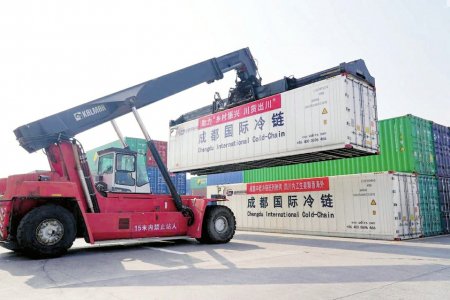
Core Insights - The cross-border cold chain transportation plan by Sichuan Runhe Agricultural Technology Co., Ltd. successfully commenced, transporting fresh ginger from Neijiang to Tilburg, Netherlands, via the Chengdu-Europe Express Railway [2][3] - This initiative is part of Chengdu International Railway Port's efforts to help agricultural enterprises expand into international markets, providing a seamless supply chain service [2][3] Group 1: Transportation Advantages - The cold chain transportation utilizes specialized containers equipped with independent refrigeration units and temperature monitoring systems, maintaining temperature fluctuations within ±2°C to ensure product freshness [2] - Compared to traditional sea freight, the Chengdu-Europe Express cold chain transportation significantly reduces transit time by 40% to 50%, saving over two-thirds of the time [2] - The cost-effectiveness of this solution is notable, saving 60% to 70% compared to air freight, thus enhancing the competitiveness of Sichuan agricultural products in international markets [3] Group 2: Economic Impact - The cold chain container base is expected to ship 200 containers annually, with plans to expand operations to cities like Moscow in the future [3] - The increase in Neijiang ginger exports is anticipated to boost local ginger cultivation, encouraging more farmers to engage in standardized planting and increasing their income [3] - The Chengdu-Europe Express Railway is positioned as a vital logistics channel for rural revitalization, facilitating the export of various Sichuan specialty agricultural products to the Eurasian market [3]