
西式快餐

Search documents
汉堡王和麦当劳成了“远房亲戚”?
3 6 Ke· 2025-11-12 04:07
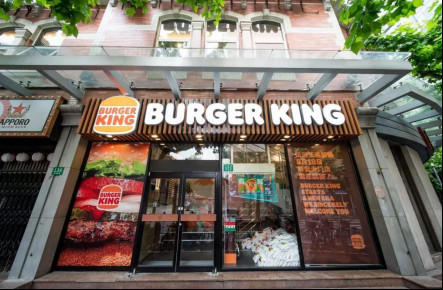
Core Insights - Burger King's Chinese operations have been sold to a private equity firm, CPE Yuanfeng, which will hold approximately 83% of the new joint venture, with RBI retaining about 17% [1][9][12] - The transaction is expected to be completed by the first quarter of 2026 [1] Financial Performance - In Q3 2025, Burger King China reported a same-store sales growth of 10.5%, with system sales reaching approximately $1.72 billion (around 12.25 billion RMB) [2] - The company has been closing underperforming stores, reducing its total from 1,467 to 1,271 over the past six months [2][6] - System sales have declined from $804 million in 2023 to $668 million in 2024, and further down to $481 million in the first three quarters of 2025 [6] Competitive Landscape - Burger King's store count in China is significantly lower than its competitors, with KFC having over 12,000 stores and McDonald's nearing 8,000 [6] - The average annual sales per store for Burger King China were approximately $400,000, ranking it last among its top ten global markets [6] Strategic Changes - RBI Group has taken back operational control of Burger King China from TFI Group, which had been managing the brand since 2012 [7][12] - CPE Yuanfeng plans to invest the initial $350 million to support store expansion, marketing, menu innovation, and operational improvements [9][12] - The goal is to expand Burger King's store count in China to over 4,000 within the next ten years [12] Industry Trends - There is a growing trend of international restaurant brands selling their Chinese operations to local partners to better compete with domestic brands [13][14] - The shift from direct management to joint ventures or franchising is seen as a way to adapt to the fast-changing Chinese market [14][15]

汉堡王中国在新股东入场后该怎么变?
Xin Lang Cai Jing· 2025-11-11 14:15
Core Insights - Burger King's development direction in China has become clearer with the partnership with CPE Yuanfeng Capital, which will inject $350 million to support expansion and operations [1][2] - The goal is to increase the number of Burger King stores in China from approximately 1,250 to over 4,000 within ten years, aiming for sustainable same-store growth [1][12] Company Strategy - The partnership with CPE Yuanfeng Capital will allow Burger King to leverage local market knowledge and resources for better operational efficiency [4][10] - CPE Yuanfeng Capital has a strong background in consumer investments, having invested over 10 billion yuan in various well-known companies, which may provide valuable insights and support for Burger King's operations in China [5][10] Market Positioning - Burger King currently faces significant competition from established players like McDonald's and KFC, particularly in terms of store count and market penetration [6][7] - Over 80% of Burger King's stores are located in tier-2 cities and above, while competitors have a more balanced presence in lower-tier cities, indicating a need for market expansion [7] Operational Challenges - The company has faced challenges with profitability, as evidenced by reports of franchisees struggling with promotional pricing leading to high food cost ratios [7] - There is a need for supply chain improvements, as Burger King lacks large-scale logistics and production facilities compared to competitors [8] Future Outlook - CPE Yuanfeng Capital plans to enhance Burger King's operations through product upgrades, brand marketing, store expansion, and digital transformation [12] - The company has seen a 10.5% increase in same-store sales in the third quarter, indicating positive momentum, although the target of 4,000 stores in ten years is considered conservative [12]
2025Q3餐饮行业季度观察
Tai Mei Ti A P P· 2025-11-07 10:08
Group 1 - The restaurant industry in China is entering a phase of rational growth and high-quality competition, with a decline in the growth rate of the overall economy observed in the third quarter of 2025 [2][4] - The national restaurant industry prosperity index showed a significant increase in July and August due to summer vacations and graduation season, but fell to 98.0 in September, a decrease of 14.5% month-on-month [5][8] - Key segments such as Chinese dining, hot pot, barbecue, fast food, and ready-to-drink beverages all experienced a decline in their prosperity indices in September after rising in July and August [9][11] Group 2 - The number of stores in major segments showed a slight decline in the third quarter, with only the ready-to-drink beverage segment experiencing continuous growth over three quarters [12][15] - The average consumer spending in the restaurant sector increased slightly to 33.0 yuan in the third quarter, with variations across different segments [16][18] Group 3 - In the third quarter, 330 brands were monitored, with 235 brands launching a total of 3,039 new products across six major segments [19] - The Western fast food segment saw the highest number of new products, with 301 items launched, primarily focusing on spicy flavors [20][21] - The noodle segment introduced 127 new products, with nearly 60% being noodle dishes, emphasizing regional flavors [22][24] - The tea beverage segment launched 756 new products, with a focus on seasonal fruits and floral elements [27][28] - The coffee segment introduced 548 new products, with a notable emphasis on fruit and floral ingredients [29][31] - The bakery segment saw 1,025 new products, with a significant number related to traditional Chinese pastries due to the Mid-Autumn Festival [32][34] - The hot pot segment introduced 282 new products, focusing on ingredient sourcing and innovative uses of lesser-known ingredients [36][37] Group 4 - The quarterly new rising restaurant brands highlighted six brands that excelled in expansion, marketing, and product innovation [38][41] - The quarterly supply chain new products emphasized quality upgrades, diverse flavors, and technological empowerment in product innovation [42][43]
《餐饮行业季度观察报告(2025年Q3)》发布
3 6 Ke· 2025-11-07 07:57
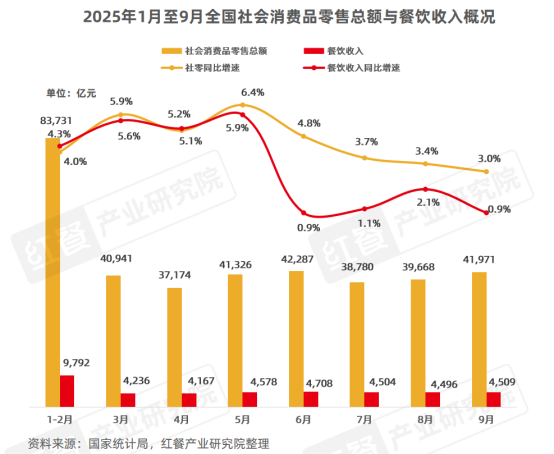
Core Insights - The report analyzes the development of the restaurant industry in Q3 2025, highlighting the performance of six major dining segments and new product launches [1][2] Industry Overview - The restaurant industry in China is experiencing a phase of rational growth and high-quality competition, with a decline in the growth rate of the overall economy [3] - National retail sales growth slowed from 3.7% to 3.0% from July to September 2025, indicating a broader economic trend [3] - Restaurant revenue growth also showed fluctuations, with a year-on-year increase of only 0.9% in September 2025 [5] Restaurant Industry Prosperity Index - The national restaurant prosperity index increased in July and August due to summer vacations and graduation season but fell to 98.0 in September, a decrease of 14.5% month-on-month [6][9] - Key dining segments such as Chinese dining, hot pot, barbecue, fast food, and ready-to-drink beverages all experienced a decline in their prosperity indices in September [10][12] Store Count and Consumer Spending - The number of stores in major segments showed a slight decline, with only the ready-to-drink beverage segment experiencing continuous growth over three quarters [13][16] - The average consumer spending in the restaurant sector rose slightly to 33.0 yuan in Q3 2025, with variations across different dining segments [18] New Product Launches - A total of 330 brands were monitored, with 235 brands launching 3,039 new products in Q3 2025 [19] - The Western fast food segment led with 301 new products, primarily focusing on spicy flavors [20][22] - The noodle segment saw 127 new products, with a strong emphasis on regional flavors [23][25] - The tea beverage segment introduced 756 new products, with a focus on seasonal fruits and floral elements [27][28] - The coffee segment launched 548 new products, highlighting the use of fruit and floral ingredients [29][31] - The bakery segment released 1,025 new products, with a significant focus on traditional Chinese pastries due to the Mid-Autumn Festival [35][33] - The hot pot segment introduced 282 new products, emphasizing ingredient sourcing and innovative uses of lesser-known ingredients [35][36] Emerging Brands and Supply Chain Innovations - The report features "Quarterly Emerging Restaurant Brands" and "Quarterly Supply Chain New Products," showcasing brands that have excelled in expansion, marketing, and product innovation [37][38] - Notable emerging brands include Puda Uncle's Rice and Wild Man, which have rapidly expanded their store counts [41] - Supply chain innovations focus on product quality, flavor diversity, and technological enhancements to meet diverse consumer needs [43]

东北证券:维持百胜中国“买入”评级 同店表现领先行业 股东回报指引上调
Zhi Tong Cai Jing· 2025-11-06 08:16
Core Viewpoint - Company is positioned as a leading local fast-food brand in China with strong shareholder returns and a focus on expanding into lower-tier markets through a small-town model [1][2] Financial Performance - In Q3 2025, the company reported total revenue of $3.21 billion, with a currency-adjusted growth of 4%, aligning with market expectations [1] - Adjusted operating profit reached $400 million, exceeding market expectations of $398 million, with a currency-adjusted growth of 8% [1] - Adjusted net profit for Q3 was $282 million, resulting in an adjusted net profit margin of 8.8% [1] Sales and Store Expansion - As of Q3 2025, the company operated 17,514 stores, including 12,640 KFC, 4,022 Pizza Hut, and 852 other brand locations [2] - In Q3, the company opened a net of 536 new stores, with KFC and Pizza Hut contributing 402 and 158 new openings, respectively [2] - The company aims to complete 1,600-1,800 new store openings for the year, having achieved nearly 70% of this target by Q3 [2] Shareholder Returns - In Q1-Q3 2025, the company returned $950 million to shareholders, including $268 million in dividends and $682 million in share buybacks [2] - The company plans to return $3 billion to shareholders from 2025 to 2026, with a target of $1.5 billion for the current year, resulting in an annual return rate of approximately 9% based on the latest market capitalization [2] Digital and Operational Efficiency - The company benefits from raw material price advantages, digital empowerment in delivery services, and operational streamlining, which are expected to drive marginal improvements in the single-store model [1]

谁将接盘汉堡王中国?母公司高层到沪密会潜在买家
Guan Cha Zhe Wang· 2025-11-03 13:31
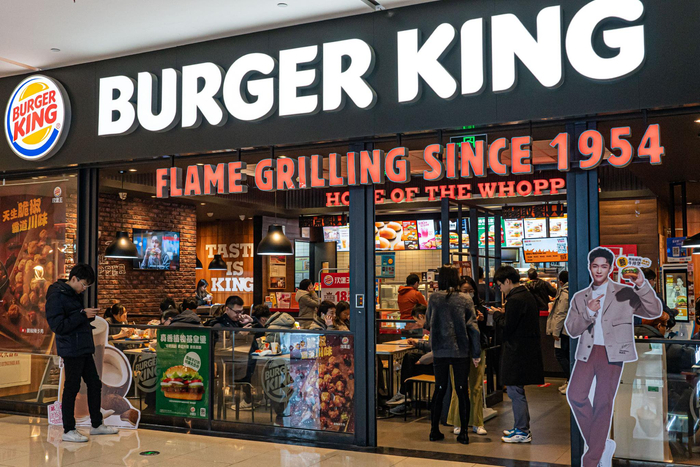
Core Viewpoint - The sale of Burger King's China business is progressing as the company seeks new local partners to revitalize its operations in the competitive market [1][11]. Company Overview - Burger King, founded in 1954 in Miami, gained popularity with its flagship product, the Whopper, which sells over 210 million units globally each year [3]. - The brand entered the Chinese market in 2005, initially opening only 52 stores in the first seven years, but expanded rapidly after 2012 under TFI Group's exclusive franchise, opening over 900 stores in six years [3]. Market Challenges - Burger King faces increasing competition from local fast-food brands and established players like McDonald's and KFC, which have adapted more effectively to local tastes [3]. - The brand's unique "flame-grilled" flavor has not been enough to maintain its market position, as it struggles with marketing and product innovation compared to competitors [3][4]. Financial Performance - In 2024, Burger King's restaurant count in China decreased by approximately 100 basis points, with lower average sales per store compared to other markets [4][6]. - As of 2024, Burger King China ranked eighth in revenue among RBI's international markets, with system sales of approximately $700 million and an average annual sales per store of about $400,000, significantly lower than in France and Korea [6]. Store Count and Competition - Burger King had around 1,300 stores in China, down from 1,587 at the end of 2023, indicating a trend of negative growth in store numbers [6]. - Competitors like Wallace and KFC have significantly more stores, with Wallace leading at 19,648 locations [7]. Strategic Changes - In February, RBI announced the acquisition of TFI Group's stake in Burger King China for $158 million, ending their partnership early due to unsatisfactory market performance [8]. - To improve operations, RBI is seeking new local partners and has appointed experienced executives to its management team to enhance local market strategies [8][10]. Recent Developments - Recent financial reports indicate a 10.5% year-over-year increase in same-store sales for Q3 2025, with total system sales reaching approximately 1.224 billion RMB [10]. - The new local management team is credited with driving improvements through enhanced marketing and product offerings [10]. Future Outlook - The success of Burger King's revitalization efforts in China hinges on the selection of a new local partner, with private equity firms reportedly interested in acquiring significant stakes [11].

80后福建老板6年狂开万店,“县城汉堡”还要冲上市?
3 6 Ke· 2025-10-20 03:23
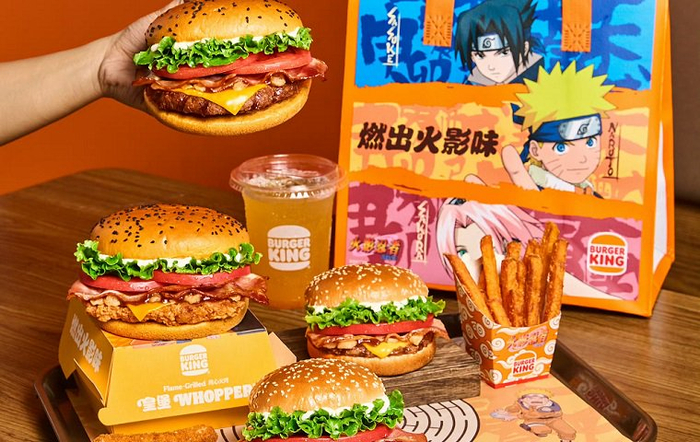
Core Insights - Tasting has officially surpassed 10,000 stores, becoming the second Chinese burger brand to join the "10,000 store club" after Wallace, with a total of 10,160 stores as of October 13, 2025 [1][3] - The rapid expansion of Tasting, which started in 2019, has seen a significant increase in new store openings, with 3,772 new stores in 2023, although the pace is expected to slow down in 2024 [1][3][7] - Tasting's business model relies heavily on franchising, which has raised concerns about maintaining service quality and profitability among franchisees [2][9] Store Expansion - Tasting's store count reached 10,160 across 27 provinces and 287 cities by October 2025, with a notable increase in new openings from 447 in 2021 to 3,772 in 2023 [1][3][7] - The company plans to increase the franchise fee from 369,800 yuan to 452,300 yuan starting in 2024, while also raising the requirements for new franchisees [4][9] - Despite a slowdown in new store openings, Tasting's growth rate remains higher than that of established competitors like McDonald's and KFC, which took 38 and 35 years, respectively, to reach similar store counts [7][8] Financial Performance - Tasting is projected to achieve revenues of 5 billion yuan in 2023, supported by franchise fees and management fees from franchisees [3][9] - The company has undergone significant ownership changes, with a new Hong Kong entity taking full control, which may be related to plans for an IPO [9] Market Competition - Tasting's competitive edge, characterized by its affordable pricing and focus on lower-tier markets, is being challenged by major players like KFC and McDonald's, which are also targeting these markets with aggressive pricing strategies [10] - The introduction of a "9.9 yuan era" in the fast-food industry has diminished Tasting's previous pricing advantages, necessitating a reevaluation of its market strategy [10] - Franchisees are facing increasing operational pressures due to heightened competition and the recent surge in delivery service subsidies, which have further strained profitability [10]
东吴证券晨会纪要-20251014
Soochow Securities· 2025-10-13 23:31
Macro Strategy - The report indicates that the economic situation is influenced by the upcoming measures for counter-cyclical adjustments, with a focus on the timing of restarting government bond trading and the potential for interest rate cuts depending on the economic outlook for Q4 2025 [1][12][13] - The ECI supply index is at 49.99%, showing a slight decline, while the demand index is at 49.91%, indicating a mixed economic recovery influenced by the recent holidays [12][13] - The report highlights the potential limited impact of Trump's renewed tariff threats on the US economy, while emphasizing the need to monitor retaliatory measures and the escalation of trade conflicts into critical sectors like rare earths and semiconductors [1][12][14] Fixed Income - The report discusses the recent issuance of secondary capital bonds, with one bond issued at a scale of 1.2 billion yuan, and a total trading volume of approximately 44.5 billion yuan, which is a significant decrease from the previous week [3][20] - It notes the issuance of green bonds totaling approximately 15.25 billion yuan, with a decrease in trading volume to 41.8 billion yuan, indicating a cooling in the market [4][21] - The report suggests that investors should prioritize controllable pullbacks in convertible bonds and focus on performance improvement or valuation recovery rather than getting caught up in clause negotiations [15][18] Company Analysis - Hong Kong Travel (00308.HK) is focusing on core profitable businesses by divesting its tourism real estate assets, with projected net profits of 270 million, 420 million, and 600 million HKD for 2025-2027, corresponding to PE ratios of 31, 20, and 14 times [5][7] - Guangyang Co., Ltd. (002708) is expected to achieve revenues of 2.774 billion, 3.700 billion, and 4.795 billion yuan, with net profits of 108 million, 218 million, and 363 million yuan for 2025-2027, indicating a recovery in profitability and new growth opportunities in FPC, low-altitude economy, and humanoid robots [8] - Hengyi Petrochemical (000703) anticipates net profits of 430 million, 650 million, and 820 million yuan for 2025-2027, benefiting from the recovery of the polyester industry and the upcoming production of its Qinzhou project [9] - Rongsheng Petrochemical (002493) is projected to have net profits of 1.9 billion, 2.9 billion, and 4.1 billion yuan for 2025-2027, with a focus on benefiting from stable growth policies in the petrochemical sector [11]
雀巢中国研发“一号位”变动;1月至8月全国铁路发送旅客32亿人次
Mei Ri Jing Ji Xin Wen· 2025-09-17 23:24
Group 1: Nestlé's Management Changes - Nestlé is optimizing its R&D model in Greater China to support transformation and accelerate development, with a new appointment effective from October 1, 2025 [1] - The new R&D head, Guglielmo Bonora, has extensive experience across multiple regions and categories, indicating a strategic shift in Nestlé's approach in the competitive Chinese market [1] - This management change aims to enhance innovation speed and product competitiveness, aligning with local consumer demands [1] Group 2: Railway Passenger Growth - From January to August, China's railway system transported 3.2 billion passengers, marking a 6.7% year-on-year increase and setting a historical record for the same period [2] - The average daily operation of passenger trains increased by 7.7%, reflecting sustained growth in capacity [2] - The introduction of tourism trains and cross-border passenger services has stimulated consumption and contributed to the development of the tourism and silver economy [2] Group 3: Subway's Localization Strategy - Subway launched a new sandwich line that incorporates traditional Chinese flavors, marking its first collaboration with a Michelin-starred chef [3] - This initiative reflects Subway's commitment to localization and its strategy to cater to Chinese consumer preferences for fresh and healthy food [3] - The introduction of the "Chinese flavor" sandwiches is expected to enhance Subway's competitiveness in the Chinese market [3] Group 4: Chaohongji's IPO Plans - Chaohongji has submitted an application for an "A+H" listing on the Hong Kong Stock Exchange, indicating an aggressive strategic expansion [4] - The company aims to raise funds for overseas expansion, brand upgrades, and capacity building amid a competitive jewelry market [4] - Chaohongji's strong revenue and profit growth in the first half of 2025, along with its innovative product offerings, position it favorably for investor interest [4] Group 5: Ctrip's Customer Protection Measures - Ctrip announced it will cover losses incurred by customers due to the postponement of the Disney cruise, demonstrating its commitment to consumer rights [5] - This decision may increase short-term costs but is expected to enhance brand image and customer loyalty in the long run [5] - By addressing this issue proactively, Ctrip aims to strengthen user engagement and solidify its position in the online travel market [5]

雀巢中国研发“一号位”变动;1月至8月全国铁路发送旅客32亿人次丨消费早参
Mei Ri Jing Ji Xin Wen· 2025-09-17 23:21
Group 1 - Nestlé is optimizing its R&D model in Greater China to support transformation and accelerate development, with a leadership change in the R&D department [1] - The new R&D head, Guglielmo Bonora, has extensive experience across multiple regions and categories, which aligns with Nestlé's strategic focus on innovation and local market needs [1] - This leadership transition is expected to enhance product competitiveness and help Nestlé regain growth advantages in the competitive Chinese food and beverage market [1] Group 2 - From January to August, China's railway system transported 3.2 billion passengers, marking a historical high with a year-on-year increase of 6.7% [2] - The average daily operation of passenger trains increased by 7.7%, indicating sustained growth in capacity and effective demand management through big data analysis [2] - The rise in cross-border passenger transport and tourism train operations is expected to stimulate consumption and contribute to the development of the tourism and silver economy [2] Group 3 - Subway introduced a new sandwich line that combines traditional Chinese flavors, marking a significant step in its localization strategy [3] - The collaboration with Michelin-starred chefs to create the "Zhi Zi Kao Rou" flavored sandwich reflects Subway's commitment to catering to local tastes and preferences [3] - This product innovation aims to enhance brand competitiveness in the Chinese market by meeting consumer demands for fresh and healthy food options [3] Group 4 - Chao Hong Ji has submitted an IPO application to the Hong Kong Stock Exchange, aiming for a dual listing in A+H shares [4] - The move indicates a proactive strategic approach to expand financing channels for overseas growth, brand upgrades, and capacity building in a competitive jewelry market [4] - The company has shown strong revenue and profit growth in the first half of 2025, alongside notable performance in IP collaborations and product innovation [5] Group 5 - Trip.com announced it will cover losses for customers affected by the postponement of the Disney cruise, demonstrating a commitment to consumer rights [6] - While this may increase short-term costs, it is expected to enhance brand image and customer loyalty in the long run [6] - The crisis management approach aims to strengthen user engagement and attract potential customers, solidifying Trip.com's position in the online travel market [6]