轻工业

Search documents
《河南省钢铁产业提质升级行动计划》印发:到2027年企业盈利能力明显提升
Di Yi Cai Jing· 2025-10-30 03:31
Core Viewpoint - The "Henan Province Steel Industry Quality Improvement and Upgrading Action Plan" aims to enhance the efficiency, innovation, and environmental performance of the steel industry by 2027, focusing on resource integration, technological upgrades, and the establishment of a modern steel industry system [1][3][4]. Group 1: Overall Requirements - The plan targets the construction of a modern steel industry system with high-end, intelligent, and green development, aiming to eliminate inefficient production capacity and enhance profitability and innovation by 2027 [4][5]. - By the end of 2025, all production capacity below the energy efficiency benchmark will undergo technological upgrades or be eliminated, with a goal of achieving ultra-low emissions [4][5]. Group 2: Key Tasks - **Optimize Industrial Layout**: The plan emphasizes controlling total steel production capacity and guiding it towards regions with strong resource and market advantages, while promoting integrated layouts among steel, coking, and sintering industries [5][6]. - **Accelerate Enterprise Restructuring**: Support for advantageous enterprises to integrate steel resources through various methods, including capital increases and mixed ownership reforms, is encouraged [5][6]. - **Strengthen Industrial Regulation**: The plan includes a graded evaluation of enterprises to promote breakthroughs in safety, energy conservation, and environmental protection [6][7]. Group 3: Product Structure Upgrade - **Enhance Technological Innovation**: The plan aims to strengthen the research and development capabilities of major innovation platforms and promote the development of high-end steel products [8][9]. - **Develop a Distinctive Product System**: It focuses on adjusting product structures to enhance market supply and build a competitive product system, particularly in high-end steel products [9][10]. Group 4: Green and Intelligent Transformation - **Promote Equipment Upgrades**: The plan supports the upgrade of compliant production equipment and encourages the implementation of capacity replacement projects [10][11]. - **Enhance Green and Low-Carbon Levels**: New and expanded steel projects must meet energy efficiency and environmental performance standards, with a shift towards electric arc furnace short-process steelmaking [10][11]. Group 5: Policy Support and Industry Ecosystem - **Strengthen Policy Support**: The plan emphasizes the role of financial institutions in supporting the steel industry's transformation and development through various financing methods [12][13]. - **Encourage Industry Self-Regulation**: The steel industry association is tasked with guiding enterprises to adhere to national policies and avoid disorderly competition [12][13].
注重以质取胜、强化数智赋能 轻工业优化供给扩消费
Jing Ji Ri Bao· 2025-10-29 00:59
Core Insights - The Ministry of Industry and Information Technology, the Ministry of Commerce, and the State Administration for Market Regulation jointly released the "Light Industry Stabilization and Growth Work Plan (2025-2026)", emphasizing the role of light industry in stabilizing growth, promoting consumption, and benefiting people's livelihoods [1][2] - The plan aims to address structural contradictions in consumption supply and enhance the quality and reasonable growth of light industry, providing strong support for industrial stability and consumption recovery [1][2] Summary by Sections Economic Performance - In the first seven months of this year, the revenue of large-scale light industry reached 13.2 trillion yuan, with profits of 760.1 billion yuan, and an industrial added value growth of 6.7% year-on-year [2] - The plan sets a growth target focused on stability, which is crucial for responding to complex international situations, while the industry possesses the capability to achieve these goals [2] Product Supply Optimization - The light industry is a major production sector in China, but it faces challenges such as supply structure imbalance and insufficient high-quality supply [3] - The plan proposes three key measures: accelerating product innovation, enhancing quality assurance, and strengthening brand cultivation [3] Digital Transformation - Companies like Luhua Group and Shandong Haihua are leveraging digital transformation to enhance operational efficiency and overall benefits [4] - The digitalization rate of light industry enterprises for R&D design tools reached 86.2%, with management digitalization at 82.3%, indicating a solid foundation for intelligent transformation [5] Consumer Demand Activation - The light industry is closely linked to the daily lives of over 1.4 billion people, making it a key player in promoting consumption and benefiting livelihoods [7] - The plan identifies new growth points in smart home products, elderly and infant goods, and health-related products, focusing on meeting the new consumer demands driven by AI and digital transformation [7][8] Future Development Trends - The plan emphasizes the importance of enhancing consumer experience through new application scenarios and promoting AI in product design and manufacturing [8] - It encourages the development of high-value-added products and the expansion of international market shares for key industries like home appliances and toys [8]
央行:前三季度工业中长期贷款保持较快增长
Zhong Guo Xin Wen Wang· 2025-10-25 06:35
Core Insights - The People's Bank of China reported that by the end of Q3 2025, the total balance of RMB loans from financial institutions reached 270.39 trillion yuan, reflecting a year-on-year growth of 6.6% [1] - The report highlights a significant increase in medium to long-term loans for the industrial sector, with a balance of 26.59 trillion yuan, growing by 9.7% year-on-year, which is 3.2 percentage points higher than the overall loan growth rate [1] - The report indicates strong support for technology-driven small and medium-sized enterprises (SMEs), with 27.54 million SMEs receiving loans, achieving a loan acquisition rate of 50.3%, up by 2.8 percentage points from the previous year [1] Loan Categories Summary - Industrial medium to long-term loans showed robust growth, with heavy industry loans at 22.6 trillion yuan (9.3% growth) and light industry loans at 3.99 trillion yuan (12.3% growth) [1] - The balance of medium to long-term loans in the service sector reached 72.36 trillion yuan, with a year-on-year growth of 6.8%, and loans excluding real estate grew by 7.5% [1] - The report also noted stable growth in loans to enterprises and institutions, rapid growth in inclusive micro and small loans, and a steady increase in household consumption loans [2]
中国人民银行:前三季度工业中长期贷款保持较快增长
Zhong Guo Xin Wen Wang· 2025-10-25 01:41
Core Insights - The People's Bank of China reported that by the end of Q3 2025, the total balance of RMB loans from financial institutions reached 270.39 trillion yuan, reflecting a year-on-year growth of 6.6% [1] - The report highlights a significant increase in medium to long-term loans for the industrial sector, with a balance of 26.59 trillion yuan, growing by 9.7% year-on-year, which is 3.2 percentage points higher than the overall loan growth rate [1] - The report indicates strong support for technology-driven small and medium-sized enterprises (SMEs), with 27.54 million SMEs receiving loans, achieving a loan acquisition rate of 50.3%, an increase of 2.8 percentage points from the previous year [1] Loan Categories Summary - Industrial medium to long-term loans showed robust growth, with heavy industry loans at 22.6 trillion yuan (up 9.3%) and light industry loans at 3.99 trillion yuan (up 12.3%) [1] - The balance of medium to long-term loans in the service sector reached 72.36 trillion yuan, growing by 6.8% year-on-year, with non-real estate service loans increasing by 7.5% [1] - The report noted a steady growth in loans to enterprises and institutions, rapid growth in inclusive micro and small loans, and a consistent increase in agricultural loans, while real estate loan growth remained stable [2]
前三季度全社会用电量同比增长4.6%
Zheng Quan Ri Bao· 2025-10-23 19:05
Core Insights - In September, China's total electricity consumption reached 888.6 billion kWh, marking a year-on-year increase of 4.5%. For the first three quarters, total electricity consumption accumulated to 7,767.5 billion kWh, with a growth of 4.6% year-on-year [1] - The third quarter saw a significant electricity consumption of 2.9 trillion kWh, driven by high temperatures in July and a recovering macroeconomic environment, leading to increased industrial capacity [1] - The second industry contributed 51% to the total electricity consumption growth in the third quarter, with a year-on-year increase of 5.1% [1] Industry Performance - The industrial electricity consumption in the third quarter grew by 5.4%, an increase of 2.3 percentage points compared to the second quarter. Manufacturing electricity consumption also rose by 5.2%, up by 3.2 percentage points from the previous quarter [2] - The third industry experienced a robust growth in electricity consumption, with an 8.3% year-on-year increase in the third quarter, driven by policies promoting consumption and the rapid development of new infrastructure [2] - Notable growth was observed in sectors such as information transmission, software, and IT services, with electricity consumption increasing by 33.8% year-on-year, and the electric vehicle charging services sector saw a remarkable growth of 49.6% [2] Quarterly Trends - Year-on-year growth rates for total electricity consumption were 2.5% in Q1, 4.9% in Q2, and 6.1% in Q3, indicating a consistent upward trend throughout the year [3]
9月社会用电量同比增长4.5%
Shang Hai Zheng Quan Bao· 2025-10-23 09:07
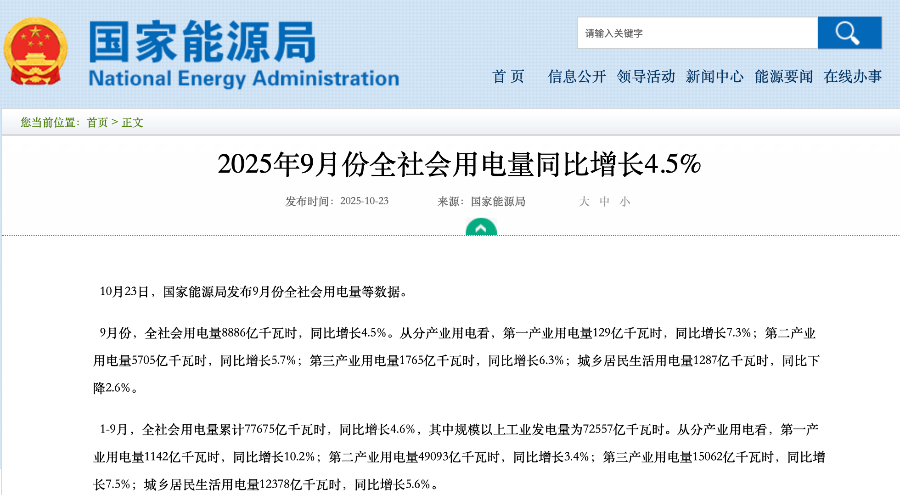
Core Insights - In September, China's total electricity consumption reached 888.6 billion kWh, a year-on-year increase of 4.5% [1] - From January to September, total electricity consumption accumulated to 7,767.5 billion kWh, with a year-on-year growth of 4.6% [1] - The third quarter saw significant growth in electricity consumption, with a total of 2.9 trillion kWh, marking a new phase in energy consumption scale for China's economic development [1] Group 1: Electricity Consumption by Sector - In September, the first industry consumed 12.9 billion kWh, up 7.3% year-on-year; the second industry consumed 5,705 billion kWh, up 5.7%; the third industry consumed 1,765 billion kWh, up 6.3%; while urban and rural residential electricity consumption fell by 2.6% to 128.7 billion kWh [1] - The second industry's electricity consumption for the first three quarters was 4.91 trillion kWh, a year-on-year increase of 3.4%, with a notable recovery in the third quarter, growing by 5.1% [2] - The manufacturing sector's electricity consumption in the third quarter increased by 5.2%, with 17 provinces reporting growth rates exceeding 5% [2] Group 2: Growth Drivers - The growth in the second industry's electricity consumption was driven by a series of government policies aimed at stabilizing growth, particularly in sectors like electronics, automotive, and steel [2] - High-tech and equipment manufacturing sectors saw a significant increase in electricity consumption, with a 9.5% year-on-year growth in the third quarter, surpassing the average growth rate of the manufacturing sector [3] - The third industry's electricity consumption grew by 8.3% in the third quarter, supported by rapid development in new energy vehicles and infrastructure [4] Group 3: Residential Electricity Consumption - The average temperature in the third quarter was historically high, leading to a record residential electricity consumption exceeding 500 billion kWh [5] - Residential electricity consumption for the first three quarters increased by 5.6%, with a 6.4% increase in the third quarter [5] - Several provinces, including Tibet and Ningxia, reported residential electricity consumption growth exceeding 10% due to higher average temperatures [5]
前9月全社会用电量达7.77万亿千瓦时,经济动能持续增强
2 1 Shi Ji Jing Ji Bao Dao· 2025-10-23 09:01
Core Insights - In September, China's total electricity consumption reached 888.6 billion kWh, marking a year-on-year increase of 4.5% [1][3] - From January to September, total electricity consumption accumulated to 7,767.5 billion kWh, with a year-on-year growth of 4.6% [1][3] - The third quarter saw a total electricity consumption of 2.9 trillion kWh, with significant monthly increases, indicating a new phase in energy consumption scale [1][3] Electricity Consumption by Sector - In September, electricity consumption by sector showed varied growth: primary industry at 12.9 billion kWh (7.3% increase), secondary industry at 5,705 billion kWh (5.7% increase), and tertiary industry at 1,765 billion kWh (6.3% increase) [3][4] - Urban and rural residential electricity consumption decreased by 2.6% to 128.7 billion kWh [3][4] - The secondary industry contributed significantly to the overall growth, with a 5.1% increase in the third quarter, accounting for 51% of total electricity consumption growth [4] Policy Impact and Industrial Recovery - Government policies have positively influenced the recovery of the secondary industry, with a notable increase in electricity consumption due to various industry stabilization plans [4] - High-energy-consuming industries saw a 3.2% increase in electricity consumption in the third quarter, driven by traditional peak seasons and recovery in production [4] - High-tech and equipment manufacturing sectors experienced a 9.5% increase in electricity consumption, surpassing the average growth rate of the manufacturing sector [4] Tertiary Industry Performance - The tertiary industry maintained robust growth, with a 7.5% year-on-year increase in electricity consumption for the first three quarters and an 8.3% increase in the third quarter [5] - New infrastructure developments, such as electric vehicles and 5G, significantly boosted electricity consumption in information transmission and retail sectors, with growth rates of 18.3% and 11.7% respectively [5] - The internet and related services saw a remarkable 33.8% increase in electricity consumption, while electric vehicle charging services surged by 49.6% [5] Regional Electricity Consumption Trends - Electricity consumption growth varied significantly across regions, with provinces like Hainan (18.6%), Tibet (15.4%), and Jilin (14.9%) showing the highest increases in September [6] - In the third quarter, Tibet (14.7%), Jilin (11.9%), and Hebei (11.7%) led in electricity consumption growth [6] - High temperatures during the summer contributed to record levels of residential electricity consumption, exceeding 500 billion kWh in the third quarter [6] Residential and Manufacturing Sector Insights - Urban and rural residential electricity consumption grew by 5.6% in the first three quarters, with a 6.4% increase in the third quarter [7] - Several provinces, including Tibet and Jilin, reported manufacturing electricity consumption growth exceeding 5%, with Tibet achieving a remarkable 25.8% increase [7]

“反内卷”“稳增长”组合拳发力,三季度第二产业用电量高增
Bei Ke Cai Jing· 2025-10-23 06:05
Core Insights - In September, the total electricity consumption reached 888.6 billion kWh, marking a year-on-year increase of 4.5% [2] - The secondary industry's electricity consumption was 570.5 billion kWh, with a year-on-year growth of 5.7%, indicating a significant rebound [2] - The third industry's electricity consumption in September was 176.5 billion kWh, showing a year-on-year increase of 6.3% [3] Group 1: Electricity Consumption Trends - The total electricity consumption for the third quarter increased by 5.1% year-on-year, with the secondary industry contributing 51.0% to this growth [2] - Industrial electricity consumption grew by 5.4% year-on-year in the third quarter, an increase of 2.3 percentage points from the second quarter [2] - Manufacturing electricity consumption rose by 5.2% year-on-year in the third quarter, up by 3.2 percentage points from the previous quarter [2] Group 2: Sector-Specific Growth - The rapid development of new energy vehicles and charging infrastructure has significantly boosted electricity consumption in the information transmission/software and IT services sectors, which grew by 18.3% and 11.7% respectively in the third quarter [3] - The internet and related services sector saw a remarkable year-on-year growth of 33.8% in electricity consumption during the third quarter [3] - The electric vehicle charging services sector experienced a staggering year-on-year increase of 49.6% in electricity consumption [3]
以重点行业带动产业体系向“新”
2 1 Shi Ji Jing Ji Bao Dao· 2025-10-17 23:42
Core Viewpoint - The implementation of the "Ten Key Industries Stabilization Growth Plan" aims to provide a clear roadmap for the industrial economy's stability and transformation, focusing on ten key sectors that account for approximately 70% of the industrial economy [1] Group 1: Policy Framework - The plan emphasizes a dual approach of supply and demand, establishing a systematic policy framework to address structural challenges through the elimination of outdated capacity and optimization of industrial structure [2] - Specific measures are tailored to different industries, such as promoting upgrades in the electronic information manufacturing sector and focusing on new energy and smart grid equipment in the power equipment sector [2] Group 2: Technological Innovation - The plan prioritizes technological innovation and quality improvement, outlining differentiated innovation paths for various industries, including smart manufacturing in machinery and green products in light industry [3] - A complete industrial ecosystem is established across the ten industries, facilitating the incubation and application of new technologies and models, thereby enhancing overall competitiveness [3] Group 3: Systemic Effects and Industry Chain Collaboration - The plan highlights the importance of systemic effects and collaboration within the industry chain, where the interconnected nature of these industries can create a ripple effect, enhancing technological progress and cost reduction across related sectors [4] - The comprehensive implementation of the stabilization growth plan is expected to usher in a new strategic development opportunity for the ten key industries, contributing to both current economic stability and long-term industrial development [4]
21评论丨以重点行业带动产业体系向“新”
2 1 Shi Ji Jing Ji Bao Dao· 2025-10-17 23:02
Core Viewpoint - The implementation of the "Ten Key Industries Stabilization Growth Plan" aims to provide a clear roadmap for the industrial economy's stability and transformation, focusing on ten key sectors that account for approximately 70% of the industrial economy [1][3]. Group 1: Policy Framework - The plan emphasizes a dual approach of supply and demand, establishing a systematic policy framework to address structural challenges through the elimination of outdated capacity and optimization of industrial structure [3][4]. - Specific measures are tailored to different industries, such as promoting upgrades in the electronic information manufacturing sector and focusing on new energy and smart grid equipment in the power equipment sector [3][4]. Group 2: Technological Innovation and Quality Improvement - The plan prioritizes technological innovation and quality enhancement, outlining differentiated innovation paths for various industries, such as advancing smart manufacturing in machinery and developing green products in light industry [4][5]. - A complete industrial ecosystem is being constructed across the ten industries, facilitating the incubation and large-scale application of new technologies and models, which will enhance overall competitiveness [4][5]. Group 3: Systemic Effects and Industry Chain Collaboration - The plan highlights the importance of systemic effects and collaboration within the industry chain, where the long chains and high interconnectivity of these industries can create a ripple effect across related sectors [5][6]. - The healthy development of the electronic information manufacturing sector can drive technological advancements and cost reductions in related industries like photovoltaics and lithium batteries [5][6]. Group 4: Long-term Development and High-Quality Growth - The comprehensive implementation of the stabilization growth plan is expected to usher in a new strategic development opportunity for the ten key industries, impacting both current economic stability and the long-term development of China's industrial system [6]. - By balancing stabilization and structural adjustment, the plan aims to promote the coordinated development of traditional industry upgrades and emerging industry cultivation, moving towards high-quality development [6].