新茶饮

Search documents
茉莉奶白回应门店事故
Xin Jing Bao· 2025-08-18 12:49
Group 1 - The incident involving the ceiling collapse at a store of the new tea beverage company, Jasmine Milk White, resulted in the death of an employee, prompting the company to cooperate fully with the investigation [1] - The affected store, located in Minhang District, Shanghai, was recently opened and had been conducting a promotional event from August 15 to 17 before closing [1] - The company provides standardized design for store renovations, emphasizing the representation of Eastern aesthetics in its space [1] Group 2 - Jasmine Milk White opened its first store in Shenzhen in 2021, focusing on jasmine tea products and has rapidly expanded its store count from under 100 in 2022 to 1,600 by mid-2025, covering over 200 cities [2] - In 2024, the company secured nearly 100 million yuan in financing, led by Alibaba's local life services, with Yang Capital serving as the exclusive financial advisor for this round [2] - The founder, Zhang Boping, is a serial entrepreneur with experience in Chinese cuisine, baking, and beverages [2]
新茶饮出海发力美国市场,茶百道北美首店落地纽约
Bei Ke Cai Jing· 2025-08-18 11:44
Group 1 - The new tea beverage company Cha Bai Dao is set to open its first store in North America in Flushing, Queens, New York, which is the largest Chinese community in the U.S. [1] - Cha Bai Dao has accelerated its international expansion this year, having entered the Singapore market in July with a successful launch, and opened its first store in Paris in May [1] - The CEO of Cha Bai Dao expressed the goal of introducing fresh tea products to global consumers and showcasing the potential of Chinese tea beverages [1] Group 2 - The new tea beverage industry is increasingly focusing on international markets, with the U.S. emerging as a key target after initial expansions in Southeast Asia [2] - The company Ning Ji decided to enter the U.S. market due to its favorable population, consumer spending power, and mature business environment, contrasting with the lower price levels and regulatory differences in Southeast Asia [2] - The company Heytea has rapidly expanded in the U.S., growing from 2 to over 30 stores within a year, making it the fastest-growing new tea brand in the country [2] - Heytea's total overseas store count has surpassed 100, with a growth of over 6 times in the past year [2] - The new tea brand Ba Wang Cha Ji opened its first U.S. store on May 9 in a popular shopping mall in Los Angeles, near Beverly Hills and West Los Angeles [2]
茉莉奶白回应门店事故:正全力配合调查和处理中
Bei Ke Cai Jing· 2025-08-18 11:44
Group 1 - The incident involving the ceiling collapse at a newly opened store of the tea brand Mo Li Nai Bai resulted in the death of an employee, prompting the company to cooperate fully with the investigation [1] - The affected store, located in Shanghai's Minhang District, was established on July 17, 2025, and had obtained a food business license [1] - The incident occurred on August 15, 2025, at approximately 8:15 PM, leading to immediate emergency response and medical treatment efforts, but unfortunately, the injured employee did not survive [1] Group 2 - Mo Li Nai Bai, founded in 2021, focuses on jasmine tea and has rapidly expanded from fewer than 100 stores in 2022 to 1,600 stores by mid-2025, covering over 200 cities [2] - The company completed nearly 100 million yuan in financing in 2024, led by Alibaba's local life services, with Xiangyang Capital serving as the exclusive financial advisor for this round [2] - The founder, Zhang Boping, is a serial entrepreneur with experience in Chinese cuisine, baking, and beverages [2]
霸王茶姬2025年“宠物友好季”正式开启 伯牙绝弦累计销售超12.5亿杯
Zheng Quan Ri Bao· 2025-08-18 09:09
沙利文数据显示,自2022年1月1日至2025年6月30日,霸王茶姬的超级单品伯牙绝弦已累计销售超12.5 亿杯,见证了无数"以茶会友"的瞬间。在宠物经济蓬勃发展的今天,霸王茶姬将"以茶会友"的理念延伸 至人与爱宠之间,用一杯茶链接更多的爱与善意。 不仅如此,今年宠物友好季,霸王茶姬还将"有爱"落到实处——携手北京爱它动物保护公益基金会(简 称"它基金")共同发起"CHAGEE好萌友回家计划",面向高校爱心社团与流浪动物救助站提供爱心物资 支持,为建立一个对小动物更友善的世界共同努力。 新茶饮和宠物经济正碰撞出新的火花。 8月17日,霸王茶姬2025年"宠物友好季"正式开启。 活动前三日,霸王茶姬全国范围内的135家指定门店同步上新限量宠物奶油(消费者可在霸王茶姬官方 小红书查询具体门店),茶友携爱宠进店即可获得一份免费宠物奶油。同时,20家宠物友好主题门店也 随之上线,店内设置互动"洞洞合影墙",让茶友与爱宠留下欢乐瞬间。 自成立之初,"以茶会友"就是霸王茶姬的重要理念之一。此次宠物友好季,霸王茶姬将经典产品伯牙绝 弦与之巧妙结合——每购买一份"双杯伯牙绝弦套餐"(含轻因产品),即可获赠一枚限量宠物冰箱贴盲 ...

港湾周评|“教育消费者”能否拯救百果园?
Sou Hu Cai Jing· 2025-08-16 16:46
Core Viewpoint - The recent comments from the founders of Aikang Guobin and Baiguoyuan have sparked public controversy, highlighting a disconnect between their business philosophies and consumer expectations [1][4]. Company Insights - Aikang Guobin's CEO Zhang Ligang questioned the effectiveness of low-cost health check-ups, suggesting that consumers should be prepared to spend significantly more for accurate diagnoses, which undermines the necessity of the health check-up industry [4][9]. - Baiguoyuan's Chairman Yu Huiyong stated that the company focuses on educating consumers rather than catering to them, implying a belief that consumers are often uninformed [1][5]. Market Dynamics - The comments from both executives reflect a misunderstanding of consumer behavior, as consumers are generally savvy and make purchasing decisions based on their own logic and needs [5][6]. - The success of companies like Pinduoduo and Mixue Ice City is attributed to their understanding of market demands and consumer price sensitivity, contrasting with the educational approach suggested by Baiguoyuan's leadership [6][7]. Financial Performance - Baiguoyuan is facing increasing operational pressure, with projected revenue and net profit declines surpassing previous years, indicating a challenging market environment [9]. - The upcoming half-year report for Baiguoyuan is anticipated to reveal whether the company's performance aligns with or deviates from market expectations, particularly in light of the controversial consumer education stance [9][10]. Consumer Sentiment - The public reaction to the statements from both companies suggests a potential backlash against their perceived elitism and disconnect from consumer realities, which could impact their market positions [4][8].

AI、短视频、短剧……让我们变蠢了吗? | 新刊发售
第一财经· 2025-08-14 15:32
Core Viewpoint - The article discusses the impact of the internet and modern entertainment on human attention spans, suggesting that the issue is more about choice and strategy rather than capability [5][22]. Group 1: Overview - The article highlights that by 2025, 5.65 billion people will use the internet, representing 68.7% of the global population, with adults spending an average of 6 hours and 38 minutes online daily, a figure that has remained stable over the past decade [3]. - It raises concerns about how various forms of entertainment, such as short videos and AI, are competing for limited attention, leading to a fragmented entertainment landscape [3][68]. Group 2: Music Industry - The article notes that the rise of a musician named "揽佬" on Spotify, surpassing Jay Chou, exemplifies how the internet has restructured the music industry, focusing on producing "hit songs" through strategic resource allocation based on audience feedback [9][14]. Group 3: Short Drama Market - The short drama market is maturing, with production companies still anxious about capturing audience attention despite their established presence [14]. - The article emphasizes the shift in career paths for young professionals, who are increasingly drawn to roles in content creation for lower-tier markets due to the significant traffic these platforms generate [17]. Group 4: Attention Management - Nir Eyal, author of "Hooked," argues that individuals must take responsibility for their attention management rather than blaming technology companies, emphasizing the importance of personal choice in how time is spent [22]. Group 5: Fast Food Industry - The article discusses the transformation of the fast food industry, particularly the "坪效之王" 南城香, which is adapting to new economic cycles by testing a weight-based pricing model in its Beijing locations [28]. Group 6: F1 Industry - The article outlines the evolution of Formula 1 from a niche sport dominated by European elites to a global entertainment product aimed at younger audiences, initiated by an American media company's acquisition eight years ago [31].

1家霸王茶姬单日营收≈4家蜜雪/沪上阿姨,谁家奶茶品牌更赚钱丨立方智库研报
Sou Hu Cai Jing· 2025-08-13 11:34
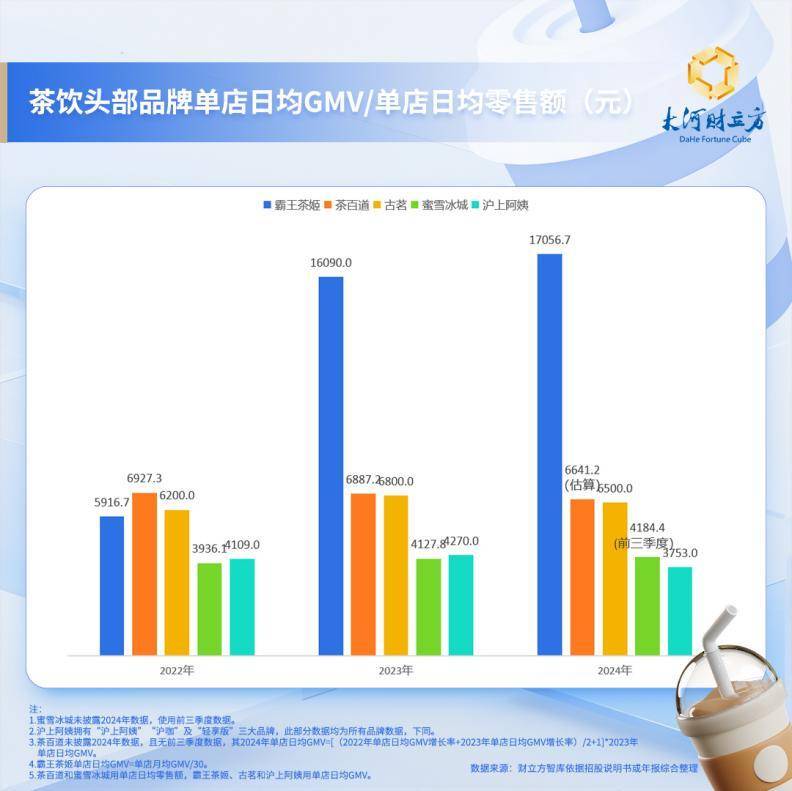
编者按 | 中国遍地都是奶茶店,谁家品牌更能赚? 近日,大河财立方智库发布了关于新茶饮品牌最新研究报告,聚焦蜜雪冰城、霸王茶姬、茶百道、古茗、沪上阿 姨五大头部品牌,多维度分析新茶饮竞争态势。即日起,大河财立方推出《立方智库研报》系列报道,从单店经 营能力、加盟商投入成本、品牌增长趋势、市场发展空间等角度,起底全国奶茶界的"霸总"。今日推出《1家霸 王茶姬单日营收≈4家蜜雪/沪上阿姨,谁家奶茶品牌更赚钱》。 【大河财立方 记者 郝楠楠】单店日均GMV(单店日均零售额)、日均销量等是门店赚钱能力PK的关键。数据 显示,头部新茶饮品牌中,2024年霸王茶姬单店日均GMV、日均销量均实现领跑;令人意外的是,"国民茶 饮"蜜雪冰城遭遇了滑铁卢。 蜜雪单店日均销量下降明显 沪上阿姨多维"失速" 新茶饮是中国消费产业的奇迹,受益于中产阶层定格支撑,从雄鸡初晓之地,长奔至喜马拉雅山脚下。 这其中,前述五大品牌的势力范围与市场纵深最有优势。具体来看,上述五大头部新茶饮品牌中,2024年霸王茶 姬以单店日均GMV超1.7万元的战绩,将其他品牌远远甩开。事实上,去年正是霸王茶姬高速发展的一年。招股 书显示,2023年—2024年 ...

行业三强扎堆赴港IPO 新茶饮赛道竞争加剧
Xin Hua Wang· 2025-08-12 05:47
Core Insights - The Hong Kong IPO market is seeing new entrants in the tea beverage sector, with companies like Mixue Ice City and Gu Ming Holdings filing for IPOs, joining Sichuan Baicha Baidao, which has also applied for listing [1] - As of Q3 2023, Mixue Ice City reported revenues of 15.393 billion yuan and profits of 2.453 billion yuan, while Gu Ming reported revenues of 5.571 billion yuan and profits of 1.002 billion yuan, indicating a competitive landscape in the tea beverage sector [1] - Both companies are focusing on enhancing their supply chain capabilities and digitalization as part of their fundraising plans [1] Supply Chain Focus - Mixue Ice City plans to use part of its fundraising to expand its end-to-end supply chain, including building new facilities for frozen fruits, coffee, syrups, and other products [2] - The company has established five production bases covering various food categories, with an annual production capacity of approximately 1.43 million tons as of September 30, 2023 [2] - Gu Ming aims to enhance its supply chain management and logistics capabilities, planning to invest in new refrigerated warehouses and smart storage facilities over the next 3-5 years [3] Store Expansion - The rapid expansion of store numbers is a key strategy for new tea beverage brands, with Mixue Ice City increasing its store count from 20,001 to 36,153 (including overseas) from the end of 2021 to September 30, 2023, a growth rate of over 80% [4] - Gu Ming's store count grew from 5,694 to 8,578 during the same period, achieving a growth rate of over 50% [4] Market Saturation and Competition - The new tea beverage market is becoming saturated as more brands adopt franchise models, with notable competitors like Heytea and Lele Tea also entering the franchise space [5] - The market size for new tea beverages is projected to reach 149.8 billion yuan in 2023, with growth rates expected to decline significantly compared to pre-pandemic levels [5] Consumer Trends and Health Concerns - The industry is facing challenges related to health perceptions, particularly concerning ingredients like "plant-based creamers," which have raised consumer concerns about health [9] - Both Mixue Ice City and Gu Ming are aware of these health concerns and are adapting their product offerings to meet consumer demands for healthier options [10] Diversification and International Expansion - Mixue Ice City is expanding into the coffee market, with its coffee brand "Lucky Coffee" already having around 2,900 stores as of Q3 2023 [10] - Gu Ming plans to diversify its product offerings to include more coffee options, capitalizing on the similarities in consumer demographics between tea and coffee drinkers [11] - Both companies are looking to expand internationally, with Mixue Ice City already operating approximately 4,000 stores in 11 countries and planning to establish a multifunctional supply chain center in Southeast Asia [12]

观察:从快速拓店到精细化运营,新茶饮公司出海渐入收获期
Zheng Quan Shi Bao Wang· 2025-08-11 12:59
Core Insights - The new tea beverage market in China is increasingly competitive, prompting leading brands to expand overseas for growth opportunities [1][2] - Brands like Heytea, Bawang Chaji, and Nayuki are rapidly increasing their international presence, particularly in Southeast Asia and North America [1][2] - The overseas expansion of these brands has transitioned from initial testing phases to large-scale operations, indicating a successful validation of their standardized operational models [2][3] Group 1: Brand Expansion - Heytea opened a store in Cupertino, California, on August 1, attracting significant local consumer interest, and has seen its overseas store count grow over sixfold in the past year [1] - Bawang Chaji, established in 2017, has expanded its global footprint with 6,681 total stores, including 169 overseas, primarily in Malaysia and Singapore [1] - Tea Baidao has also entered the Malaysian market with a larger store format to cater to local consumer preferences [2] Group 2: Market Potential - The overseas market, especially in Southeast Asia and North America, presents substantial growth potential due to low penetration rates of new tea beverages [2] - Nayuki plans to open 20 stores in Thailand this year, reflecting its commitment to expanding in the Southeast Asian market [2] - The overseas sales revenue for Bawang Chaji reached 178 million yuan last year, marking an over 80% year-on-year increase [2] Group 3: Operational Strategy - The industry is shifting from rapid store expansion to refined operational strategies, focusing on local supply chains, product customization, and professional teams [3] - Brands need to balance globalization and localization to maintain growth, emphasizing supply chain optimization, digital marketing, and product innovation [3]
京东三个月连投6家具身智能企业;Temu东南亚月活用户突破2200万|36氪出海·要闻回顾
36氪· 2025-08-10 13:34
Core Viewpoint - The article highlights the increasing investments and developments in the field of embodied intelligence and cross-border e-commerce, showcasing significant growth in user engagement and logistics capabilities across various companies and sectors. Group 1: Investments in Embodied Intelligence - JD.com has invested in six companies related to embodied intelligence within three months, indicating a strong focus on this sector as a competitive area in the AI era [4] - Other major internet companies like Alibaba, Meituan, and Tencent are also actively investing in the embodied intelligence field, making it a key battleground for tech giants [4] Group 2: Growth of Temu in Southeast Asia - Temu's monthly active users in Southeast Asia have surpassed 22 million, with significant growth in the Philippines and Thailand, which account for approximately 86% of its total traffic in the region [4] Group 3: Logistics and Cross-Border Services - Cainiao has upgraded its G2G cross-border logistics service in Europe, now supporting e-commerce express delivery between 35 European countries, covering 99% of the region [5][6] - The average cost per kilogram for shipping has decreased by 1-2 euros, enhancing the competitiveness of cross-border logistics [5] Group 4: Expansion of Chinese Brands Overseas - Heytea has seen its overseas store count grow over six times in the past year, now exceeding 100 locations across multiple countries [8] - The new tea brand Tianlala has opened three stores in Bali, with significant daily revenue and customer traffic, bringing its total overseas signed stores to over 200 [8] Group 5: Regulatory Approvals and Market Expansion - Ant International's WorldFirst has received approval for a cross-border payment service license in Malaysia, expanding its reach in key trade regions [6] - The RWA registration platform has launched in Hong Kong, facilitating the tokenization of real-world assets [13] Group 6: Trade Partnerships and Export Growth - ASEAN, EU, and the US are China's top three trade partners, with trade values of 4.29 trillion yuan, 3.35 trillion yuan, and 2.42 trillion yuan respectively [12] - China's exports in July increased by 7.2% year-on-year, with expectations of a 2.5% growth in the second half of the year [12] Group 7: Innovations in Robotics and AI - The Chinese robotics industry has seen a revenue growth of 27.8% in the first half of the year, with significant increases in both industrial and service robots [14] - The demand for humanoid robots is rising, particularly in performance and interactive service sectors, indicating a growing market for advanced robotics [14]