低空经济

Search documents
天津国资、中国电信成立低空量子网络科技发展公司
Xin Lang Cai Jing· 2026-01-23 05:36
企查查APP显示,近日,天津城投低空量子网络科技发展有限公司成立,注册资本为1000万元,经营范 围包含:智能无人飞行器销售;5G通信技术服务;数据处理和存储支持服务;互联网数据服务等。企 查查股权穿透显示,该公司由天津低空经济投资发展有限公司、中国电信全资子公司中电信无人科技 (江苏)有限公司共同持股。 ...

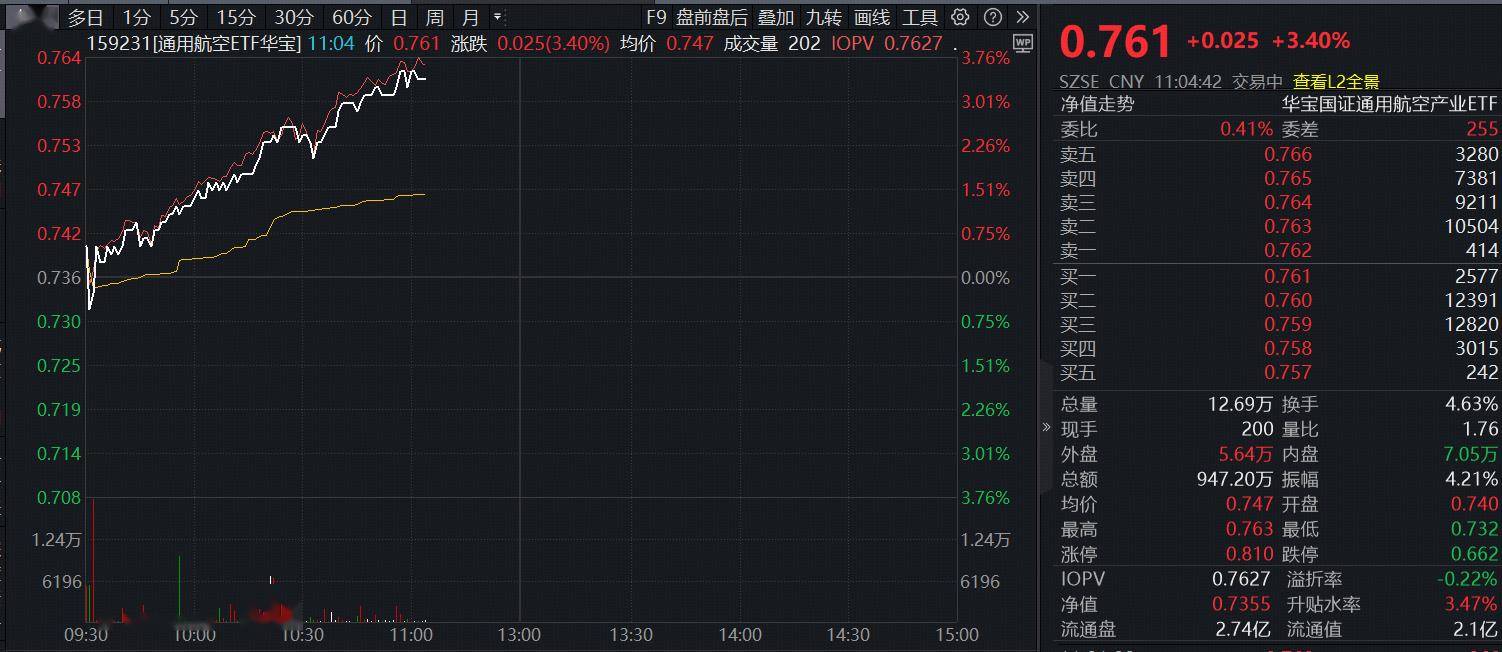
ETF盘中资讯|重磅太空算力会议来袭!SpaceX将发射太阳能人工智能卫星?商业航天含量65%的通用航空ETF(159231)大涨3.4%强势收复10日均线
Sou Hu Cai Jing· 2026-01-23 03:31
Group 1 - The commercial aerospace and satellite navigation sectors are experiencing a resurgence, with stocks like Ruichuang Micro-Nano and Aerospace Electronics seeing significant gains of 20% and 10% respectively [1] - The General Aviation ETF Huabao (159231) is showing strong performance, up 3.4%, and has recovered its 10-day moving average, indicating positive market sentiment [1] - The upcoming "Star Computing and Intelligent Connection" seminar by the China Academy of Information and Communications Technology on January 26, 2026, will focus on advancements in space computing and infrastructure [3] Group 2 - The General Aviation ETF Huabao covers 50 aerospace stocks, with over 88% exposure to low-altitude economy, 65% to commercial aerospace, and 47% to satellite navigation, making it a comprehensive tool for investing in China's aerospace industry [4] - The fund does not charge a sales service fee, and the redemption fees are structured based on the holding period, with specific rates for different investment amounts [4]


制度创新打通要素壁垒 长三角科创共同体再升级|“十五五”开局新气象
证券时报· 2026-01-23 00:17
Core Viewpoint - The article emphasizes the significant advancements in technological innovation and industrial collaboration in the Yangtze River Delta region during the 14th Five-Year Plan period, highlighting the importance of institutional innovation and collaborative frameworks for future development [1][3][4]. Group 1: Institutional Innovation and Collaboration - The Yangtze River Delta has enhanced its regional innovation system through institutional innovation, platform co-construction, and element interconnectivity, with the implementation of the "Decision on Promoting Collaborative Technological Innovation in the Yangtze River Delta" starting September 1, 2025 [3][4]. - Key initiatives include organizing joint projects annually, exploring mechanisms like "pay after use" for patents, and establishing a joint fund for basic research [3][4]. - The collaborative innovation community in the Yangtze River Delta has made significant progress, with 24 innovation alliances entering the pilot construction phase by the end of the 14th Five-Year Plan [3][4]. Group 2: Development of World-Class Industrial Clusters - The G60 Science and Innovation Corridor, which connects nine cities, has been established as a collaborative industrial network, enhancing the international influence of industrial clusters [6][7]. - The G60 corridor has evolved into a "nine-city linkage" model, facilitating a division of labor where research and development are concentrated in core areas while manufacturing occurs in surrounding regions [6][7]. - For instance, the localization rate of large aircraft manufacturing has increased from 10% to 60%, with significant contributions from various cities in the region [6][7]. Group 3: Future Industry Development - The Yangtze River Delta is pursuing an integrated approach to develop future industries, focusing on low-altitude economy infrastructure and cross-regional cooperation [7]. - Recent measures aim to enhance low-altitude infrastructure collaboration across the region, promoting efficient linkage between technology research, equipment manufacturing, and application scenarios [7]. Group 4: Deepening Integration and Overcoming Barriers - The 15th Five-Year Plan will focus on deepening integration in technological innovation, with Shanghai positioned as a resource organizer for regional innovation [9][10]. - Despite notable achievements, challenges remain due to administrative barriers that hinder deeper collaboration, particularly in talent evaluation and cross-regional cooperation [9][10]. - The goal is to transition from "institutional integration" to "deep symbiosis," ensuring a robust system for original innovation and industrial collaboration [10].

纳入“十五五”四大新兴产业,低空经济加速“起飞”还有多远
Di Yi Cai Jing· 2026-01-22 15:13
Core Insights - The article emphasizes the importance of strategic emerging industries in China's economic planning, particularly focusing on four key sectors: new energy, new materials, aerospace, and low-altitude economy [2][3] - The low-altitude economy is transitioning from early-stage applications to deeper penetration, with a focus on transforming blueprints into valuable commercial scenarios and improving related infrastructure [2][3] Group 1: Low-Altitude Economy Development - The Chinese government aims to accelerate the development of strategic emerging industry clusters, including the low-altitude economy, through large-scale application demonstrations of new technologies and products [3] - Nearly 1,000 companies have registered civil unmanned aerial vehicle products, with 3,191 types of products and over 478,000 units [3] - The eVTOL (electric vertical takeoff and landing) sector has received over 1,000 orders from domestic and international clients since 2025, with various application scenarios being explored [3] Group 2: Application Scenarios and Challenges - Most eVTOL applications are still in the testing phase, with commercial operations requiring operational certificates, which currently have many restrictions [4] - The low-altitude economy has three main application scenarios: manned low-altitude transportation, unmanned low-altitude logistics, and low-altitude digital applications [5] - Agricultural applications of the low-altitude economy are showing promising trends, with over 300,000 agricultural drones and an operational area exceeding 46 million acres by 2025 [6] Group 3: Infrastructure and Regulatory Challenges - Infrastructure development for the low-altitude economy is accelerating, with plans to establish 46 low-altitude flight service stations by 2025, covering 23 provinces [7] - Challenges include fragmented airspace management and the need for improved approval efficiency for new aircraft types, which is currently a bottleneck for rapid development [7][8] - The low-altitude airspace is still under strict control, requiring approvals from military and air traffic control, which complicates the establishment of a comprehensive low-altitude traffic network [8] Group 4: Future Outlook - The goal is to have large unmanned aerial vehicles with transfer capabilities operational by 2035, integrating manned and unmanned operations into a complex air route network [8] - The large-scale commercial application of eVTOL and other low-altitude economy aircraft in urban air traffic may take another decade to realize [9]

纳入“十五五”四大新兴产业,低空经济加速“起飞”还有多远
第一财经· 2026-01-22 14:34
Core Viewpoint - The article emphasizes the importance of developing strategic emerging industries, particularly focusing on low-altitude economy, which is transitioning from early-stage applications to deeper penetration, requiring effective infrastructure and commercial scenarios to accelerate growth [3][4]. Group 1: Emerging Industries - The recent guidelines highlight the need to accelerate the development of strategic emerging industries, including new energy, new materials, aerospace, and low-altitude economy [4]. - The low-altitude economy is characterized by a long industrial chain and requires cluster development, with the low-altitude manufacturing sector currently experiencing the fastest growth [4]. Group 2: eVTOL Development - As of 2025, over 1,000 domestic and international orders for eVTOLs have been received, with applications being explored in various scenarios, including logistics in mountainous regions and urban flights in Qatar [4]. - However, most eVTOL applications are still in the testing phase, with commercial operations requiring operational certificates, which currently have significant restrictions [5]. Group 3: Application Scenarios - The low-altitude economy has three main application scenarios: manned low-altitude transportation, unmanned logistics, and low-altitude digital applications [6]. - In agriculture, the low-altitude economy is showing promising results, with over 300,000 agricultural drones and a mechanization rate of 76.7% expected by 2025 [6]. Group 4: Infrastructure Development - The construction of low-altitude infrastructure is accelerating, with plans to establish a network of low-altitude flight service stations and optimize regulatory platforms by 2026 [7]. - The current strict regulation of low-altitude airspace poses challenges for the industry, necessitating a comprehensive air traffic network and operational rules [8]. Group 5: Future Outlook - The roadmap for civil unmanned aerial vehicles aims for the integration of manned and unmanned aircraft by 2035, indicating that large-scale commercial applications of eVTOLs may still be a decade away [8].

2026年中国创新增量在哪里?
Xin Lang Cai Jing· 2026-01-22 10:20
Core Insights - The new economy, represented by technological innovation, has surpassed 18% of GDP, with new growth engines accelerating in strategic emerging industries, future industries, and the digital and AI transformation of traditional industries [3][4][25]. Group 1: Technological Innovation and Economic Growth - China aims to become an innovative power, with R&D expenditure reaching over 3.6 trillion yuan in 2024, accounting for 2.8% of GDP, approaching developed countries' average of 3.2% [4][26]. - The "three new" economies (including nine categories of new industries) accounted for 18.01% of GDP in 2024, an increase of 0.43 percentage points from the previous year, with a total value of 24.3 trillion yuan, growing by 6.7% [4][26]. - The government plans to expand investment in technology innovation and create a supportive ecosystem for scientific research and financial policies by 2026 [4][26]. Group 2: Strategic Emerging Industries - Strategic emerging industries are categorized into nine new industries, including new generation information technology, biotechnology, new energy, new materials, high-end equipment, new energy vehicles, green environmental protection, aerospace, and marine equipment [5][27]. - The "15th Five-Year Plan" emphasizes accelerating the development of strategic emerging industry clusters, particularly in new energy, new materials, and low-altitude economy [9][31]. Group 3: Future Industries and Market Potential - Future industries, such as brain-computer interfaces and embodied intelligence, are in early stages but show significant market potential, with predictions indicating the embodied intelligence market could exceed one trillion yuan by 2035 [14][36]. - The focus is shifting from technological novelty to commercial certainty in embodied intelligence applications across various sectors [14][36]. Group 4: AI Transformation in Traditional Industries - AI is transforming traditional manufacturing and service sectors, enhancing productivity, quality, and value addition [19][41]. - The core AI industry in China is projected to exceed 900 billion yuan in 2024, with a growth rate of 24%, and is expected to surpass 1.2 trillion yuan in 2025 [22][44]. Group 5: Investment and Financing Strategies - A multi-tiered financing service system is recommended to support innovation, including the establishment of a national-level intellectual property assessment center and a technology credit system [39]. - The National Venture Capital Guiding Fund, launched in late 2025, aims to invest in early-stage, small, and long-term hard technology projects, with a total funding of 100 billion yuan [40].

纳入“十五五”四大新兴产业,低空经济加速“起飞”还有多远|“十五五”产业前瞻
Di Yi Cai Jing· 2026-01-22 10:18
Core Insights - The key to accelerating the low-altitude economy lies in transforming blueprints into actionable and valuable business scenarios, along with improving the related infrastructure network [1] Group 1: Government Initiatives - The recent guidelines emphasize the need to accelerate the development of strategic emerging industries, including low-altitude economy, with nearly 30 provinces incorporating it into their 14th Five-Year Plan [1] - The focus on low-altitude economy has been reiterated in multiple government reports, highlighting its significance in national economic planning [1] Group 2: Industry Development - The low-altitude economy is transitioning from early-stage applications to a critical phase of deep penetration, necessitating cluster development due to its extensive industrial chain [2] - As of now, nearly 1,000 companies have registered civil unmanned aerial vehicle products, with 3,191 types of products and over 478,000 units [2] - The eVTOL (electric vertical takeoff and landing) sector has received over 1,000 intent orders from domestic and international clients since 2025, showcasing its potential in low-altitude applications [2] Group 3: Application Scenarios - Current eVTOL applications are primarily in the testing phase, with limited commercial operations due to stringent operational certifications [3] - The low-altitude economy is expected to have three main application scenarios: manned low-altitude transportation, unmanned low-altitude logistics, and low-altitude digital applications [3][4] - Agricultural applications of low-altitude technology are showing promising trends, with over 300,000 agricultural drones and an operational area exceeding 46 million acres by 2025 [4] Group 4: Infrastructure Development - The construction of low-altitude infrastructure is accelerating, with plans to issue six types of unmanned aerial vehicle type certificates by 2025 and establish a flight service network covering 23 provinces [6] - The low-altitude economy faces challenges such as fragmented airspace management and the need for improved approval efficiency, which are critical for its commercial viability [6] - The current strict regulation of low-altitude airspace requires approvals from military and air traffic control, indicating a need for a comprehensive low-altitude traffic network [7] Group 5: Future Outlook - The goal is to have hub-type large unmanned aerial vehicle takeoff and landing sites operational by 2035, integrating manned and unmanned operations into a complex route network [7] - The large-scale commercial application of eVTOL and other low-altitude aircraft in urban air mobility may take up to ten years to realize [7]
新技术催生“未来感”新职业 激发就业市场澎湃活力释放无限可能
Yang Shi Wang· 2026-01-22 08:17
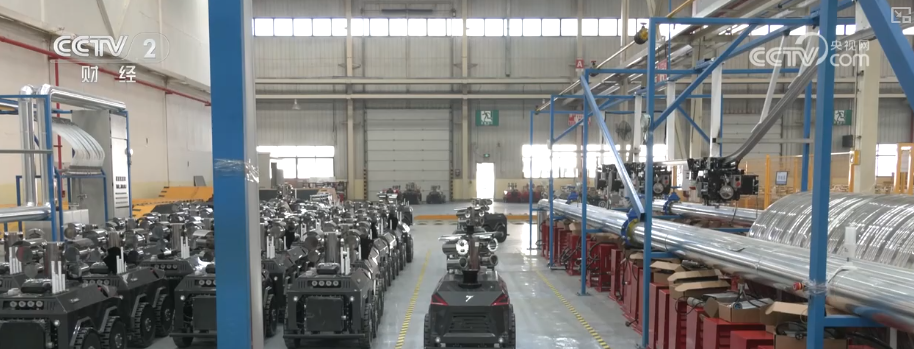
Core Viewpoint - The continuous development of technology is leading to the emergence of new jobs and professions, with 17 new occupations and 42 new job types announced for 2025, marking the highest number of new job types in history [1][27]. Group 1: New Job Creation - The introduction of new professions is revitalizing the market and expanding the occupational landscape [1]. - The demand for roles such as robot product testers and human-machine coordination dispatchers is increasing as the application of robots becomes more widespread across various industries [11][13]. - Emerging roles like low-altitude economy engineers, large model application engineers, and cross-border e-commerce operation managers are seeing a surge in demand [18]. Group 2: Industry-Specific Developments - In the robotics sector, roles such as robot product testers are crucial for quality assurance and route planning, ensuring smooth operation in production environments [5][7][9]. - The cultural and creative industry is also witnessing growth, with professionals like cultural product planning and operation specialists developing unique products that enhance local tourism [20][24]. - The training programs for new professions are expanding, with over 11 million subsidized training sessions conducted by the end of 2025, indicating a strong focus on skill development [27]. Group 3: Future Trends - The growth of emerging industries such as commercial aerospace, low-altitude economy, and deep-sea technology is expected to further diversify the types of new jobs available [31]. - The development of future industries like biomanufacturing, quantum technology, and 6G will continue to enrich the job market and stimulate employment opportunities [31].
省政协委员刘德军:为山东经济发展谋实策
Qi Lu Wan Bao· 2026-01-22 06:01
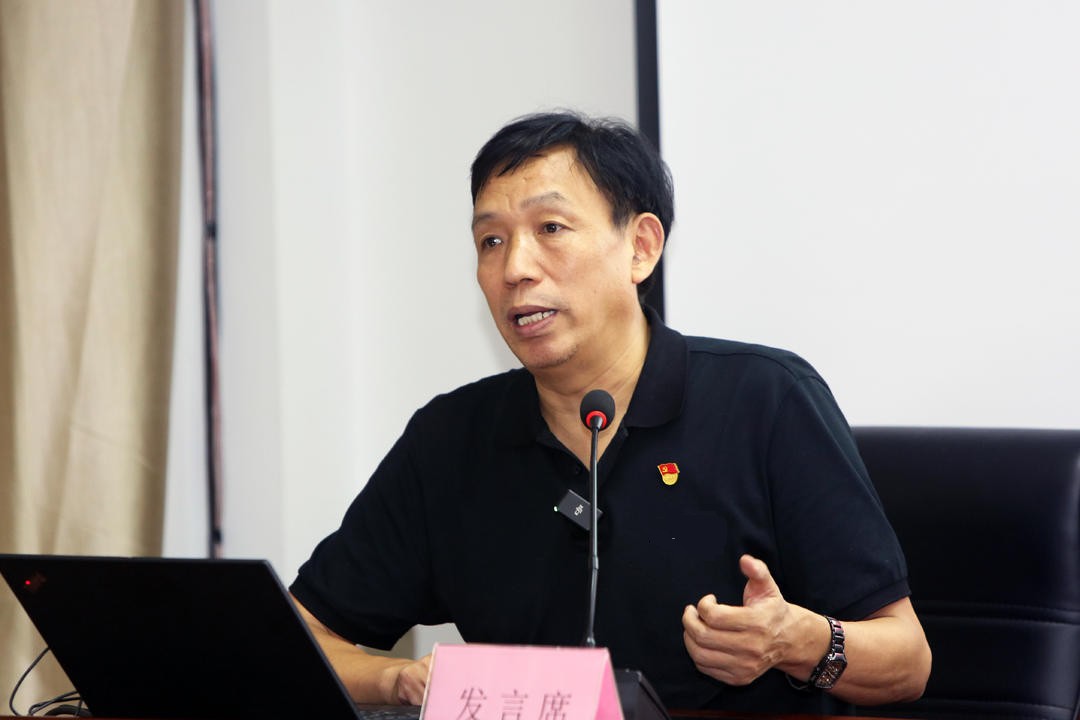
齐鲁晚报.齐鲁壹点记者李文璇 参加政协重要会议100多次,作大会发言50余次,形成提案十多个;仅2025年就参加各类调研活动100余次,调研成果累计获得主要领导批示50多项……这 是山东省政协委员、省宏观经济研究院战略规划所所长刘德军交出的履职答卷。 2024年省两会期间,刘德军的大会发言"谋篇布局竞逐低空经济新赛道"引发热议。过去一年的调研中,他仍保持着对这一新质生产力的敏锐洞察,探索出 发展低空经济的清晰路径。 在刘德军看来,山东制造业基础雄厚,地形地貌多样,且物流需求旺盛,在发展低空经济方面具备得天独厚的优势。他向记者介绍,目前山东已建成524 个无人机起降平台,超过8784公里的高速公路网与25个通用机场,为"天地互联"提供了物理基础;日照、滨州、德州等地抢抓低空经济发展机遇,形成了 特色产业集群。 山东的低空经济仍处于初步发展阶段,有望成为未来的区域发展新抓手。刘德军表示,发展低空经济不能靠"等政策",而应提前完善政策法规体系,搭建 公共服务平台,同时坚定"场景驱动"发展,以真实需求牵引供给。 从火电大省向新能源大省转型,山东的任务依然艰巨。刘德军介绍,山东省传统产业占比大、耗能多,一年就要消耗4. ...
琼中争创海南自由贸易港建设中部标杆
Xin Lang Cai Jing· 2026-01-22 05:49
Core Viewpoint - The government of Qiongzhong Li and Miao Autonomous County emphasizes the importance of the "14th Five-Year Plan" period for high-quality development and the establishment of a benchmark for the Hainan Free Trade Port [1] Group 1: Economic Development Goals - Qiongzhong aims to implement Free Trade Port policies through parks, focusing on trade with external markets and targeting a park output value exceeding 2.5 billion by 2030 [2] - The county will concentrate on ecological agriculture, biomanufacturing, low-altitude economy, and digital economy for targeted investment attraction [2] - The total output value of agriculture, forestry, animal husbandry, and fishery is expected to exceed 8 billion by 2030 [2] Group 2: Infrastructure and Urban Development - Qiongzhong plans to enhance urbanization and implement new urban renewal actions, optimizing public services and reducing the gap in urbanization rates with the provincial average [5] - Key infrastructure projects include the Qiongzhong Bayling Airport and the Hainan Central Railway, aimed at improving external connectivity [5] Group 3: Education and Talent Development - A new round of "Skills Free Trade Port" five-year action plan will be initiated, focusing on building local talent cultivation systems and industry innovation research institutes [3] - The county aims to establish several provincial-level industry-education integration bases to foster talent in future industries [3] Group 4: Environmental and Ecological Initiatives - Qiongzhong is committed to ecological civilization construction, aiming for a leading national level in environmental quality and achieving carbon peak by 2030 [5] - The county will implement a "no-waste city" initiative and explore innovative green finance products [5] Group 5: Social Welfare and Public Services - The government will implement employment-first policies and support income growth to expand the middle-income group [7] - There will be enhancements in healthcare services, including the construction of a new traditional Chinese medicine hospital and improvements in emergency and chronic disease care [7]