啤酒

Search documents
中金:维持百威亚太(01876)跑赢行业评级 目标价9.80港元
智通财经网· 2026-02-13 02:09
Group 1 - The core viewpoint of the report indicates that China International Capital Corporation (CICC) has lowered Budweiser APAC's (01876) 2026 EBITDA forecast by 7.1% to $1.593 billion and introduced a 2027 EBITDA forecast of $1.637 billion, maintaining a target price of HKD 9.80 per share, which implies a 25.2% upside potential from the current stock price [1] Group 2 - For Q4 2025, the company's performance was in line with CICC's expectations, with revenue, sales volume, average selling price (ASP), and EBITDA showing year-on-year declines of -4.2%, -0.7%, -3.5%, and -24.7% respectively, particularly in China where these figures were -11.4%, -3.9%, -7.7%, and -42.3% [2] Group 3 - In the China region, Q4 2025 faced weak demand and deepened channel adjustments, leading to a 3.9% year-on-year decline in sales volume, primarily due to the poor performance in key channels like dining and nightlife, while ASP dropped by 7.7% due to increased investment in off-premise channels [3] Group 4 - Other regions showed mixed results, with India continuing to grow while South Korea's profitability awaited recovery; in the Eastern Asia region, sales volume declined by 1.3% year-on-year due to a weak consumption environment in South Korea, although ASP increased by 2.5% due to price hikes in core categories [4] Group 5 - The company has set a growth-first strategy for 2026, aiming to proactively address market challenges, with the current on-premise channel share at a historical low, suggesting limited downside potential; if the on-premise channel recovers, Budweiser could exhibit stronger-than-industry elasticity [5]

青岛啤酒借助人工智能技术,实现全流程数据畅通 搭建与时间赛跑的极速保鲜链
Ren Min Ri Bao· 2026-02-12 22:24
Core Insights - Qingdao Beer, with over 100 years of history, is leveraging artificial intelligence technology to enhance its production and distribution processes, creating a more efficient supply chain [1] Group 1: Production Innovations - The brewery has established seven intelligent management systems utilizing IoT, AI, and big data, which differ from traditional brewing methods, allowing for rapid response in production [2] - An intelligent scheduling system automates production planning and interacts with material delivery systems to specify the types, quantities, and timing of required raw materials [2] - The production line can quickly switch between over 500 different product varieties, reducing the time for product changeovers by 70% and shortening order delivery times by 50% [2] - Production efficiency has increased by 60%, and carbon emissions density in the factory has decreased by 40% over three years [2] Group 2: Logistics and Warehousing - The brewery's intelligent vertical warehouse, standing 34 meters tall, utilizes robots and automated systems for efficient inventory management, handling over 200,000 boxes daily [3] - The system allows for automatic binding of products to orders and delivery vehicles, facilitating rapid dispatch to consumers [3]
百威亚太(01876.HK):4Q25延续调整 公司2026年定调增长优先
Ge Long Hui· 2026-02-12 22:09
Core Insights - The company's 4Q25 performance aligns with expectations, showing a decline in revenue, sales volume, ASP, and EBITDA, particularly in the Chinese market [1] - The company aims for growth in 2026, adopting a proactive approach to market challenges, with potential for recovery in the on-premise channel [2] Financial Performance - 4Q25 revenue, sales volume, ASP, and EBITDA decreased by 4.2%, 0.7%, 3.5%, and 24.7% year-on-year, respectively, with the Chinese market showing declines of 11.4%, 3.9%, 7.7%, and 42.3% [1] - The EBITDA forecast for 2026 is adjusted down by 7.1% to $1.593 billion, with a new estimate for 2027 at $1.637 billion [2] Market Trends - In China, weak demand and channel adjustments continue to pressure volume and pricing, with a 3.9% decline in sales volume attributed to poor performance in key channels [1] - The Indian market continues to show strong growth, helping to offset pressures from the Chinese market [1] Strategic Outlook - The company is prioritizing growth in 2026, with expectations for stabilization as the macro environment improves and strategic adjustments are made [2] - The current stock price reflects a valuation of 6.5x and 6.2x EV/EBITDA for 2026 and 2027, respectively, with a target price of HKD 9.80 per share indicating a potential upside of 25.2% [2]
百威亚太:重燃在华增长趋势
Zheng Quan Ri Bao· 2026-02-12 15:48
Core Insights - Budweiser APAC reported a revenue of $5.764 billion for 2025, a decrease of 6.1% year-on-year, with net profit attributable to shareholders at $489 million, down 32.6% [1] - Total sales volume reached 7.9658 million kiloliters, reflecting a decline of 6.08% compared to the previous year [1] - The company is undergoing a "strategic shift" in response to competitive pressures, particularly in the Chinese market, where it aims to enhance channel management and product diversification [2] Regional Performance - In the Western Asia-Pacific market, sales volume and revenue decreased by 6.7% and 8.2% respectively, with revenue per hectoliter down by 1.5% [1] - Conversely, in the Eastern Asia-Pacific market, sales volume declined by 3.7%, while revenue and revenue per hectoliter increased by 1.3% and 2.5% respectively [1] Chinese Market Focus - In Q4 2025, Budweiser APAC's sales in China fell by 3.9% due to weak performance in the ready-to-drink channel, leading to a year-on-year revenue decline of 11.4% [1] - For the entire year, sales and revenue in China decreased by 8.6% and 11.3% respectively, attributed to increased investments in expanding non-ready-to-drink business [1] - The company is focusing on three main areas: strengthening non-ready-to-drink channels, enriching product offerings, and driving innovation around key brands to reignite growth [2] Management's Strategic Outlook - The management believes that China remains a significant profit pool and growth opportunity, planning to leverage brand innovation and digital transformation to enhance execution and consumer engagement [3] - The CEO's leadership since April 2025 is seen as a pivotal moment for the company, with expectations for new strategies to address domestic competition and adapt to local consumer needs [2]
百威英博2025年财报:净利润增长16.77%,高端化与数字化驱动发展
Jing Ji Guan Cha Wang· 2026-02-12 15:16
Company Performance - The net profit for 2025 reached $6.837 billion, representing a year-on-year growth of 16.77%, significantly higher than the growth rate in 2024 [2] - Despite a 0.75% decline in revenue to $59.32 billion, the company achieved an organic growth rate of 2.0%, indicating the effectiveness of its premiumization strategy [2] Business Development - The sales volume of non-beer products continues to expand, with non-alcoholic beer revenue growing over 20%, and products like Corona Zero maintaining a leading position in key markets [3] - The company has driven an increase in average price through a super-premium product mix (e.g., Corona, Hoegaarden), partially offsetting a total sales volume decline of 2.54% [3] Digital and Sustainability Initiatives - The B2B platform BEES achieved a total GMV of $49 billion, covering 28 markets, with 75% of revenue generated through digital channels [4] - The company accelerated its carbon neutrality efforts, with 81.2% of operational electricity sourced from renewable power, and a 29.5% reduction in carbon intensity compared to 2017 [4] Industry Context - The Asia-Pacific market was impacted by a 13.1% revenue decline in China, although South Korea achieved a ten-year high in market share [5] - The North American market stabilized its share through premium brands like Michelob, while the Latin American market benefited from double-digit growth in Brazil [5]

青岛啤酒:青岛啤酒产品长期出口欧洲市场,在当地主要通过合资公司面向当地经销商开展产品销售业务
Zheng Quan Ri Bao Zhi Sheng· 2026-02-12 13:40
Core Viewpoint - Qingdao Beer is recognized as the most well-known Chinese brand in the international market, focusing on high quality, high price, and high visibility in its branding strategy [1] Group 1: Brand Strategy - The company emphasizes internationalization and interactive brand promotion to enhance its global market presence [1] - Qingdao Beer continues to innovate in distribution channels to expand its overseas market coverage [1] Group 2: Sales and Market Presence - The proportion of overseas export products in total sales remains relatively small for the company [1] - Qingdao Beer has a long-standing presence in the European market, primarily selling products through joint ventures with local distributors [1]
百威亚太去年收入减少6.1%至57.64亿美元,中国市场非即饮及O2O渠道对销量及收入贡献有所提升
Cai Jing Wang· 2026-02-12 08:40
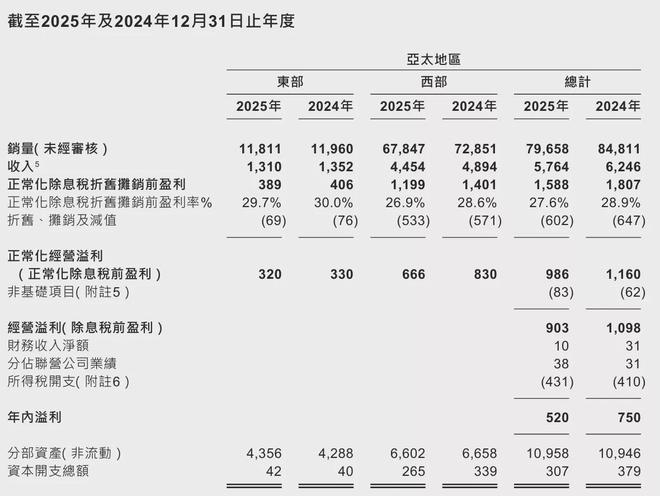
Core Viewpoint - Budweiser APAC reported a decline in total beer sales and revenue for 2025, with total sales at 7.966 billion liters, down 6.0% year-on-year, and revenue at $5.764 billion, down 6.1% year-on-year. Normalized EBITDA decreased by 9.8% to $1.588 billion [1] Sales and Revenue Summary - Total sales for 2025 were 7.966 billion liters, a decrease from 8.481 billion liters in 2024, reflecting a 6.0% decline [2] - Revenue for 2025 was $5.764 billion, down from $6.246 billion in 2024, marking a 6.1% decrease [2] - Normalized EBITDA for 2025 was $1.588 billion, compared to $1.807 billion in 2024, representing a 12.4% decline [2] Regional Performance - In the fourth quarter of 2025, sales in the Western Asia-Pacific region increased by 0.1%, while revenue and revenue per hectoliter decreased by 5.6% and 5.7%, respectively [3] - In China, fourth-quarter sales decreased by 3.9% due to weak performance in the ready-to-drink channel, with revenue and revenue per hectoliter down by 11.4% and 7.7%, respectively [3] - In India, the company achieved strong double-digit revenue growth through its premiumization strategy, contributing to overall market share expansion [1] Strategic Initiatives - The company is focusing on expanding its non-ready-to-drink channels and increasing penetration in online-to-offline (O2O) channels, which have shown improved contributions to sales and revenue [4] - Increased investments to support distributors and activate brands in non-ready-to-drink and emerging channels have been noted, despite the impact on revenue performance [3][4]

里昂:百威亚太上季净亏损高于预期 派息符预期 予“跑赢大市”评级
Zhi Tong Cai Jing· 2026-02-12 07:58
Core Viewpoint - The report from Citi maintains a target price of HKD 9 for Budweiser APAC (01876) and rates it as "outperform" [1] Group 1: Financial Performance - Budweiser APAC's Q4 performance was largely in line with expectations, with organic revenue declining by 4% year-on-year and organic normalized EBITDA dropping by 25%, which aligns with Citi's forecasts and market consensus [1] - The net loss was higher than expected due to tax expenses exceeding projections [1] Group 2: Market Analysis - The Chinese market continues to drag down overall performance, with revenue decreasing by 11% and sales volume experiencing a continuous narrowing of decline; however, investment in home channels and product mix changes did not yield positive results, leading to pressure on average selling prices [1] - Conversely, the group's performance in South Korea and India remains robust [1] Group 3: Key Focus Areas - Key areas of concern include macroeconomic policies, the development of home channels, and marketing budgets [1]
里昂:百威亚太(01876)上季净亏损高于预期 派息符预期 予“跑赢大市”评级
智通财经网· 2026-02-12 07:52
Core Viewpoint - Credit Suisse has set a target price of HKD 9 for Budweiser APAC (01876) and rated it as "Outperform" based on its fourth-quarter performance, which was largely in line with expectations despite a decline in organic revenue and EBITDA [1] Financial Performance - For the fourth quarter, Budweiser APAC reported an organic revenue decline of 4% year-on-year and an organic normalized EBITDA drop of 25%, which was in line with both Credit Suisse's expectations and market consensus [1] - The net loss was higher than expected due to tax expenses exceeding forecasts [1] Market Analysis - The Chinese market continues to negatively impact overall performance, with revenue decreasing by 11% and a continuous narrowing of sales decline; however, investments in home channels and product mix changes have not yielded positive results, leading to pressure on average selling prices [1] - Conversely, the South Korean and Indian markets showed stable performance [1] Dividend and Strategic Focus - The dividend payout met expectations, indicating a stable return to shareholders [1] - Key areas for attention include macroeconomic policies, the development of home channels, and marketing budgets [1]
净利四年连降,中国市场失速,百威亚太仍深陷增长困境
Xin Lang Cai Jing· 2026-02-12 07:27
Core Viewpoint - Budweiser APAC reported a significant decline in performance for 2025, with total sales down 6.0% to 79.658 million hectoliters, revenue falling 6.1% to $5.764 billion, and net profit attributable to shareholders plummeting 32.6% to $489 million, indicating unprecedented growth pressures on the company [2][17]. Financial Performance - The company has experienced a continuous decline in net profit for four consecutive years, with revenue decreasing for two years despite growth potential in the Asia-Pacific beer market [2][17]. - Normalized EBITDA for 2025 was $1.588 billion, a decrease of 9.8%, with the corresponding profit margin dropping 113 basis points to 27.6% [2][17]. - Basic earnings per share fell from 5.51 cents to 3.70 cents, reflecting a weakening profitability that has eroded investor confidence [2][17]. Market Dynamics - The Chinese market, once a core growth engine, saw sales drop 8.6% and revenue decline 11.3% in 2025, significantly underperforming compared to overall company metrics [4][19]. - The company’s reliance on immediate consumption channels has been detrimental, as foot traffic in these areas has decreased, directly impacting sales [21]. - Despite efforts to expand non-immediate consumption channels and O2O strategies, these investments have temporarily reduced profitability [22][23]. Regional Performance - The western Asia-Pacific region, including China and India, reported a 6.7% decline in sales and an 8.2% drop in revenue, while the eastern markets achieved a slight revenue increase of 1.3% but experienced a minor sales decline [10][25]. - The strong performance in the Indian market, which contributed over 20% revenue growth, was insufficient to offset declines in the Chinese and Korean markets, highlighting a lack of regional synergy [10][25]. Internal and External Challenges - Internal issues include mismatches in channels, products, and organizational structure, with a high dependency on immediate consumption channels and slow responses to changing consumer trends [26]. - Externally, increasing competition from local brands and macroeconomic fluctuations have further pressured the company’s market position [26][27]. Strategic Adjustments - Budweiser APAC aims to regain growth momentum by focusing on market share recovery in China, enhancing product innovation in core and premium segments, and accelerating digital transformation through the BEES platform [28]. - The company plans to invest in the Korean market for profit margin expansion and target India as a key growth driver, while also exploring acquisition opportunities in Southeast Asia [28][29]. - The board has proposed maintaining a stable dividend of 5.66 cents per share, reflecting confidence in long-term growth despite current performance challenges [29].