塑料

Search documents
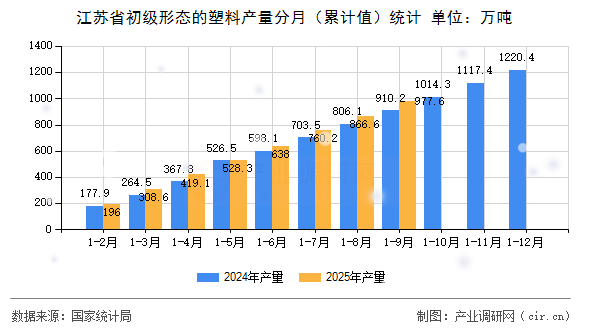
【图】2025年9月江苏省初级形态的塑料产量数据
Chan Ye Diao Yan Wang· 2025-12-31 07:45
Core Insights - The production of primary plastic shapes in Jiangsu Province reached 9.776 million tons in the first nine months of 2025, marking a 7.4% increase compared to the same period in 2024, although the growth rate has slowed by 0.3 percentage points from 2024 and is 4.2 percentage points lower than the national average [1] - In September 2025, the production of primary plastic shapes in Jiangsu was 1.108 million tons, reflecting a 6.4% increase year-on-year, with a slowdown of 0.5 percentage points compared to September 2024, and 4.0 percentage points lower than the national growth rate [2] Summary by Category Production Data - In the first nine months of 2025, Jiangsu's primary plastic production accounted for 8.9% of the national total of 10,970.31 million tons [1] - The September 2025 production represented 8.7% of the national total of 1,266.55 million tons for that month [2] Growth Trends - The growth rate of plastic production in Jiangsu for the first nine months of 2025 is lower than both the previous year and the national average [1] - The September 2025 growth rate also shows a decline compared to the same month in 2024, indicating a trend of slowing growth in the sector [2]

华信新材股价涨1%,中信保诚基金旗下1只基金位居十大流通股东,持有43.74万股浮盈赚取8.31万元
Xin Lang Cai Jing· 2025-12-31 06:37
Core Viewpoint - Huaxin New Materials Co., Ltd. has shown a positive stock performance with a 1% increase, reaching a share price of 19.15 yuan, and a total market capitalization of 1.968 billion yuan as of December 31 [1] Group 1: Company Overview - Huaxin New Materials, established on June 6, 2000, is located in Xinyi City, Jiangsu Province, and was listed on November 6, 2017 [1] - The company specializes in the research, production, and sales of functional plastic film materials, with 99.07% of its main business revenue coming from smart card substrates [1] Group 2: Shareholder Information - CITIC Prudential Fund's multi-strategy mixed fund (LOF) A (165531) has entered the top ten circulating shareholders of Huaxin New Materials, holding 437,400 shares, which is 0.43% of the circulating shares [2] - The fund has achieved a year-to-date return of 44.87%, ranking 1595 out of 8085 in its category, and a one-year return of 42.61%, ranking 1567 out of 8085 [2] - The fund manager, Wang Ying, has been in position for 8 years and 321 days, with a total fund asset size of 4.904 billion yuan [2]

泰国推动塑料垃圾100%回用
Zhong Guo Hua Gong Bao· 2025-12-31 03:41
Group 1 - The Thai government has launched a "Plastic Waste Management Roadmap" aiming for 100% recycling of target plastic waste by 2027, focusing on the collection and sorting of single-use plastic products such as bottles, caps, plastic bags, and single-layer film packaging [1] - The PPP Plastics initiative is collaborating with the Federation of Thai Industries (FTI) and other organizations to reduce marine debris through two main pillars: reducing the use of target plastics and enhancing the collection and recycling of these plastics [1] - An industry association comprising 28 companies is actively promoting the conversion of waste plastics into high-value materials, although insufficient statistical data makes it challenging to grasp the actual situation [1] Group 2 - The EU's Carbon Border Adjustment Mechanism (CBAM) requires companies to submit emission reports from 2023 to 2025, with full implementation starting in 2026, initially applicable to sectors such as steel, aluminum, cement, fertilizers, electricity, and hydrogen [2] - The PPP Plastics initiative is working with local governments, communities, and retailers to establish collection points for discarded bags and films, with a processing capacity of approximately 700,000 tons per year under the circular model concept [2] - The transition period of CBAM only requires reporting obligations without the need to purchase certificates, emphasizing the importance of calculating and certifying emissions, which will necessitate data linkage across the supply chain as a preliminary investment [2]
塑料日报:震荡运行-20251230
Guan Tong Qi Huo· 2025-12-30 12:02
Group 1: Investment Rating - No investment rating provided in the report Group 2: Core Viewpoints - On December 30, new maintenance devices such as Zhanjiang BASF's full - density were added, and the plastic operating rate dropped to about 86.5%. The overall supply and demand pattern of plastics remains unchanged, and the upward space for plastics in the near future is expected to be limited. Due to new plastic production capacity coming on - stream recently and the gradual end of the peak season for agricultural films, the L - PP spread is expected to decline [1] Group 3: Summary by Relevant Catalogs 1. Market Analysis - On December 30, new maintenance devices led to a decline in the plastic operating rate to a neutral level. As of the week of December 26, the PE downstream operating rate was at a relatively low level in recent years. The overall supply of plastics increased with new production capacity coming on - stream, and downstream demand decreased as the agricultural film season ended and terminal construction slowed. The cost - end crude oil price rebounded limitedly, and the overall supply - demand pattern of plastics remained unchanged, with limited upward space [1] 2. Futures and Spot Market Conditions - **Futures**: The plastic 2605 contract increased positions and fluctuated. The lowest price was 6436 yuan/ton, the highest was 6486 yuan/ton, and it closed at 6461 yuan/ton, down 0.09% below the 60 - day moving average. The position increased by 3545 lots to 512784 lots [2] - **Spot**: The PE spot market showed mixed trends, with price changes ranging from - 100 to + 100 yuan/ton. LLDPE was reported at 6200 - 6370 yuan/ton, LDPE at 7700 - 8530 yuan/ton, and HDPE at 6550 - 7850 yuan/ton [3] 3. Fundamental Tracking - **Supply**: On December 30, new maintenance devices were added, and the plastic operating rate dropped to about 86.5%, at a neutral level [4] - **Demand**: As of the week of December 26, the PE downstream operating rate decreased by 0.62 percentage points to 41.83% week - on - week. The agricultural film was gradually exiting the peak season, with orders and raw material inventory decreasing. The packaging film orders also slightly decreased, and the overall PE downstream operating rate was at a relatively low level in recent years [4] - **Inventory**: The petrochemical early - morning inventory on Tuesday increased by 20,000 tons to 600,000 tons week - on - week, 50,000 tons higher than the same period last year, at a relatively high level in recent years [4] - **Raw Materials**: The Brent crude oil 03 contract fluctuated around 62 US dollars/barrel. The Northeast Asian ethylene price remained flat at 725 US dollars/ton week - on - week, and the Southeast Asian ethylene price remained flat at 745 US dollars/ton week - on - week [4]
塑料板块12月30日跌0.89%,上纬新材领跌,主力资金净流出16.33亿元
Zheng Xing Xing Ye Ri Bao· 2025-12-30 08:56
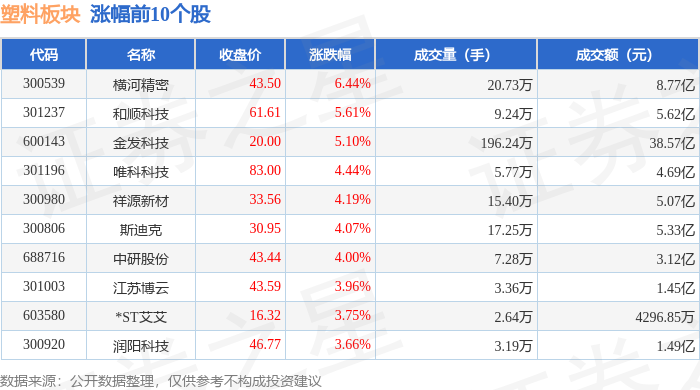
Market Overview - The plastic sector experienced a decline of 0.89% on December 30, with Shangwei New Materials leading the drop [1] - The Shanghai Composite Index closed at 3965.12, showing no change, while the Shenzhen Component Index rose by 0.49% to 13604.07 [1] Stock Performance - Notable gainers in the plastic sector included: - Henghe Precision (300539) with a closing price of 43.50, up 6.44% and a trading volume of 207,300 shares, totaling 877 million yuan [1] - Heshun Technology (301237) at 61.61, up 5.61% with 92,400 shares traded, amounting to 562 million yuan [1] - Jinfat Technology (600143) at 20.00, up 5.10% with a volume of 1,962,400 shares, totaling 3.857 billion yuan [1] - Conversely, significant decliners included: - Shangwei New Materials (688585) at 118.67, down 10.19% with a trading volume of 176,700 shares, totaling 2.091 billion yuan [2] - Shenjian Co. (002361) at 13.04, down 10.01% with 3,641,300 shares traded, amounting to 4.908 billion yuan [2] - Ruihua Technology (688323) at 22.95, down 3.57% with a volume of 159,700 shares, totaling 376 million yuan [2] Capital Flow - The plastic sector saw a net outflow of 1.633 billion yuan from major funds, while retail investors contributed a net inflow of 1.424 billion yuan [2] - The distribution of capital flow among key stocks showed: - Jinfat Technology (600143) had a net inflow of 2.13 billion yuan from major funds, but a net outflow of 1.98 billion yuan from retail investors [3] - Henghe Precision (300539) recorded a net inflow of 1.11 billion yuan from major funds, with a significant outflow from retail investors totaling 972.74 million yuan [3] - Other stocks like Zhejiang Zhongcheng (002522) and Weike Technology (301196) also experienced varying degrees of net inflows and outflows from different investor categories [3]


双象股份:整体经营情况良好
Zheng Quan Ri Bao Wang· 2025-12-29 12:42
Group 1 - The core viewpoint of the article is that the company, Shuangxiang Co., Ltd. (002395), is performing well overall and has applications for its optical-grade PMMA materials in optical instruments and lenses [1] Group 2 - The company responded to investor inquiries on an interactive platform, indicating a positive outlook on its business operations [1] - The optical-grade PMMA materials produced by the company are specifically applicable in the fields of optical instruments and optical lenses [1]

2025年LLDPE跌幅近30% 2026年首季LDPE承压最大
Zhong Guo Neng Yuan Wang· 2025-12-29 09:31
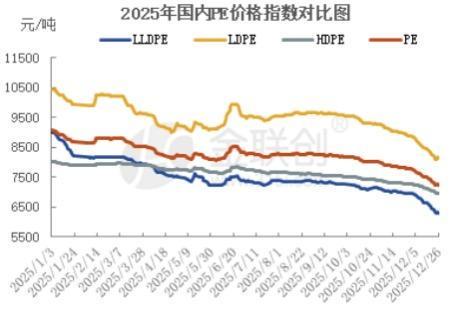
Group 1 - The domestic polyethylene (PE) market in 2025 continued to decline, with LLDPE experiencing the largest drop of 29.76% year-on-year, followed by LDPE at 22.35% and HDPE at 13.45%, resulting in an overall decline of 20.28% for polyethylene [2] - The market faced a severe contradiction of "high supply, weak demand, and high inventory," leading to a significant loss of market confidence and a continuous decline in LLDPE futures [2] - The first half of 2025 saw a downward trend in the market, with a slight rebound due to temporary factors such as the easing of US-China trade tensions and rising oil prices, but overall demand remained weak [2] Group 2 - In the second half of 2025, the decline in prices accelerated, with LLDPE and LDPE becoming the hardest hit, as the market faced a "cold wave" of accelerated decline, with price indices hitting multi-year lows [2] - The domestic supply pressure reached a peak, leading petrochemical companies and traders to engage in aggressive price cuts to capture market share, resulting in a vicious cycle of "price cuts - poor transactions - further price cuts" [2] - On December 24, 2025, a slight recovery in low-end pricing occurred due to technical rebounds in futures, but this was not indicative of a demand reversal, merely a temporary stabilization after significant declines [2] Group 3 - In the North China market, LLDPE prices ranged from 6,100 to 9,000 CNY/ton, with the lowest point on December 23 and the highest on January 1; LDPE prices ranged from 7,800 to 10,550 CNY/ton, with similar low and high points [3] - The polyethylene market in the first quarter of 2026 is expected to face challenges due to "strong supply and high inventory" against a backdrop of "weak recovery and slow destocking," limiting the potential for price rebounds [3] Group 4 - BASF's 500,000 tons/year polyethylene facility in Guangdong successfully produced qualified products on December 21, 2025, marking a successful startup [4] - Shandong Yulong Petrochemical's 500,000 tons/year LDPE/EVA facility is scheduled to start production in March 2026, while Zhejiang Petrochemical's new high-pressure and LDPE/EVA facilities are also set to commence in the first quarter of 2026 [4] - The expansion of high-pressure capacity and the continued release of capacity from ExxonMobil's Huizhou facility are expected to exert significant pressure on high-pressure market prices, while low-pressure prices will continue to seek new equilibrium points due to increased supply [4]
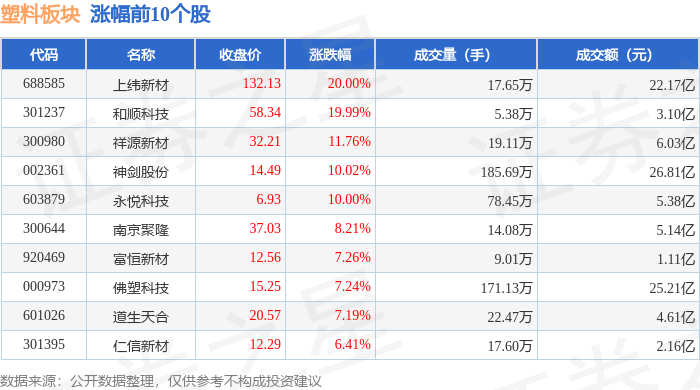
塑料板块12月29日涨3.24%,上纬新材领涨,主力资金净流入5797.99万元
Zheng Xing Xing Ye Ri Bao· 2025-12-29 08:58
Group 1 - The plastic sector experienced a significant increase of 3.24% on December 29, with Shangwei New Materials leading the gains [1] - The Shanghai Composite Index closed at 3965.28, up 0.04%, while the Shenzhen Component Index closed at 13537.1, down 0.49% [1] - Notable stocks in the plastic sector included Shangwei New Materials, which rose by 20.00% to a closing price of 132.13, and Heshun Technology, which increased by 19.99% to 58.34 [1] Group 2 - The plastic sector saw a net inflow of 57.98 million yuan from main funds, while retail investors contributed a net inflow of 15.6 million yuan [2] - Major stocks like Fushun Technology and Jinfat Technology had significant main fund inflows of 227 million yuan and 217 million yuan, respectively [3] - Retail investors showed a net outflow in several stocks, including Heshun Technology and Shangwei New Materials, indicating varied investor sentiment [3]


国贸期货塑料数据周报-20251229
Guo Mao Qi Huo· 2025-12-29 07:15
1. Report Industry Investment Rating - The investment rating for both PE and PP is "oscillating", indicating that the short - term market has no obvious driving force and is expected to move in a range [2][3] 2. Core Viewpoints of the Report - For PE, the supply is neutral, demand is bearish, inventory is bullish, basis is neutral, profit is bearish, valuation is bullish, and macro - policy is neutral. The short - term market is expected to oscillate [2] - For PP, the supply is bullish, demand is bearish, inventory is bullish, basis is neutral, profit is neutral, valuation is neutral, and macro - policy is neutral. The short - term market is expected to oscillate [3] 3. Summary by Related Catalogs PE Fundamental Changes - **Supply**: This week, China's PE production was 67.22 tons, a 1.09% decrease from last week. The capacity utilization rate was 84.11%, a 0.06 - percentage - point increase. New maintenance at Dushanzi Petrochemical was offset by restarts of some existing plants [2] - **Demand**: The average downstream product start - up rate decreased. In November, imports were 106.22 tons, a 9.93% year - on - year decrease and a 5.04% month - on - month increase, due to delayed shipments in October and more Iranian resources arriving in November [2] - **Inventory**: The sample inventory of Chinese PE producers was 45.86 tons, a 5.99% decrease from the previous period. Producers cut prices to reduce inventory, and downstream factories replenished at low prices [2] - **Basis**: The current main - contract basis is around 173, with the futures price at a discount [2] - **Profit**: Oil - and methanol - based production costs increased, while coal - and ethane - based costs decreased. The overall profit situation is bearish [2] - **Valuation**: The spot price is relatively low, and the main contract is at a discount [2] PP Fundamental Changes - **Supply**: This week, domestic PP production was 79.37 tons, a 3.18% decrease from last week but a 10.56% increase from the same period last year. The average capacity utilization rate was 76.87%, a 2.53% decrease [3] - **Demand**: The average start - up rate decreased by 0.56 percentage points to 53.24%. Weak cost support and pessimistic market sentiment among industry players [3] - **Inventory**: Producer inventory decreased by 0.45 tons (0.84%), port inventory increased by 0.12 tons (1.78%), and trader inventory decreased by 1.11 tons (5.62%) [3] - **Basis**: The current main - contract basis is around - 82, with the futures price at a premium [3] - **Profit**: Profits from some production methods improved, while others declined. The average weekly import profit was - 328.98 yuan/ton, a 1.49% decrease from last week [3] - **Valuation**: The spot price is relatively low, and the main contract is at a premium [3] Main Weekly Data Changes - **Prices**: PP futures price increased by 1.27%, PE futures price increased by 2.29%, LLDPE CFR decreased by 2.95% [4] - **Production and Capacity Utilization**: PP production increased by 4.54%, PE production decreased by 1.09%, PP start - up rate increased by 1.87%, PE start - up rate decreased by 1.46% [4] - **Inventory**: PP factory inventory decreased by 4.70%, PE social inventory increased by 1.97% [4]
【掘金板块牛熊】机器人再迎利好 背后受益板块浮出水面!
第一财经· 2025-12-29 05:25
Group 1 - The article highlights the strong performance of PEEK material concept stocks, with Hengbo Co., Ltd. hitting the daily limit up, and other companies like Chaojie Co., Ltd., Guangwei Composite Materials, Nanjing Julong, Huami New Materials, Shuangyi Technology, and Fuheng New Materials also experiencing gains [1] - The brain-computer interface concept is showing a strong upward trend, with Xiangyu Medical rising over 10%, and other companies such as Beiyikang, Innovation Medical, Sanbo Brain Science, Meihao Medical, and Botuo Biology following suit, indicating a potential for significant growth in this sector [1] - The lithium battery sector is experiencing a downturn, with lithium mines and electrolyte directions leading the decline, as companies like Xinwangda and Hongyuan Pharmaceutical fell over 10%, while Duofluo, Tianhua New Energy, Dazhong Mining, Haike New Source, and Qingshuiyuan all dropped over 7% [1]