
科技行业

Search documents
Q3财报超预期 天弘科技(CLS.US)涨超6%
Zhi Tong Cai Jing· 2025-10-28 15:27
Core Insights - Tianhong Technology (CLS.US) shares rose over 6%, reaching a new all-time high, with a year-to-date increase of 246% [1] Financial Performance - The company reported Q3 revenue of $3.19 billion, a 28% year-over-year increase, surpassing the expected $3.02 billion [1] - Adjusted earnings per share (EPS) for Q3 were $1.58, a 52% year-over-year increase, exceeding the anticipated $1.47 [1] Future Outlook - The company raised its full-year 2025 guidance, increasing revenue from $11.55 billion to $12.2 billion and adjusted EPS from $5.50 to $5.90 [1] - For the first time, the company provided guidance for 2026, projecting revenue of $16 billion, a 31.2% increase, and adjusted EPS of $8.20, a 39% increase [1]

美股异动 | 明星科技股盘初普涨 微软(MSFT.US)、苹果(AAPL.US)小幅上涨 市值均突破4万亿美元
智通财经网· 2025-10-28 14:05
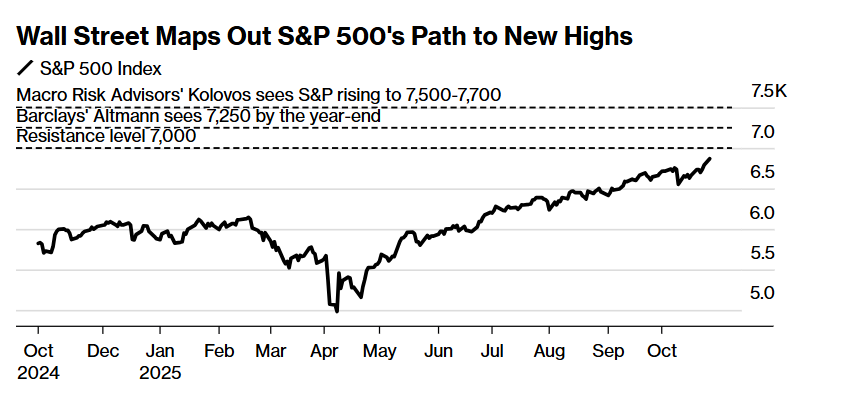
Core Viewpoint - The U.S. stock market opened slightly higher, with major indices showing positive movement, particularly in technology stocks, indicating strong investor sentiment and potential growth opportunities in the sector [1] Group 1: Company Performance - Microsoft (MSFT.US) shares rose nearly 3%, with its market capitalization surpassing $4 trillion, following a significant contract with OpenAI for an additional $250 billion in Azure services [1] - Apple (AAPL.US) saw a slight increase of 0.2% in its stock price, marking its market capitalization crossing the $4 trillion threshold for the first time, making it the third U.S. company to achieve this milestone [1] - Other notable tech stocks, including Tesla (TSLA.US), Nvidia (NVDA.US), and Broadcom (AVGO.US), experienced gains of over 1% [1] Group 2: Market Sentiment and Economic Indicators - Morgan Stanley analyst Samik Chatterjee projected that Apple's services business could account for 25% of total revenue, contributing up to 50% of profits, highlighting the strong user engagement with products like Apple Pay and iCloud subscriptions [1] - Positive macroeconomic signals, ongoing capital inflows, and seasonal trends are driving bullish sentiment on Wall Street, with the S&P 500 index closing at a record 6875 points, fueled by favorable trade signals, interest rate cut expectations, and strong corporate earnings [1] - Strategists from multiple institutions believe the market is poised to break the 7000-point barrier, with 7500-7700 points identified as the next target range [1]


有关突破7000点的一切都已烘托到位! 标普500蓄势冲击里程碑点位
智通财经网· 2025-10-28 12:03
首先是市场愈发聚焦的资金流数据显示,散户与机构投资者们正不断涌入美股市场,并且更重要的是——技术分析指标 显示在这一整数里程碑之前技术层面阻力非常微弱。作为一种季节性的怪癖——9月与10月往往是股票市场的疲软时 期,然而,刚刚过去的一周在经历过的75年中是对股票市场最为有利的一周。无论是基本面预期、技术面还是资金流, 抑或是历史流数据都已经充分铺垫,标普500指数冲破7,000点这一超级关口可能就是在最近几个交易日。 "推动风险资产走高的催化剂根本不缺少。"来自瑞银证券的对冲基金股票衍生品销售主管Michael Romano周日在致客户 们的一份研究报告中写道。"曾被视为年末7,100点的'蓝天极限情景',正迅速成为市场的基准情景,因为市场把明年的 上行预期提前反映并定价了。" 对于一些立场谨慎的投资者而言,这种乐观情绪无疑将在本周面临严峻考验,因为驱动美股自2023年以来牛市行情且在 标普500指数中占据高权重的"七大科技巨头"中的五家科技巨擘将于美东时间周三和周四美股收盘之后公布业绩。 智通财经APP获悉,随着一场季节性的剧烈波动基本上已经过去,看涨美国股市的华尔街对冲基金以及机构投资者们正 排队押注标普 ...



九联科技:2025年前三季度净利润约-1.20亿元
Mei Ri Jing Ji Xin Wen· 2025-10-28 11:05
Group 1 - Company Jiulian Technology (SH 688609) reported a revenue of approximately 1.761 billion yuan for the first three quarters of 2025, representing a year-on-year decrease of 6.28% [1] - The net profit attributable to shareholders of the listed company was a loss of approximately 120 million yuan [1] - As of the report date, Jiulian Technology's market capitalization was 4.8 billion yuan [2] Group 2 - The A-share market has surpassed 4000 points, marking a significant resurgence after a decade of stagnation, with the technology sector leading the market's transformation [2] - A new "slow bull" market pattern is emerging, indicating a shift in market dynamics [2]

Fed Expected to Deliver Second Straight Rate Cut
Youtube· 2025-10-27 16:29
Economic Outlook - The upcoming week will feature significant tech earnings on Wednesday and Thursday, alongside a crucial meeting between US and Chinese leaders on Thursday [1] - The Federal Reserve's decision is anticipated, but the ongoing government shutdown complicates data availability for October, leading to uncertainty for November as well [2][9] Labor Market Insights - The Chicago Fed's real-time unemployment forecast estimates an unemployment rate of 4.35% for October, showing little change from September's 4.3% [3] - Despite the lack of comprehensive data due to the shutdown, there is no indication of a significant deterioration in the labor market [4] Data Collection Challenges - The Federal Reserve's ability to gather accurate data is hindered, with the next meeting scheduled for December 10, leaving a gap in data collection for potentially one to three months [9][12] - The reliance on electronic sources for job data may allow for some estimates, but the unemployment number remains challenging to obtain due to its dependence on telephone surveys [8] Inflation and Consumer Confidence - There is a possibility of obtaining a reasonable estimate for the October CPI report if the government shutdown ends early in November, as only 2.5% of the sample is needed for a reasonable estimate [6] - Consumer confidence and jobless claims data will be monitored, although the overall data week is expected to be light due to cancellations [4][5]
Fed Chair Jerome Powell Just Gave Investors a Reality Check -- Here's Your Playbook for What Comes Next
Yahoo Finance· 2025-10-27 10:15
Key Points There are growing signs of economic weakness, making the Federal Reserve's job harder. Meanwhile, stock prices have soared faster than underlying earnings, pushing valuations higher. Powell warns there's "no risk-free path" going forward -- here's what to do. These 10 stocks could mint the next wave of millionaires › The current bull market is showing no signs of slowing down anytime soon. The S&P 500 climbed nearly 40% from its April lows. The tech-heavy Nasdaq Composite soared even h ...
【招银研究】海外降息预期强化,国内市场情绪升温——宏观与策略周度前瞻(2025.10.27-10.31)
招商银行研究· 2025-10-27 10:05
Group 1: U.S. Macro Strategy - The Federal Reserve is expected to lower interest rates by 25 basis points in both October and December meetings, bringing the year-end policy rate to a range of 3.5-3.75% [2] - September's U.S. CPI data was weaker than expected, with a year-on-year increase of 3.0% and a month-on-month increase of 0.3%, indicating short-term inflation concerns may be alleviated [2] - The U.S. economy is facing downward pressure, with a significant tightening in fiscal stance reflected in a surplus of $25.4 billion for week 42, compared to the same period last year [3] Group 2: U.S. Equity Market - The S&P 500 index rose by 1.9% last week, supported by strong corporate earnings and the expectation of continued rate cuts from the Federal Reserve [3] - Despite the current resilience in the U.S. stock market, uncertainties are rising, with high valuations primarily driven by AI narratives and tech giants' earnings [3] - The risk premium in the U.S. stock market is low, which may not align with potential credit and geopolitical risks [3] Group 3: U.S. Debt Market - Due to lower-than-expected inflation, expectations for rate cuts have strengthened, leading to a forecasted decline in U.S. Treasury yields [4] - The long-term interest rates face pressure from concerns over U.S. fiscal sustainability and the independence of the Federal Reserve, limiting their downward potential [4] Group 4: Chinese Macro Strategy - High-frequency data indicates a contraction in durable goods consumption and real estate transactions, with new home sales in 30 major cities down by 23.6% year-on-year [7] - Industrial enterprise profit growth accelerated to 21.6% year-on-year in September, supported by low base effects and recovery in upstream product prices [8] - Exports are expected to remain stable in October, with positive signals from recent U.S.-China trade discussions [9] Group 5: Chinese Equity Market - The A-share market saw a 2.9% increase last week, driven by liquidity support and stable economic fundamentals [11] - Growth and small-cap stocks are expected to outperform, with technology sectors showing high investment interest [11] - The Hong Kong stock market rebounded by 3.6%, benefiting from improved U.S.-China trade relations and favorable policies for the technology sector [12]
本周前瞻:央行决议超级周聚焦美联储降息
Sou Hu Cai Jing· 2025-10-27 08:51
Core Viewpoint - This week marks the last week of October, featuring a "super week" of central bank decisions, with the Federal Reserve's interest rate decision being the focal point. Other central banks, including the Bank of Canada, the Bank of Japan, and the European Central Bank, will also announce their rate decisions. A series of important economic data will be released, including GDP figures from the Eurozone and Germany, as well as the U.S. GDP and core PCE price index. The earnings reports from major tech companies such as Microsoft, Meta, Apple, Alphabet, and Amazon will also be significant events that could impact global financial markets [1]. Economic Data and Events Summary - **Monday**: Focus on Germany's IFO Business Climate Index, which may show a second consecutive month of slowdown, indicating further challenges for the German economy. The U.S. will release September durable goods orders data, with investors watching for a continuation of the previous mild growth trend. The Dallas Fed Business Activity Index for October is expected to remain negative, reflecting ongoing low business activity in the region [3]. - **Tuesday**: Attention will be on the U.S. Conference Board Consumer Confidence Index for October, with expectations that it may further decline to around 90, reflecting consumer concerns about the economic outlook. The Richmond Fed Manufacturing Index will also be monitored for signs of continued pressure on U.S. manufacturing [4]. - **Wednesday**: The Bank of Canada will announce its interest rate decision, with a high probability (over 86%) of a 25 basis point cut, bringing the benchmark policy rate down to 2.25%. This follows unexpected inflation rise (September CPI at 2.4%) and warnings from the central bank governor about economic risks [6]. - **Thursday**: The Federal Reserve is expected to announce a 25 basis point rate cut amid a lack of significant economic signals due to the recent government shutdown. The decision is anticipated to create notable market volatility. The Bank of Japan will also announce its rate decision, with new uncertainties introduced by the recent election of Prime Minister Suga. The Eurozone and Germany's Q3 GDP data will be closely watched, with the Eurozone needing to maintain over 1% annual growth to support optimistic economic outlooks [7][9]. - **Friday**: The Eurozone will release CPI data, expected to remain at 2.2%, above the ECB's target. The U.S. core PCE price index for September will also be released, with market attention on whether it remains around 3%. Any unexpected data could lead to market fluctuations [10][11].

光大证券伍礼贤:市场关注中美元首会面 料恒指年内仍有望刷新高位
智通财经网· 2025-10-27 08:07
Core Viewpoint - The market is currently in a wait-and-see mode regarding the outcomes of the US-China trade negotiations and the upcoming meeting between the two presidents, which is expected to significantly influence future market trends [1] Market Sentiment - The meeting between the two leaders is anticipated to have a notable impact on market direction, with the Hang Seng Index expected to find substantial support around the 25,200 points level [1] - A positive outcome from the negotiations could lead to the index potentially reaching new highs for the year [1] Trading Volume and Trends - Current events are limiting market movement, resulting in low trading volumes, but a clear direction is expected to emerge following the announcement of the negotiation results, which will be crucial for Hong Kong stock performance in November [1] Economic Indicators - The expectation is that a certain level of agreement will be reached, although resolving all issues between the US and China will take time [1] - The Federal Reserve's recent interest rate cuts are factored into the market, and while there is speculation about Hong Kong following suit, the ultimate performance of the Hang Seng Index will depend on the progress of US-China negotiations [1] Investment Recommendations - It is suggested to consider high-dividend stocks, particularly Chinese telecom companies with growth prospects and oil stocks that have attracted ongoing interest from investors [2] - For those interested in technology stocks, it is advised to wait for the results of the US-China negotiations before making any investments [2]

美媒:医美成硅谷男高管“必修课”
Huan Qiu Shi Bao· 2025-10-26 22:33
Core Insights - Cosmetic surgery is becoming a "mandatory course" for male executives in the Silicon Valley tech industry, with the number of male tech managers undergoing cosmetic procedures increasing over five times in the past five years [1] - The number of facial and eyelid surgeries has risen by 25% and 50%, respectively, compared to pre-COVID levels [1] - The cost of a facelift ranges from $40,000 to $65,000, and due to the wealth of Silicon Valley tech executives, they are willing to invest significantly in their personal image [1] Industry Trends - The shift to remote or hybrid work models post-pandemic has provided tech executives with the time to undergo cosmetic procedures without impacting their work [1] - Male tech professionals in their 30s tend to prefer non-invasive cosmetic treatments, such as facial fillers, while those in their 40s are more inclined to opt for surgical options [1] - The perception of aging in the tech industry is changing, with male executives feeling pressure to maintain a youthful appearance to avoid being labeled as "outdated" [1] Social Dynamics - There is a societal shift where the pressure regarding appearance, previously focused on female professionals, is now extending to male executives in Silicon Valley [1] - The industry is increasingly demanding that successful male professionals also present themselves as attractive and charismatic [1]