高端装备

Search documents
如果找错了合伙人,是否要兑现股权?
创业家· 2025-12-17 10:15
Core Viewpoint - The article emphasizes the importance of trust and credibility in entrepreneurial ventures, particularly regarding equity distribution among employees, suggesting that even if mistakes are made, it is crucial to maintain trust and fulfill commitments to ensure long-term success [1]. Group 1: Event Overview - The event led by Wu Shichun focuses on exploring the technology manufacturing industry and aims to unlock opportunities in a trillion-dollar market [6]. - Participants will engage in a three-day immersive learning experience, covering topics from technological innovation to commercialization strategies [8]. - The event will feature interactions with key industry players and investors, fostering collaboration and problem-solving among entrepreneurs [8]. Group 2: Itinerary Highlights - Day 1 includes participant registration, a welcome dinner, and a private sharing session titled "Entrepreneurship Insights" [15]. - Day 2 features a lecture on "Technological Innovation and Industry Breakthroughs" by Wu Shichun, along with a cultural exploration of Xi'an [15]. - Day 3 consists of a peak dialogue with Wu Shichun and a case study on satellite manufacturing and commercialization led by Peng Yuanyuan, founder of Xingyi Lianxin [15]. Group 3: Target Audience - The event targets various sectors, including robotics, smart manufacturing, low-altitude economy, aerospace, hard technology, and new materials [17][18][19][20][21]. - It aims to attract entrepreneurs and investors interested in cutting-edge technologies and innovative business models [8]. Group 4: Pricing and Inclusions - The original price for the event is 15,800 yuan per person, with an early bird discount bringing it down to 12,800 yuan [23]. - The fee includes two nights of hotel accommodation, meals, activity materials, and entrance tickets to scenic spots, excluding airfare and optional personal projects [24].


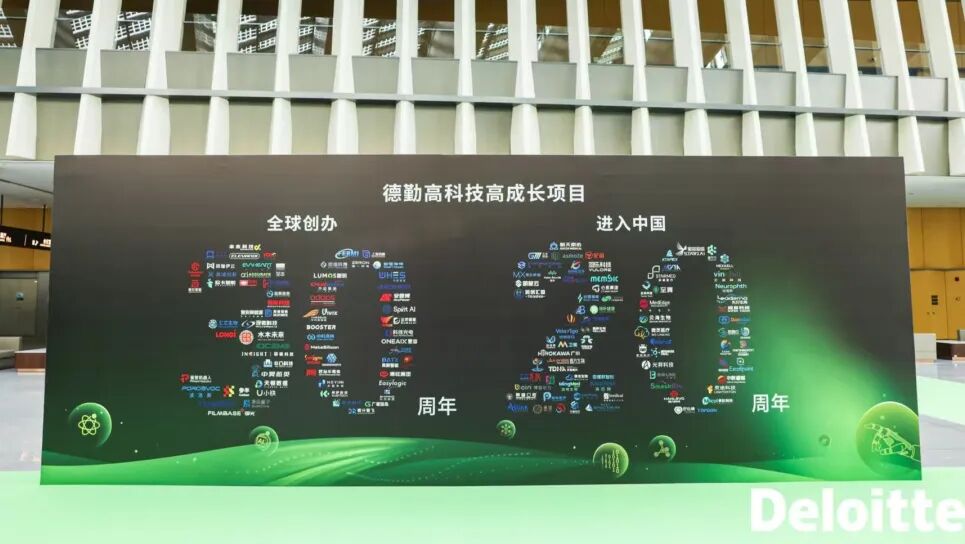
《2025德勤中国高科技高成长50强及明日之星报告》发布
Zheng Quan Ri Bao Wang· 2025-12-17 06:10
Group 1 - The report by Deloitte China highlights that the average cumulative revenue growth rate of the top 50 high-growth companies in China is 490% over three years [1] - In terms of revenue scale, companies with revenues between 50 million and 100 million yuan represent 38% of the top 50, while those with revenues above 100 million yuan account for 44%, indicating a rise in the proportion of small and medium-sized enterprises [1] - The Greater Bay Area accounts for 52% of the top companies, with Shenzhen, Shanghai, Beijing, and Guangzhou leading, showcasing that first-tier cities remain the primary birthplace for tech companies due to their mature industrial base and abundant talent [1] Group 2 - Key drivers for technology and innovation in enterprises include talent, capital, and AI R&D investment, with 23% of the top 50 companies and 66% of the "Tomorrow's Stars" investing over 50% of their revenue in AI R&D [2] - Both the top 50 companies and the "Tomorrow's Stars" face challenges such as a shortage of high-tech talent, insufficient application of AI technology in business scenarios, and rising R&D costs [2] - The Chinese tech industry is expanding into multiple high-potential sectors, leveraging technological innovation and ecological scene implementation to gain a competitive edge [2]

报告:中国科技50强营收增长率较去年略有下降
第一财经· 2025-12-17 04:41
Core Insights - The average three-year cumulative revenue growth rate for the top 50 high-tech companies in China is 490%, showing a slight decline compared to 2024, while the revenue growth rate for the top 10 companies remains stable [3][4]. - The proportion of companies with revenue between 50 million and 100 million yuan has increased to 38%, while those with revenue over 100 million yuan remains at 44%, indicating a rise in the share of small and medium-sized enterprises [3]. - The Greater Bay Area accounts for 52% of the top 50 companies, with Shenzhen, Shanghai, Beijing, and Guangzhou leading, highlighting the importance of first-tier cities in nurturing tech enterprises [3]. Revenue Distribution - The hardware industry leads with a 28% share, followed by high-end equipment at 18%, benefiting from growth in the semiconductor sector and strong performance in intelligent manufacturing [3]. - Clean technology has seen an increase to 10% due to the inclusion of more new energy companies, while software and life sciences have declined, and the internet sector has experienced a significant drop, reflecting a trend towards hard technology [3][4]. Key Drivers and Challenges - Talent, capital, and AI R&D investment are identified as the three key drivers for technological innovation among companies [4]. - 23% of the top 50 companies and 66% of the rising stars allocate over 50% of their revenue to AI R&D, but they face challenges such as a shortage of high-tech talent, insufficient application of AI in business scenarios, and rising R&D costs [4][5]. Future Trends - The global tech industry is undergoing a deep transformation driven by AI, with trends including computational sovereignty competition, the rise of open-source model ecosystems, and the evolution of AI agents [5]. - From 2025 to 2030, China is expected to enter a period of explosive growth in "AI + manufacturing/new energy/life sciences," becoming a beneficiary and backup provider in the global "computational replacement of labor" landscape [5]. - The technology sector in China is enhancing innovation through five key areas: AI penetration, iteration of computational and connectivity technologies, robotics breakthroughs, advancements in energy and green technology, and the rise of space and low-altitude economies [5]. Health Sector Insights - Over 60% of the companies listed in the 2025 China Pharmaceutical and Health Rising Stars report have valuations exceeding 1 billion yuan, with innovative drugs and medical devices accounting for 80% of the most dynamic sectors [5]. - The Yangtze River Delta, Beijing-Tianjin-Hebei, and Pearl River Delta regions are identified as key innovation hubs in the pharmaceutical and health sector, hosting nearly 90% of the listed companies [5].

创金合信基金魏凤春:2026年资产配置的基准线
Xin Lang Cai Jing· 2025-12-17 01:39
本文作者为创金合信基金首席经济学家魏凤春 自11月19日首席视点提出积极地等待后,市场处于相对僵持的状态。此后,我们陆续讨论了2026年流动 性、康波周期等五大周期,以及策略实施的问题。上期提出了锚定盈利、聚焦中游、工具适配的2026年 资产配置策略,其有效性根植于"风险溢价下行、盈利上行、结构分化"的三重共振。契合我们一直坚持 的"周期共振为锚、战略聚焦新动能、战术攻守兼备"的核心框架,在不确定性中锚定盈利确定性,在结 构分化中把握中游产业的稀缺价值。 在上述策略的实施中,还有一些基本的技术细节没有处理。这些细节对单一资产收益和风险边界的确 定,对股票、债券、黄金等不同资产性价比的认定具有决定性的作用,主要指资产配置的基准线。从宏 观策略的视角看,这些基准线由收益的基准线和风险的基准线组成。收益的基准线主要指基础因子中的 经济增长,GDP增长率和企业盈利率是最基本的分析因素。 风险的基准线主要指通货膨胀因子,CPI和PPI是主要观察对象。除此之外,无风险收益率是资产配置的 基准,这可以纳入流动性因子之中。投资者关注的流动性还包括资金的价格和资金的数量,资金的价格 包括贷款市场报价利率(LPR)以及人民币汇率 ...
山西初步形成转型金融标准体系,授信超百亿元
Zhong Guo Xin Wen Wang· 2025-12-17 00:56
Core Insights - Shanxi Province has established a transformation financial standard system with local characteristics, facilitating credit issuance of 13.17 billion RMB to 17 enterprises since the beginning of the 14th Five-Year Plan [1] Group 1: Financial Support and Standards - The province has implemented transformation financial standards in the coking and non-ferrous industries, promoting pilot programs for national coal, electricity, and steel industry transformation financial support [1] - A total of 36.86 million RMB has been lent to 17 enterprises applying transformation financial standards [1] Group 2: Green Financing and Investment - As of the end of Q3 this year, the balance of green loans in Shanxi reached 567.045 billion RMB, reflecting a growth of 12.72% since the beginning of the year [1] - The government investment fund has invested in 248 projects totaling 33.6 billion RMB, focusing on high-end equipment manufacturing, biomedicine, wind energy, low-altitude economy, and semiconductors [1]
看好中国股市 国际长线资金源源不断流入
Zheng Quan Ri Bao· 2025-12-16 16:06
Group 1 - Several foreign institutions, including UBS, JPMorgan, and Fidelity International, believe that Chinese assets have a solid foundation for continued rebound due to profit growth, accelerated innovation, and attractive valuations in their 2026 macroeconomic and stock market outlooks [1] - International long-term capital is showing strong interest in Chinese assets, particularly in sectors like healthcare, robotics, and low-altitude economy, with significant investments from Middle Eastern funds [2] - As of November, foreign long-term capital net bought approximately $10 billion in A-shares and H-shares, contrasting sharply with an outflow of about $17 billion in 2024, indicating a positive trend in foreign investment [3] Group 2 - Deutsche Bank projects that consumption will remain the main driver of China's economic growth, with a recovery in investment contributions and strong export performance [4] - The Central Economic Work Conference emphasized the need for effective qualitative improvements and reasonable quantitative growth in the economy, which is expected to support ongoing structural reforms [5] - UBS highlights that the technology sector in China represents one of the most significant global opportunities, with expected corporate profit growth of up to 37% in 2026, driven by ample liquidity [6]


德勤:今年中国50强企业三年累计营收增长率平均值达490%
Guo Ji Jin Rong Bao· 2025-12-16 15:16
Group 1: Core Insights - The "2025 Deloitte China High-Tech High-Growth 50" and "Deloitte China Rising Stars" lists were announced, showing an average three-year cumulative revenue growth rate of 490% for the top 50 companies, slightly down from 2024, while the top 10 companies maintained their revenue growth rates [1] - Companies with revenue between 50 million and 100 million yuan increased to 38%, while those with revenue over 100 million yuan remained at 44%, indicating a rise in the share of small and medium-sized enterprises [1] - The Greater Bay Area accounted for 52% of the companies, with Shenzhen, Shanghai, Beijing, and Guangzhou leading, highlighting the importance of first-tier cities in nurturing tech enterprises [1] Group 2: Industry Distribution - The hardware sector led with a 28% share, followed by high-end equipment at 18%, benefiting from growth in the semiconductor field and smart manufacturing [1] - Clean technology's share rose to 10% due to the inclusion of more new energy companies, while software and life sciences saw declines, and the internet sector experienced a significant drop, reflecting a trend towards hard technology transformation [1] Group 3: Key Drivers and Challenges - Talent, capital, and AI R&D investment are identified as the three key drivers for companies pushing technology and innovation, with 23% of the top 50 companies and 66% of rising stars investing over 50% of their revenue in AI R&D [2] - Both the top 50 and rising star companies face challenges such as a shortage of high-tech talent, insufficient application of AI technology in business scenarios, and rising R&D costs [2] - Core technology self-research, rapid product iteration, and diversified financing are becoming breakthrough points for resilient development [2] Group 4: Future Trends - The Chinese tech industry is expected to expand into multiple fields driven by AI trends, with a projected explosion of the "AI + manufacturing/new energy/life" technology matrix from 2025 to 2030 [2] - The industry is strengthening technological innovation across five areas: AI penetration, computing power and connectivity technology iteration, robotics technology explosion, breakthroughs in energy and green technology, and the rise of space and low-altitude economies [2] Group 5: Healthcare Sector Insights - Over 60% of the companies listed in the "2025 China Pharmaceutical Health Rising Stars" have valuations exceeding 1 billion yuan, with innovative drugs and medical devices accounting for 80% of the list [2] - The Yangtze River Delta, Beijing-Tianjin-Hebei, and Pearl River Delta regions are key innovation sources in the pharmaceutical health sector, hosting nearly 90% of the listed companies [2] - The "14th Five-Year Plan" positions the biopharmaceutical industry as a core area of "new productivity," accelerating innovation and high-quality development in the pharmaceutical health sector [3]
两张榜单重磅发布!
Xin Lang Cai Jing· 2025-12-16 14:03
Core Insights - The "2025 Deloitte China High-Tech High-Growth 50" and "Deloitte China Rising Star" lists were unveiled at the summit held in Wuxi, showcasing the vitality of China's industrial innovation and exploring new trends in future technology development [1][21]. Industry Overview - The report indicates that the hardware sector leads the "China 50" with a 28% share, followed by high-end equipment at 18%. The growth in the semiconductor field has significantly benefited hardware, while high-end equipment thrives on intelligent manufacturing. Clean technology has increased to 10% due to the inclusion of more renewable energy companies. Software and life sciences have seen a decline compared to the previous year, with the internet sector experiencing a notable drop, indicating a shift in China's tech industry towards "hard technology" [4][23]. - The Greater Bay Area continues to dominate with a 52% share, with Shenzhen, Shanghai, Beijing, and Guangzhou remaining the top cities for tech entrepreneurship due to their mature industrial chains, talent pools, and capital environments [4][23]. - AI has become a standard in R&D, with 23% of the "China 50" companies and 66% of "Rising Star" companies investing over 50% of their revenue in AI development [4][23]. Regional Development - The event's theme "Innovation Without Boundaries, Resilient Growth" reflects the recognition of Huishan's innovation ecosystem and industrial development strength, highlighting Deloitte's collaboration with Huishan to build a high-tech hub for sustainable economic growth [4][25]. - Huishan has established itself as an innovative demonstration zone in Jiangsu, focusing on nurturing tech enterprises through high-level platforms and a comprehensive service chain from R&D to results transformation [6][25]. Company Highlights - Jiangsu Weiheng Intelligent Technology Co., a representative in the digital energy sector, has developed a technology system centered on "AI + new energy storage," successfully entering over 60 countries and showcasing China's hard tech international competitiveness. Since its establishment in Huishan High-tech Zone in 2021, it has achieved rapid growth and was included in Wuxi's unicorn cultivation list [13][32]. - Two Wuxi companies made it to the lists: Jiangsu Weiheng Intelligent Technology Co. with a 344% three-year revenue growth rate in the "2025 China High-Tech Growth 50" and Wuxi Pamu Medical Technology Co. in the "2025 Deloitte China Medical Health Rising Star" list [14][33]. - Pamu Medical, focused on cardiovascular diseases, has developed innovative solutions for pulmonary hypertension and heart failure, gaining global recognition for its original technology. Its product PFlexi sheath received FDA approval, showcasing China's innovative medical device capabilities [16][35]. Collaborative Ecosystem - Deloitte and Huishan have been collaborating on optimizing the business environment and regional economic research, resulting in the "2025 Huishan District Investment Environment White Paper," which highlights the area's advantages in industrial chain completeness, policy support, and talent environment [18][37]. - The white paper uses the acronym "HUI" to represent High potential, Unique, and Innovation, emphasizing Huishan's high-value industries, unique location advantages, and commitment to integrating research, development, and application [18][37]. Conclusion - The 2025 Deloitte dual lists not only document the growth trajectory of China's high-tech enterprises but also reflect the path of regional economic upgrades through systematic ecological construction. Huishan's proactive layout in hard technology, comprehensive innovation service system, and capital investment strategies have attracted companies to settle and grow locally while expanding globally [20][39].
2016—2025年中央经济工作会议创新部署的十年演进:科技创新不断深化,新质生产力蓄势跃升
Capital Securities· 2025-12-16 11:27
Group 1: Strategic Evolution - The strategic positioning of technology innovation has shifted from a "supporting role" to a "core engine" of economic growth, indicating its integration into the core logic of economic growth and productivity restructuring[6] - The focus of innovation policy has transitioned from "bridging gaps" to "building advantages," emphasizing the cultivation of globally competitive industrial systems[8] - The institutional arrangements have evolved from primarily resource allocation to establishing long-term mechanisms that foster innovation, highlighting a systemic approach to innovation ecology[10] Group 2: Policy Implications - The policy emphasis has moved from merely supporting technology to ensuring that technology serves as a foundational support for national development security[6] - The shift in policy logic reflects a deeper understanding of how to sustainably convert technology into productive forces, impacting local governance, enterprise development, and capital market operations[11] - The current capital market trends are not short-term fluctuations but rather a concentrated reflection of the ongoing evolution of innovation policy logic, with technology innovation becoming a systematic project for long-term growth[12] Group 3: Market Dynamics - The capital market has seen a structural rally driven by sectors such as artificial intelligence, advanced manufacturing, and semiconductors, indicating a strong consensus on technology as the main investment theme[5] - The emphasis on nurturing new momentum while updating old momentum suggests a recognition that new quality productivity is not merely a replacement for traditional industries but a comprehensive upgrade through digitalization and green transformation[9] - The evolving role of the capital market is crucial, serving not only as a financing platform for tech companies but also as a hub connecting technology, industry, and market expectations[11]
吴世春:创业者总喊融不到钱,但真相其实是……
创业家· 2025-12-16 10:12
Core Insights - The article emphasizes that many entrepreneurs claim to lack funding or talent, but the underlying issue is often a lack of clear strategy [3][4]. - A well-defined strategy can attract sufficient funding and talent, as China's capital chain and talent pool are among the most complete and abundant globally [6][7]. Investment and Fund Management - The company has been managing funds for nearly 11 years, with a total fund size exceeding 10 billion [8]. - It has invested in over 600 companies, with around 70 of them reaching profitability close to A-share listing standards, and expects over 20 companies to go public in the coming year [9]. Entrepreneurial Support and Events - The article promotes an upcoming event where the company will lead 100 entrepreneurs to explore the technology manufacturing industry in Xi'an, aiming to tap into a trillion-dollar market [11][17]. - Participants will engage in deep learning experiences, networking with key industry players, and exploring strategies for innovation and commercialization [19][20]. Industry Focus Areas - The event will cover various sectors, including robotics, aerospace, high-end equipment, new materials, and digital tourism experiences [17][33]. - It aims to provide insights into capital trends and the core logic of hot investment sectors, helping entrepreneurs understand the underlying mechanisms for success [20][22].