
清洁技术

Search documents
焦虑工业落后中美,出台系列保护法案,欧盟加大对华限制遭六国联名警告
Xin Lang Cai Jing· 2026-02-11 22:53
Group 1 - The European Union (EU) is increasingly anxious about its industrial economy lagging behind the US and China, prompting the implementation of protectionist policies to revive local industries [1][2] - French President Macron has called for increased investment in key areas such as ecological transition, artificial intelligence, and quantum technology to prevent Europe from falling further behind [1] - The upcoming informal meeting of EU leaders will focus primarily on restoring European economic competitiveness, which has been a core agenda since the current EU Commission took office in mid-2024 [1][2] Group 2 - The EU's recent economic policies exhibit a clear protectionist trend, particularly against China, which has significantly impacted normal trade relations [2][3] - The proposed "Industrial Accelerator Act" will require foreign investments in the EU to form joint ventures with a maximum 49% foreign ownership and mandates the transfer of intellectual property [2] - Several EU member states have expressed opposition to protectionist measures, warning that prioritizing European goods and services could hinder access to leading global technologies and deter investment [3] Group 3 - Analysts suggest that the EU's protectionist approach reflects its anxiety about falling behind in emerging economic competition, and while the intent to revive industry is understandable, the methods may be misguided [3][4] - The EU's reliance on transatlantic alliances for security and deep integration into global supply chains complicates its position in the US-China rivalry, making it vulnerable to external pressures [4] - There remains significant potential for sustainable and mutually beneficial cooperation between the EU and China if the EU can provide a predictable business environment and transparent regulations [4]
欧盟批准德国30亿欧元国家援助计划
Zhong Guo Hua Gong Bao· 2026-02-09 02:46
Core Points - The European Commission has approved a €3 billion state aid plan for Germany, aligning with the goals of the Clean Industry Agreement to support the transition to a net-zero economy [1] - The aid plan is available to businesses across Germany and will provide subsidies until December 31, 2030, including grants, tax incentives, interest subsidies on new loans, and loan guarantees [1] - The funding will support the expansion of production capacity for net-zero technologies and their core components, as well as the use of secondary raw materials in production [1] Summary by Categories - **Approval and Framework** - The plan was approved based on the Clean Industry Agreement State Aid Framework (CISAF) established on June 25, 2025, which aims to support key areas for the EU's transition to a net-zero economy [1] - The European Commission determined that the plan meets CISAF conditions and is necessary and reasonable for promoting the production of clean technologies and essential raw materials [1] - **Subsidy Measures** - Member states can implement various subsidy measures under the CISAF framework until the end of 2030, covering areas such as renewable energy promotion, electricity price relief for high-energy-consuming enterprises, industrial decarbonization, clean technology capacity assurance, and risk mitigation for private green investments [1]
英国媒体:中国电动汽车出口强劲有助于提升绿色技术领先地位
Xin Lang Cai Jing· 2026-02-07 11:29
Group 1 - The core viewpoint of the article is that the rapid growth of China's electric vehicle exports enhances its leading position in clean energy technology [1][5] - China is leading the global clean technology industry, with electric vehicle exports being a significant representation of this leadership [1] - By 2025, Chinese electric vehicles are expected to be sold in over 150 countries and regions, with electric vehicles accounting for more than half of new cars manufactured in China [1] Group 2 - The largest market for Chinese electric vehicles is Belgium, followed by the UK and the UAE, with affluent countries increasingly importing these vehicles [2] - In the past year, the most significant growth in orders for Chinese electric vehicles has been observed in Africa, followed by the Middle East, with notable increases in Asia and Oceania as well [2] - The growth in electric vehicle exports allows Chinese manufacturers to significantly expand their sales volume and enhance service and after-sales business, including battery systems and grid management components [5] Group 3 - The increasing sales of electric vehicles in various countries drive the demand for charging infrastructure, necessitating urgent action from policymakers and power companies to ensure local grids are operational [5] - This situation provides opportunities for China's leading grid management and clean energy technology products to play a role in the construction of these energy systems [5] - As more consumers purchase Chinese electric vehicles, there is a growing preference for other clean technology products produced in China, such as residential solar panels and battery storage systems [7]


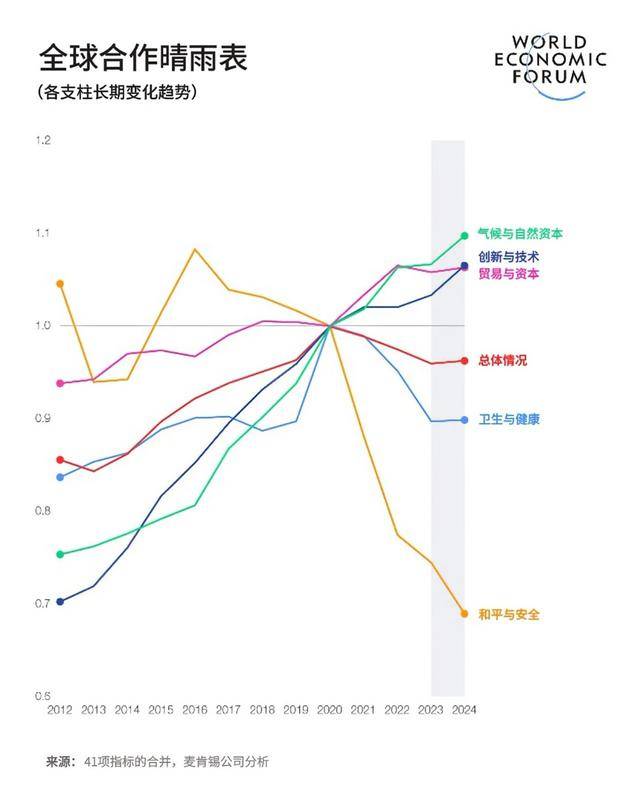
世界经济论坛《2026年全球合作晴雨表》:和平与安全合作下滑显著
Sou Hu Cai Jing· 2026-01-09 04:22
Core Insights - The World Economic Forum's "2026 Global Cooperation Index" indicates a shift towards trade and technology cooperation among like-minded countries, while peace and security cooperation has significantly declined [1] Trade and Capital - Overall cooperation in trade and capital remains above the 2019 baseline, but structural changes are profound; global goods trade continues to grow, yet at a slower pace than global economic development [3] - Trade flows are increasingly concentrating among like-minded partners, with many countries forming smaller alliances due to rising barriers in the multilateral trade system [3] Innovation and Technology - Cooperation in innovation and technology is strengthening despite tightening technology controls, leading to new development momentum [3] - There has been a significant increase in information technology services and talent mobility, with international bandwidth capacity expanding fourfold compared to pre-pandemic levels [3] - Restrictions on the flow of key resources, technologies, and knowledge are increasing, while new cooperation models are emerging, particularly in cutting-edge technologies like AI and 5G infrastructure among aligned nations [3] Climate and Natural Capital - Progress in climate and natural capital cooperation has been made, but it still falls short of global expectations [3] - The deployment of clean technologies reached a historical high in 2025, driven by expanded financing and global supply chain collaboration [3] - China contributed two-thirds of the new capacity in solar, wind, and electric vehicles, with other developing economies accelerating their efforts [3] Health and Wellness - Cooperation in health and wellness remains stable, showing resilience, but the global health assistance system faces significant pressure [4] - The overall level of health cooperation has not declined, partly due to ongoing improvements in health indicators post-pandemic [4] - However, the pressure on multilateral institutions has led to a blockage in health support funding, significantly reducing development aid, which poses severe challenges for low- and middle-income countries [4] Peace and Security - Cooperation in peace and security is continuously shrinking, with all monitored indicators below pre-pandemic levels [4] - Escalating conflict situations and rising military expenditures are evident, while global multilateral mediation mechanisms struggle to alleviate crises [4] - By the end of 2024, the number of forcibly displaced persons is projected to reach 123 million, a historical high, prompting new cooperation dynamics through regional peacekeeping mechanisms [4]
“2025德勤中国高科技高成长50强及明日之星”榜单在无锡揭晓
Yang Zi Wan Bao Wang· 2025-12-17 10:59
Core Insights - The "2025 Deloitte China High-Tech High-Growth 50" and "Deloitte China Tomorrow's Stars" lists were unveiled, highlighting trends and challenges in the high-tech sector in China [1][2] Group 1: Revenue and Growth - The average three-year cumulative revenue growth rate for the 2025 China 50 Strong companies is 490%, showing a slight decline compared to 2024, while the top 10 companies' growth rates remained stable [3] - Companies with revenues between 50 million and 100 million yuan now account for 38% of the list, while those with revenues over 100 million yuan maintain a 44% share, indicating a rise in mid-sized companies [3] Group 2: Geographic Distribution - The Greater Bay Area accounts for 52% of the companies, followed by Beijing-Tianjin-Hebei and the Yangtze River Delta, with first-tier cities like Shenzhen, Shanghai, Beijing, and Guangzhou being the primary hubs for tech startups [3][4] - Jiangsu province has limited representation, with only one company in the "China 50 Strong" list, indicating a need for improvement in core enterprise development [4] Group 3: Industry Distribution - The hardware sector leads with a 28% share, followed by high-end equipment at 18%, benefiting from growth in the semiconductor field and smart manufacturing [3] - The clean technology sector has increased to 10% due to the inclusion of more renewable energy companies, while software and life sciences have seen declines, reflecting a shift towards hard technology [3] Group 4: AI and Innovation - 23% of the China 50 Strong companies and 66% of Tomorrow's Stars allocate over 50% of their revenue to AI R&D, highlighting the critical role of AI in driving innovation [5] - Companies face challenges such as a shortage of high-tech talent and rising R&D costs, with a focus on core technology development and product diversification as key strategies for resilience [5] Group 5: Regional Development - The event marked the first time the Deloitte project was held in Wuxi, recognizing the city's innovation ecosystem and providing a platform for technology and industry exchange [5][6] - Wuxi has established itself as an innovative demonstration zone, successfully nurturing high-growth companies in sectors like electronic information, renewable energy, and biomedicine [6]

报告:中国科技50强营收增长率较去年略有下降
第一财经· 2025-12-17 04:41
Core Insights - The average three-year cumulative revenue growth rate for the top 50 high-tech companies in China is 490%, showing a slight decline compared to 2024, while the revenue growth rate for the top 10 companies remains stable [3][4]. - The proportion of companies with revenue between 50 million and 100 million yuan has increased to 38%, while those with revenue over 100 million yuan remains at 44%, indicating a rise in the share of small and medium-sized enterprises [3]. - The Greater Bay Area accounts for 52% of the top 50 companies, with Shenzhen, Shanghai, Beijing, and Guangzhou leading, highlighting the importance of first-tier cities in nurturing tech enterprises [3]. Revenue Distribution - The hardware industry leads with a 28% share, followed by high-end equipment at 18%, benefiting from growth in the semiconductor sector and strong performance in intelligent manufacturing [3]. - Clean technology has seen an increase to 10% due to the inclusion of more new energy companies, while software and life sciences have declined, and the internet sector has experienced a significant drop, reflecting a trend towards hard technology [3][4]. Key Drivers and Challenges - Talent, capital, and AI R&D investment are identified as the three key drivers for technological innovation among companies [4]. - 23% of the top 50 companies and 66% of the rising stars allocate over 50% of their revenue to AI R&D, but they face challenges such as a shortage of high-tech talent, insufficient application of AI in business scenarios, and rising R&D costs [4][5]. Future Trends - The global tech industry is undergoing a deep transformation driven by AI, with trends including computational sovereignty competition, the rise of open-source model ecosystems, and the evolution of AI agents [5]. - From 2025 to 2030, China is expected to enter a period of explosive growth in "AI + manufacturing/new energy/life sciences," becoming a beneficiary and backup provider in the global "computational replacement of labor" landscape [5]. - The technology sector in China is enhancing innovation through five key areas: AI penetration, iteration of computational and connectivity technologies, robotics breakthroughs, advancements in energy and green technology, and the rise of space and low-altitude economies [5]. Health Sector Insights - Over 60% of the companies listed in the 2025 China Pharmaceutical and Health Rising Stars report have valuations exceeding 1 billion yuan, with innovative drugs and medical devices accounting for 80% of the most dynamic sectors [5]. - The Yangtze River Delta, Beijing-Tianjin-Hebei, and Pearl River Delta regions are identified as key innovation hubs in the pharmaceutical and health sector, hosting nearly 90% of the listed companies [5].

德勤:今年中国50强企业三年累计营收增长率平均值达490%
Guo Ji Jin Rong Bao· 2025-12-16 15:16
Group 1: Core Insights - The "2025 Deloitte China High-Tech High-Growth 50" and "Deloitte China Rising Stars" lists were announced, showing an average three-year cumulative revenue growth rate of 490% for the top 50 companies, slightly down from 2024, while the top 10 companies maintained their revenue growth rates [1] - Companies with revenue between 50 million and 100 million yuan increased to 38%, while those with revenue over 100 million yuan remained at 44%, indicating a rise in the share of small and medium-sized enterprises [1] - The Greater Bay Area accounted for 52% of the companies, with Shenzhen, Shanghai, Beijing, and Guangzhou leading, highlighting the importance of first-tier cities in nurturing tech enterprises [1] Group 2: Industry Distribution - The hardware sector led with a 28% share, followed by high-end equipment at 18%, benefiting from growth in the semiconductor field and smart manufacturing [1] - Clean technology's share rose to 10% due to the inclusion of more new energy companies, while software and life sciences saw declines, and the internet sector experienced a significant drop, reflecting a trend towards hard technology transformation [1] Group 3: Key Drivers and Challenges - Talent, capital, and AI R&D investment are identified as the three key drivers for companies pushing technology and innovation, with 23% of the top 50 companies and 66% of rising stars investing over 50% of their revenue in AI R&D [2] - Both the top 50 and rising star companies face challenges such as a shortage of high-tech talent, insufficient application of AI technology in business scenarios, and rising R&D costs [2] - Core technology self-research, rapid product iteration, and diversified financing are becoming breakthrough points for resilient development [2] Group 4: Future Trends - The Chinese tech industry is expected to expand into multiple fields driven by AI trends, with a projected explosion of the "AI + manufacturing/new energy/life" technology matrix from 2025 to 2030 [2] - The industry is strengthening technological innovation across five areas: AI penetration, computing power and connectivity technology iteration, robotics technology explosion, breakthroughs in energy and green technology, and the rise of space and low-altitude economies [2] Group 5: Healthcare Sector Insights - Over 60% of the companies listed in the "2025 China Pharmaceutical Health Rising Stars" have valuations exceeding 1 billion yuan, with innovative drugs and medical devices accounting for 80% of the list [2] - The Yangtze River Delta, Beijing-Tianjin-Hebei, and Pearl River Delta regions are key innovation sources in the pharmaceutical health sector, hosting nearly 90% of the listed companies [2] - The "14th Five-Year Plan" positions the biopharmaceutical industry as a core area of "new productivity," accelerating innovation and high-quality development in the pharmaceutical health sector [3]
报告:中国科技50强营收增长率较去年略有下降
Di Yi Cai Jing· 2025-12-16 09:48
Group 1 - The core drivers for companies pushing technology and innovation are talent, capital, and AI research and development investment [1][2] - The average three-year cumulative revenue growth rate for the top 50 companies in China is 490%, showing a slight decline compared to 2024, while the top 10 companies' revenue growth rate remains stable [1] - Companies with revenue between 50 million and 100 million yuan account for 38% of the top 50, while those with revenue over 100 million yuan maintain a 44% share, indicating a rise in the proportion of small and medium-sized enterprises [1] Group 2 - The Greater Bay Area accounts for 52% of the top 50 companies, with Shenzhen, Shanghai, Beijing, and Guangzhou leading, highlighting the importance of mature industrial foundations and talent resources in first-tier cities [1] - The hardware industry leads with a 28% share, followed by high-end equipment at 18%, benefiting from growth in the semiconductor sector and strong performance in intelligent manufacturing [1] - AI research and development investment accounts for over 50% of revenue for 23% of the top 50 companies and 66% of the rising stars, indicating a significant trend towards AI integration [2] Group 3 - The global technology industry is undergoing a profound transformation driven by AI, characterized by competition for computing power sovereignty, the rise of open-source model ecosystems, and the evolution of AI agents [3] - From 2025 to 2030, China is expected to enter a period of explosive growth in the "AI + manufacturing/renewable energy/life sciences" matrix, becoming a beneficiary and backup provider of global "computing power replacing human labor" [3] - Over 60% of the companies listed in the 2025 China Pharmaceutical and Health Rising Stars report have valuations exceeding 1 billion yuan, with innovative drugs and medical devices accounting for 80% of the most dynamic sectors [3]
欧盟松口气:中国发证了,有效期更长
Guan Cha Zhe Wang· 2025-12-16 08:25
Core Viewpoint - The European Union has reported that China has begun issuing longer-term rare earth export licenses, which are crucial for industries such as clean technology, automotive manufacturing, and defense contracting [1][7]. Group 1: License Issuance - China has started issuing general licenses for rare earth exports with a validity of one year, which is expected to alleviate bottlenecks in the application process that previously threatened the operations of key industries like German automotive manufacturing [1][3][7]. - The European Commission has noted that approximately 70% of license applications have been approved by China since April, an increase from the previously estimated 50% [3][9]. Group 2: Regulatory Context - The export license system was established by China to regulate the transportation of critical minerals, including rare earths, which China largely controls, causing concern in Europe, the United States, and other regions [3][10]. - The EU has been actively seeking general licenses to facilitate the export of rare earths, which are essential for future industries such as robotics, automation, advanced defense, electric vehicles, and green energy technologies [10][11]. Group 3: Diplomatic Engagement - Following recent trade discussions between the U.S. and China, the EU has engaged in dialogues with Chinese representatives to confirm the situation regarding rare earth exports and to promote stability in the supply chain [6][11]. - The EU and China have agreed to continue communication to address mutual concerns in the export control domain, aiming to ensure the stability and smooth operation of the industrial supply chain [11].

意前官员:美国无法撼动中国发展进程,能源领域将迎新格局丨世界观
Zhong Guo Xin Wen Wang· 2025-12-15 10:08
Core Viewpoint - The development process of China is resilient and cannot be easily disrupted by the United States, particularly in the energy sector, which is expected to witness a new competitive landscape [1][4][6]. Group 1: China's Manufacturing Strategy - The "Made in China 2025" initiative has successfully achieved its goals over the past decade, aiming to upgrade the manufacturing sector and reduce reliance on imports while enhancing global competitiveness [1][5]. - The strategic framework of "Made in China 2025" is crucial, as it allows enterprises to execute specific strategies within a clear developmental direction [1][5]. - China has made significant investments in both physical infrastructure and human capital, resulting in a workforce of 70 million skilled technical workers supporting manufacturing development [3][5]. Group 2: Economic Performance - China's GDP has averaged a growth rate of 5.6% in recent years, significantly outpacing major European economies and more than double that of the United States [5]. - The country continues to strengthen its position in global exports, with a trade surplus approaching $1 trillion in 2024, which supports public fiscal deficits in Western countries, including the U.S. [5]. Group 3: Energy Sector Dynamics - China is increasing its focus on renewable energy, leading in both production and consumption, and is set to drive technological innovation in this sector [6][7]. - The contrasting approaches of China and the U.S. in energy policy highlight a new competitive dynamic, with China advocating for international cooperation while the U.S. maintains a more isolationist stance [6][7].