
航空航天

Search documents
大基金千亿引领万亿联动助推硬科技 精准落子重点布局激发产业投资活力
Chang Jiang Shang Bao· 2026-02-08 23:48
Group 1 - The National Industry Investment Fund (referred to as "Big Fund") is a core force in venture capital, leveraging hundreds of billions in fiscal funds to mobilize trillions in social capital in key national sectors, thus creating a new investment landscape in China's industry [1][2] - By 2025, the Big Fund aims to lead investments in critical industries, becoming a "weather vane" for the transition towards hard technology and high value-added sectors, contributing to high-quality economic development [1][2] Group 2 - The Big Fund system continues to expand, with the establishment of the National Venture Capital Guidance Fund and the National Integrated Circuit Industry Investment Fund, transitioning from simple capital injection to a collaborative model of "capital + industry + technology" [2][3] - The National Venture Capital Guidance Fund, launched at the end of 2025, is designed to leverage hundreds of billions in fiscal funds to mobilize trillions in social capital, supporting hard technology enterprises with a longer investment horizon [2][3] Group 3 - Various state-owned enterprises and local government funds are increasing investments in hard technology, with significant funds established to support sectors like artificial intelligence and semiconductors [3] - By 2025, 53% of newly established guidance funds allow for longer-than-10-year durations for sub-funds, effectively reducing the risk of forced exits during market downturns [3] Group 4 - The improvement of market-oriented operational mechanisms has further enhanced the investment vitality of the Big Fund, with more flexible return constraints and differentiated return ratios improving capital allocation efficiency [4] Group 5 - The Big Fund focuses on strategic emerging industries and weak links in the industrial chain, investing in early-stage innovative companies to support high-quality economic development [5] - The semiconductor industry is a key focus, with the National Integrated Circuit Industry Investment Fund holding over 100 billion yuan in total market value across 30 A-share listed companies, emphasizing a strategy of "full-chain breakthroughs" [5] Group 6 - Strategic emerging industries such as artificial intelligence, aerospace, and new materials are also key areas of investment for the Big Fund [6] Group 7 - In January 2025, the National Artificial Intelligence Industry Investment Fund was established with a total scale of 60.06 billion yuan, focusing on a layout that includes "chips + data centers + industrial digitalization" [7] - The Big Fund is actively investing in humanoid robots and other future industries, positioning itself to accelerate the growth of hard technology enterprises [7]
商飞参加新加坡航展助力全球拓展,继续看好大飞机和商业航天
Orient Securities· 2026-02-08 15:20
Investment Rating - The report maintains a "Positive" outlook on the defense and military industry [4] Core Insights - The report emphasizes the focus on domestic large aircraft and commercial aerospace, highlighting the successful participation of COMAC in the 2026 Singapore Airshow, which is expected to accelerate order acquisition [7][10] - The design and testing phase of the C929 wide-body aircraft is progressing rapidly, with initial wind tunnel tests already underway, indicating a potential acceleration in R&D progress [12] - The report continues to favor commercial aerospace, military aircraft, and new types of combat capabilities, suggesting that the military industry will benefit from both domestic and international demand [13] Summary by Sections 1.1 COMAC's Participation in the 2026 Singapore Airshow - COMAC showcased multiple aircraft models, including the C909 and C919, and secured an order for six C909 firefighting aircraft, indicating a growing recognition of domestic large aircraft in international markets [10][11] 1.2 Acceleration of C929 Development - The C929's design and testing are being expedited, with resources mobilized to potentially launch the aircraft ahead of schedule. Initial wind tunnel tests have begun, marking a significant milestone in the aircraft's development [12] 1.3 Continued Optimism for Commercial Aerospace and Military Growth - The report anticipates that the "14th Five-Year Plan" will enhance military equipment construction, with a focus on unmanned systems and deep-sea technology. The military sector is expected to see growth from both civilian and military trade, positioning it as a second growth driver for the industry [13][14]
晚间公告|2月8日这些公告有看头
第一财经网· 2026-02-08 10:57
Major Events - Shenjian Co., Ltd. reported that its revenue from the commercial aerospace application field accounted for less than 1% of total revenue, with aerospace-related revenue at 1.39 billion yuan, representing 7.59% of total revenue for Q3 2025 [1] - Jinfutech is in the planning stage for a share acquisition, with uncertainty regarding the transaction's completion and integration risks due to the differing industries involved [2] - Yongtai Technology plans to acquire a 25% stake in Yongtai High-tech from CATL, with stock trading suspended [3] - Ruili Kemi is planning to acquire a 16% stake in Wuhan Kede Si, with stock trading also suspended [4] - Yunlu Co., Ltd. announced the lifting of detention measures on its chairman, allowing him to resume normal duties [5] - Guolian Minsheng intends to increase its investment in Minsheng Securities by 200 million yuan, with funds sourced from a specific stock issuance [6] - Zhongsheng Pharmaceutical's subsidiary has reported positive results from two Phase III clinical trials for its innovative drug, Anladiwei [7] - Mingguan New Materials has decided to terminate its investment in a solar panel production project due to industry overcapacity and declining profitability [8] - Sichuan Changhong plans to transfer 58.33% of its data company to its controlling shareholder for 33.1245 million yuan, as the data company ceased operations in 2023 [9] Shareholding Changes - Linyang Energy's controlling shareholder plans to increase its stake by 50 million to 100 million yuan within 12 months [10] - Anlu Technology's shareholders plan to collectively reduce their holdings by up to 4% [11] - Zhongfu Shenying's controlling shareholder intends to reduce its stake by up to 3% [12] Major Contracts - Sairisi signed a cooperation agreement with the Shapingba District Government in Chongqing to establish a new company with shared ownership [13] - Singshan Co., Ltd. signed a restructuring investment agreement with investors, potentially changing its controlling shareholder [14] - Tianceng Zikong's subsidiary received a notification to supply passenger car seats, with an expected project lifecycle revenue of 2.3 billion yuan [15]






机构论后市丨短期结构仍由科技主导,中期高股息板块或成为主线之一
第一财经网· 2026-02-08 10:09
Group 1 - The A-share market has experienced declines, with the Shanghai Composite Index down 1.27%, the Shenzhen Component down 2.11%, the ChiNext down 3.28%, and the Sci-Tech Innovation Board down 4.31% [1] - Citic Securities highlights a conflict between short-term interests and long-term value in overseas markets, driven by a heightened urgency for real economy investments and the disruptive innovation brought by AI [1] - China’s capital market has already transitioned towards real economy pricing, focusing on quality and efficiency improvements, suggesting that short-term market fluctuations should not cause anxiety [1] Group 2 - China Galaxy Securities recommends a "light position for the holiday" strategy to mitigate risks while retaining opportunities for the post-holiday spring market, particularly in a transitional phase where policy expectations have partially materialized [2] - The focus should be on two main lines: the "anti-involution" concept driven by improved supply-demand dynamics and the emphasis on sectors with safety margins in valuations, such as non-ferrous metals, basic chemicals, steel, cement, and financials [2] - The second line of focus includes key areas like semiconductors, AI, new energy, military, and aerospace, which are aligned with the new production capacity logic in the domestic economy [2] Group 3 - Zhongtai Securities indicates that the market will maintain a structurally active and oscillating pattern, with technology sectors remaining active in the short term, particularly in AI applications, robotics, and semiconductor equipment [3] - High-dividend sectors are expected to gain traction as the market transitions from high-elasticity trading to more certain configurations post-Spring Festival, with a focus on low-valuation, stable earnings, and high dividend certainty [3] Group 4 - Guojin Securities notes that the global AI industry cycle is entering a new phase, with a shift in focus towards infrastructure investments that cannot be disrupted by AI, leading to a revaluation of physical assets [4] - Recommendations include investing in physical assets like oil, copper, aluminum, and lithium, as well as sectors with global comparative advantages such as electrical equipment and engineering machinery [4] - The consumption recovery channel is expected to benefit from capital inflows, easing of balance sheet pressures, and trends in personnel re-entry, particularly in aviation, duty-free, hotels, and food and beverage sectors [4]
一周军评:六代机时代或许军评会更难写
Xin Lang Cai Jing· 2026-02-08 02:03
Group 1: U.S. Military Actions and Capabilities - The U.S. has significantly increased its military presence in the Middle East, including the deployment of an F-15E squadron and over 30 KC-135 refueling aircraft, alongside the USS Lincoln carrier strike group [2][4] - The U.S. military's operational capacity against Iran is primarily based in Gulf countries and Turkey, with approximately 200 combat aircraft and over 40 carrier-based aircraft from the Lincoln [4] - The potential for U.S. military action against Iran is limited by the absence of ground troop deployments, indicating that any ground offensive would be unlikely [4][5] Group 2: Assessment of Military Objectives - Questions arise regarding whether the U.S. military's capabilities are sufficient to destroy Iran's entire military apparatus or specifically target its nuclear and missile facilities [5] - The effectiveness of airstrikes is deemed secondary to the understanding of Iran's internal dynamics and military capabilities [5][7] Group 3: Future Military Technology and Systems - The development of China's sixth-generation fighter jets, including the North and South variants, is highlighted, with a focus on their design features and operational capabilities [8][10][19] - The concept of "system of systems" in sixth-generation aircraft emphasizes the integration of various platforms, including manned and unmanned systems, to enhance combat effectiveness [14][15] - The evolution of air combat is expected to shift towards a more complex environment where sensor networks and platform capabilities will play a crucial role in strategic decision-making [21][22]

中国第一批没有论文的工科博士毕业了
量子位· 2026-02-08 01:40
Core Viewpoint - The article discusses the introduction of a new type of doctoral degree in China, known as the "practical doctoral degree," which emphasizes practical achievements over traditional thesis requirements, aiming to cultivate top engineers and enhance national innovation capabilities [2][42]. Group 1: Introduction of Practical Doctoral Degree - China has officially launched a practical doctoral degree that does not require a thesis, focusing instead on hard-core practical outputs [1][4]. - This initiative is part of a broader strategy to elevate the country's overall innovation capacity by training top engineers [2][42]. Group 2: Implementation and Examples - Since September 2022, at least 11 individuals have been awarded practical doctoral degrees across various critical technology fields, including energy equipment and aerospace [9][10]. - Notable examples include: - Yuan Xiaohu from Chongqing University, who developed a high-temperature oxidation-resistant coating for turbine valves, achieving over 100 million yuan in economic benefits [12][15]. - Wei Lianfeng from Harbin Institute of Technology, who worked on vacuum laser welding technology, addressing critical issues in nuclear material welding [17][19]. - Nie Hailiang from Tsinghua University, who developed a technology for steel furnace dust treatment, recognized for its industrial application value [21][23]. - Qiu from Xi'an Jiaotong University, who focused on digital hydraulic servo systems for heavy equipment, receiving high praise from industry experts [25][26]. Group 3: Legal and Policy Framework - The core shift in the doctoral degree awarding system is anchored in the implementation of the "Degree Law of the People's Republic of China" on January 1, 2025, which recognizes practical achievements as valid for doctoral graduation [42][43]. - This legal framework marks a significant departure from the traditional emphasis on thesis-based evaluations, promoting a more diversified and legally grounded assessment of doctoral candidates [43][46]. Group 4: Historical Context and Future Outlook - The development of practical doctoral degrees has been a long-term effort, beginning with the establishment of engineering doctoral programs in 2011 and evolving through various policy reforms [44][46]. - The future of doctoral education in engineering is expected to see an increase in practical talent, with a complete reform cycle established from top-level design to nationwide implementation [46].

“津关24条”新版发布 支持在京津冀开展保税展示交易
Zhong Guo Jing Ying Bao· 2026-02-07 12:53
Core Viewpoint - The Tianjin Customs is set to implement the "Tianjin Customs 24 Measures (2026 Version)" to enhance the city's high-level opening-up and support foreign trade development, following the successful implementation of the previous version [1][2]. Group 1: Policy Implementation - The "Tianjin Customs 24 Measures" will be officially released in early 2024, serving as a key driver for high-quality foreign trade development in Tianjin [1]. - In 2025, Tianjin's total import and export value reached 835.87 billion, with a year-on-year growth of 2.8%, and exports exceeded 400 billion for the first time, reaching 430.94 billion, a 10.1% increase [1]. Group 2: Focus Areas of the New Measures - The new measures will focus on five key areas, including the implementation of national strategies, development of new productive forces, construction of a pioneering reform and opening-up zone, building a modern socialist metropolis, and safeguarding national security [2][3][4]. Group 3: Specific Initiatives - The measures include support for technological innovation tax incentives, expansion of customs clearance for high-tech equipment, and facilitation of cross-border e-commerce [2][3]. - Initiatives to enhance the import and export processes for agricultural products, medical health industries, and high-end manufacturing sectors are also outlined [2][3]. - The establishment of a green channel for the Shanghai Cooperation Organization countries and the promotion of the Belt and Road Initiative are part of the strategic focus [1][2]. Group 4: Security and Safety Measures - The measures emphasize strengthening border security, enhancing the ability to manage public health emergencies, and ensuring food safety at entry points [4].
微醺的马斯克聊嗨了:盛赞中国、预言天上的 AI
Sou Hu Cai Jing· 2026-02-07 10:29
Core Insights - Elon Musk discussed the future of AI infrastructure in space, emphasizing that within 30 to 36 months, space will become the preferred location for AI data centers due to energy efficiency and scalability [4][10][27] - Musk highlighted the challenges of energy supply on Earth, stating that the growth of chip production is outpacing energy production, which could hinder AI development [4][45] - He predicted that in five years, the annual AI computing power launched and operated in space will exceed the cumulative total on Earth, potentially reaching 1 terawatt of power [4][27][74] Group 1: Space as AI Infrastructure - Musk believes that space will be the most economically attractive place for deploying AI due to the efficiency of solar panels in space, which can generate five times the power compared to Earth [8][21] - The construction of data centers in space is seen as a solution to the energy supply issues faced on Earth, where building new power plants is slow and complicated [11][24] - Musk stated that the average power consumption in the U.S. is currently 0.5 terawatts, and achieving 1 terawatt for data centers would require significant infrastructure [11][27] Group 2: Challenges and Innovations - The manufacturing of solar panels for space is expected to be cheaper and easier due to the lack of weather-related constraints, which eliminates the need for robust structures [21][23] - Musk pointed out that the bottleneck in scaling AI infrastructure will shift from energy to chip production once space operations begin [45][46] - He mentioned that the current global chip production capacity is insufficient to meet future demands, necessitating the establishment of large-scale chip manufacturing facilities [38][39] Group 3: Competitive Landscape - Musk warned that without breakthrough innovations in the U.S., China could dominate the AI and manufacturing sectors due to its advanced capabilities and larger workforce [74][75] - He emphasized the importance of addressing energy constraints to maintain competitiveness in the global market [66][67] - The discussion highlighted the need for the U.S. to innovate rapidly to avoid falling behind in AI and robotics, particularly in the context of manufacturing and energy production [75][70]



押注关键矿产,美国召集54国开会,中方作出回应
Sou Hu Cai Jing· 2026-02-07 08:17
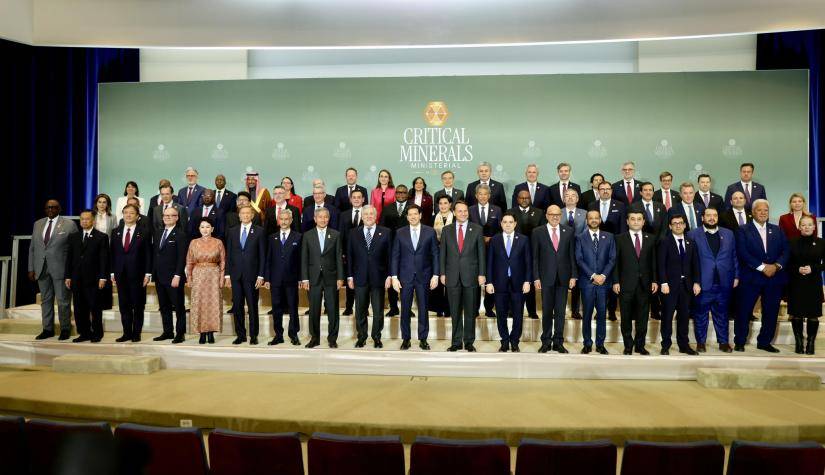
Group 1 - The core focus of the ministerial meeting held in Washington was to coordinate policies among countries to create a diversified, resilient, and secure supply chain for critical minerals [1] - A significant concept introduced at the meeting was the establishment of a price floor for minerals, aimed at preventing low-price dumping by non-market economies, indicating increasing survival pressure on U.S. mining companies [3][5] - The U.S. aims to protect its mining companies by encouraging allied nations to procure resources from a prioritized trade group, which may lead to increased raw material costs for downstream manufacturers like Boeing, GM, and Tesla [5] Group 2 - The meeting featured representatives from over 50 countries, including the EU, Japan, South Korea, and resource-rich nations like the Democratic Republic of the Congo, highlighting a broad international interest in critical minerals [7] - Despite the impressive turnout, there are notable divisions among participants, particularly between the EU and the U.S. regarding trade barriers, which could affect the unity of the proposed trade group [7] - The concept of "decoupling from China" emerged as a central theme, as China dominates the global rare earth market, controlling approximately 60% of mining and over 90% of processing capabilities, posing a significant challenge for the U.S. to establish a competitive supply chain [9]
细分领域基金加速落地 银行系AIC成硬科技投资“新势力”
Zhong Guo Jing Ying Bao· 2026-02-07 03:20
Core Insights - The article highlights the increasing establishment of venture capital funds in niche sectors, particularly focusing on "hard technology" by bank-affiliated Asset Investment Companies (AIC) [1][3]. Group 1: Investment Trends - Several bank-affiliated AICs are launching funds targeting artificial intelligence and aerospace industries, with notable examples including a 1 billion yuan fund by Lushin Venture Capital and a similar fund by Bank of China Capital [2]. - The investment focus is on sectors such as artificial intelligence hardware and software, commercial aerospace, and core application technologies [2][3]. Group 2: Drivers of Investment - The acceleration in fund establishment is driven by three main factors: expanding policy support for AIC equity investment, the growth potential of artificial intelligence as a strategic emerging industry, and the need for banks to explore new growth avenues due to narrowing profit margins in traditional lending [3]. - The shift from traditional credit support to a combination of equity and debt financing reflects a strategic move by banks to enhance their role in key technological breakthroughs and modernize industrial chains [3]. Group 3: Investment Focus and Strategy - Bank-affiliated AICs are prioritizing investments in areas aligned with national strategic directions, particularly in artificial intelligence and aerospace, to facilitate industrial upgrades and attract social capital [3][4]. - There is a tendency to focus on foundational infrastructure and closely integrated application scenarios, which present clearer business models and manageable technical risks, aligning with banks' risk control requirements [4]. Group 4: Market Impact and Future Trends - The establishment of these funds is expected to significantly increase the supply of capital in the primary market, guiding resources toward high-quality innovation projects and key industries [5]. - The entry of bank-affiliated AICs is likely to deepen the integration of production and finance, stabilizing valuation fluctuations and supporting companies with solid technology and clear applications [5]. - Future trends may include deeper exploration of vertical industries, attention to intersections between artificial intelligence and data elements, and enhanced international collaboration to introduce advanced technologies [5].

