机电

Search documents
10.3万亿!美国跌至第三,不再是中国第一大出口国,谁上位了?
Sou Hu Cai Jing· 2025-07-02 16:02
Core Insights - China's foreign trade has shown remarkable resilience, with a total import and export value of 10.3 trillion yuan in Q1 2025, including exports of 6.13 trillion yuan, despite a 6% decline in imports [1][4][21] - The trade surplus reached 237.6 billion USD, highlighting the irreplaceable role of Chinese manufacturing in the global market [1][4] - The easing of U.S. tax policies has led to an influx of foreign trade orders, benefiting Chinese exporters [3][4] Trade Performance - In Q1 2025, China's total trade volume increased year-on-year, marking the second consecutive year of surpassing 10 trillion yuan in a single quarter [4][21] - Exports to ASEAN and the EU have been growing, with figures exceeding 146 billion USD and 122.08 billion USD respectively [6][21] - The share of trade with countries involved in the Belt and Road Initiative has also increased, particularly with ASEAN, which saw a 7.1% growth in trade share compared to the previous year [7][21] Export Categories - The top three export categories in Q1 2025 were electromechanical products, integrated circuits, and automobiles, with electromechanical products accounting for over 60% of exports [10][11] - The rise of technical products such as industrial machinery, semiconductor components, and transportation equipment showcases China's strong manufacturing capabilities [11][14] Import Trends - The slowdown in import growth is attributed to fluctuations in international commodity prices, particularly for energy and agricultural products [12][14] - China is undergoing a significant energy structure transformation, optimizing the import of coal and iron resources while promoting green economic development [14][25] Emerging Products - New categories of exports, referred to as the "new three samples," include wind power generators, integrated circuits, and lithium batteries, which have seen significant growth [15][20] - Wind power generator exports increased by 71.9% last year, with a further 43% growth in Q1 2025 [17] - Integrated circuits are projected to reach a trade total of nearly 160 billion USD in 2024, with a year-on-year increase of 18% [18] - Lithium battery exports to the U.S. reached over 15.3 billion USD in 2023, with a 7.7% increase in Q1 2025 despite tariff sanctions [20] Market Diversification - China's GDP is increasingly reliant on the domestic market, with over 60% of GDP coming from domestic consumption [24][25] - Chinese companies are actively reducing dependence on the U.S. market by exploring diverse export channels and developing non-U.S. market strategies [25][26] - The cross-border e-commerce sector has played a crucial role in expanding foreign markets, supported by the establishment of over 165 cross-border e-commerce pilot zones [26][28]

深耕“蓝海” 海上风电成辽宁振兴突破新引擎
Zhong Guo Neng Yuan Wang· 2025-07-02 02:34
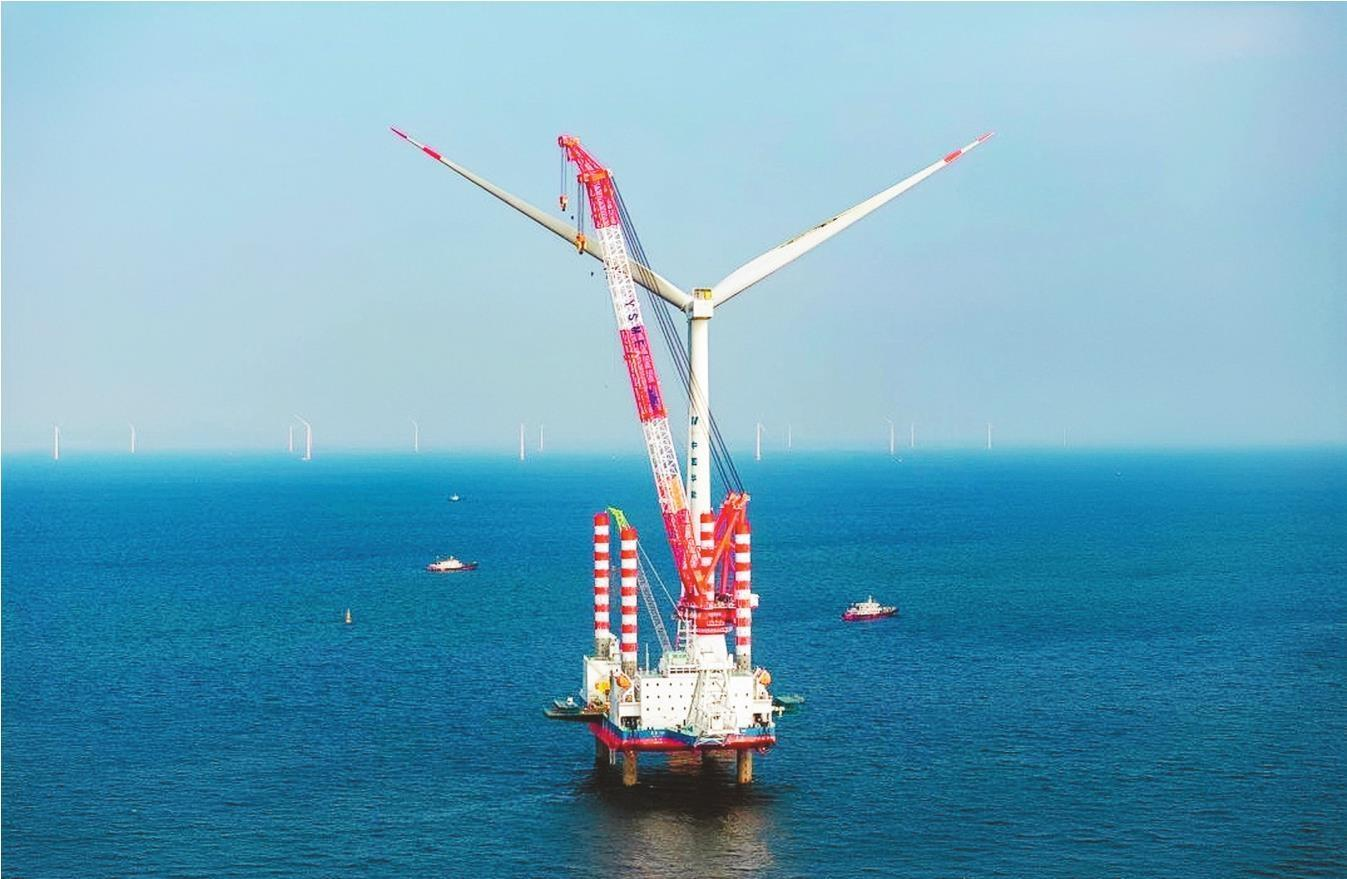
Core Viewpoint - Liaoning Province is advancing its offshore wind power projects, with a total capacity of 13.1 million kilowatts, which is expected to drive the transformation of traditional industries and stimulate regional economic growth [1][3][12]. Group 1: Offshore Wind Power Development - The 13.1 million kilowatt offshore wind power project is progressing steadily, aiming to enhance the energy structure towards greener and newer sources [3][4]. - By 2024, clean energy generation capacity and output in Liaoning are projected to exceed 50%, achieving the goals set in the 14th Five-Year Plan ahead of schedule [3][4]. - Liaoning's offshore wind power capacity has reached 1.25 million kilowatts, with plans to develop two large-scale offshore wind power bases exceeding 5 million kilowatts each [4][7]. Group 2: Economic Impact - The construction of the 13.1 million kilowatt offshore wind power project is estimated to attract investments of approximately 300 billion yuan, generate annual output exceeding 100 billion yuan, and create over 100,000 jobs [4][12]. - Liaoning ranks second in the country for green electricity trading, with a trading volume of 12.783 billion kilowatt-hours, highlighting its significant role in the national green energy market [4][8]. Group 3: Industrial Integration and Innovation - The offshore wind power industry in Liaoning is expected to integrate with traditional industries such as steel, metallurgy, and shipbuilding, leveraging the region's strong industrial base [7][10]. - A collaborative initiative involving 35 leading companies from various sectors aims to establish a world-class offshore wind power industrial cluster in Liaoning [8][10]. - The Taiping Bay Innovation Cooperation Zone is being developed as a hub for offshore wind power, focusing on creating a complete industrial chain for green energy [10][11]. Group 4: Future Prospects - By 2025, Liaoning aims to achieve a clean energy generation capacity share of 55% and an output share of over 53%, marking significant progress in its energy transition [11][12]. - The development of offshore wind power is seen as a strategic pivot for Liaoning, potentially transforming its traditional manufacturing sector into a modern, intelligent, and green industry [13][14].
台企频频点赞营商环境,溧水和凤机电产业融合“强磁场”
Xin Hua Ri Bao· 2025-07-01 00:20
Group 1: Core Insights - The two sides (He Feng) electromechanical industry cooperation demonstration park is thriving, with local government support facilitating the growth of Taiwanese enterprises [1][5] - The park has attracted 15 Taiwanese companies, benefiting from a full-cycle service system including talent apartments and support for financing and labor issues [1][4] - The park's industrial output value reached 5 billion yuan, and it was recognized as a national torch characteristic industry base in 2022 [5] Group 2: Investment and Economic Performance - In the first five months, He Feng Town completed five projects with over 100 million yuan in investment, achieving 71.42% of the annual target [2] - The signed investment amount reached 1.39 billion yuan, accounting for 69.5% of the annual goal, with expectations to surpass both targets by June [2] - The industrial output value in He Feng Town is projected to reach 1.323 billion yuan, with a year-on-year growth of 13.46% [3] Group 3: Business Services and Upgrades - The enterprise service center is actively supporting companies in applying for national-level specialized and innovative "little giant" enterprises [3] - The town aims to assist companies in digital transformation and establish a benchmark "smart factory" for Taiwanese enterprises [3] - A focus on enhancing the business environment has led to regular visits by local leaders to address enterprise needs efficiently [4] Group 4: Cross-Strait Cooperation - The establishment of a direct contact mechanism between local leaders and Taiwanese enterprises has improved service efficiency [4] - Events such as the "Focus on Safety Production" salon have been organized to optimize the business environment for Taiwanese companies [4] - The park has evolved from a single Taiwanese enterprise to a full industrial chain, attracting more Taiwanese businesses to establish a "second home" [4]
“巴中合作前景广阔”
人民网-国际频道 原创稿· 2025-06-30 02:51
Group 1 - Bahrain's diplomatic policy is characterized as moderate and pragmatic, aligning with China's principles of peaceful coexistence, which strengthens the foundation for developing bilateral relations based on mutual trust and respect [1] - The economic relationship between Bahrain and China has been steadily developing over the past two decades, with China becoming one of Bahrain's most important trading partners, exporting machinery and consumer goods to Bahrain while importing aluminum and chemical products [3][4] - Recent initiatives include Bahrain hosting the 33rd Arab League Summit with a high-level Chinese delegation attending, and the upcoming state visit of the King of Bahrain to China in May 2024, coinciding with the 10th Ministerial Meeting of the China-Arab States Cooperation Forum [3] Group 2 - The introduction of a visa exemption policy for all Gulf Cooperation Council (GCC) countries, including Bahrain, by China is expected to facilitate personnel exchanges between the two nations [3] - The cooperation between Bahrain and China spans various sectors, including ports, energy, and industrial parks, indicating a broad and promising future for bilateral collaboration [3] - The emphasis on "strategic patience" by Chinese leadership highlights a long-term approach to addressing external challenges, which is seen as a key factor in China's sustained development and the pursuit of high-quality products [4]

全球特色好物“赶集”中博会
Guang Zhou Ri Bao· 2025-06-29 01:50
Core Insights - The 20th China International Small and Medium Enterprises Fair (CISMEF) is currently taking place in Guangzhou, showcasing a strong international presence with participants from over 50 countries and regions [2][4] - The event features an international exhibition area that includes products from more than 30 countries, highlighting a diverse range of goods from food to advanced technology [3][5] - The fair serves as a platform for international cooperation, particularly in the context of small and medium enterprises, with a focus on developing resilient supply chains and collaborative opportunities [5][6] Group 1 - The international exhibition area at CISMEF includes unique products such as Spanish ham, Italian chocolate, and advanced materials from South Korea, creating a vibrant marketplace [3] - The event has attracted over 120 participants, including international representatives from 17 countries, emphasizing its global reach and influence [2][6] - Egypt, as the guest country, has over 80 enterprises showcasing diverse products, indicating a deepening collaboration in various sectors [5] Group 2 - The international technology exchange event aims to enhance global technological cooperation and align technological innovations with market demands [6] - Key speakers at the event discussed the importance of innovation and intellectual property in supporting the growth of small and medium enterprises [6] - The discussions highlighted the need for a new intellectual property order to adapt to current international challenges, providing insights for companies' international strategies [6]
工信部:持续完善新能源汽车废旧动力电池综合利用标准体系
news flash· 2025-06-27 07:37
Core Viewpoint - The Ministry of Industry and Information Technology has issued an implementation plan to advance green and low-carbon standardization in the industrial and information sectors, focusing on improving resource utilization standards and promoting the comprehensive use of industrial solid waste [1] Group 1: Resource Utilization Standards - The plan emphasizes the need to revise and establish standards for source reduction technologies and evaluation, as well as comprehensive utilization technologies and product standards for major industrial solid wastes such as metallurgical slag, chemical slag, industrial by-product gypsum, and red mud [1] - It aims to promote the large-scale application of industrial solid waste in the production of building materials and roadbed materials [1] Group 2: Waste Management Standards - The initiative includes the development of standards for waste-free parks and enterprises, guiding key industries and industrial parks towards waste-free transformation [1] - There is a focus on the refined dismantling and low-cost, large-scale comprehensive utilization of new solid wastes such as retired photovoltaic components and wind turbine blades [1] Group 3: Battery and Resource Recycling Standards - The plan aims to enhance the standard system for the comprehensive utilization of waste batteries from new energy vehicles and accelerate research on the comprehensive utilization standards for waste lithium-ion batteries from electric bicycles [1] - It also seeks to increase the supply of technical and product standards for the comprehensive utilization of renewable resources, expanding the types and specifications of applicable products [1] - The initiative includes strengthening the revision of remanufacturing technology standards for important electromechanical products [1]
国泰海通|海外策略:一页纸精读行业比较数据:6月——行业比较月报
国泰海通证券研究· 2025-06-26 14:01
Investment Chain - Prices of copper, aluminum, lead, tin, and silver have risen since June 2025. Fixed asset investment growth rate has decreased to 3.70% as of May 2025, with real estate development investment declining by 10.70% and manufacturing fixed asset investment down to 8.50% [1][2] - Infrastructure investment growth rate has also decreased to 10.42%. Since June 2025, prices of gold, zinc, and nickel have fallen, while coal prices slightly decreased to 663 RMB/ton [1][2] Consumption Chain - Retail sales growth rate has increased, with nominal growth rebounding to 6.40% in May 2025 and cumulative growth rising to 5.00%. Automobile sales growth rate for May 2025 increased to 11.15% [2][3] - The cumulative growth rate for commercial housing sales has declined to -3.62%. Retail sales of home appliances surged with a growth rate of 56.98% in May 2025 [2][3] Export Chain - Export growth rates to the US, Japan, and ASEAN have decreased, while exports to the EU have increased. In May 2025, the export growth rate for toys, lighting, coke, coal, steel, ships, plastics, and auto parts rose, while agricultural products, furniture, and refined oil exports saw declines [3][4] - The electronic export growth rate increased to 21.17% in May 2025, while textile and clothing exports fell to 1.98% [3][4] Price Chain - Oil prices rose, with WTI reaching 64.37 USD/barrel on June 24, 2025. Prices for PVC and MDI have decreased, with PVC at 4680 RMB/ton and pure MDI at 17100 RMB/ton as of June 20, 2025 [4] - Pork prices dropped to 14.45 RMB/kg on June 11, 2025, while new credit increased to 620 billion RMB in May 2025 [4]

中国电子商会副秘书长答21:消费电子出海可把握三大机遇
2 1 Shi Ji Jing Ji Bao Dao· 2025-06-25 12:51
Group 1 - In the first five months of the year, China's export value increased by 4.8% year-on-year, a slight decrease from the previous value of 8.1% [1] - The export growth of electromechanical products, which account for 60% of total exports, was notable, with a year-on-year increase of 9.3%, driven mainly by integrated circuits and automobile exports [1] - Exports of mobile phones, automatic data processing equipment and parts, and home appliances faced challenges, with declines of 7.4%, 3.9%, and 3.4% respectively, all below the average growth rate of the electromechanical sector [1] Group 2 - The global smart machinery and electronic products expo is set to take place from December 4 to 6, 2025, in Macau and Zhuhai, aiming to rival major international exhibitions like CES and IFA [3] - The expo will feature six themed exhibition halls and invite 5,000 international business representatives, domestic and foreign buyers, industry leaders, and experts [3] - The choice of the Greater Bay Area for the expo is based on its complete machinery and electronics industry chain and the advantages of the "one exhibition, two cities" model, which leverages Macau's policies to attract international business [3] Group 3 - Despite unfavorable factors in the international trade environment, there are opportunities in green home appliances and electronics, leveraging the EU's carbon tax policy to open market channels [2] - China's high-end consumer electronics maintain strong competitive advantages globally, representing a high-growth potential sector [2] - Emerging markets outside Europe and the United States, such as Latin America and Southeast Asia, present structural growth opportunities for Chinese companies through local partnerships to reduce import tariffs and better access local markets [2]
【西安】前5月经济运行稳中向好
Shan Xi Ri Bao· 2025-06-23 23:15
Economic Overview - Xi'an's economy shows a stable upward trend with industrial production growing rapidly, fixed asset investment remaining stable, and a recovering consumer market [1][2]. Industrial Production - In the first five months, the industrial added value in Xi'an increased by 13% year-on-year. Key sectors include electrical machinery and equipment manufacturing, which grew by 53.3%, and automobile manufacturing, which saw a 35% increase. New energy vehicle production rose by 37.7% [1]. Fixed Asset Investment - Fixed asset investment (excluding rural households) in Xi'an increased by 0.6% year-on-year. Industrial investment grew by 18.6%, accounting for 20.4% of total fixed asset investment, an increase of 3.1 percentage points from the previous year. Notably, investment in industrial technological upgrades surged by 30.8% [2]. Consumer Market - Retail sales of consumer goods in Xi'an reached 114.537 billion yuan, a year-on-year increase of 2.2%. The "old for new" policy positively impacted sales, with home appliances and audio-visual equipment retail sales growing by 16.4% and communication equipment sales increasing by 86.4% [2]. Foreign Trade - Xi'an's total import and export value reached 190.965 billion yuan in the first five months, marking an 11.5% year-on-year increase. Exports alone amounted to 133.567 billion yuan, growing by 16.2%. General trade saw a significant increase of 33.6%, accounting for 37.8% of total trade [3].
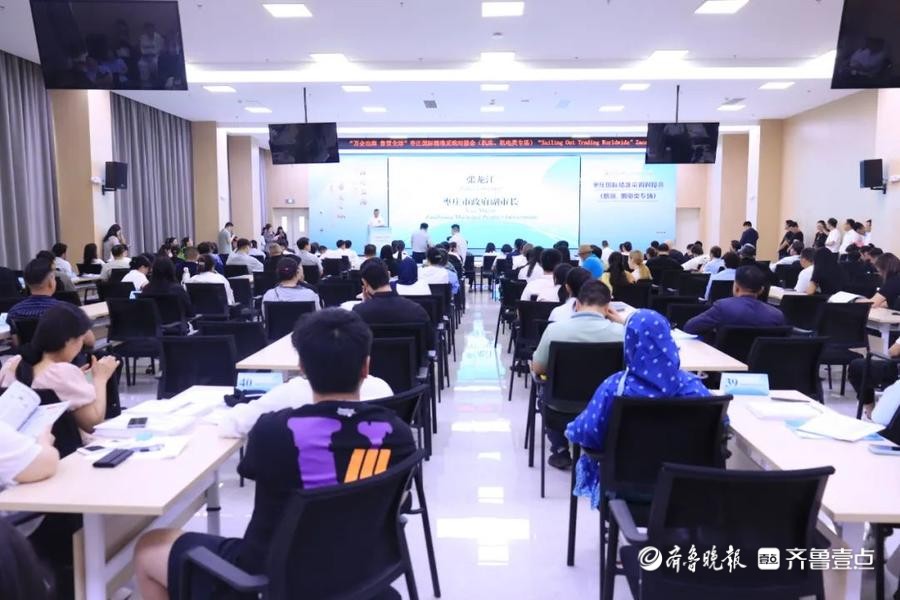
国际精准采购对接会机床、机电类枣庄专场活动成功举办
Qi Lu Wan Bao Wang· 2025-06-22 11:25
Group 1 - The "Wanqi Chuhai Lumaog Global" International Accurate Procurement Matchmaking Conference for machine tools and electromechanical products was successfully held in Tengzhou, Shandong Province [2][14] - The event was attended by key government officials, including Vice Mayor Zhang Longjiang and representatives from various international procurement companies and local manufacturing enterprises [2][11] - Over 50 procurement companies from 14 countries, including Germany, Poland, Uganda, Indonesia, and Pakistan, engaged in trade discussions with more than 150 suppliers from Zaozhuang City [14] Group 2 - The event aims to promote enterprises' international expansion, increase market presence, and boost order acquisition, supported by the Shandong Provincial Department of Commerce [14][16] - Zaozhuang City has been expanding its foreign trade scale and optimizing trade structure, with plans to continue supporting enterprises in their international endeavors [16]