
化肥

Search documents
化肥概念震荡走高 鲁西化工涨超8%
Xin Lang Cai Jing· 2026-01-20 05:51
Group 1 - The fertilizer sector is experiencing a significant upward trend, with Lu Xi Chemical rising over 8% [1] - Other companies in the sector, such as Li Guo Chemical, Bo Yuan Chemical, Chuan Jin Nuo, and Hua Lu Heng Sheng, are also showing notable gains [1]

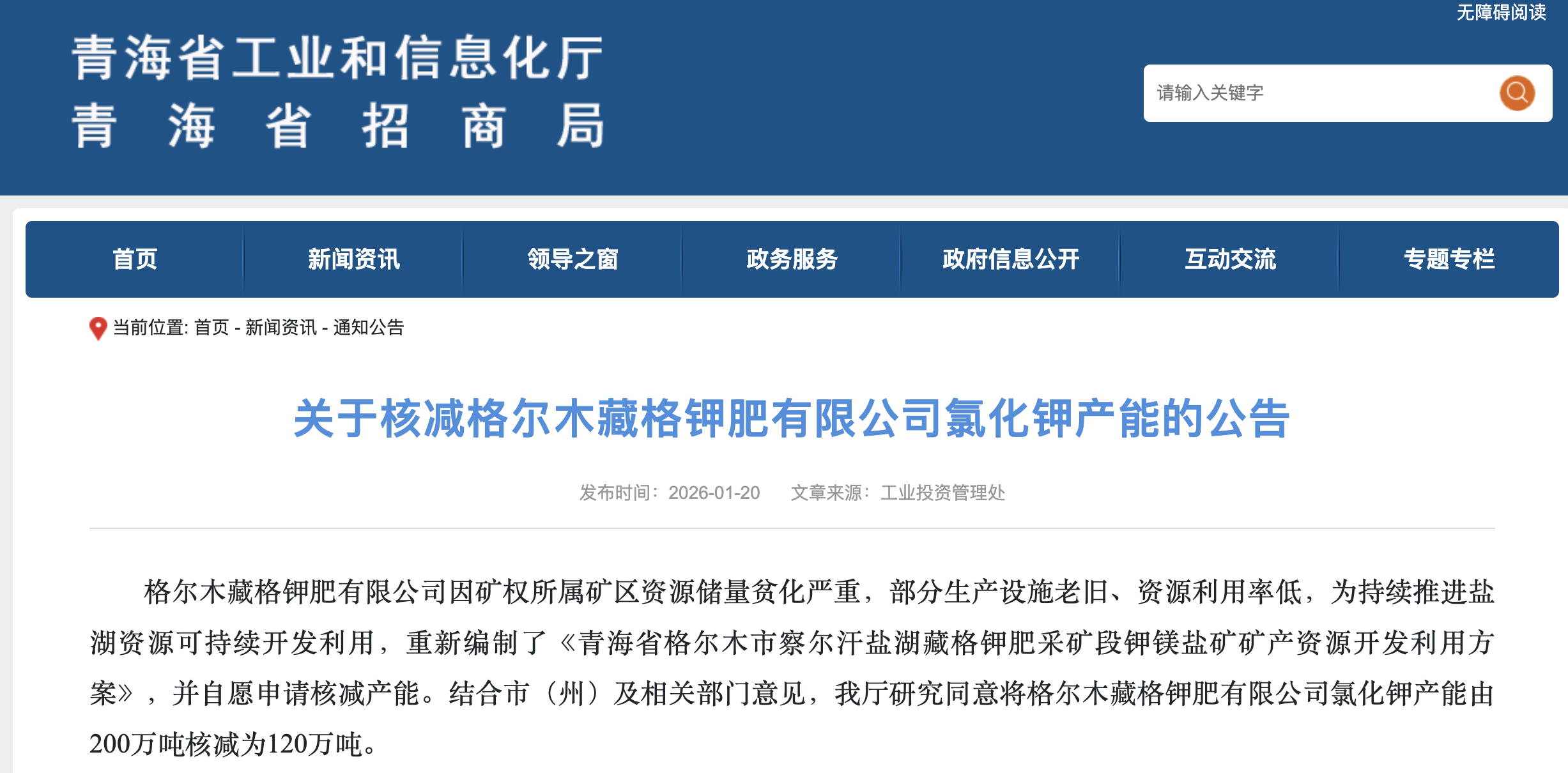
青海:核减格尔木藏格钾肥有限公司氯化钾产能 200万吨核减为120万吨
Zheng Quan Shi Bao Wang· 2026-01-20 05:18
Core Viewpoint - The announcement from the Qinghai Provincial Department of Industry and Information Technology indicates a significant reduction in the potassium chloride production capacity of Geermu Zangge Potash Fertilizer Co., Ltd. due to resource depletion and outdated facilities [1] Group 1: Company Information - Geermu Zangge Potash Fertilizer Co., Ltd. has voluntarily applied to reduce its potassium chloride production capacity from 2 million tons to 1.2 million tons [1] - The decision to reduce capacity is based on the severe depletion of mineral resources in the mining area and low resource utilization rates [1] Group 2: Industry Context - The announcement is part of a broader initiative to promote the sustainable development and utilization of salt lake resources in Qinghai Province [1] - The revised development plan for the potash and magnesium salt mineral resources in the Chaka Salt Lake area has been recompiled to align with sustainable practices [1]


2025年11月中国矿物肥料及化肥进出口数量分别为139万吨和443万吨
Chan Ye Xin Xi Wang· 2026-01-20 03:40
Core Insights - In November 2025, China's import of mineral fertilizers and chemical fertilizers reached 1.39 million tons, representing a year-on-year increase of 22.3% [1] - The import value for the same period was $522 million, showing a significant year-on-year growth of 51% [1] - China's export of mineral fertilizers and chemical fertilizers in November 2025 amounted to 4.43 million tons, with a year-on-year increase of 31.7% [1] - The export value for this period was $1.385 billion, reflecting a year-on-year growth of 40.3% [1] Import Statistics - The import quantity of mineral fertilizers and chemical fertilizers in November 2025 was 1.39 million tons, up 22.3% compared to the previous year [1] - The corresponding import value was $522 million, which is a 51% increase year-on-year [1] Export Statistics - The export quantity of mineral fertilizers and chemical fertilizers in November 2025 was 4.43 million tons, marking a 31.7% increase from the previous year [1] - The export value reached $1.385 billion, indicating a year-on-year growth of 40.3% [1]

未知机构:钾肥企业基本面更新202601191氯化钾旺季即将来临-20260120
未知机构· 2026-01-20 02:20
Summary of Key Points from Conference Call Records Industry Overview - The potassium chloride (KCl) market is entering its peak season, which typically occurs from January to April in the Northern Hemisphere, leading to price increases in the spot market and optimistic market expectations [1][2] - The supply-demand dynamics for potassium chloride are tightening, with a clear trend observed, and the market is currently awaiting catalysts for further developments [2][3] Company-Specific Insights - **Yara International**: The company is ramping up production at its Xiaodongbu project, with expectations to release performance results in Q1 2026. The company has been selected as one of the top ten stocks by Changjiang Securities for January 2026, indicating strong market confidence [2][3] - **Salt Lake Co.**: The company is also ramping up its production capacity for lithium carbonate at 40,000 tons per year. The focus is on monitoring the ramp-up progress, with significant volume increases expected in 2026. The recent strong price trends for lithium carbonate suggest potential for both volume and price growth [3] - **Dividend and Buyback Initiatives**: The company is continuing its dividend and share buyback programs, with expectations for these initiatives to materialize soon [4] - **Performance Forecast**: The company has released a performance forecast for 2025, estimating a net profit attributable to shareholders between 8.29 billion and 8.89 billion yuan, representing a year-on-year growth of 77.78% to 90.65%. The Q4 net profit is projected to be between 3.787 billion and 4.387 billion yuan, indicating a quarter-on-quarter growth of 90% to 121% [4] - **Oriental Tower**: The XDL potassium salt project is progressing, with mining rights expected to be secured in 2026 [4] Additional Important Insights - Recent reports from foreign investment banks have shown a bullish outlook on the potassium fertilizer industry, contributing to a consensus in the market [2][3]
亚钾国际涨6.16%,中国银河二个月前给出“买入”评级
Sou Hu Cai Jing· 2026-01-19 07:48
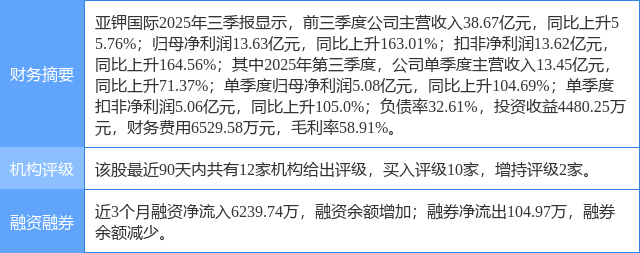
Core Viewpoint - Yara International (000893) has seen a stock price increase of 6.16%, closing at 55.3 yuan, with analysts projecting steady profit growth and new capacity investments expected in the coming years [1] Financial Summary - For the first three quarters of 2025, Yara International reported a main revenue of 3.867 billion yuan, a year-on-year increase of 55.76% - The net profit attributable to shareholders reached 1.363 billion yuan, up 163.01% year-on-year, while the net profit excluding non-recurring items was 1.362 billion yuan, reflecting a 164.56% increase - In Q3 2025, the company achieved a single-quarter main revenue of 1.345 billion yuan, a 71.37% year-on-year increase, and a net profit of 508 million yuan, up 104.69% year-on-year, with a gross margin of 58.91% [1][1][1] Analyst Ratings - Over the past 90 days, 12 institutions have rated the stock, with 10 giving a "buy" rating and 2 an "accumulate" rating - Analysts from China Galaxy, Guojin Securities, and Kaiyuan Securities have all issued "buy" ratings for Yara International [1][1][1] Earnings Forecast - The earnings forecast for Yara International from 2025 to 2027 predicts net profits attributable to shareholders of 1.910 billion, 2.709 billion, and 3.449 billion yuan, representing year-on-year growth rates of 101.00%, 41.80%, and 27.31% respectively - The diluted EPS for the same period is expected to be 2.07, 2.93, and 3.73 yuan per share, with corresponding PE ratios of 21.36, 15.06, and 11.83 times [1][1][1]


河南省洛阳市市场监督管理局发布关于2025年流通领域产品质量监督抽查情况的公告
Zhong Guo Zhi Liang Xin Wen Wang· 2026-01-19 07:16
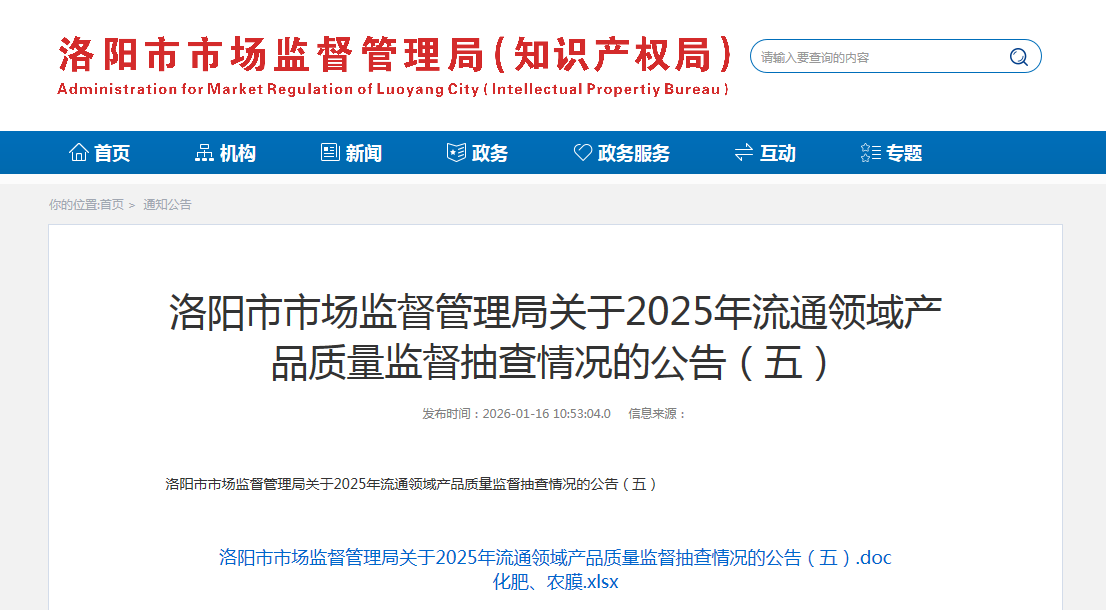
Group 1 - The core viewpoint of the news is that the product quality supervision and sampling inspection conducted in Luoyang City for 2025 revealed a compliance rate of 92% among the sampled products, with 6 out of 75 batches failing to meet quality standards [1][2][3] - The inspection covered various products, including fertilizers and agricultural films, indicating a proactive approach by the Luoyang Market Supervision Administration to ensure product quality in the circulation field [1][2] - The local market supervision authorities have taken action against non-compliant products, with measures including legal processing for local manufacturers and referral to corresponding authorities for out-of-city manufacturers [1][2] Group 2 - A total of 75 batches of products were sampled, with 6 batches found to be non-compliant, resulting in a compliance rate of 92% [1][2] - Specific details of the non-compliant products include issues related to effective phosphorus content and labeling standards, highlighting areas of concern in product quality [2][3] - The inspection results reflect the ongoing efforts to maintain high standards in agricultural inputs, which are crucial for the agricultural sector's sustainability and productivity [1][2]
尿素:震荡整理
Guo Tai Jun An Qi Huo· 2026-01-19 02:08
1. Report's Industry Investment Rating - The report gives a rating of "Oscillating and Consolidating" for urea [1] 2. Core Viewpoints of the Report - In the short - term, the sentiment of bulk commodities has weakened, the spot trading of urea has weakened, and the futures price has reached the policy pressure level, so the urea price will experience a short - term correction. However, due to the strong expectation of agricultural demand, the correction range is expected to be limited, and the price will still be strong in the medium - term. The demand - side shows that continuous procurement by reserves and the grassroots has led to a stage improvement in the urea fundamentals. Whether the driving force can continue to rise depends on the continuity of mid - stream restocking. For the 05 contract, the fundamental pressure level is around 1830 yuan/ton, mainly the policy pressure line. Supported by the strong expectation of the agricultural demand peak in 2026, the fundamental support level is expected to be around 1700 - 1720 yuan/ton [3][4] 3. Summary by Relevant Catalogs 3.1 Fundamental Tracking 3.1.1 Futures Market - For the urea main contract (05 contract): the closing price decreased from 1801 yuan/ton to 1791 yuan/ton, a decrease of 10; the settlement price decreased from 1805 yuan/ton to 1798 yuan/ton, a decrease of 7; the trading volume increased from 144,515 lots to 156,787 lots, an increase of 12,272; the open interest decreased from 250,303 lots to 242,992 lots, a decrease of 7,311; the number of warehouse receipts remained unchanged at 13,355 tons; the trading volume increased from 521,622 ten - thousand yuan to 563,750 ten - thousand yuan, an increase of 42,128 ten - thousand yuan; the basis in Shandong area increased from - 41 to - 21, an increase of 20; the basis of Fengxi - futures price (with a freight of about 100 yuan/ton) remained unchanged at - 151; the basis of Dongguang - futures price (the cheapest deliverable) remained unchanged at - 51; the spread between UR05 and UR09 decreased from 29 to 28, a decrease of 1 [2] 3.1.2 Spot Market - Urea factory prices: Henan Xinlianxin remained unchanged at 1760 yuan/ton; Yankuang Xinjiang remained unchanged at 1320 yuan/ton; Shandong Ruixing increased from 1715 yuan/ton to 1745 yuan/ton, an increase of 30; Shanxi Fengxi remained unchanged at 1640 yuan/ton; Hebei Dongguang remained unchanged at 1740 yuan/ton; Jiangsu Linggu increased from 1790 yuan/ton to 1800 yuan/ton, an increase of 10. Trader prices: in Shandong area, it increased from 1760 yuan/ton to 1770 yuan/ton, an increase of 10; in Shanxi area, it increased from 1630 yuan/ton to 1640 yuan/ton, an increase of 10. Supply - side indicators: the operating rate increased from 84.72% to 85.19%, an increase of 0.47%; the daily output increased from 199,480 tons to 200,580 tons, an increase of 1,100 [2] 3.2 Industry News - As of January 14, 2026, the total inventory of Chinese urea enterprises was 986,100 tons, a decrease of 36,100 tons from the previous week, a month - on - month decrease of 3.53%. During this period, the domestic urea enterprise inventory decreased slightly. Recently, the urea market has fluctuated narrowly. The downstream compound fertilizer industrial demand has continued to advance, and the local agricultural demand has begun to increase. Some urea enterprises have achieved a balance between production and sales, and some have accelerated their shipment, leading to a decline in inventory. Provinces with decreased enterprise inventory include Anhui, Hebei, Heilongjiang, Hubei, Inner Mongolia, Shandong, Sichuan, and Chongqing. Provinces with increased enterprise inventory include Hainan, Henan, Jiangxi, Liaoning, Qinghai, Shanxi, Shaanxi, Xinjiang, and Yunnan [3] 3.3 Trend Intensity - The trend intensity of urea is 0, indicating a neutral trend [4]
郑商所优化尿素期货规则 拓展服务实体深度
Qi Huo Ri Bao Wang· 2026-01-18 22:32
Group 1 - The Zhengzhou Commodity Exchange has announced revisions to the urea futures business rules, focusing on expanding the delivery product range and optimizing the warehouse receipt registration process to better align with the development of the spot market and enhance market efficiency [1][6] - One of the core changes is the formal inclusion of large granular urea into the alternative delivery product system, allowing it to be used alongside existing small granular urea products for delivery [1][2] - The adjustment is driven by industry changes, with large granular urea's application in modern agriculture and compound fertilizer production increasing, projected to account for 20% of domestic production in 2024 [2][3] Group 2 - The inclusion of large granular urea in the delivery system is expected to improve price coverage in major production and sales areas, promote price linkage among different urea specifications, and enhance the price discovery function of the futures market [2][6] - The Northeast region, a major grain production area, has a high demand for large granular urea, which will facilitate faster access to quality fertilizers for farmers, thereby stabilizing grain production [2][3] - The new delivery product classification is anticipated to provide more precise pricing references for the entire industry, enhancing the overall operational efficiency of the market [2][3] Group 3 - The revisions also include optimizing the warehouse receipt inspection process, changing from on-site sampling by quality inspection personnel to a method where the warehouse and receipt registrant jointly seal samples for mailing to designated inspection agencies [4][5] - This change aims to reduce sampling cycle times and costs, improving transparency and efficiency in the inspection process [4][5] - The new rules will be implemented in phases, with the inclusion of large granular urea expected to take effect after the completion of the rule revisions [5]
基础化工三大龙头预计2025年业绩翻倍 股价渐涨
Xin Lang Cai Jing· 2026-01-18 16:22
Core Viewpoint - The rebound in potassium and lithium product prices has led to a rapid recovery in the performance of some leading companies in the basic chemical sector, with expectations of a doubling in performance by 2025 [1] Group 1: Performance Forecasts - As of January 14, 21 basic chemical companies in the A-share market have disclosed annual performance forecasts, with 11 companies expecting profit growth, indicating a recovery in multiple sub-sectors [1] - Salt Lake Industry expects a net profit attributable to shareholders of 8.29 billion to 8.89 billion yuan for 2025, representing a year-on-year increase of 77.78% to 90.65% [1] - Companies such as Lier Chemical, Chuanjin Nuo, and Yonghe Co. anticipate a minimum profit growth exceeding 100% [1] Group 2: Sector Insights - The companies with increased performance forecasts are primarily concentrated in the fertilizer and pesticide sectors, benefiting from a strong performance in the phosphate and lithium chemical sectors expected in Q4 2025 [1] - The rise in both volume and price of related products is driving significant profit growth for these companies [1]


南华期货尿素产业周报:多单持有-20260118
Nan Hua Qi Huo· 2026-01-18 13:14
Group 1: Report Industry Investment Rating - Not provided in the content Group 2: Core Views of the Report - Urea is in a phase of supply surplus due to the continuous release of new production capacity in 2026, and its price center will further decline, but the decline will be supported by export policies. The price trend in the first half of the year will depend on the demand rhythm, and in the second half, it will be policy - dominated. The urea 05 contract has a price increase expectation, but the price is expected to correct in the short term, with the top range between 1850 - 1950 yuan/ton. It is recommended to hold long positions [4]. - The short - term upstream price will remain firm, and some prices will continue to rise, but the market is afraid of high prices, and the procurement rhythm of the middle and lower reaches has slowed down [8]. - The urea market is expected to fluctuate strongly, with the UR2605 operating range between 1650 - 1950 yuan/ton. It is recommended to build long positions around 1700 yuan/ton [10]. Group 3: Summary by Directory Chapter 1: Core Contradictions and Strategy Recommendations 1.1 Core Contradictions - Urea is in a supply - surplus stage. In 2026, the price center will decline, and the price trend will be affected by export policies and demand rhythm. The urea 05 contract has a price increase expectation but may correct in the short term [4]. 1.2 Trading - Type Strategy Recommendations - **Trend Judgment**: Urea is expected to fluctuate strongly, with the UR2605 operating in the range of 1650 - 1950 yuan/ton. It is recommended to build long positions around 1700 yuan/ton [10]. - **Basis, Spread, and Hedging Arbitrage Strategy Recommendations**: The 11, 12, 01 contracts have a weak unilateral trend, while the 02, 03, 04, 05 contracts are strong with peak - season demand expectations. The upper pressure of the 05 contract is 1950 yuan/ton, and the lower static support is 1650 yuan/ton. There is no hedging arbitrage strategy [10][11]. Chapter 2: This Week's Important Information and Next Week's Attention Events 2.1 This Week's Important Information - **Positive Information**: The fourth quarter is the winter storage period for the fertilizer industry. The national off - season reserve is concentrated from December to March, and the relatively low price may attract spontaneous reserves. India's NFL issued a new round of urea import tender, intending to purchase 1.5 million tons [12]. - **Negative Information**: The current domestic daily urea production is 20810 tons. Next week, some maintenance devices will resume operation, and some gas - head urea plants will have concentrated maintenance. The domestic daily urea production is expected to decline significantly after a narrow increase. The demand side should focus on the procurement rhythm of reserve demand and the start - up change of Northeast compound fertilizer plants [12]. 2.2 Next Week's Important Events to Follow - China's urea production this week was 1.3153 million tons, a week - on - week increase of 37400 tons or 2.93%. Next week, the weekly production is expected to be around 1.34 million tons, continuing to increase [13]. Chapter 3: Disk Interpretation 3.1 Price, Volume, and Fund Interpretation - The domestic urea market continued to rise over the weekend, with a price increase of 10 - 40 yuan/ton. The prices of small and medium - sized particles in the mainstream areas are between 1510 - 1630 yuan/ton. Driven by the fourth batch of urea export quotas and the news of a new round of Indian tenders, the market sentiment is strong, but the middle and lower reaches are resistant. The short - term market will continue to be stable and strong [14]. - After the premium of the 05 contract is compressed, it is recommended to do a positive spread for 5 - 9 at low positions [15]. 3.2 Industry Hedging Recommendations - **Price Range Forecast**: The price range of urea is 1650 - 1950 yuan/ton, with a current volatility of 27.16% and a historical percentile of 62.1% in three years [21]. - **Urea Hedging Strategy Table**: Different hedging strategies are provided for inventory management and procurement management under different scenarios, including shorting urea futures, buying put options, selling call options, etc., with corresponding hedging ratios and recommended entry intervals [23]. Chapter 4: Valuation and Profit Analysis 4.1 Upstream Profit Tracking in the Industrial Chain - The document shows the seasonal charts of urea's weekly fixed - bed production cost, water - coal slurry gasification production cost, natural - gas production cost, and corresponding production profits [25][27]. 4.2 Upstream Start - up Rate Tracking - The document presents the seasonal charts of urea's daily output, weekly capacity utilization rate, weekly coal - head capacity utilization rate, and weekly natural - gas production capacity utilization rate [31]. 4.3 Upstream Inventory Tracking - The document includes the seasonal charts of China's weekly urea enterprise inventory, weekly port inventory, weekly Guangdong and Guangxi inventory, and the combined inventory of ports and inland areas [33][35]. 4.4 Downstream Price and Profit Tracking - The document shows the seasonal charts of compound fertilizer's weekly capacity utilization rate, inventory, production cost, production profit, and the seasonal charts of melamine's weekly capacity utilization rate, market price, production volume, and production profit. It also shows the market prices of different types of compound fertilizers and synthetic ammonia [37][45][51]. 4.5 Spot Production and Sales Tracking - The document provides the seasonal charts of urea's average production and sales, as well as the production and sales in Shandong, Henan, Shanxi, Hebei, and East China [61][62].