火锅

Search documents
海底捞搞小火锅,陪吃熊哭了
3 6 Ke· 2025-08-04 05:40
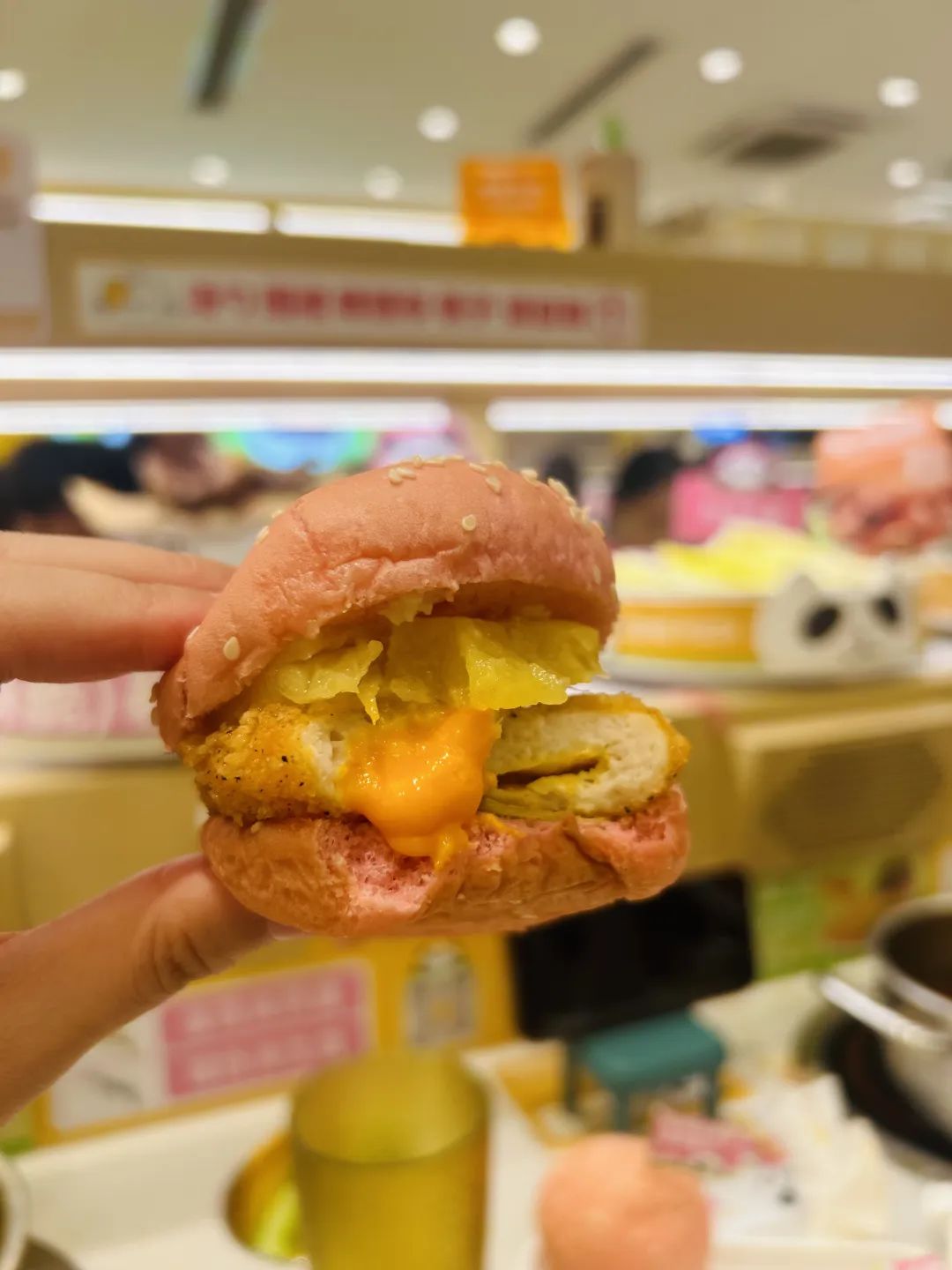
呷哺呷哺因大量关店让出的单人小火锅市场,正在被各家分食。围辣、龍歌、农小锅、一围等到处开店,已经有了一定消费者认知度。7月,海底捞也在 长沙、南京、宁波,开始试水自家小火锅品牌——举高高。 59.9元/位的价格谈不上便宜。许多消费者尝鲜后,既有中意者,也有人觉得"差异化不大"。海底捞搞小火锅,瞄准的是家庭、同事聚会之外的场景和人 群。大众关心的是:它好吃吗?资本关心的是:它能开出千店吗?业内人士认为,小火锅已有20年历史,如果只剩下同质化下的性价比之争,这个行业没 有出路。 海底捞自助小火锅,迎多元声音 周末,长沙某商场负一层,"举高高"回转自助小火锅迎来客流高峰,等位时间逼近两小时。若非媒体报道和围挡提醒,少有人会意识到——这家门店背 后,站着的是海底捞。 这里没有"甩面"表演,没有美甲、擦鞋、生日歌,也没有宽敞卡座和热情招呼。只有不停转动的传送带,咕嘟作响的小锅,以及一排排紧凑的单人吧台席 位。——陪吃熊,失业了。 长沙青年林泽,逛商场时看到这家小火锅,一等等了两小时。他感觉,举高高的整体观感与商场其他常见的回转小火锅差不多,价格也落在自助小火锅的 常规区间——59.9元,不算贵,也谈不上便宜。 卖点之一 ...


火锅巨头业绩暴雷,股价被“涮”成仙股
Shang Hai Zheng Quan Bao· 2025-08-04 05:21
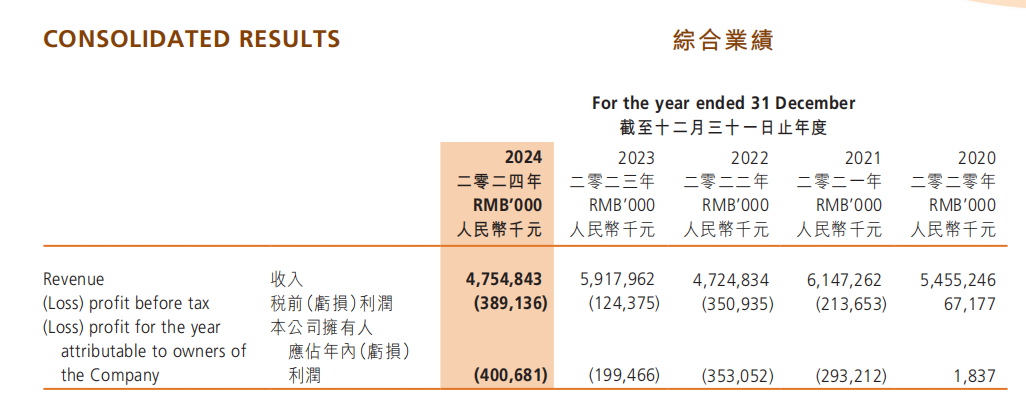
Group 1: Market Overview - The Hong Kong stock market opened lower but rebounded, with the Hang Seng Index closing at 24,627.25 points, up 119.44 points, or 0.49% [1] - The Hang Seng Tech Index also rose, closing at 5,447.62 points, up 50.22 points, or 0.93% [1] - Gold stocks in Hong Kong surged, with Shandong Gold and Chifeng Gold rising over 9% due to increased attractiveness of gold amid Fed rate cut expectations [1][16] Group 2: Company Performance - Xia Bo Xia Bo - Xia Bo Xia Bo, known as the "first rotating hot pot stock," announced a projected revenue of approximately RMB 1.9 billion for the first half of the year, a year-on-year decrease of about 18.9% [3] - The company expects a net loss between RMB 80 million to 100 million, with a year-on-year decline in losses of approximately 63.2% to 70.5% [3] - Since 2021, Xia Bo Xia Bo has faced continuous losses, accumulating a total loss of approximately RMB 1.326 billion from 2021 to 2024 [4] Group 3: Stock Performance - Xia Bo Xia Bo - Xia Bo Xia Bo's stock price fell nearly 4% in early trading, with a cumulative decline of over 92% since its peak in January 2023, leaving a market capitalization of only HKD 815 million [5] - The stock price was reported at HKD 0.75 per share, reflecting a drop of 3.85% [5][6] Group 4: Gold Market Dynamics - The recent surge in gold prices, with London gold spot prices rising over 2% to USD 3,362.64 per ounce, has been attributed to increasing expectations of a Fed rate cut [16] - This rise in gold prices has led to a significant increase in the stock prices of gold companies in Hong Kong, with several stocks rising over 8% [15][16] Group 5: InnoTek's Market Activity - InnoTek's stock price increased by over 40% in two trading days, driven by a partnership with NVIDIA to promote an 800 VDC power architecture for AI data centers [9][12] - The stock price reached HKD 62.65, with a market capitalization of HKD 56.03 billion [11]
呷哺呷哺:预计上半年收入约19亿元 同比减少约18.9%
Zhong Guo Neng Yuan Wang· 2025-08-04 02:49
Group 1 - The company, Xiaobuxiang, expects revenue for the six months ending June 30, 2025, to be approximately RMB 1.9 billion, representing a year-on-year decrease of about 18.9% [1] - The company anticipates a net loss ranging from approximately RMB 80 million to RMB 100 million, with a year-on-year decline in loss between approximately 63.2% and 70.5% [1]
呷哺呷哺(00520)发盈警 预计中期净亏损约0.8亿元至1.0亿元 同比收窄约63.2%至70.5%
智通财经网· 2025-08-03 23:12
智通财经APP讯,呷哺呷哺(00520)发布公告,集团预期截至2025年6月30日止6个月收入约为人民币 19 亿元,相较于截至2024年6月30日止6个月收入减少约18.9%。相较于截至2024年6月30日止6个月集团取 得净亏损人民币2.74亿元,集团预期于截至2025年6月30日止6个月将取得净亏损介乎约人民币0.8亿元至 1.0亿元之间,亏损较2024年同期大幅收窄,降幅介乎约63.2%至70.5%之间。 集团一直确保现金流稳健及财务状况良好,同时推展各项营运管理,包括(i)实施餐厅网络焕新策略,通 过高潜力区域精准卡位与低效餐厅结构性出清,实现资源再配置及效率跃升,构筑精益化成本管理新範 式;(ii)深化即时配送服务生态布局,驱动业务规模高质量扩张与经营效益结构化提升;(iii)战略性拓展预 付式消费模式,通过动态价值治理机制优化折扣结果,实现经营收益增长与利润空间升维的协同共振; 及(iv)推进与头部动漫IP达成深度合作计划,通过联名产品开发、门店主题改造及数字化营销,深度触 达年轻消费群体,重塑品牌活力并构筑强劲增长新引擎。 集团截至2025年6月30日止6个月的净亏损大幅减少主要乃由于(i)集 ...
餐饮行业“卷价格”不如“卷品质”
Sou Hu Cai Jing· 2025-08-01 02:41
Core Viewpoint - The restaurant industry is experiencing a price-cutting trend that leads to low-quality competition, disrupting market order and harming overall industry interests and consumer rights. There is a call for the industry to shift focus from price competition to quality and service enhancement [4][5]. Group 1: Industry Trends - Many restaurant brands are lowering prices, while some are promoting waste reduction through signage and integrating conservation concepts into takeaway packaging [4]. - The Chengdu Catering Industry Association advocates for a return to quality and service fundamentals, aligning with the new regulations aimed at reducing food waste and promoting high-quality development [4][5]. Group 2: Regulatory Changes - The new regulations establish a comprehensive supervision system covering the entire dining consumption chain, including precise recommendations based on the number of diners and mandatory labeling of ingredient quantities on menus [5]. - Specific measures target the hot pot industry, which faces higher waste risks due to its self-service model and group dining scenarios [5]. Group 3: Digital Transformation - The digital transformation in the hot pot industry has become essential, with companies like Haidilao implementing management information systems to enhance food safety and inventory management, achieving a 30% increase in ingredient turnover rates [6][7]. - Other companies are adopting centralized kitchen and supply chain models to optimize operations and reduce waste, demonstrating the shift towards data-driven management [6][7]. Group 4: Consumer Behavior and Market Dynamics - The trend towards smaller portion sizes aligns with consumer preferences for value and quality, responding to the rise of the "single economy" and changing consumption structures [8]. - The introduction of centralized kitchens and community micro-warehouses is expected to enhance efficiency and reduce logistics costs, allowing hot pot businesses to expand beyond physical store limitations [8][9]. Group 5: Brand Development and Differentiation - New regulations support the development of local specialty cuisines, providing opportunities for hot pot businesses to innovate and differentiate their offerings [9]. - The industry is transitioning from scale expansion to quality competition, emphasizing the importance of respecting ingredients and innovating processes to thrive in a new normal focused on waste reduction [9].
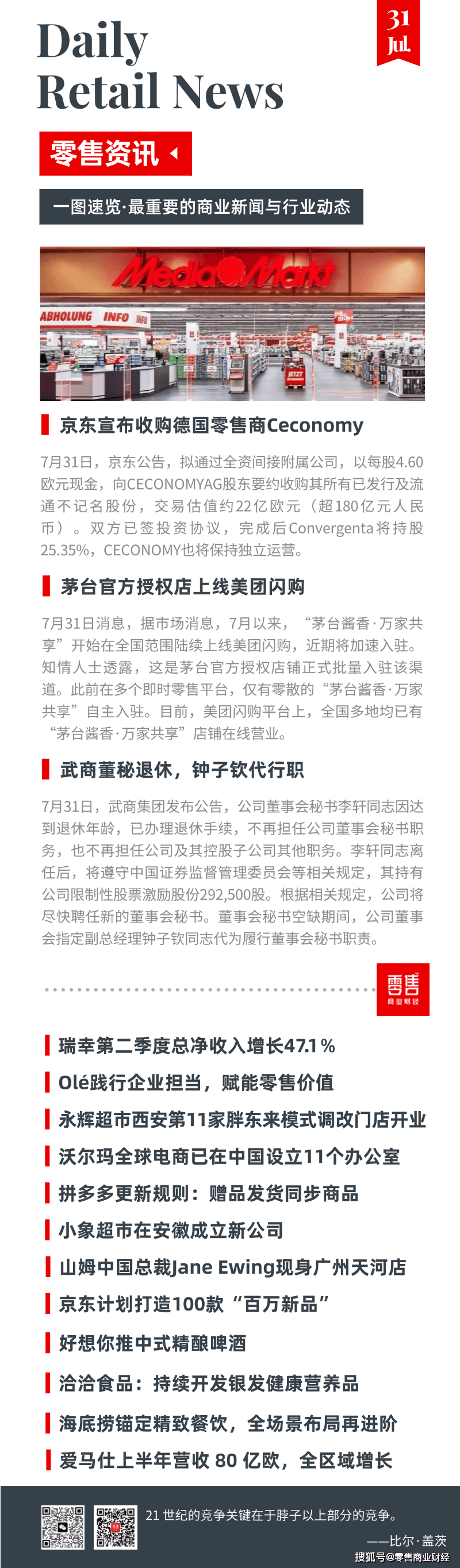
京东计划打造100款“百万新品”;茅台官方授权店上线美团闪购
Sou Hu Cai Jing· 2025-07-31 15:55
Group 1: JD's Acquisition and Retail Developments - JD announced the acquisition of German retailer Ceconomy for approximately €2.2 billion (over 18 billion RMB), with a cash offer of €4.60 per share, resulting in a 25.35% stake in Ceconomy while maintaining its independent operations [7] - Moutai's official authorized store has launched on Meituan Flash Purchase, expanding its presence across the country with multiple stores now operational [7] Group 2: Corporate Changes and Financial Performance - Wushang Group's board secretary, Li Xuan, has retired, and Deputy General Manager Zhong Ziqin will temporarily assume the secretary's responsibilities until a new appointment is made [8] - Luckin Coffee reported a record net revenue of 12.359 billion RMB for Q2 2025, a 47.1% year-on-year increase, with a net profit of 1.251 billion RMB, up 43.6% [9] Group 3: Retail Innovations and Market Strategies - Yonghui Supermarket opened its 11th "Fat Donglai" model store in Xi'an, marking a significant expansion of its strategic layout in the region [12] - Walmart's global e-commerce has established 11 operational offices in China, expanding its presence beyond major cities [14] - Pinduoduo updated its shipping rules, requiring that gift items be shipped within the same timeframe as the main transaction items, effective August 7, 2025 [15] Group 4: New Ventures and Product Development - Xiaoxiang Supermarket has established a new company in Anhui with a registered capital of 10 million RMB, focusing on internet sales and food services [16] - Sam's Club China President Jane Ewing was seen at the Guangzhou Tianhe store, indicating active management and oversight as the company prepares for leadership transitions [17] - JD plans to create 100 "million-level new products" and 20 "ten-million-level new products" in the AI toy sector, aiming to become a hub for AI toy brands [18] Group 5: Industry Trends and Consumer Products - Haoxiangni has launched a range of craft beers, diversifying its product offerings amid ongoing financial losses, raising concerns about potential over-diversification [20] - Qiaqia Foods is committed to developing more health and nutrition products tailored for the elderly demographic [22] - Haidilao opened its first high-end "Selected Store" in Beijing, focusing on premium hot pot offerings, as part of its strategy to capture the high-end market [22] - Hermès reported a 7% increase in revenue to €8 billion for the first half of 2025, with all regions showing growth, although net profit decreased by 5% to €2.2 billion [24]


餐饮行业产品上新报告(2025年6月)
Hong Can Chan Ye Yan Jiu Yuan· 2025-07-31 14:27
Investment Rating - The report does not explicitly provide an investment rating for the restaurant industry Core Insights - The report analyzes the new product launch trends in the restaurant industry, focusing on six representative categories: Western fast food, noodles, tea drinks, coffee drinks, bakery, and hot pot. A total of 330 brands were monitored, with 177 brands launching new products in June 2025, accounting for 53.6% of the monitored sample. The total number of new products launched across these categories was 785, representing a 14.1% decrease compared to May 2025 [4][10][15]. Summary by Category Western Fast Food - In June 2025, 20 brands launched 66 new products, with dessert items leading at 24.2%. Innovations focused on filling and flavor, with 51.4% of new products emphasizing filling innovation, integrating local and healthy ingredients [24][17][22]. Noodles - Among 61 monitored brands, 21 launched 65 new products, with mixed noodles and dessert drinks forming a core launch strategy, together accounting for over 40%. The main innovation direction involved using local and wild ingredients as toppings, with 66.7% of innovations focusing on toppings [32][30]. Tea Drinks - A total of 64 brands launched 245 new products, with fruit tea leading the category. The report highlights the use of seasonal fruits and emphasizes the reduction of vegetable elements in new products. 73.1% of new products contained tea bases, with green tea being the most popular [35][36][40]. Coffee Drinks - 23 brands launched 78 new products, with fruit elements comprising 71.2% of the ingredients. Coffee liquid bases were predominant, making up 66% of new products. The report notes a trend towards complex flavor profiles in new coffee products [46][50][53]. Bakery - 33 brands launched 263 new products, with cakes being the most prevalent at 57.8%. The report indicates a focus on seasonal and health-oriented products, with a notable increase in the use of fruits and dairy ingredients [60][63]. Hot Pot - 16 brands launched 68 new products, with hot pot ingredients leading at 54.4%. The emphasis was on the quality of ingredients and traditional preparation methods, showcasing local specialties [66][64].
排队200桌,年轻人狂打卡,网红茶火锅能火多久?
3 6 Ke· 2025-07-31 12:25
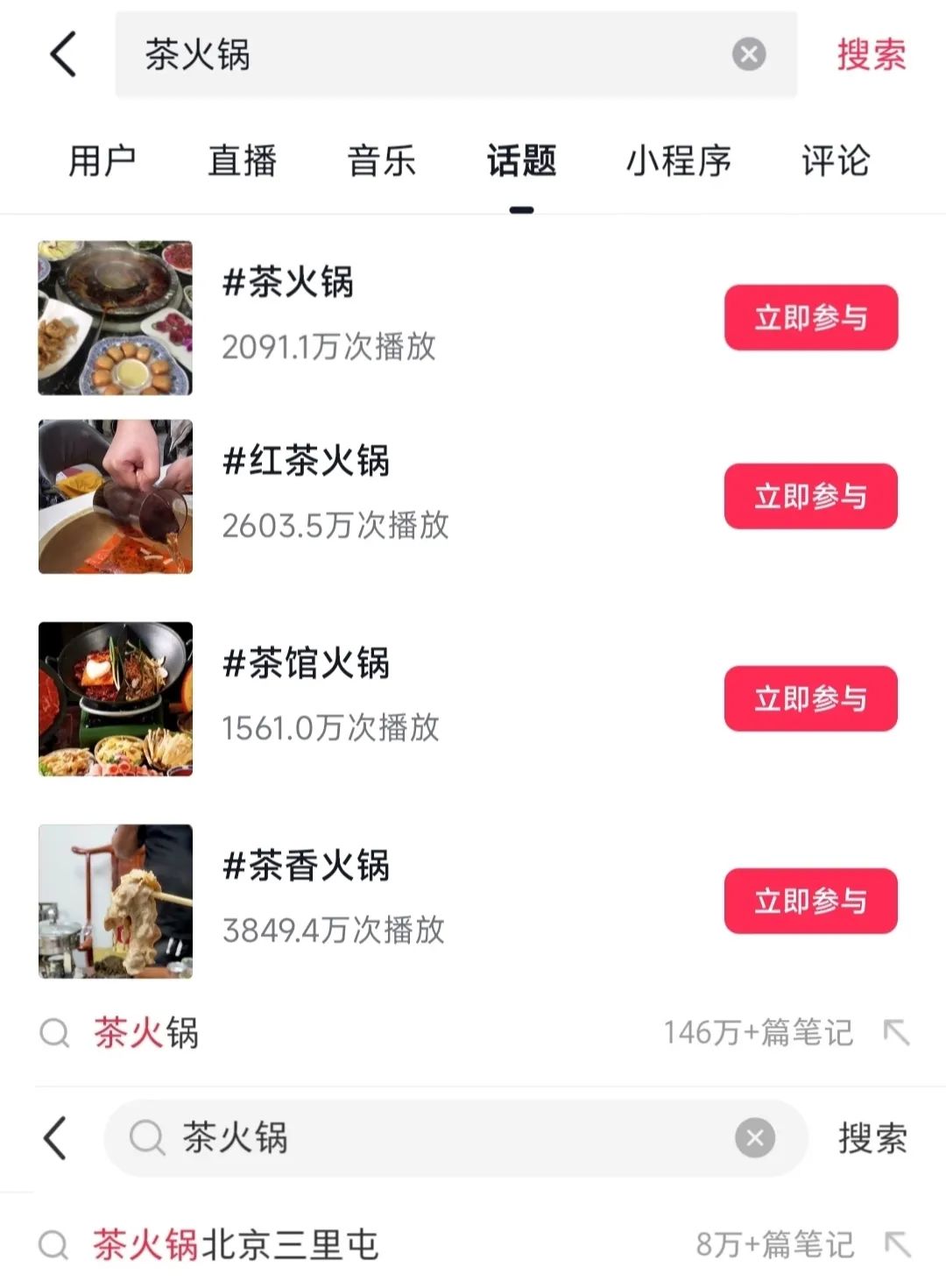
Core Insights - The emergence of "tea hotpot" restaurants across various cities in China, such as Chongqing, Beijing, and Suzhou, has gained significant popularity, blending tea culture with traditional hotpot dining experiences [1][4][8] - The trend is particularly appealing to younger consumers, with substantial social media engagement, including over 100 million views on Douyin related to "tea hotpot" [1][4] Group 1: Popularity and Market Presence - The "tea hotpot" concept has seen a surge in popularity, with notable establishments like Hu Tea House in Beijing consistently ranking high on local dining platforms since its opening in 2021 [3][4] - In Nanjing, Su Jianshan's tea hotpot has sold over 5,000 units of its popular "Su-style 18 cup tea hotpot" within just three months of opening [4][8] - Other cities are also witnessing the rise of tea hotpot restaurants, including Tea Pao Old Hotpot in Chongqing and Gonglu Tea Soup Hotpot in Wuhan, contributing to a nationwide trend [8] Group 2: Unique Features and Offerings - The design and ambiance of tea hotpot restaurants emphasize tea culture, with decor often reflecting traditional tea house aesthetics, such as large tea displays and themed furnishings [9][11] - The hotpot bases prominently feature various types of tea, including popular options like jasmine tea and lesser-known varieties like Pu'er and Longjing tea, enhancing the dining experience [13][15] - Signature dishes often incorporate tea elements, such as "tea-flavored beef" and "jasmine flower tripe," showcasing the integration of tea into both the broth and the ingredients [16] Group 3: Economic Considerations and Challenges - The operational costs for tea hotpot restaurants are elevated due to the need for elaborate decor and marketing strategies aimed at attracting social media attention, leading to higher average consumer spending [17][21] - Despite initial popularity, some establishments face challenges with customer retention, as the novelty of the experience may not justify the higher prices compared to traditional hotpot options [21][22] - Industry experts suggest that the tea hotpot trend may lack a distinct flavor profile compared to other hotpot varieties, raising questions about its long-term sustainability in the market [22]
海底捞想突破天花板
3 6 Ke· 2025-07-31 09:18
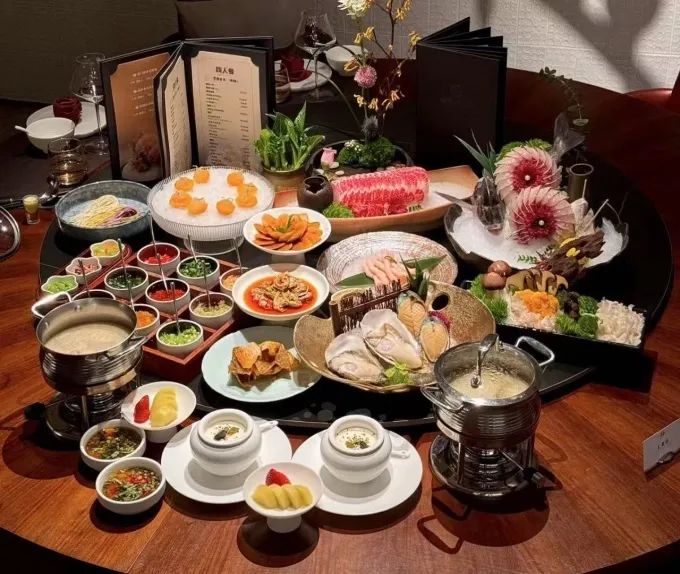
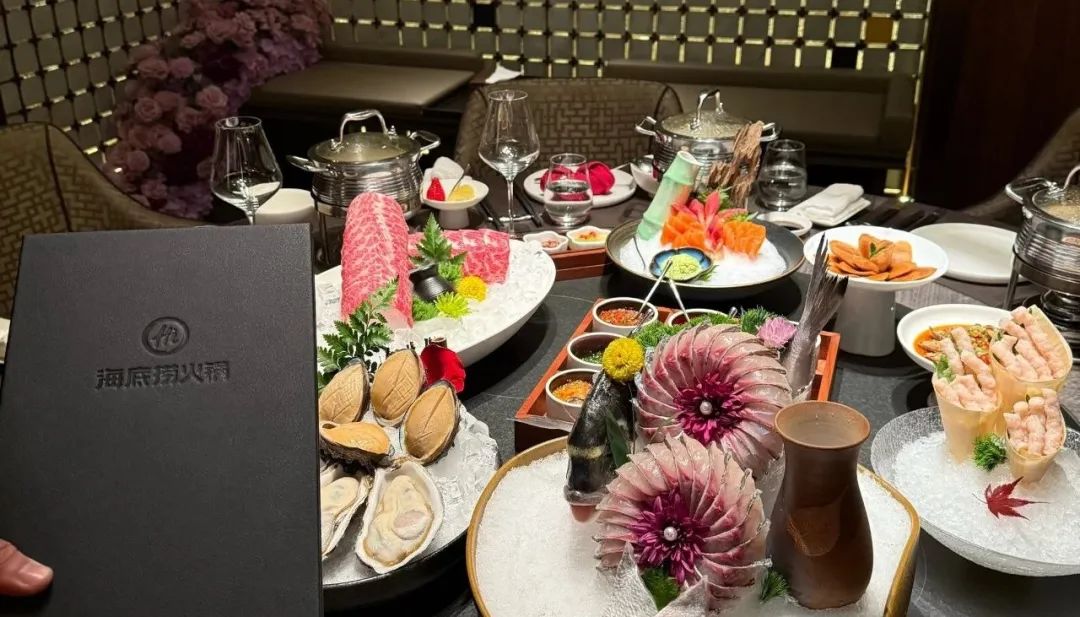
Core Viewpoint - Haidilao is launching a premium restaurant concept, the "Haidilao Zhenxuan" store, focusing on high-end Cantonese seafood hotpot, diverging from the competitive pricing trend in the hotpot industry [1][7][20] Group 1: Store Concept and Offerings - The Zhenxuan store features high-quality seasonal ingredients, including premium seafood and poultry, with a per capita consumption of 700 yuan [1][6] - All staff members have undergone professional etiquette training, with a team experienced in high-end dining, indicating a focus on elevating service standards [3][20] - The store operates on a reservation-only basis, requiring advance bookings, especially on weekends and holidays [4][20] Group 2: Market Positioning and Strategy - Haidilao aims to target the high-end hotpot market, particularly for business dining, to enhance profitability and brand premium [7][15] - The company is responding to declining average spending per customer, which fell to 97.5 yuan in 2024, aligning with broader market trends of price sensitivity among consumers [14][15] - The introduction of the Zhenxuan store is part of Haidilao's strategy to diversify its brand and explore new market segments, particularly in high-end dining [20][23] Group 3: Market Insights and Trends - The hotpot market is segmented into quality hotpot (average spending over 120 yuan), mass-market hotpot (60-120 yuan), and budget hotpot [16][17] - The quality hotpot market is projected to grow from 741 billion yuan in 2024 to 805 billion yuan in 2025, indicating a significant opportunity for premium offerings [17] - High-end hotpot consumers prioritize food quality, dining environment, and service experience, often associating higher prices with brand value [19][20]
火锅巨头海底捞怎么“变高端了”?
3 6 Ke· 2025-07-31 03:47
Core Insights - Haidilao's first "Zhenxuan" store has quickly gained popularity, with reservations fully booked for two weeks and a focus on high-end Cantonese hot pot, featuring premium ingredients and a refined dining experience [1][2][8] Product Offering - The Zhenxuan store specializes in Cantonese hot pot, offering high-end ingredients such as M9+ Wagyu beef and Australian lobster, with a focus on seafood freshness displayed in a live seafood tank [2][4] - The menu includes classic Cantonese broth options, emphasizing freshness and quality, with a variety of cooking styles available [4][5] Pricing Strategy - The average spending per customer exceeds 500 yuan, indicating a shift towards a premium dining experience [5][12] - The store charges a service fee of 10% in the dining area and 15% in private rooms, reflecting the enhanced service quality [7] Service Enhancement - Staff members are trained in professional etiquette, with some having experience in high-end hospitality, providing personalized service [7][8] - The store features a spacious layout with multiple private rooms and dedicated areas for tea and cocktails, enhancing the overall dining atmosphere [5][9] Strategic Rationale - Haidilao aims to tap into the high-end market segment, addressing the demand for quality dining experiences among existing customers [8][9] - The Zhenxuan store is strategically located in high-end business districts to attract corporate clientele, offering customized services for business gatherings [9][11] Market Positioning - The introduction of the Zhenxuan store is part of Haidilao's strategy to diversify its offerings and address the saturation in the traditional hot pot market [11][12] - The company is transitioning from a focus on rapid expansion to enhancing the value of individual stores, aiming for a comprehensive dining ecosystem that covers various market segments [12][19] Growth Challenges - Haidilao faces slowing growth in its core business, with revenue growth projected at 3.1% for 2024, indicating a need for new growth avenues [12][13] - The company has launched multiple new brands to explore different dining categories, although many have faced operational challenges [15][16] Future Outlook - The Zhenxuan store represents a critical step in Haidilao's strategy to create a multi-dimensional dining experience, potentially reshaping the high-end hot pot market [20][21] - The success of the Zhenxuan store could serve as a model for future expansions and innovations within Haidilao's broader strategic framework [20][21]