
化工原料

Search documents
鼎龙科技(603004) - 2025年第三季度主要经营数据公告
2025-10-29 09:30
浙江鼎龙科技股份有限公司(以下简称公司)根据《上海证券交易所上市公 司自律监管指引第3号—行业信息披露:第十三号——化工》有关规定和披露要 求,现将2025年第三季度主要经营数据公告如下: 证券代码:603004 证券简称:鼎龙科技 公告编号:2025-053 浙江鼎龙科技股份有限公司 2025 年第三季度主要经营数据公告 本公司董事会及全体董事保证本公告内容不存在任何虚假记载、误导性陈述 或者重大遗漏,并对其内容的真实性、准确性和完整性承担法律责任。 四、其他说明 2025 年第三季度未发生对公司生产经营具有重大影响的其他事项。 注:报告期内,生产量和销售量包括了公司向外采购的成品。 | 主要产品名称 | 销售均价(万元/吨) | | | | 同比变 | 三季度较二 季度环比变 | | --- | --- | --- | --- | --- | --- | --- | | | 2025 年 月 年 | 7-9 | 2024 | 7-9 月 | 动幅度 | 动幅度 | | 染发剂原料 | | 26.65 | | 25.87 | 3.02% | -2.09% | | 特种工程材料单体 | | 28.77 | | ...

威尔药业(603351) - 威尔药业关于公司2025年第三季度主要经营数据公告
2025-10-29 09:30
证券代码:603351 证券简称:威尔药业 公告编号:2025-032 (一)主要产品销售价格变动情况 单位:元/吨(不含税) | 主要产品 | 2025 年 1-9 月 平均售价 | 2024 年 1-9 月 平均售价 | 变动比例 | | --- | --- | --- | --- | | 1、合成润滑基础油 | 14,838.44 | 15,734.98 | -5.70% | | 其中:机械类 | 16,267.41 | 17,859.70 | -8.92% | | 非机械类 | 11,454.28 | 11,718.61 | -2.26% | | 2、药用辅料 | 27,215.59 | 31,477.51 | -13.54% | | 其中:注射用 | 249,791.39 | 273,647.23 | -8.72% | | 非注射用 | 19,776.42 | 20,158.03 | -1.89% | (二)主要原材料价格波动情况 南京威尔药业集团股份有限公司 关于公司2025年第三季度主要经营数据的公告 本公司董事会及全体董事保证本公告内容不存在任何虚假记载、误导性陈述 或者重大遗漏,并对其内容的 ...

嘉化能源:2025年前三季度净利润约8.23亿元
Mei Ri Jing Ji Xin Wen· 2025-10-29 08:54
Group 1 - The core viewpoint of the article highlights that Jiahu Energy reported a revenue of approximately 7.731 billion yuan for the first three quarters of 2025, representing a year-on-year increase of 9.33% [1] - The net profit attributable to shareholders of the listed company was approximately 823 million yuan, reflecting a year-on-year growth of 4.05% [1] - As of the report, Jiahu Energy's market capitalization stands at 11.6 billion yuan [1] Group 2 - The article also notes that the A-share market has surpassed 4,000 points, indicating a significant market resurgence after a decade of stagnation [1] - It mentions that the technology sector is reshaping the market dynamics, leading to a new "slow bull" market pattern [1]

西南期货早间评论-20251029
Xi Nan Qi Huo· 2025-10-29 02:37
1. Report Industry Investment Ratings There is no information about the report industry investment ratings in the provided content. 2. Core Views of the Report - **Treasury Bonds**: Expected to have no trend - based market, maintain a cautious stance [6][7] - **Stock Index Futures**: Low risk of significant decline, consider taking long positions opportunistically [9][10] - **Precious Metals**: Pricing is relatively full, take profit on previous long positions and then wait and see [11][12] - **Rebar and Hot - Rolled Coils**: The mid - term weakness of rebar prices is hard to change, and hot - rolled coils may follow a similar trend. Look for short - selling opportunities at high levels during rebounds [13][14] - **Iron Ore**: The short - term supply - demand pattern supports prices, but it may weaken in the medium term. Look for buying opportunities during pullbacks [16] - **Coking Coal and Coke**: Consider buying during pullbacks [18][19] - **Ferroalloys**: May continue to have oversupply in the short term. Consider long positions at low levels when the spot falls into the loss range again after a decline [21][22] - **Crude Oil**: Temporarily wait and see [24][25] - **Fuel Oil**: Look for long - buying opportunities [26][27] - **Synthetic Rubber**: Oscillate [28][29] - **Natural Rubber**: Look for long - buying opportunities [30][31] - **PVC**: Pay attention to changes on the supply side [32][35] - **Urea**: Limited downside space [36][37] - **Para - Xylene (PX)**: May have an oscillatory adjustment in the short term, with support at the bottom. Consider participating at low levels [38][39] - **PTA**: May oscillate in the short term. Be cautiously bullish and pay attention to oil price changes [40] - **Ethylene Glycol**: May oscillate in the short term. Participate within a range and pay attention to port inventory and import changes [41][42] - **Short - Fiber**: May oscillate following costs. Control risks and pay attention to cost changes and macro - policy adjustments [43] - **Bottle Chips**: Expected to oscillate following the cost side. Control risks [44][45] - **Lithium Carbonate**: Pay attention to the sustainability of consumption [46] - **Copper**: Look for long - buying opportunities [47][48] - **Tin**: May oscillate with an upward bias [49] - **Nickel**: Expected to oscillate [51] - **Soybean Oil and Soybean Meal**: Consider long positions for soybean meal after adjustment; temporarily wait and see for soybean oil [54][55] - **Palm Oil**: Temporarily wait and see [56][58] - **Rapeseed Meal and Rapeseed Oil**: Temporarily wait and see for rapeseed oil [59][60] - **Cotton**: Limited upside space for cotton prices [61][62] - **Sugar**: There is support at the bottom [64][67] - **Apples**: Expected to run strongly [69][71] - **Pigs**: Take profit on short positions in the short term and then wait and see. Wait for opportunities to sell short on rebounds [72][73] - **Eggs**: Hold short positions and look for opportunities to add short positions on rebounds [74][75] - **Corn and Starch**: It is advisable to wait and see for corn; corn starch may follow the corn market [76][77] 3. Summary by Related Catalogs Treasury Bonds - Last trading day, treasury futures closed up across the board. The central bank conducted 475.3 billion yuan of 7 - day reverse repurchase operations, with a net investment of 315.8 billion yuan. ADP will release weekly US employment data. The current macro - data is stable, but the recovery momentum needs strengthening. The yield is relatively low, and the market risk preference has increased. It is expected that there will be no trend - based market [5][6] Stock Index Futures - Last trading day, stock index futures showed mixed performance. The domestic economy is stable, but the recovery momentum is weak, and corporate profit growth is low. However, domestic asset valuations are low, and the economy has sufficient resilience. Market sentiment has warmed up, and incremental funds have entered the market. The uncertainty in Sino - US economic and trade relations has eased, and the risk of significant decline is low [8][9] Precious Metals - Last trading day, gold and silver futures closed down. The US housing price index increased. The complex global trade and financial environment, the trend of "de - globalization" and "de - dollarization", and potential Fed rate cuts are beneficial to precious metals. However, the recent increase has been large, and the pricing is full [11] Rebar and Hot - Rolled Coils - Last trading day, rebar and hot - rolled coil futures rebounded slightly. In the medium term, prices are dominated by industry supply - demand logic. The real - estate industry's downward trend remains unchanged, and rebar demand is declining year - on - year. Although it is the traditional peak demand season, the inventory pressure is obvious. The basic logic of hot - rolled coils is similar to that of rebar [13][14] Iron Ore - Last trading day, iron ore futures rebounded significantly. The national hot - metal daily output remains at around 2.4 million tons, supporting prices. Although the import and domestic production of iron ore have increased quarter - on - quarter since the second quarter, the year - on - year decline in the first 9 months remains unchanged. The port inventory is lower than last year [16] Coking Coal and Coke - Last trading day, coking coal and coke futures declined slightly. Coking coal supply is slightly tight due to safety inspections, and demand is okay. The second - round increase in coke procurement prices is gradually being implemented. Coking profits are stable, and demand remains high [18] Ferroalloys - Last trading day, manganese - silicon futures closed down, and silicon - iron futures closed up. The manganese - ore shipment from Gabon decreased, and the Australian ore supply increased. The port manganese - ore inventory increased slightly, but the level is still low. The cost of ferroalloys has increased, and the supply is in short - term surplus [21] Crude Oil - Last trading day, INE crude oil oscillated downward but remained above the 5 - day moving average. The US government shutdown suspended the CFTC report. The number of US oil and gas rigs increased for the second consecutive week. India's Reliance Industries will comply with sanctions on Russia. The increase in US crude - oil production is difficult, and sanctions on Russia are beneficial to oil prices [23][24] Fuel Oil - Last trading day, fuel oil oscillated downward following crude oil. The sanctions on oil have increased market sentiment. The Asian high - sulfur and ultra - low - sulfur fuel - oil spreads are strong, and the Singapore fuel - oil supply is tight. Sanctions on Russia are beneficial to fuel - oil prices [26] Synthetic Rubber - Last trading day, synthetic rubber futures closed down. The short - and medium - term maintenance is expected to increase, which may drive the market to stop falling and rebound. The raw - material side is bearish, and the private - enterprise supply is expected to increase. The short - term market is weak, and it will oscillate [28] Natural Rubber - Last trading day, natural - rubber futures showed mixed performance. The market should focus on the weather in production areas and demand expectations. The new - rubber production is slow due to weather disturbances, and the raw - material purchase price has increased. The tire - enterprise capacity utilization has increased slightly, and the inventory has decreased significantly [30] PVC - Last trading day, PVC futures closed down. The oversupply situation continues, but the downward space is limited. After the holiday, focus on exports and supply reduction. The PVC production capacity utilization has decreased, and the demand from downstream industries has increased. The cost - profit situation is complex [32][33] Urea - Last trading day, urea futures closed down. In the short term, pay attention to export - policy changes and the seasonal recovery of agricultural demand. The supply pressure has eased, and the demand from the agricultural market has increased. The cost is stable, and the inventory is lower than expected [36] Para - Xylene (PX) - Last trading day, PX futures rose. The PXN spread is relatively strong, and the supply has slightly decreased. The cost - side crude oil has recovered. In the short term, PX may oscillate and adjust, with support at the bottom [38][39] PTA - Last trading day, PTA futures rose. The supply has changed, and the demand from the polyester industry is stable. The processing fee has been significantly under pressure, and the inventory is low. The cost - side crude oil has recovered. In the short term, it may oscillate [40] Ethylene Glycol - Last trading day, ethylene glycol futures closed down. The overall operating load has increased, and the port inventory has decreased. The downstream polyester industry's operating rate is stable, but the terminal demand support is limited. In the short term, it may oscillate [41][42] Short - Fiber - Last trading day, short - fiber futures rose. The device load has decreased, and the demand has improved. The processing fee is around 1,125 yuan/ton. In the short term, it may oscillate following costs [43] Bottle Chips - Last trading day, bottle - chip futures rose. The processing fee has decreased to around 450 yuan/ton. The factory load has increased, and the export growth has slowed down. It is expected to oscillate following the cost side [44][45] Lithium Carbonate - Last trading day, lithium - carbonate futures rose. The production is at a high level, and the supply - side profit is sufficient. The demand from the energy - storage and power - battery sectors has improved, and the social inventory is decreasing [46] Copper - Last trading day, Shanghai copper futures fell significantly. The spot market was mediocre, and the downstream consumption sentiment was low. The Indonesian copper mine has not resumed production, which supports copper prices. There are different views on the Sino - US APEC meeting [47] Tin - Last trading day, tin futures rose. The mining end is tight, the resumption of production in Wa State is slow, and the domestic processing fee is low. The demand shows certain resilience. The refined - tin inventory is decreasing, and the price may oscillate upward [49] Nickel - Last trading day, nickel futures closed down. The change in Indonesia's RKAB approval policy has raised supply concerns. The mining - end price has weakened, and the domestic port inventory is increasing. The high - grade nickel ore is still tight. The stainless - steel consumption is weak, and the refined - nickel market is in surplus [51] Soybean Oil and Soybean Meal - Last trading day, soybean - meal futures rose, and soybean - oil futures fell. Sino - US trade frictions may ease. The soybean - crushing volume of oil mills has recovered to a high level. The soybean - meal inventory has decreased, and the soybean - oil inventory pressure is still large. The consumption of soybean oil may be suppressed, and the demand for soybean meal is expected to grow moderately [53][54] Palm Oil - Malaysian palm - oil futures fell for the third consecutive day. Indonesia's palm - oil production is expected to increase by 10% in 2025. The domestic palm - oil import has decreased, and the inventory is at a medium level in the past 7 years [56] Rapeseed Meal and Rapeseed Oil - Canadian rapeseed prices rose. In China, the import of rapeseed and rapeseed meal decreased in September, while the import of rapeseed oil increased. The inventory of rapeseed, rapeseed meal, and rapeseed oil is at different levels in the past 7 years [59] Cotton - Last trading day, domestic cotton futures oscillated. The market has high expectations for Sino - US negotiations. The export of textile and clothing is relatively stable. The domestic cotton production is expected to be high this year, and the cotton price is under pressure [61][62] Sugar - Last trading day, Zhengzhou sugar futures rebounded significantly, while overseas sugar futures fell to a four - year low. Brazil's sugar production has slightly exceeded expectations, and the global sugar supply is expected to be in surplus. The domestic northern region has started sugar production, and the southern region will start in December [64][66] Apples - Last trading day, domestic apple futures rose significantly due to quality concerns. The opening price this year is higher than last year. The late - maturing apple market is active, but the quality is poor [69][70] Pigs - Yesterday, the national average pig price rose. At the end of the month, the northern market is strengthening, and the southern market is following. The supply from group farms has decreased slightly, and the retail - farmer reluctance to sell remains. The consumption demand has improved. In the second half of the month, the supply from group farms is expected to increase [72] Eggs - Last trading day, the average egg price in the main production and sales areas remained unchanged. The cost per catty has increased slightly, and the farming profit is negative. The number of laying hens in stock is at a high level in the past 9 years. In October, the supply is expected to increase, and the consumption may be lower than expected [74] Corn and Starch - Last trading day, corn futures rose, and corn - starch futures fell. The new - season corn is accelerating to ports, and the inventory is expected to increase. The demand for corn is growing slightly, but the price is under pressure due to the harvest. Corn starch has weak supply and demand, and the inventory is at a high level [76][77]
永东股份Q3营收利润双降 在建项目加码布局长期发展
Xin Lang Cai Jing· 2025-10-28 10:39
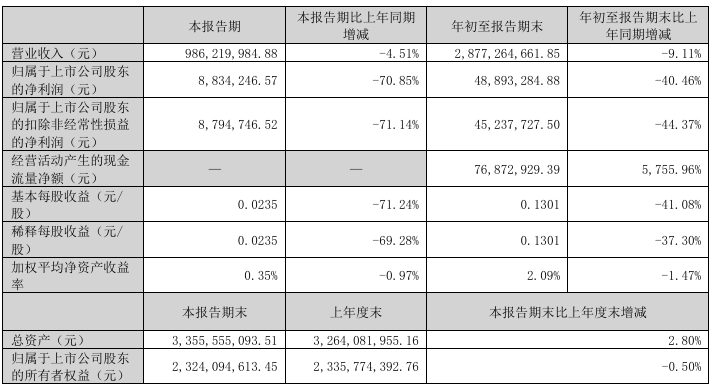
Core Insights - Yongdong Co., Ltd. reported a decline in core operating indicators for Q3 2025, indicating pressure on profitability, but a significant improvement in operating cash flow [1][3] - The company is investing in ongoing projects to support long-term development [1] Financial Performance - The company's revenue for the quarter was 986.22 million yuan, a decrease of 4.51% year-on-year; cumulative revenue for the year-to-date was 2.88 billion yuan, down 9.11% [2][3] - Net profit attributable to shareholders was 8.83 million yuan for the quarter, a sharp decline of 70.85%; year-to-date net profit was 48.89 million yuan, down 40.46% [3] - The net profit excluding non-recurring items also saw a significant drop, with figures of 8.79 million yuan for the quarter and 45.24 million yuan year-to-date, reflecting declines of 71.14% and 44.37% respectively [3] - Basic earnings per share were 0.0235 yuan, down 71.24% for the quarter; year-to-date basic earnings per share were 0.1301 yuan, a decrease of 41.08% [3] - The weighted average return on equity was 0.35% for the quarter, down 0.97 percentage points; year-to-date it was 2.09%, a decrease of 1.47 percentage points [3] Cash Flow and Investment - Operating cash flow showed remarkable improvement, with a net cash flow from operating activities of 76.87 million yuan, an increase of 5755.96% year-on-year, primarily due to reduced cash payments for raw material purchases [3][4] - Cash flow from investing activities turned negative at -107 million yuan, a shift from positive to negative, mainly due to increased cash payments for fixed asset purchases [3][4] - Cash flow from financing activities was also negative at -28.30 million yuan, but this was an improvement from -131 million yuan in the previous year, attributed to increased cash payments for debt repayment and share buybacks [4] Asset and Liability Structure - Total assets increased by 2.80% to 3.36 billion yuan, with significant internal structural adjustments [4] - The amount for ongoing construction projects reached 207 million yuan, a substantial increase of 486.99%, primarily for new power generation and coal tar processing projects, laying the foundation for future capacity release [4]


“反内卷”预期增强抵消新产能投产的利空 PTA在弱现实与强预期博弈中上涨
Xin Hua Cai Jing· 2025-10-28 07:29
10月PTA延续低加工费,临近月底,PTA行业座谈会即将召开的消息提振市场,PTA行情反弹。 不过,往后来看,市场仍将关注低加工费背景之下PTA企业的减产力度,整体预估后期PTA现货行情或 将上涨。但PTA产能过剩需要漫长的时间完成优胜劣汰,因此预估本轮PTA行情上涨空间有限。 不过,贸易谈判取得进展,利好大宗商品市场心态,也利好终端纺织品服装出口,产业链需要自下而上 的需求提振,而不仅仅是从供应端减产原料。 短期从需求角度来看,10月底需求旺季尾声,11月PTA大概率从去库存向累库存过渡,且按季节性规律 来看,2025年12月至2026年2月PTA会加速积累库存。目前11月底货源成交基差为-70元/吨,也反应了 市场对于11月市场并不乐观的预期。 基于上述供需面,PTA在弱现实与强预期的博弈之下,减产将决定短期PTA是否累库。如果低加工费之 下PTA企业主动集中减产,11-12月份PTA可能不会累库存,将推涨PTA行情上涨及现货基差走强。但如 果减产力度有限,无法改变目前供应充足的格局,PTA现货基差或继续偏弱。 综上所述,PTA绝对价格偏低、生产亏损,市场信心需要利好驱动因素来提振,"反内卷"预期的出现虽 ...

韩国六氟化钨供应商针对半导体制造商大规模涨价:涨幅70%-90%
Ge Long Hui· 2025-10-28 07:18
Group 1 - The core point of the article is that due to a significant increase in tungsten prices, suppliers of tungsten hexafluoride (WF6) in South Korea are initiating substantial price hikes for semiconductor manufacturers, with increases expected to be between 70% and 90% starting next year [1] - Major manufacturers such as SK Specialty, Hoosung, and Kanto Chemical have notified semiconductor companies including Samsung Electronics, SK Hynix, DB HiTek, and Magnachip about the price adjustments [1] - The reason for the price increase is attributed to tungsten prices doubling within five months, leading to increased cost burdens for suppliers [1] Group 2 - A representative from the industry indicated that Japanese natural gas companies are also requesting a 90% price increase, citing factors such as exchange rates [1] - Semiconductor manufacturers are aware of the rising tungsten prices and feel compelled to accept the price hikes from suppliers [1]
申万宏源证券晨会报告-20251028
Shenwan Hongyuan Securities· 2025-10-28 03:14
Core Insights - The report highlights a significant decline in investment growth across various sectors, including infrastructure, services, manufacturing, and real estate, with fixed asset investment growth dropping to historical lows since mid-2025 [11][5][4] - The central bank's decision to resume government bond trading is expected to have a short-term positive impact, but the long-term effects may be neutral due to ongoing economic pressures [12][14] - China Shenhua's Q3 2025 performance showed stable growth despite challenges, with revenue and net profit exceeding market expectations, driven by cost control measures [4][13] Investment Growth Decline - Investment growth has sharply decreased, with fixed asset investment growth falling 9.2 percentage points to -6.5% in September 2025, marking the lowest point in five years [11] - Major sectors such as infrastructure, services, real estate, and manufacturing have all experienced declines, with specific drops of 13.1%, 11.1%, 9.3%, and 9.1% respectively [11] - The decline in construction and installation investment is identified as a primary factor contributing to the overall drop in fixed asset investment [11] Reasons for Investment Slowdown - The acceleration of debt resolution has occupied investment funds, explaining over half of the investment decline, with the issuance of special refinancing bonds significantly impacting available government investment funds [11][5] - Companies are being pressured to clear debts, which has further constrained their ability to invest, particularly affecting state-owned enterprises and the real estate sector [11] - A lack of new projects is also contributing to the investment slowdown, with new construction projects seeing a significant drop in growth [11] Policy Optimization Effects - Recent fiscal measures are aimed at alleviating the impact of debt resolution on investment, with targeted policies already showing some positive effects [11] - The report suggests that improving cash flow for enterprises through debt resolution could restore investment vitality, particularly for small and medium-sized enterprises [11] Company Performance Insights - China Shenhua reported a Q3 2025 revenue of CNY 750.42 billion, a 9.51% increase from Q2, although it represents a 13.10% year-on-year decline [13] - The company’s net profit for Q3 was CNY 144.11 billion, reflecting a 13.54% increase from the previous quarter but a 6.24% year-on-year decline [13] - The company maintains a high dividend payout ratio, planning to distribute CNY 194.71 billion in dividends for the first half of 2025, which is 79% of its net profit [13][17] Market Trends and Future Outlook - The report indicates that the market may experience a short-term boost from the resumption of government bond trading, but the overall economic environment remains challenging [12][14] - The performance of various sectors, including the coal and energy sectors, is under scrutiny, with expectations of continued pressure on profit margins due to fluctuating prices [17][18] - Companies are advised to focus on optimizing costs and enhancing operational efficiency to navigate the current economic landscape [17][18]
国信证券晨会纪要-20251028
Guoxin Securities· 2025-10-28 01:14
Macro and Strategy - The public REITs index has rebounded, with a weekly increase of 0.2%, and the average weekly change for property and operating rights REITs was +0.1% and +0.7% respectively [9][10] - The total market value of REITs increased to 218.8 billion yuan, with an average daily turnover rate of 0.52%, up 0.13 percentage points from the previous week [10][11] Chemical Industry - The 2026 refrigerant quota distribution plan has been released, with a reduction of 3,000 tons for R22 production quotas and a complete elimination of R141b quotas [14][15] - The flexibility of the third-generation refrigerant quotas has been enhanced, allowing for two adjustments per year, with a total not exceeding 30% of the quota amount [14][15] - The chemical industry is expected to maintain a favorable outlook for refrigerants, particularly R32 and R134a, due to tightening quota constraints [15] Mechanical Industry - Tesla plans to launch the Optimus V3 robot in Q1 2026, with a production capacity target of 1 million units by the end of next year [16][17] - The humanoid robot industry is anticipated to enter a large-scale production phase, benefiting both the complete machine and component supply chains [17][18] Oilfield Services - The company is a leading global oilfield service provider, with a focus on offshore oil and gas exploration and production [28][29] - The company is expected to benefit from China's offshore oil and gas development, with a projected capital expenditure of 135 billion yuan in 2025 [29][30] - The drilling platform utilization rate is high, and daily fees are expected to rise due to a decrease in retired platforms [29][30] Chemical Manufacturing - WanHua Chemical reported a revenue of 53.32 billion yuan in Q3 2025, with a year-on-year increase of 5.5% and a net profit of 3.03 billion yuan [31][32] - The polyurethane segment is experiencing a mixed demand, with a planned capacity expansion of 700,000 tons for MDI by Q2 2026 [32][33] - The petrochemical segment is under pressure from price declines, but revenue is expected to grow due to increased production capacity [33] Agricultural Solutions - Guoguang Co. reported a revenue of 1.523 billion yuan in the first three quarters of 2025, with a year-on-year increase of 6.09% [35][36] - The company is focusing on promoting comprehensive crop management solutions, with a significant increase in R&D investment [35][36] - The company plans to maintain a high dividend payout ratio, reflecting its commitment to shareholder returns [36][37] Dental Care - Dengkang Dental achieved a revenue of 1.228 billion yuan in the first three quarters of 2025, with a year-on-year increase of 16.66% [38] - The company is adjusting its online marketing strategy, which has led to a temporary slowdown in growth [38]
江苏索普:2025年前三季度净利润约1.26亿元
Mei Ri Jing Ji Xin Wen· 2025-10-27 09:01
Group 1 - Jiangsu Sopo reported a revenue of approximately 4.661 billion yuan for the first three quarters of 2023, a year-on-year decrease of 5.74% [1] - The net profit attributable to shareholders for the same period was approximately 126 million yuan, reflecting a year-on-year decline of 39.21% [1] - As of the report date, Jiangsu Sopo's market capitalization stood at 8.5 billion yuan [2]
