航空航天

Search documents
特朗普关税威胁“升空”,喷气机站在了美加贸易冲突前线
Di Yi Cai Jing· 2026-02-05 08:08
Core Viewpoint - The growing business jet market is facing uncertainty due to threats from former President Trump regarding aircraft certification and potential tariffs on Canadian-made planes [1][4]. Group 1: Aircraft Certification Issues - The Canadian Transport Department is collaborating with the FAA to address delays in the certification of certain Gulfstream jet models [1]. - Trump accused Canada of "wrongfully, illegally, and stubbornly refusing" to certify Gulfstream models 500, 600, 700, and 800, threatening a 50% tariff on Canadian aircraft sold in the U.S. [1]. - Experts indicate that without Canadian recognition of FAA certifications, Gulfstream aircraft cannot be delivered to Canadian buyers or operate in Canadian airspace [1][2]. Group 2: Regulatory Landscape - Following the Boeing 737 MAX crashes, countries like Canada and the EU are increasingly focusing on their own airworthiness certification capabilities rather than relying solely on FAA approvals [2]. - The FAA has granted exemptions for the G700 and G800 models, allowing phased deliveries until the end of 2026, but Canada has refused certification due to incomplete fuel system testing [2]. - The Chicago Convention mandates that safety is the priority, and the fuel icing tests are critical for engine fuel supply [2]. Group 3: Market Dynamics - The business jet market is recovering, with a forecast of 8,500 new business jets to be delivered over the next decade, valued at approximately $283 billion [3]. - North America currently holds over 60% of the global business jet fleet and is expected to receive about 70% of new deliveries in the next three years [3]. - The demand for orders is stimulated by the U.S. "Big and Beautiful" Act's 100% bonus depreciation policy and the popularity of fractional ownership models [3]. Group 4: Competitive Landscape - Bombardier is a strong competitor to Gulfstream, with its latest ultra-long-range business jets priced around $80 million, often adjusted based on customer specifications [4]. - Trump's threats have created uncertainty in the market, affecting ongoing transactions, such as a deal to sell Bombardier jets to the U.S. [4]. - Legal experts have noted the unprecedented nature of Trump's actions, which could impact the rights of private jet owners protected by the constitution [4].

单箭发射效率有望提升100%!航空航天ETF(159227)盘中成交2.87亿
Xin Lang Cai Jing· 2026-02-05 05:51
Group 1 - The Aerospace and Aviation Industry Index (CN5082) shows mixed performance among its constituent stocks, with Beimo High-Tech leading at a 10.00% increase, followed by Hangfa Technology at 4.36% and Hangcai Co. at 2.77%, while China Satellite experienced the largest decline [1] - The Aerospace ETF (159227) is currently priced at 1.47 yuan, with a turnover rate of 8.27% and a transaction volume of 287 million yuan during the trading session [1] - Over the past month, the average daily transaction volume of the Aerospace ETF reached 712 million yuan as of February 4 [1] Group 2 - Tianbing Technology announced that its satellite launch technology facility in Jiuquan has passed pre-acceptance review, marking the first commercial satellite launch technology facility in China [1] - The establishment of the Jiuquan satellite facility signifies Tianbing Technology's transition to engineering applications, enhancing single rocket launch efficiency by 100% and reducing network costs by over 30%, enabling more than 60 high-frequency launches annually [1] - According to Zheshang Securities, rocket capacity is a short-term bottleneck for domestic low-orbit satellite constellation construction, with approximately 13,000 launches planned over the next five years, leading to an expected increase in launch frequency from 54 times in 2025 to 860 times by 2030, representing a CAGR of about 74% [1] Group 3 - The Aerospace ETF (159227) closely tracks the National Aerospace Index, covering key industry chain segments such as aerospace equipment, space equipment, satellite navigation, and new materials, with a high weight of 70% in commercial aerospace concepts [2] - The top ten holdings in the ETF include industry leaders such as Aerospace Development, China Satellite, Aerospace Electronics, AVIC Aircraft, and AVIC High-Tech [2]
代表建议统筹考虑产业全要素集聚,“争取唯一性产业相关组织落地上海”
第一财经· 2026-02-05 04:28
Core Viewpoint - The article emphasizes the importance of accelerating the construction of the "Five Centers" in Shanghai during the 14th Five-Year Plan period, highlighting the city's commitment to enhancing its urban capabilities and competitiveness [2]. Group 1: Development of the Five Centers - The Shanghai government report outlines support for industries such as smart connected vehicles, marine economy, low-altitude economy, aerospace, and satellite internet, aiming to cultivate distinctive digital industry clusters and enhance service sector quality [3]. - The report advocates for the synergistic development of the "Five Centers," promoting mutual support and efficient collaboration to amplify overall, platform, and radiation effects [4]. - A representative from the Shanghai Robotics Industry Technology Research Institute suggests that high-quality industrial development requires comprehensive support across the entire supply chain and resource allocation [4]. Group 2: Internationalization and Global Engagement - The article discusses the need for Shanghai to enhance its international presence by participating in the formulation of international rules and strengthening its voice on the global stage, particularly in supporting talent and projects that take on leadership roles in international organizations [5]. - The construction of Shanghai's international shipping center is transitioning from "basically completed" to "fully completed," yet it faces challenges in enhancing its soft power and optimizing the port business environment [6]. Group 3: Recommendations for Shipping and Trade - Suggestions include signing inter-port cooperation agreements with major international ports to promote green and digital shipping corridors, establishing dynamic optimization mechanisms for business content, and enhancing strategic cooperation among friendly ports [7]. - The article highlights the need for innovative port supervision models to support cross-border e-commerce and the integration of shipping trade with digital platforms, focusing on improving digital infrastructure and public service capabilities [8]. - To enhance shipping factor aggregation, the article recommends attracting quality shipping enterprises, supporting existing local companies, and implementing policies to draw back "convenient flag ships" and high-end shipping talents [8].


C919斩获超千架订单!航空航天ETF天弘(159241)标的指数逆市涨超1%
Mei Ri Jing Ji Xin Wen· 2026-02-05 02:48
Group 1 - The aerospace sector is experiencing a positive trend, with the aerospace ETF Tianhong (159241) rising by 1.10% and achieving a trading volume of 17.61 million yuan [1] - The aerospace ETF has seen a net inflow of 405 million yuan over the last 20 trading days, reaching a new high of 999.7 million yuan as of February 4, 2026 [1] - The ETF focuses on military aerospace, covering key components such as fighter jets, transport aircraft, helicopters, and missiles, aligning with the "integrated aerospace" strategic direction [1] Group 2 - The merger between SpaceX and xAI aims to deploy a million satellites to create an orbital AI data center, indicating significant advancements in commercial aerospace [1] - The C929 wide-body passenger aircraft by COMAC has entered the wind tunnel testing phase, while the C919 has received over a thousand orders following its flight demonstration at the Singapore Airshow [1] - The construction of China's first commercial aerospace common test platform is underway, supporting heavy rocket testing, and multiple government reports highlight commercial aerospace as a key industry [1][2]
航材股份股价涨5.11%,华夏基金旗下1只基金位居十大流通股东,持有475.58万股浮盈赚取1712.09万元
Xin Lang Cai Jing· 2026-02-05 02:18
Group 1 - The core viewpoint of the news is that Hangcai Co., Ltd. has seen a stock price increase of 5.11%, reaching 74.00 CNY per share, with a total market capitalization of 33.3 billion CNY as of the report date [1] - Hangcai Co., Ltd. specializes in the research, production, and sales of components and materials for aviation and aerospace, with its main business revenue composition being: aviation finished products 46.54%, basic materials 44.60%, non-aviation finished products 4.18%, processing services 3.96%, and others 0.72% [1] Group 2 - Among the top ten circulating shareholders of Hangcai Co., Ltd., Huaxia Fund's ETF (588000) reduced its holdings by 2.67 million shares in the third quarter, now holding 4.76 million shares, which accounts for 4.07% of the circulating shares [2] - The Huaxia ETF has a total scale of 76.02 billion CNY, with a year-to-date return of 8.12%, ranking 1361 out of 5566 in its category, and a one-year return of 51.79%, ranking 1116 out of 4285 [2] Group 3 - The fund manager of Huaxia ETF, Rong Ying, has a cumulative tenure of 10 years and 95 days, with the fund's total asset scale at 143.28 billion CNY, achieving a best return of 188.24% and a worst return of -7.58% during the tenure [3]

从“单打独斗”到“万马奔腾”的创新跃升
Xin Hua Ri Bao· 2026-02-04 21:41
Core Insights - The article highlights the recognition of eight innovative companies in Taicang High-tech Zone, referred to as the "Eight Steeds," which span various cutting-edge fields including aerospace materials, medical imaging, and controlled nuclear fusion [1][3]. Group 1: Company Innovations - Huatai Ruixiang has developed the world's first one-piece titanium alloy low-pressure turbine blade, overcoming significant material challenges [2][3]. - Hangchen System's hydraulic actuator has won the first prize in the 2025 China Aerospace Society Science and Technology Progress Award, showcasing superior performance compared to foreign counterparts [2]. - Antong Fusion is the first domestic company focused on commercializing Z-pinch fusion, aiming for commercial power generation by 2040 [3][11]. - YunYao Shenwei utilizes advanced micro-level 3D printing technology to achieve high precision in manufacturing, addressing issues with high-temperature alloy printing [3][4]. Group 2: R&D Investment - The article notes a 45.6% increase in R&D investment in Taicang High-tech Zone during the 14th Five-Year Plan period, indicating a collective commitment to high R&D spending among the "Eight Steeds" [4]. - Yunmu Zhizao has ambitious growth projections, with expected revenue increasing from 4 million in 2024 to over 100 million in 2026, driven by sustained R&D investment [3][4]. Group 3: Industry Ecosystem - The "Eight Steeds" collectively contribute to a robust industrial ecosystem in Taicang, which includes aerospace, new materials, artificial intelligence, and biomedicine [6][7]. - The region has established a collaborative network among companies, enhancing efficiency and innovation through proximity and shared resources [6][7]. - High-level research platforms in the area serve as accelerators for technology transfer, fostering a strong link between academia and industry [6][8]. Group 4: Talent Development - The success of the "Eight Steeds" is attributed to a concentration of top-tier talent, including leading scientists and engineers, which drives innovation [10][11]. - Taicang High-tech Zone has introduced numerous talent projects, significantly boosting the local talent pool and enhancing the overall innovation landscape [10][11]. - Companies emphasize the cultivation of young talent, creating a sustainable talent pipeline that supports long-term growth and innovation [10][11].
火石创造| 31省份“十五五”抢滩新兴产业和未来产业
Sou Hu Cai Jing· 2026-02-04 20:23
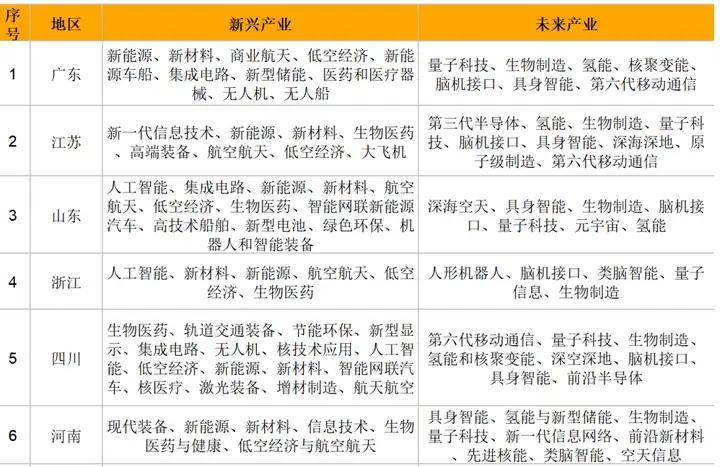
Core Insights - The "14th Five-Year Plan" marks the beginning of a new round of industrial transformation in China, with a clear focus on emerging and future industries across various provinces [1][10] - A comprehensive industrial map has emerged, showcasing strategic competition and collaboration among coastal economic provinces and emerging inland regions [1] Emerging Industries - Low-altitude economy is prioritized by over 28 provinces, making it a nearly universal focus, followed by new materials and new energy, each mentioned by 25 provinces [2] - Biomedicine is highlighted as the most covered future industry, appearing in the plans of 26 provinces, with embodied intelligence and hydrogen energy following closely with 20 and 19 provinces respectively [4] Regional Characteristics - Major economic provinces like Guangdong, Jiangsu, Shandong, and Zhejiang exhibit a comprehensive approach to industrial layout, focusing on both current and future industries [6][7] - Central and western provinces leverage their unique resources to carve out specialized paths, with Sichuan emphasizing nuclear technology and aerospace, while Hubei focuses on optoelectronic information [8] Future Industry Clusters - Six disruptive future industry clusters have been identified: - Intelligent integration cluster focusing on AI and embodied intelligence, with key regions including Zhejiang and Beijing [9] - Quantum information cluster led by Anhui and Beijing, focusing on quantum computing and communication [9] - Future energy cluster targeting hydrogen and nuclear fusion energy, with active participation from Inner Mongolia and Sichuan [9] - Aerospace and deep-sea cluster promoting commercial aerospace and low-altitude economy, with contributions from coastal and inland provinces [9] - Life sciences cluster redefining health and manufacturing, with strengths in Shanghai and Guangdong [9] - Advanced materials cluster providing foundational support for future industries, with significant efforts from Jiangsu and Zhejiang [9] Conclusion - The "14th Five-Year Plan" not only outlines an economic map but also serves as a strategic guide for China to seize opportunities in the global technological revolution and industrial transformation [10]
代表建议统筹考虑产业全要素集聚,“争取唯一性产业相关组织落地上海”
Di Yi Cai Jing· 2026-02-04 13:55
Group 1 - The core focus is on accelerating the construction of the "Five Centers" in Shanghai, which includes enhancing the city's international economic center capabilities and fostering the development of various industries such as smart connected new energy vehicles, marine economy, low-altitude economy, aerospace, and satellite internet [1][2] - The Shanghai government report emphasizes the importance of synergistic development among the "Five Centers" to enhance overall effects, platform effects, amplification effects, and radiation effects [1] - The representatives highlight the need for a comprehensive approach to industry development, including the integration of resources, platforms, and support systems to ensure high-quality industrial growth [2] Group 2 - The construction of Shanghai's international shipping center is transitioning from "basically completed" to "fully completed," but it still faces challenges in enhancing the business environment and the level of shipping element aggregation [3][4] - Suggestions include optimizing the port business environment by establishing international port cooperation agreements and promoting green and digital shipping corridors [4] - There is a focus on attracting high-quality shipping-related enterprises to Shanghai and implementing supportive policies to draw back "convenient flag ships" and high-end shipping talents [5]
前瞻全球产业早报:2026年中央一号文件发布
Qian Zhan Wang· 2026-02-04 13:32
Group 1: Agricultural and Rural Development - The 2026 Central Document emphasizes modernizing agriculture and rural areas, aiming for comprehensive rural revitalization as a primary focus [2] - It highlights the importance of enhancing agricultural policies, ensuring food security, and improving rural living conditions to support China's modernization [2] Group 2: State-Owned Enterprises and Innovation - The State-owned Assets Supervision and Administration Commission (SASAC) is pushing for the development of strategic emerging industries and the transformation of traditional industries [3] - There is a focus on fostering technology-driven enterprises and enhancing collaboration between state-owned enterprises and research institutions to drive innovation [3] Group 3: Energy and Fuel Prices - Starting February 3, domestic gasoline and diesel retail prices will increase by 205 yuan and 195 yuan per ton, respectively, leading to an increase of 0.16 yuan per liter for 92-octane gasoline [4] Group 4: Technological Advancements and Investments - Shanghai is prioritizing the development of future industries such as brain-computer interfaces and fourth-generation semiconductors [5] - The Beijing Humanoid Robot Innovation Center has secured over 700 million yuan in market financing, marking a significant step towards market operation and industrialization [5] Group 5: Robotics and AI Innovations - Zhejiang University has launched the Bolt humanoid robot, which is currently the fastest in the world, capable of running at 10 meters per second [6] - A new AI-assisted puncture navigation robot has received approval for market entry, showcasing advancements in AI technology for clinical applications [6] Group 6: Market Movements and Stock Performance - The South Korean stock market experienced significant volatility, with the composite index dropping over 5% before rebounding and triggering a trading halt [9] - Major indices in the US and A-shares showed positive performance, with the Dow Jones increasing by 1.05% and the Shanghai Composite Index rising by 1.29% [14][15] Group 7: Semiconductor Industry Developments - Samsung and SK Hynix are planning to expand their advanced NAND flash memory production capacity, with Samsung discussing a monthly investment of 40,000 to 50,000 wafers [10] - Samsung Electro-Mechanics is advancing its semiconductor glass substrate project, aiming for commercialization by 2027 [11] Group 8: Corporate Mergers and Strategic Moves - Elon Musk announced the merger of SpaceX and xAI to create a space-based data center, emphasizing the need for AI infrastructure in space to meet growing energy demands [12]



中三省去年GDP总值达15.4万亿,产业竞争力显著提升
第一财经· 2026-02-04 12:43
Economic Performance - The total GDP of the "Central Triangle" formed by Hunan, Hubei, and Jiangxi reached 153,989.55 billion yuan in 2025, an increase of 6,543.09 billion yuan compared to 2024 [2] - Jiangxi's GDP was 36,020.0 billion yuan with a year-on-year growth of 5.2%, while Hubei's GDP was 62,660.90 billion yuan, growing by 5.5%. Hunan's GDP surpassed 55,000 billion yuan, reaching 55,308.65 billion yuan, with a growth rate of 4.8% [2] Industrial Competitiveness - Hubei's industrial competitiveness has significantly improved, with a comprehensive technology innovation index ranking 7th nationally and 1st in Central China. The industrial contribution to economic growth reached 36.1% [4] - Hunan's advanced manufacturing industry is projected to account for 51.7% of the manufacturing value added by 2025, with high-tech manufacturing growing by 11.2%, surpassing the national average by 1.8 percentage points [4] - Jiangxi's industrial value added grew by 7.5%, with key industries like automotive manufacturing and electronics showing significant growth rates of 21.5% and 12.9%, respectively [5] Consumer Market - The total retail sales of consumer goods in the three provinces reached 62,565.91 billion yuan, with Hubei at 27,938.62 billion yuan, Hunan at 21,204.59 billion yuan, and Jiangxi at 13,422.7 billion yuan [7] - Consumption policies, such as trade-in programs, have been effective in boosting demand, with significant growth in retail sales of smart devices and home appliances across the provinces [7][8] Foreign Trade - Hubei's total import and export value reached 834.01 billion yuan, growing by 18.2%, while Hunan's reached 541.41 billion yuan, increasing by 10.8%. Jiangxi's foreign trade totaled 482.3 billion yuan, with a growth of 2.7% [10] - Jiangxi's exports of high-tech products showed strong growth, with high-end equipment and electronic components increasing by 39.7% and 43.1%, respectively [10][11] - Hunan's electric vehicle exports saw a remarkable increase, with total automotive exports exceeding 30 billion yuan for the first time, reaching 33.84 billion yuan, a growth of 26.8% [10][11]