
军工

Search documents
A股收评:指数集体下跌!商业航天回调,贵金属逆市爆发
Ge Long Hui· 2026-01-20 07:53
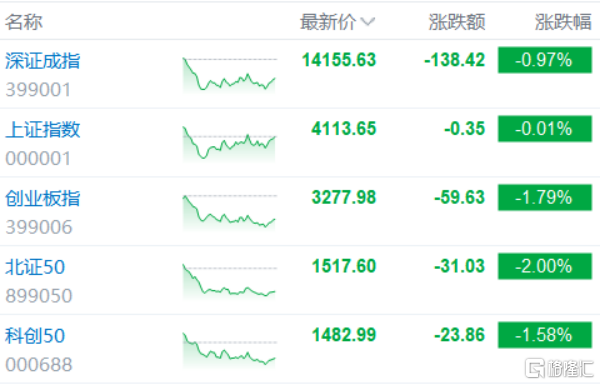
Market Overview - The A-share market experienced a collective decline on January 20, with the Shanghai Composite Index down 0.01% to 4113 points, the Shenzhen Component Index down 0.97%, and the ChiNext Index down 1.79% [1][2] - The total market turnover reached 2.8 trillion yuan, an increase of 72 billion yuan compared to the previous trading day, with over 3100 stocks declining [1] Sector Performance - The commercial aerospace and satellite internet sectors saw significant declines, with multiple stocks hitting the daily limit down, including Tongyu Communication and Sanwei Communication [4] - The photovoltaic equipment sector also fell, with Guosheng Technology hitting the limit down, and several other stocks following suit [6] - The military industry sector weakened, with Shenjian Co. and others hitting the limit down [8] - Conversely, the epoxy propylene and chemical raw materials sectors performed well, with China Chemical and Hongbaoli hitting the limit up [12] - The precious metals sector continued to rise, with Hunan Silver and Zhaojin Gold both hitting the limit up [10] Notable Stocks - Aerospace Macro's stock price dropped over 11%, while Tongyu Communication and Sanwei Communication fell by approximately 10% [6][4] - In the photovoltaic sector, leading companies are expected to report losses for the 2025 fiscal year, with a total estimated loss of 41.5 to 47 billion yuan [7] - The military sector saw significant drops, with Xice Testing down over 12% and other stocks following suit [9] Economic Indicators - The price of spot gold surpassed $4700 per ounce, marking a historical high, with an increase of 8.8% in January alone [11] - Global chemical giants like BASF and Dow have announced price increases across various regions, indicating a potential upward trend in chemical product prices [13] Future Outlook - The overall valuation of the A-share market remains within a reasonable range, with investor risk appetite still high. Factors such as macro policy support, medium to long-term capital inflows, and moderate corporate profit recovery are expected to sustain the bullish market trend [19]


稀土断供213吨重创日本;高市早苗接到死亡通知:血债必须清算!
Sou Hu Cai Jing· 2026-01-20 06:45
Core Viewpoint - Japan is facing a crisis due to its heavy reliance on Chinese rare earth exports, which have significantly decreased, threatening its advanced manufacturing sector and military capabilities [1][3][21]. Group 1: Economic Impact - China's rare earth exports to Japan dropped by 213 tons in December, leading to critical shortages for companies like Mitsubishi Heavy Industries, which now has only 15 days of alloy powder inventory left [1][5]. - Japan's dependency on Chinese rare earths exceeds 70%, with nearly 100% reliance in heavy rare earths, highlighting the vulnerability of its high-end manufacturing industry [3][21]. - The procurement cycle for neodymium-iron-boron magnets has extended from 1-2 months to 3-4 months, directly impacting the operational readiness of Japan's main fighter jets [11][29]. Group 2: Supply Chain and Regulatory Changes - The Chinese government has mandated that all companies exporting rare earths to Japan must provide detailed information about the entire supply chain, including potential resale to the U.S. [7][9]. - A "rare earth fingerprint" tracking system has been implemented, allowing China to monitor the flow of rare earths and impose severe penalties for any violations, which complicates procurement for Japanese firms [9][21]. Group 3: Geopolitical Tensions - China's maritime patrols near the Diaoyu Islands have intensified, with a recent 29-hour operation demonstrating a show of force against Japan [15][21]. - Japan's government is increasing its defense budget and engaging in military collaborations with the Philippines, indicating a strategic pivot in response to perceived threats from China [15][25]. - The diplomatic landscape is strained, with Japan's provocative statements regarding Taiwan and historical grievances exacerbating tensions with China [19][23][30]. Group 4: Historical Context and Future Outlook - China's recent statements emphasize the need for historical accountability regarding Japan's militaristic past, framing current tensions within a broader historical narrative [23][34]. - The economic repercussions for Japan are severe, with a potential GDP loss of 0.43% due to supply chain disruptions, further complicating its economic recovery [29][30]. - Japan's attempts to balance relations with the U.S. while confronting China may lead to further economic and diplomatic challenges, as it navigates a precarious geopolitical landscape [30][32].

关注军工ETF(512660)投资机会,军工板块长期趋势向好,回调或可布局
Mei Ri Jing Ji Xin Wen· 2026-01-20 06:14
Group 1 - The long-term trend of the military industry is positive, as highlighted by the 20th Central Committee's Fourth Plenary Session, which aims to achieve the centenary goal of building a strong military and to advance the modernization of national defense and the military [1] - The two major aerospace state-owned enterprises have set key tasks for the "14th Five-Year Plan" to establish a strong aerospace nation, focusing on defense industries, internationalization, and technological applications [1] - The military ETF (512660) tracks the CSI Military Industry Index (399967), which selects the top ten military groups and representative companies related to the military industry from the Shanghai and Shenzhen markets to reflect the overall performance of military-themed stocks [1] Group 2 - The index has a bias towards small and mid-cap stocks, with industry allocations primarily in aviation equipment and military electronics, covering fields such as aerospace, weaponry, and military electronics [1]
国泰海通晨报-20260120
GUOTAI HAITONG SECURITIES· 2026-01-20 05:47
Group 1: Company Overview - The report highlights that the company Lin Qingxuan has been deeply engaged in the oil-based skincare sector for many years, establishing itself as a pioneer in this field with significant growth potential driven by product expansion and channel development [1][2] - The main brand Lin Qingxuan, founded in 2003, initially focused on natural skincare products and later launched the Camellia Oil Essence in 2014, which has become a leading product in the oil-based skincare category [2][3] - The company has experienced remarkable growth, with revenue and net profit for the first half of 2025 reaching 1.05 billion and 180 million RMB, respectively, representing year-on-year increases of 98% and 110% [2] Group 2: Market Position and Growth Potential - The oil-based skincare market is expected to grow significantly, with a projected market size of 5.3 billion RMB in 2024, reflecting a year-on-year increase of 43% and a compound annual growth rate (CAGR) of 42% from 2019 to 2024 [2][3] - Lin Qingxuan holds a leading market share of 12.4% in the facial oil category, significantly ahead of other brands, thanks to its long-term market education and the popularity of its Camellia Oil Essence [2][3] Group 3: Sales Channels and Performance - The company's star product, the Camellia Oil Essence, has seen rapid sales growth, with revenue from this category increasing by 176% year-on-year in the first half of 2025, accounting for 46% of total revenue [3] - Online sales have surged, with a 137% year-on-year increase in online revenue, which now represents 65% of total sales, driven by the popularity of platforms like Douyin [3] - The company has expanded its offline presence, with over 554 stores as of the first half of 2025, indicating significant potential for further growth in physical retail [3]





*ST亚太2026年1月20日跌停分析
Xin Lang Cai Jing· 2026-01-20 05:29
Core Viewpoint - *ST Asia Pacific (sz000691) experienced a limit down on January 20, 2026, with a price of 9.05 yuan, a decline of 4.83%, and a total market capitalization of 4.398 billion yuan [1] Group 1: Company Financials and Risks - The company has a negative net asset value as of 2024, and if it does not turn a profit by 2025, it faces the risk of delisting [2] - A high percentage of shareholder pledges is evident, with a total pledge ratio of 79.22% among concerted actors, indicating significant financial pressure on shareholders [2] - The company has completed its restructuring plan, but there remains a risk of failure in executing this plan, which could lead to bankruptcy [2] Group 2: Business Transformation Challenges - The transition from traditional chemicals to electronic chemicals and military industries presents technical and management challenges, with uncertain outcomes for the transformation [2] - The company's involvement in fine chemicals and military sectors is subject to market sentiment, which can be influenced by various factors affecting the overall performance of these sectors [2] Group 3: Market Conditions and Stock Performance - A significant number of restricted shares, totaling 63.3596 million shares (13.07% of total shares), are set to be released on January 12, 2027, which may increase supply pressure on the stock price [2] - The stock price may face downward pressure due to multiple negative factors, especially if there is insufficient upward momentum in previous price movements [2]

午评:沪指跌0.3% 地产、银行等板块上扬 军工板块下挫
Zheng Quan Shi Bao Wang· 2026-01-20 04:49
Core Viewpoint - The A-share market is experiencing a downward trend, with major indices showing significant declines, influenced by various macroeconomic factors and sector performance [1]. Market Performance - As of the midday close, the Shanghai Composite Index fell by 0.3% to 4101.62 points, the Shenzhen Component Index dropped by 1.22%, and the ChiNext Index decreased by 1.83% [1]. - Approximately 3400 stocks in the A-share market were in the red, with total trading volume across the Shanghai, Shenzhen, and North exchanges reaching about 1.87 trillion yuan [1]. Sector Analysis - Sectors such as military, non-ferrous metals, and steel are experiencing declines, while real estate, insurance, banking, and semiconductors are showing upward movement [1]. - Active concepts include phosphate-related stocks and the "China Special Valuation" theme [1]. Market Sentiment and Future Outlook - According to Zhongyin Securities, the "spring fever" market is facing short-term pressure due to a complex overseas macro environment, increased uncertainty in the Federal Reserve's monetary policy, and domestic regulatory efforts to stabilize the market [1]. - The risk appetite is not the only factor influencing pricing themes; sector catalysts and positioning are also crucial. The likelihood of "one sector rising while another falls" is greater than "synchronous declines" in the current market context [1]. - Recent changes in trading volume proportions among the top ten concept sectors indicate an increase in semiconductor, photovoltaic, and robotics sectors, with high potential for AI application catalysts in the future [1]. - The short-term adjustment is attributed to previous overvaluations and emotional impacts from event disturbances, but the underlying logic of the AI application trend remains intact, suggesting that the market may continue to perform well [1].
ETF盘中资讯|军工急跌,什么情况? 512810盘中下探3.85%!商业航天热门股齐挫,中国卫星跌超5%
Sou Hu Cai Jing· 2026-01-20 03:06
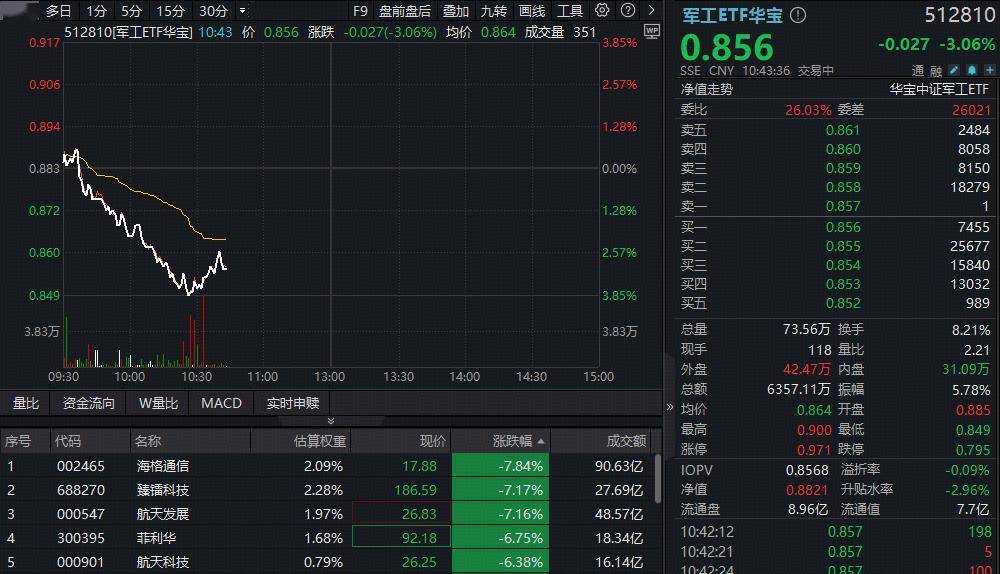
Core Viewpoint - The military industry sector experienced a decline in early trading on January 20, with the military ETF Huabao (512810) dropping by 3.85%, and several commercial aerospace stocks falling over 7% [1][3]. Market Performance - The A-share market saw a shift in market sentiment, with all three major indices declining, indicating a rapid change in risk appetite among investors [1]. - As of January 19, the financing balance in the A-share market was reported at 2.7059 trillion yuan, a decrease of 8.5 billion yuan, marking the first decline since December 31 of the previous year [3]. Industry Analysis - The military sector is characterized by high volatility and is significantly influenced by short-term sentiment, although the fundamental outlook remains positive [4]. - According to Fangzheng Securities, the military industry is expected to enter a new upward cycle driven by domestic demand and foreign trade, with ongoing orders anticipated due to the transition to mass production of new models [4]. - The military trade market in China is evolving from a focus on cost-effectiveness to becoming a technology benchmark and a rule-maker in the global arms race, presenting historical opportunities for growth [4]. Investment Opportunities - The military industry is expected to enter a long-term prosperous phase, with traditional military sectors showing advantages in positioning, event catalysts, and improving fundamentals [4]. - The Huabao military ETF (512810) covers various hot themes such as commercial aerospace, low-altitude economy, large aircraft, satellite navigation, military informationization, and controllable nuclear fusion, serving as an efficient tool for investing in core military assets [4][6].


军工急跌,什么情况? 512810盘中下探3.85%!商业航天热门股齐挫,中国卫星跌超5%
Xin Lang Ji Jin· 2026-01-20 02:55
Core Viewpoint - The military industry sector experienced a decline in early trading on January 20, with significant drops in key stocks related to commercial aerospace and military technology, indicating a rapid shift in market sentiment and risk preference [1][3]. Market Performance - The military ETF Huabao (512810) saw a drop of 3.85% during intraday trading, reflecting a broader trend where major indices in the A-share market fell simultaneously [1][2]. - Key stocks such as Aerospace Development, Aerospace Science and Technology, China Satellite, and Haige Communication experienced declines exceeding 7% [1]. Financing Trends - As of January 19, the financing balance in the A-share market was reported at 27,059 billion CNY, a decrease of 8.5 billion CNY, marking the first decline since December 31 of the previous year [3]. - The military sector, characterized by high volatility, was among the areas where financing clients reduced their holdings, alongside electronics and communications [3]. Industry Outlook - Despite short-term fluctuations, the fundamental outlook for the military industry remains positive, with expectations of entering a new growth cycle driven by domestic demand and foreign trade [3]. - The military industry is anticipated to benefit from a combination of traditional military advantages, event-driven catalysts, and improving fundamentals, presenting a significant investment opportunity [3]. Investment Tools - The military ETF Huabao (512810) provides exposure to various themes such as commercial aerospace, low-altitude economy, large aircraft, satellite navigation, military information technology, and controllable nuclear fusion, serving as an efficient tool for investing in core military assets [4].
中信证券:当前建议关注宽基产品中的创业板50、创业板指、双创50、中证1000等ETF
Jin Rong Jie· 2026-01-20 00:40
Core Insights - The ETF market has recently experienced record outflows, with broad-based ETFs seeing over 200 billion yuan in outflows in a single week, while sector and thematic ETFs in technology and cyclical sectors continue to attract inflows [1] Group 1: Market Trends - The outflow of funds from broad-based ETFs indicates a significant market adjustment, which may help temper market sentiment and promote rationality in capital markets [1] - Small-cap stocks have been less impacted by the outflows, while sectors such as banking, food and beverage, coal, and non-bank financials have faced greater challenges [1] Group 2: Investment Recommendations - The report suggests focusing on broad-based products like the ChiNext 50, ChiNext Index, Double Innovation 50, and CSI 1000 ETFs, as well as thematic products in new energy, non-ferrous metals, agriculture, pharmaceuticals, and medical devices [1]

贵金属依然“金贵”
Yang Zi Wan Bao Wang· 2026-01-19 23:20
Market Performance - Fenglong Co., Ltd. achieved a 14-day consecutive rise, while Xinhua Department Store and Sanbian Technology recorded 4 and 5 days of consecutive increases respectively [1] - The Shanghai Composite Index showed strong performance, with a total trading volume of 2.71 trillion yuan, a decrease of 317.9 billion yuan compared to the previous trading day [1] - Over 3,500 stocks in the market experienced an increase, with sectors such as power grid equipment, military industry, robotics, and precious metals leading the gains [1] Precious Metals Sector - International precious metal prices reached historical highs, with spot gold exceeding $4,690 and spot silver surpassing $94 per ounce [1] - The precious metals sector performed exceptionally well, with Sichuan Gold hitting the daily limit, and both Shanjin International and Xiaocheng Technology rising over 5%, achieving historical highs [1] Company Announcements - Yidian Tianxia announced the end of its suspension for stock trading, set to resume on January 20, 2026, after a self-examination regarding significant stock price fluctuations [2] - Chengdu Huamei projected a net profit increase of 74% to 109% for 2025, with Q4 net profit expected to grow by 458% to 614% due to increased demand in the special integrated circuit industry [2] - Dingtong Technology forecasted a 120% increase in net profit for 2025, driven by significant growth in its high-speed communication products due to strong market demand [3]