
基金

Search documents
一周快讯丨200亿,澳门将设引导基金;100亿,长三角数智文化产业基金正式成立;510亿,央企战新产业发展基金招GP
FOFWEEKLY· 2026-03-01 07:20
Group 1 - The article highlights the establishment of various funds across regions such as Jiangsu, Anhui, and Sichuan, focusing on sectors like artificial intelligence, new materials, high-end manufacturing, and health care [2][3] - The Macau government announced the creation of a government-guided fund with an expected scale of 20 billion Macau dollars, with a government investment of 11 billion [5] - The Jiangsu New Energy (Guoxin) Industry Special Fund has been launched with a total scale of 5 billion yuan, targeting investment in wind energy, hydrogen energy, and new energy storage [21] Group 2 - The Central State-Owned Enterprises Strategic Emerging Industry Development Fund is seeking GP for its sub-funds, emphasizing investment in strategic emerging industries and future industries [6] - Leshan Science and Technology Innovation Group plans to establish a 10 billion yuan mother fund to support advanced manufacturing and new energy sectors [7] - The Nantong Industrial Chain Development Fund has a total scale of 5 billion yuan, focusing on key industrial clusters and strategic emerging industries [11] Group 3 - The Long Triangle Digital Cultural Industry Fund has been established with a total scale of 10 billion yuan, focusing on AI and digital cultural technology [19] - The Tianjin Binhai New Energy Storage Equity Investment Fund has been established with a capital of 2 billion yuan, focusing on private equity investment and asset management [25] - The Zhejiang University Qizhen Future Fund has been established with a scale of 1.5 billion yuan, targeting strategic emerging industries such as integrated circuits and high-end intelligent manufacturing [33]


每日钉一下(机构卖出指数基金,这意味着什么呢?)
银行螺丝钉· 2026-02-28 13:52
Group 1 - The article discusses the recent trend of institutional investors selling index funds, indicating a potential shift in market sentiment as the A-share market reached a peak of around 3 stars in early 2026, with significant net outflows from major ETFs like the CSI 300 ETF, which saw a net outflow of approximately 20 billion on a single day, the largest since 2012 [6][7]. - The total scale of ETFs in China has grown rapidly from less than 1 trillion to 5-6 trillion by early 2026, with institutional investors being the primary drivers of this growth, including entities like the National Team, insurance companies, and pension funds [7][8]. - The National Team typically buys during market downturns and holds their positions until the market reaches a higher valuation, at which point they begin to take profits, as seen in their trading patterns from 2024 to early 2026 [8][9]. Group 2 - The article outlines a strategy of "buy low, sell high" employed by institutional investors, where they increase their stock asset allocation during market lows and reduce it as valuations rise, reflecting a disciplined approach to asset management [8][9]. - The company has adopted a similar investment strategy, pausing active selection and index enhancement when the market reached 3 stars in January 2026, while also adjusting their portfolio to take profits on overvalued small-cap and growth stocks and increasing positions in undervalued value stocks [10].

公募REITs周度跟踪(2026.02.23-2026.02.27):6单商业不动产REITs进入问询-20260228
Shenwan Hongyuan Securities· 2026-02-28 11:05
1. Report Industry Investment Rating - Not provided in the given content 2. Core View of the Report - The report is a weekly tracking of public REITs from February 23 - 27, 2026. It covers the progress of new REITs in the primary market, the performance of REITs in the secondary market, and important news and announcements of the week. The primary market has 10 new first - issue public REITs making progress, and the secondary market shows that the CSI REITs Total Return Index closed down this week. [3] 3. Summary According to the Directory 3.1 Primary Market: 10 First - issue Public REITs Made New Progress - As of February 27, 2026, 20 REITs have been successfully issued since 2025, with a total issuance scale of 40.3 billion yuan. This week, 10 first - issue public REITs made new progress, including 2 new commercial real - estate REITs and 2 new infrastructure REITs. Six commercial real - estate REITs from the first batch of applications have entered the exchange inquiry stage. One expansion - offering REIT, CICC Xiamen Anju REIT, has received feedback. [3] - The table shows details of 23 first - issue REITs, including their project types, application types, project statuses, update dates, and application dates. [14] 3.2 Secondary Market: The Index Closed Down This Week 3.2.1 Market Review: The CSI REITs Total Return Index Fell by 1.08% - This week, the CSI REITs Total Return Index (932047.CSI) closed at 1035.78 points, a decline of 1.08%, underperforming the CSI 300 by 2.16 percentage points and the CSI Dividend by 3.88 percentage points. The year - to - date increase of the CSI REITs Total Return Index is 2.57%, outperforming the CSI 300 by 0.83 percentage points but underperforming the CSI Dividend by 3.29 percentage points. By project attribute, equity - type REITs fell by 1.45% and franchise - type REITs fell by 0.07%. By asset type, the data center (+2.02%), transportation (+0.11%), warehousing and logistics (-0.51%), and energy (-0.83%) sectors performed well. Among individual bonds, 17 rose and 62 fell this week. [3] 3.2.2 Liquidity: The Turnover Rate and Trading Volume of Equity - type REITs Increased - The average daily turnover rates of equity - type/franchise - type REITs this week were 0.38%/0.28%, an increase/decrease of 3.87/-3.22 BP compared to last week. The trading volumes during the week were 325 million/74 million shares, a week - on - week increase/decrease of 5.55%/-15.99%. The data center sector was the most active. [3] 3.2.3 Valuation: The Valuation of the Affordable Housing Sector is Relatively High - From the perspective of ChinaBond valuation yields, the yields of equity - type/franchise - type REITs are 3.85%/4.82% respectively. The transportation (5.85%), warehousing and logistics (5.41%), and park (4.66%) sectors rank among the top three. [3] 3.3 This Week's Important News and Announcements 3.3.1 Important News - On February 24, 2026, the winning bid for Hubei Cultural Tourism Group's public REITs project was announced. The candidate financial advisor is Guotai Junan Securities, with a bid of 5 million yuan, and the candidate public fund manager and plan manager is AVIC Fund Management Co., Ltd., with a fee rate of 0.2%. - On February 25, 2026, the Suzhou government's work report pointed out that it will seize the opportunity of the expansion of infrastructure REITs and promote the listing of a number of high - quality projects such as industrial parks, commercial office facilities, and clean energy. - On February 25, 2026, Hong Kong's Financial Secretary Paul Chan Mo - po announced in the 2026 - 2027 government budget that the government and the Hong Kong Securities and Futures Commission will strive to include REITs in the inter - connectivity mechanism as soon as possible and plan to submit a bill for amendment this year to facilitate the privatization or restructuring of REITs. [32] 3.3.2 Important Announcements - There are multiple announcements, including the lifting of the lock - up period for strategic placement shares of several REITs and the release of operation data for some REITs in January 2026, such as daily toll - paying traffic volume and toll revenue. [33][35]
从理念到实践的全面拆解:十年绩优基金经理王鹏投资深度解析
Huafu Securities· 2026-02-28 10:15
Group 1 - The core investment philosophy of the fund manager emphasizes "independent thinking, probabilistic thinking, contrarian courage, and forward-looking vision," focusing on balanced allocation and risk control through a multi-faceted stock selection framework of "cigar butt stocks (static undervaluation) + quality stocks (steady growth) + technology stocks (forward-looking layout)" [2][14][15] - The representative product, Guotou Ruijin New Silk Road Fund, has achieved a total return of 148.37% and an annualized return of 8.93% since its inception, significantly outperforming the average of its peers and ranking in the top 15.95% of its category [3][29][30] - The fund's performance over various time frames shows returns of 24.86% over the past year, 12.82% over three years, 24.66% over five years, and 109.60% over ten years, all substantially exceeding the performance benchmark [4][29] Group 2 - The fund maintains a high equity position, consistently above 90%, focusing on stock selection rather than market timing, which reflects its core investment philosophy of emphasizing industry allocation and individual stock selection [37][38] - The industry allocation strategy is characterized by balanced diversification, with the largest sector allocation typically remaining below 25%, thus effectively controlling risks associated with overexposure to any single sector [38][41] - The fund's stock selection is diverse, focusing on long-term value, with a rigorous selection standard that prioritizes long-term factors over short-term market trends [53][54] Group 3 - The fund has demonstrated a low turnover rate, maintaining it below 100% since 2022, which indicates a stable investment style and effective cost management [66][67] - The fund has provided consistent dividends, with a total of 9 distributions amounting to 110 million yuan, exceeding 1.4 times the current fund net value, showcasing its commitment to returning profits to investors [5][72] - The investment management company, Guotou Ruijin, emphasizes value investing and fundamental research, aiming to create long-term stable returns for investors [80][81]
证监会召开资本市场“十五五”规划外资机构座谈会
证监会发布· 2026-02-28 09:52
Core Viewpoint - The article emphasizes the positive developments in China's capital market since the implementation of the new "National Nine Articles," highlighting increased foreign participation and confidence in the long-term growth of the Chinese economy and capital market [2][3]. Group 1: Capital Market Developments - The new "National Nine Articles" have led to improvements in foundational systems, market functions, and the investment value of listed companies, as well as an expansion of high-level openness [2]. - Foreign institutions have shown a significant increase in willingness and enthusiasm to participate in China's capital market [2]. Group 2: Suggestions for the 14th Five-Year Plan - Suggestions include enhancing the adaptability and coverage of capital market services for the real economy, improving policy continuity and predictability, and increasing the investment value of listed companies while strengthening investor protection and corporate governance [2]. - There is a call to improve cross-border investment and financing facilitation, aligning with international standards and regulatory rules [2]. - The need for a dual approach of "bringing in" and "going out" for industry institutions is emphasized, supporting differentiated and specialized development of foreign institutions and enhancing local institutions' global resource allocation capabilities [2]. Group 3: Regulatory Focus - The China Securities Regulatory Commission (CSRC) aims to implement the directives from the 20th Central Committee and the upcoming National "Two Sessions," focusing on high-quality development in the capital market over the next five years [3]. - The CSRC emphasizes a market-oriented, legal, and international approach, using the Sci-Tech Innovation Board and the Growth Enterprise Market as key reform tools [3]. - There is a commitment to creating a transparent, stable, and predictable market environment while encouraging foreign institutions to leverage their global resource allocation and expertise for the development of China's capital market [4].

ETF 周报:上周光伏、军工 ETF 领涨,中证 1000ETF 净赎回居首-20260228
Guoxin Securities· 2026-02-28 08:31
Report Industry Investment Rating - Not provided in the content Core Viewpoints - Last week (from February 24 to February 27, 2026), the median weekly return of equity ETFs was 1.54%. Among broad-based ETFs, the median return of CSI 1000 ETF was 4.30%, the highest. By sector, the median return of cyclical ETFs was 4.14%, the highest. By theme, the median return of photovoltaic ETFs was 3.89%, the highest [1][12]. - Last week, equity ETFs had a net redemption of 36.867 billion yuan, but the overall scale increased by 23.01 billion yuan. Among broad-based ETFs, SSE 50 ETF had the least net redemption, at 467 million yuan. By sector, the large financial ETF had the most net subscriptions, at 2.057 billion yuan. By hot theme, the securities ETF had the most net subscriptions, at 2.261 billion yuan [2]. - As of last Friday, the valuation quantiles of ChiNext - related ETFs among broad - based ETFs were relatively low; by sector, the valuation quantiles of consumer and large financial ETFs were relatively moderate; by sub - theme, the valuation quantiles of liquor and new energy vehicle ETFs were relatively low [3]. - From Monday to Thursday last week, the margin trading balance of equity ETFs increased from 48.205 billion yuan in the previous week to 48.997 billion yuan, and the short - selling volume increased from 2.23 billion shares in the previous week to 2.3 billion shares. Among the top 10 ETFs in terms of average daily margin trading volume and short - selling volume, securities ETFs and STAR Market ETFs had relatively high average daily margin trading volumes, and CSI 1000 ETFs and SSE 500 ETFs had relatively high average daily short - selling volumes [4]. - As of last Friday, Huaxia, E Fund, and Huatai - Peregrine ranked the top three in terms of the total scale of listed, non - monetary ETFs. This week, 8 ETFs will be issued, including ICBC CSI Hong Kong Stock Connect Internet ETF, Great Wall China Securities Free Cash Flow ETF, etc. [5] Summary by Directory ETF Performance - Last week, the median weekly return of equity ETFs was 1.54%. Among broad - based ETFs, the median returns of CSI 1000, CSI 500, STAR Market, A500, SSE 500, ChiNext - related, and SSE 50 ETFs were 4.30%, 4.29%, 2.18%, 2.11%, 1.06%, 1.04%, and 0.16% respectively. The median returns of commodity, monetary, bond, and cross - border ETFs were 3.06%, 0.04%, 0.02%, and - 1.52% respectively [12]. - By sector, the median returns of cyclical, technology, consumer, and large financial sector ETFs among equity ETFs last week were 4.14%, 1.43%, - 0.29%, and - 0.97% respectively [18]. - By hot theme, the median returns of photovoltaic, military, and dividend ETFs among equity ETFs last week were 3.89%, 3.12%, and 2.76% respectively, showing relatively strong performance; the median returns of liquor, bank, and securities ETFs were - 1.98%, - 0.99%, and - 0.42% respectively, showing relatively weak performance [18]. ETF Scale Change and Net Subscription/Redeem - As of last Friday, the scales of equity, cross - border, and bond ETFs were 3.1167 trillion yuan, 1.0232 trillion yuan, and 734.6 billion yuan respectively. The scales of commodity and monetary ETFs were relatively small, at 344.5 billion yuan and 163.9 billion yuan respectively [20]. - Among broad - based ETFs, the scales of SSE 500 and A500 ETFs were relatively large, at 589 billion yuan and 258.3 billion yuan respectively. The scales of STAR Market, CSI 500, ChiNext - related, SSE 50, and CSI 1000 ETFs were relatively small, at 191.6 billion yuan, 139.1 billion yuan, 127.7 billion yuan, 81 billion yuan, and 54.2 billion yuan respectively [20]. - By sector, as of last Friday, the scale of the technology sector ETF was 555.5 billion yuan, and the scale of the cyclical sector ETF was 366.8 billion yuan. The scales of large financial and consumer ETFs were relatively small, at 199.8 billion yuan and 198.9 billion yuan respectively [26]. - By hot theme, as of last Friday, the scales of chip, securities, and pharmaceutical ETFs were the highest, at 198.9 billion yuan, 141.5 billion yuan, and 114.4 billion yuan respectively [26]. - Last week, equity ETFs had a net redemption of 36.867 billion yuan, and the overall scale increased by 23.01 billion yuan; monetary ETFs had a net subscription of 305.1 million yuan, and the overall scale increased by 306.4 million yuan. Among broad - based ETFs, SSE 50 ETF had the least net redemption, at 467 million yuan, and its scale decreased by 337 million yuan; CSI 1000 ETF had the most net redemptions, at 8.124 billion yuan, and its scale decreased by 5.656 billion yuan [27]. - By sector, last week, the large financial ETF had the most net subscriptions, at 2.057 billion yuan, and its scale increased by 711 million yuan; the technology ETF had the most net redemptions, at 5.107 billion yuan, and its scale increased by 2.737 billion yuan. By hot theme, last week, the securities ETF had the most net subscriptions, at 2.261 billion yuan, and its scale increased by 1.646 billion yuan; the dividend ETF had the most net redemptions, at 2.391 billion yuan, and its scale decreased by 99.9 million yuan [31] ETF Benchmark Index Valuation - As of last Friday, the price - to - earnings ratios of SSE 50, SSE 500, CSI 500, CSI 1000, ChiNext - related, and A500 ETFs were at the 80.35%, 86.21%, 99.83%, 100.00%, 71.10%, and 97.32% quantiles respectively, and the price - to - book ratios were at the 54.91%, 73.58%, 100.00%, 86.54%, 68.70%, and 97.81% quantiles respectively. Since December 31, 2019, the current price - to - earnings ratio and price - to - book ratio of STAR Market - related ETFs are at the 77.70% and 80.68% quantiles respectively [34][36]. - As of last Friday, the price - to - earnings ratios of cyclical, large financial, consumer, and technology sector ETFs were at the 93.39%, 22.46%, 21.06%, and 96.70% quantiles respectively, and their price - to - book ratios were at the 92.24%, 31.87%, 31.30%, and 93.97% quantiles respectively [40]. - As of last Friday, the price - to - earnings ratio quantiles of military, photovoltaic, and chip ETFs were relatively high, at 99.50%, 97.27%, and 96.78% respectively; the price - to - book ratio quantiles of AI, robot, and dividend ETFs were relatively high, at 98.68%, 96.12%, and 93.48% respectively [43]. ETF Margin Trading and Short - Selling - Overall, the margin trading balance and short - selling volume of equity ETFs have both increased in the past year. As of last Thursday, the margin trading balance of equity ETFs increased from 48.205 billion yuan in the previous week to 48.997 billion yuan, and the short - selling volume increased from 2.23 billion shares in the previous week to 2.3 billion shares [47]. - Among the top 10 equity ETFs in terms of average daily margin trading volume from Monday to Thursday last week, securities ETFs and STAR Market ETFs had relatively high average daily margin trading volumes. Among the top 10 equity ETFs in terms of average daily short - selling volume, CSI 1000 ETFs and SSE 500 ETFs had relatively high average daily short - selling volumes [50][52]. ETF Managers - As of last Friday, Huaxia Fund ranked first in the total scale of listed non - monetary ETFs and had a relatively high management scale in multiple sub - fields such as scale - index ETFs, theme, style, and strategy - index ETFs, and cross - border ETFs. E Fund ranked second, with a relatively high management scale in scale - index ETFs and cross - border ETFs. Huatai - Peregrine Fund ranked third, with a relatively high management scale in scale - index ETFs and theme, style, and strategy - index ETFs [56]. - Last week, 1 new ETF was established, namely E Fund CSI Battery Theme ETF. This week, 8 ETFs will be issued, including ICBC CSI Hong Kong Stock Connect Internet ETF, Great Wall China Securities Free Cash Flow ETF, etc. [59]
ETF周报:上周光伏、军工ETF领涨,中证1000ETF净赎回居首-20260228
Guoxin Securities· 2026-02-28 08:28
1. Report Industry Investment Rating There is no information about the report industry investment rating in the provided content. 2. Core Viewpoints of the Report - Last week (from February 24 to February 27, 2026), the median weekly return of equity ETFs was 1.54%. Among broad - based ETFs, the median return of CSI 1000 ETF was 4.30%, the highest. By sector, the median return of cyclical ETFs was 4.14%, the highest. By theme, the median return of photovoltaic ETFs was 3.89%, the highest [1][12][18]. - Last week, equity ETFs had a net redemption of 36.867 billion yuan, but the overall scale increased by 23.01 billion yuan. Among broad - based ETFs, SSE 50 ETF had the least net redemption of 467 million yuan; by sector, the large - financial ETF had the most net subscription of 2.057 billion yuan; by hot theme, the securities ETF had the most net subscription of 2.261 billion yuan [2][27][31]. - As of last Friday, the valuation quantiles of ChiNext - related ETFs among broad - based ETFs were relatively low; by sector, the valuation quantiles of consumer and large - financial ETFs were relatively moderate; by sub - theme, the valuation quantiles of liquor and new energy vehicle ETFs were relatively low [3][46]. - From last Monday to Thursday, the margin trading balance of equity ETFs increased from 48.205 billion yuan in the previous week to 48.997 billion yuan, and the short - selling volume increased from 2.23 billion shares in the previous week to 2.3 billion shares. Among the top 10 ETFs with the highest average daily margin trading purchases and short - selling volumes, securities ETFs and STAR Market ETFs had relatively high average daily margin trading purchases, while CSI 1000 ETFs and SSE 500 ETFs had relatively high average daily short - selling volumes [4][50][52]. - As of last Friday, Huaxia, E Fund, and Huatai - Peregrine ranked in the top three in terms of the total scale of listed non - monetary ETFs. This week, 8 ETFs will be issued, including ICBC CSI Hong Kong - Stock Connect Internet ETF, Great Wall China Securities Free Cash Flow ETF, etc. [5][59] 3. Summary by Relevant Catalogs ETF Performance - The median weekly return of equity ETFs last week was 1.54%. The median returns of CSI 1000, CSI 500, STAR Market, A500, SSE 500, ChiNext - related, and SSE 50 ETFs were 4.30%, 4.29%, 2.18%, 2.11%, 1.06%, 1.04%, and 0.16% respectively. The median returns of commodity, monetary, bond, and cross - border ETFs were 3.06%, 0.04%, 0.02%, and - 1.52% respectively [12]. - By sector, the median returns of cyclical, technology, consumer, and large - financial sector ETFs among equity ETFs last week were 4.14%, 1.43%, - 0.29%, and - 0.97% respectively. By hot theme, the median returns of photovoltaic, military, and dividend ETFs were 3.89%, 3.12%, and 2.76% respectively, showing relatively strong performance; the median returns of liquor, bank, and securities ETFs were - 1.98%, - 0.99%, and - 0.42% respectively, showing relatively weak performance [18]. ETF Scale Changes and Net Subscriptions/Redeemptions - As of last Friday, the scales of equity, cross - border, and bond ETFs were 3.1167 trillion yuan, 1.0232 trillion yuan, and 734.6 billion yuan respectively. The scales of commodity and monetary ETFs were relatively small, at 344.5 billion yuan and 163.9 billion yuan respectively. Among broad - based ETFs, the scales of SSE 500 and A500 ETFs were relatively large, at 589 billion yuan and 258.3 billion yuan respectively [20]. - By sector, as of last Friday, the scale of technology sector ETFs was 555.5 billion yuan, followed by cyclical sector ETFs with a scale of 366.8 billion yuan. The scales of large - financial and consumer ETFs were relatively small, at 199.8 billion yuan and 198.9 billion yuan respectively. By hot theme, as of last Friday, the scales of chip, securities, and pharmaceutical ETFs were the highest, at 198.9 billion yuan, 141.5 billion yuan, and 114.4 billion yuan respectively [26]. - Last week, equity ETFs had a net redemption of 36.867 billion yuan and the overall scale increased by 23.01 billion yuan; monetary ETFs had a net subscription of 3.051 billion yuan and the overall scale increased by 3.064 billion yuan. Among broad - based ETFs, SSE 50 ETF had the least net redemption of 467 million yuan, and its scale decreased by 337 million yuan; CSI 1000 ETF had the most net redemption of 8.124 billion yuan, and its scale decreased by 5.656 billion yuan [27]. - By sector, last week, the large - financial ETF had the most net subscription of 2.057 billion yuan, and its scale increased by 711 million yuan; the technology ETF had the most net redemption of 5.107 billion yuan, and its scale increased by 2.737 billion yuan. By hot theme, last week, the securities ETF had the most net subscription of 2.261 billion yuan, and its scale increased by 1.646 billion yuan; the dividend ETF had the most net redemption of 2.391 billion yuan, and its scale decreased by 999 million yuan [31]. ETF Benchmark Index Valuation - As of last Friday, the price - to - earnings ratios of SSE 50, SSE 500, CSI 500, CSI 1000, ChiNext - related, and A500 ETFs were at the 80.35%, 86.21%, 99.83%, 100.00%, 71.10%, and 97.32% quantiles respectively, and the price - to - book ratios were at the 54.91%, 73.58%, 100.00%, 86.54%, 68.70%, and 97.81% quantiles respectively. Since December 31, 2019, the current price - to - earnings and price - to - book ratios of STAR Market - related ETFs are at the 77.70% and 80.68% quantiles respectively [34][36]. - As of last Friday, the price - to - earnings ratios of cyclical, large - financial, consumer, and technology sector ETFs were at the 93.39%, 22.46%, 21.06%, and 96.70% quantiles respectively, and their price - to - book ratios were at the 92.24%, 31.87%, 31.30%, and 93.97% quantiles respectively [40]. - As of last Friday, the price - to - earnings quantiles of military, photovoltaic, and chip ETFs were relatively high, at 99.50%, 97.27%, and 96.78% respectively; the price - to - book quantiles of AI, robot, and dividend ETFs were relatively high, at 98.68%, 96.12%, and 93.48% respectively [43]. ETF Margin Trading - Overall, the margin trading balance and short - selling volume of equity ETFs have both increased in the past year. As of last Thursday, the margin trading balance of equity ETFs increased from 48.205 billion yuan in the previous week to 48.997 billion yuan, and the short - selling volume increased from 2.23 billion shares in the previous week to 2.3 billion shares [47]. - Among the top 10 equity ETFs with the highest average daily margin trading purchases from last Monday to Thursday, securities ETFs and STAR Market ETFs had relatively high average daily margin trading purchases. Among the top 10 equity ETFs with the highest average daily short - selling volumes, CSI 1000 ETFs and SSE 500 ETFs had relatively high average daily short - selling volumes [50][52]. ETF Managers - As of last Friday, Huaxia Fund ranked first in the total scale of listed non - monetary ETFs, and had a relatively high management scale in multiple sub - fields such as scale - index ETFs, theme, style, and strategy - index ETFs, and cross - border ETFs; E Fund ranked second, and had a relatively high management scale in scale - index ETFs and cross - border ETFs; Huatai - Peregrine Fund ranked third, and had a relatively high management scale in scale - index ETFs and theme, style, and strategy - index ETFs [56]. - Last week, 1 new ETF was established, which was E Fund CSI Battery Theme ETF. This week, 8 ETFs will be issued, including ICBC CSI Hong Kong - Stock Connect Internet ETF, Great Wall China Securities Free Cash Flow ETF, etc. [59]
广州时隔27年重启赛马业,英伟达第四财季营收暴增 | 财经日日评
吴晓波频道· 2026-02-28 08:08
Group 1 - Guangzhou is planning to establish a 10 square kilometer deep cooperation zone for the horse industry, aiming to tap into the high-end consumption market potential of the Guangdong-Hong Kong-Macao Greater Bay Area, which is valued at hundreds of billions [2][3] - The upcoming horse racing event at the Hong Kong Jockey Club's Conghua Racecourse in October is positioned as a non-betting demonstration event, focusing on horse breeding, cultural tourism, and exhibition economy to drive profitability [2][3] - The revival of horse racing in Guangzhou is expected to create new job opportunities and enhance local employment [2] Group 2 - The revised CPA law aims to strengthen oversight and increase accountability in the auditing profession, addressing issues of audit fraud and enhancing the regulatory framework [4][5] - The draft includes 22 articles that impose stricter prohibitions on CPAs, including the issuance of false reports and failure to maintain professional skepticism [4] - The changes are anticipated to bolster the credibility of financial disclosures, which is crucial for maintaining investor confidence in the capital market [5] Group 3 - Moody's report indicates that the five major data center operators in the U.S. have made future leasing commitments totaling $662 billion, which is 113% of their adjusted debt [6][7] - By the end of 2025, the total undiscounted future leasing commitments of these companies could reach $969 billion, potentially impacting their balance sheets significantly [6][7] - The hidden debt structure poses risks, as it could lead to broader repercussions if the financial health of these companies deteriorates [7] Group 4 - NVIDIA reported a 73% year-over-year revenue growth in Q4 of fiscal 2026, reaching $68.127 billion, surpassing its guidance [8] - The data center business generated $62.314 billion in revenue, reflecting a 75% increase, while the gaming segment grew by 47% [8] - The upcoming launch of the next-generation Rubin chip in 2026 is expected to further solidify NVIDIA's leading position in the AI chip market [8] Group 5 - Ctrip's Q4 net revenue reached approximately 15.398 billion yuan, a year-on-year increase of about 20.83%, with a net profit growth of approximately 98.47% [10][11] - The company is facing challenges due to an antitrust investigation, which may impact its future performance despite strong growth driven by the recovery of the inbound tourism market [10][11] - The departure of co-founders from key positions may signal a restructuring effort amid ongoing regulatory scrutiny [11] Group 6 - CK Hutchison Holdings announced the sale of its UK Power Networks business for over HKD 110 billion, aiming to reinvest the proceeds into future opportunities [12][13] - The sale reflects a strategic shift as the company seeks to optimize its investment portfolio in light of stricter price controls in the UK public utility sector [12][13] - The group is also preparing to split its global telecom assets and focus on core retail business listings, indicating a potential pivot towards technology and energy transition investments [13] Group 7 - A trend of lowering management fees for money market funds has emerged, with several funds reducing rates significantly to maintain positive yields for investors [14][15] - Despite declining yields, the overall scale of money market funds continues to grow, with a net increase of 1.43 trillion yuan in 2025 [14][15] - Investors are increasingly turning to money market funds as a low-risk transitional option amid falling deposit rates [15] Group 8 - The stock market experienced mixed performance, with the Shanghai Composite Index closing at 4146.63 points, down 0.01%, while the Shenzhen Component Index rose by 0.19% [16][17] - Market volatility continues, with significant fluctuations in various sectors, particularly in computing hardware and energy [16][17] - The film industry has faced challenges, contributing to declines in related stocks, while real estate showed limited recovery [17]


官宣:顾勇履新,又一基金总经理变更
Zhong Guo Ji Jin Bao· 2026-02-28 04:24
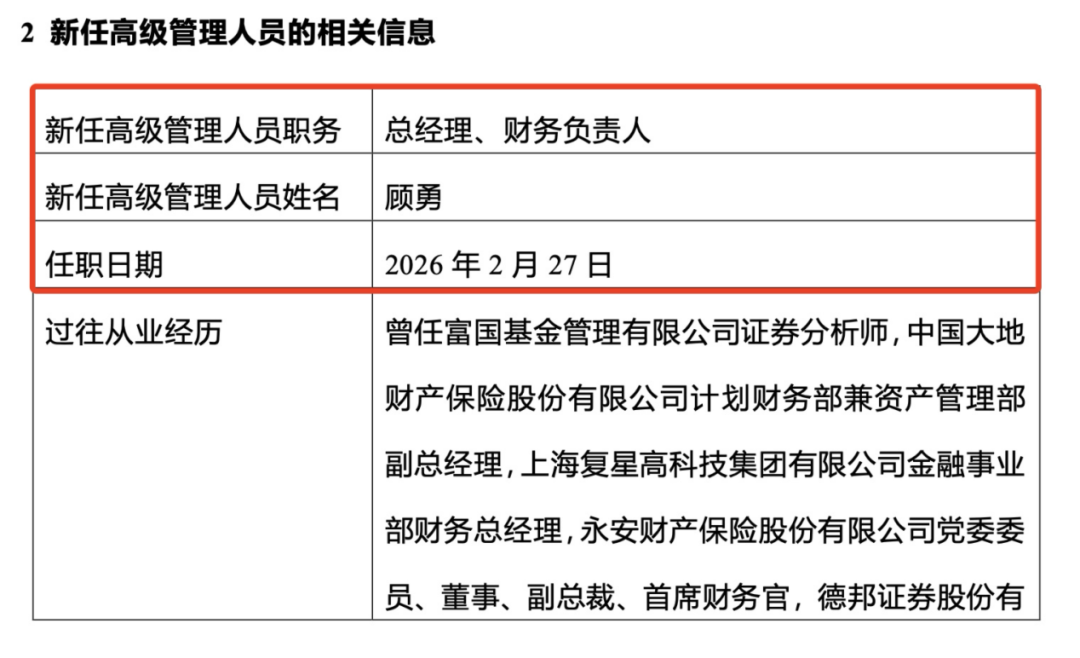
Group 1 - The core point of the article is the announcement of a leadership change at Dongcai Fund, with Gu Yong being appointed as the new General Manager, succeeding Sha Fugui who stepped down due to work arrangements [1][2][4]. - Dongcai Fund was established on October 26, 2018, and is fully owned by Dongcai Securities. As of the end of last year, the fund's public fund management scale reached 57.6 billion yuan, ranking 84th in the industry [1][5]. - Gu Yong has a diverse background in finance, having previously held positions at various financial institutions, including as a securities analyst at Fortune Fund Management Co., Ltd. and as a financial general manager at Fosun High Technology Group [3][4]. Group 2 - Under Gu Yong's leadership, Dongcai Fund is expected to enhance the integration of investment research and technology, potentially bringing new opportunities to the company [4]. - The fund has experienced significant growth in its scale, primarily driven by its fixed income business, with a year-on-year increase of 130.4% as of the end of last year [5]. - The Dongcai Rui Li Bond Fund has seen remarkable growth, reaching a scale of 35.32 billion yuan, with a year-on-year increase of 359.64% [5][8].
人保行业轮动混合基金经理刘石开离任
Xin Lang Cai Jing· 2026-02-28 04:14
2月28日,人保行业轮动混合(006573)发布公告,基金经理刘石开因工作调整于2026年2月27日离任。 2月28日,人保行业轮动混合(006573)发布公告,基金经理刘石开因工作调整于2026年2月27日离任。 ...