量子计算

Search documents
10月23日外盘头条:美国制裁俄罗斯两大石油巨头 特斯拉第三季度利润逊于预期 谷歌称Willo...
Xin Lang Cai Jing· 2025-10-22 22:06
Group 1: U.S. Sanctions on Russian Oil Companies - The U.S. has imposed sanctions on Russia's largest oil producers, Rosneft and Lukoil, as part of efforts to pressure President Putin to end the Ukraine conflict, marking the most significant action to date [4][6] - The U.S. Treasury stated that these sanctions aim to weaken Moscow's ability to fund its military operations [4] Group 2: Tesla's Third Quarter Performance - Tesla reported a 12% increase in revenue for Q3, reaching $28.1 billion, but net profit fell by 37% to $1.37 billion, missing analyst expectations [11] - The decline in profit is attributed to reduced electric vehicle prices and a 50% increase in operating expenses related to AI and other R&D projects [11] Group 3: Google's Quantum Computing Breakthrough - Google announced a breakthrough with its "Willow" quantum computing chip, which runs an algorithm outperforming traditional supercomputers by 13,000 times [13] - This advancement is expected to pave the way for practical applications of quantum technology within the next five years, particularly in medicine and materials science [13] Group 4: Amazon's New Robotics System - Amazon introduced a new robotic system named "Blue Jay," designed to perform multiple tasks simultaneously in its warehouses [17][18] - The system integrates three independent robotic workstations into a single efficient unit, enhancing operational efficiency in a smaller physical space [18]





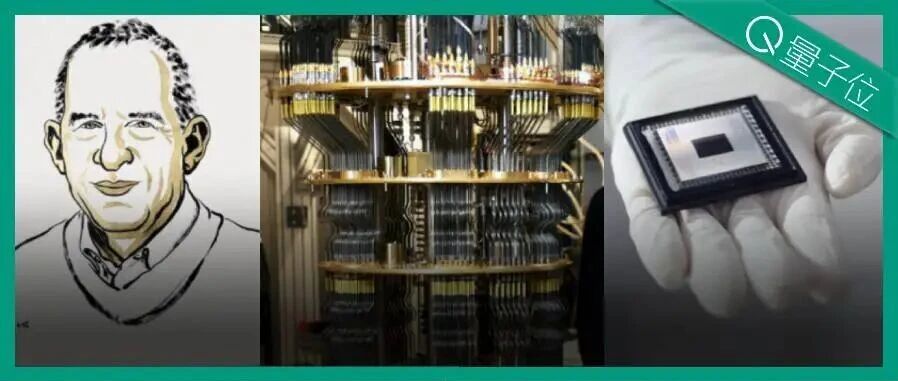
刚拿诺奖就登Nature封面!谷歌“量子回声”算法计算提速13000倍,可重复验证结果
量子位· 2025-10-22 15:27
Core Viewpoint - Google's quantum team, recently awarded the Nobel Prize in Physics, has introduced a new algorithm called "Quantum Echoes," which allows for repeatable verification of quantum computing results, addressing previous challenges in confirming quantum outcomes [1][4]. Group 1: Quantum Computing Advancements - The new algorithm enables quantum computers to perform calculations that would take traditional supercomputers 3.2 years in just 2.1 hours, achieving a speed increase of 13,000 times [2][17]. - The research involved over 200 authors, including notable scientists from Princeton University, UC Berkeley, and MIT, highlighting the collaborative effort in advancing quantum computing [4]. Group 2: Algorithm Functionality and Applications - The "Quantum Echoes" algorithm utilizes a method called "non-temporal correlation function" (OTOC), which enhances the ability to observe quantum systems over extended periods compared to traditional methods [12][14]. - OTOC has demonstrated the capability to reveal phenomena that classical computers cannot simulate, such as "large-loop interference," which classical simulations struggle to replicate [16][17]. - The algorithm has practical applications in determining unknown parameters of quantum systems, showcasing its utility in real-world scenarios like analyzing quantum materials [21][23]. Group 3: Hardware and Future Directions - The breakthrough relies on the Willow chip's hardware advantages, which has shown low error rates and high-speed operations, essential for the algorithm's performance [23]. - The current generation of the Willow chip achieves a fidelity of 99.97% for single-qubit gates and 99.88% for entangling gates, indicating significant advancements in quantum hardware [23]. - Looking ahead, the Google quantum team plans to focus on developing "long-lived logical qubits" to lay the groundwork for larger-scale, error-corrected practical quantum computers [26].
科技竞争战略焦点,量子计算应用迈出关键一步
Xuan Gu Bao· 2025-10-22 15:14
Group 1 - The research team led by Professor Feng Feng from Tianjin University's Microelectronics Institute has proposed a novel multi-port electromagnetic response amplitude calculation method based on the Harrow-Hassidim-Lloyd (HHL) quantum algorithm, marking a significant advancement in quantum computing applications [1] - Quantum computing is recognized as a disruptive technology that can effectively address the limitations of traditional computing power, positioning it as a strategic focus in global technological competition [1] - The quantum computing industry is at a critical turning point, transitioning from technology-driven development to application-driven growth, with a projected market size reaching hundreds of billions by 2025-2030 [1] Group 2 - Relevant A-share concept stocks include Tiantong Co., Ltd. and Electronic City, which are associated with the advancements in quantum computing technology [2]
谷歌公司Quantum在《自然》披露与Willow芯片相关的量子计算突破性进展
Hua Er Jie Jian Wen· 2025-10-22 15:05
市场有风险,投资需谨慎。本文不构成个人投资建议,也未考虑到个别用户特殊的投资目标、财务状况或需要。用户应考虑本文中的任何 意见、观点或结论是否符合其特定状况。据此投资,责任自负。 风险提示及免责条款 谷歌公司Quantum在《自然》披露与Willow芯片相关的量子计算突破性进展。 ...
量子计算产业最新进展
2025-10-21 15:00
摘要 中国量子计算领域正快速发展,超导技术路线领先,本源量子估值近 100 亿元人民币,并已启动 IPO,但整体商用化仍面临规模、保证度及 市场接受度等多重挑战,预计还需 5-8 年。 超导量子计算面临严峻的技术挑战,包括极低温环境控制和大规模量子 比特的布线复杂性,特别是稀释制冷剂的国际供应封锁,迫使国内企业 自主研发。 离子阱和中性原子技术受限于规模化和操控精度,离子阱难以稳定囚禁 大量离子,中性原子纠缠操作的工程实现仍存在困难,限制了信息传输 距离。 光量子计算器件简单易于产生光子,但因光子间缺乏相互作用力,难以 构建通用型双比特逻辑门,主要应用于专用型场景,且光子运行后即消 失,无法存储。 量子计算产业链条长,资金流动性强,各国政府投入巨大,如欧洲"量 子旗舰计划"和美国"量子法案",中国也通过超长期特别国债支持量 子计算相关项目。 Q&A 量子计算在中美两国的发展情况如何?有哪些主要的技术路线和应用进展? 量子计算作为未来计算能力的重要补充,近年来在中美两国均取得了显著进展。 中国目前采用多路线并行发展的策略,主要包括超导、原子型(如中性原子和 离子阱)以及专用型(如光量子和相干易兴机)等技术路线。 ...
“国家队”重仓工业母机,10个亿丨投融周报
投中网· 2025-10-20 06:45
Key Points - The low-altitude economy continues to attract significant financing, with capital concentrating on leading companies. Recently, Zero Gravity Aircraft Industry (Hefei) Co., Ltd. announced the completion of A++++ round financing amounting to nearly 300 million yuan, bringing its total financing in two months to nearly 700 million yuan [4][11]. - Quantum computing competition is intensifying, with multiple technological routes being pursued. Logic Bit, a superconducting quantum computing company, completed a Pre-A round financing of tens of millions of yuan, primarily from existing shareholders [4][13]. Additionally, Bosc Quantum completed an A++ round financing of several hundred million yuan [4][15]. - In the health sector, early-stage tools and platform technologies are receiving support. OxTium Technology announced the completion of several million yuan in angel+ round financing led by Sequoia China Seed Fund [5][33]. - The new consumption sector is also seeing active financing, with Velotric completing a B round financing led by Shunwei Capital [8]. - The hard technology sector is witnessing significant investments, with companies like Rock Energy and BridGene Biosciences completing substantial financing rounds [14][36]. - The healthcare industry is experiencing a surge in financing, with companies like Yike Medical and Wuyou Jump completing rounds of several million to nearly 200 million yuan [28][30]. - The AI and enterprise service sectors are also active, with companies like Future Intelligence and Aishi Technology completing significant financing rounds [43][46]. Group 1 - Low-altitude economy financing remains high, with Zero Gravity Aircraft Industry raising nearly 300 million yuan [4][11] - Quantum computing competition is heating up, with Logic Bit and Bosc Quantum securing significant funding [4][13][15] - Health sector tools and platforms are gaining early-stage support, exemplified by OxTium Technology's financing [5][33] Group 2 - New consumption sector financing is active, with Velotric's B round led by Shunwei Capital [8] - Hard technology sector investments are significant, with Rock Energy and BridGene Biosciences completing major financing [14][36] - Healthcare industry financing is surging, with Yike Medical and Wuyou Jump securing substantial rounds [28][30] Group 3 - AI and enterprise service sectors are also seeing significant financing, with Future Intelligence and Aishi Technology completing major rounds [43][46]



蚂蚁集团出手,领投L4无人驾驶企业数亿美元融资;新锐AIGC视频生成大模型创企获复星等投资 | 每周十大股权投资
Sou Hu Cai Jing· 2025-10-20 06:30
Financing Transactions - Boson Quantum completed a Series A+ financing round, raising hundreds of millions of RMB, with investments from Qif Capital and GF Xinde, focusing on the development and industrialization of domestic optical quantum computers [1] - Tongchuang Purun, a leading manufacturer of high-purity metal materials, secured 1 billion RMB in Pre-IPO financing, with investors including SAIC Group's Shangqi Capital, addressing critical material needs in the semiconductor and display panel industries [1] - Aishi Technology, an AIGC video platform, raised 100 million RMB in Series B+ financing, backed by Fosun Ruijing Capital and Shunxi Fund, focusing on AI video generation technology [2] - Zero Gravity Aircraft Industry, specializing in eVTOL aircraft, completed a Series A+ financing round of 300 million RMB, with investments from Fangguang Capital and Sichuan Industrial Revitalization Fund, aligning with the national "low-altitude economy" strategy [2] - Jiushi Intelligent, a global L4 autonomous driving company, raised hundreds of millions of USD in Series C financing led by Ant Group, focusing on B2B urban freight solutions [3] - Tupu Medical, a leader in high-end ophthalmic medical equipment, completed a strategic financing round with investors including Beijing Guoguan, aiming to break the monopoly of imported brands in the high-end ophthalmic equipment market [3] - Wolant Aviation, engaged in eVTOL development, completed hundreds of millions of RMB in Series B financing, attracting top-tier investment institutions [4] - Revolut, a leading fintech platform, secured a strategic financing round of up to 3 billion USD (approximately 19.5 billion RMB), enhancing its position as Europe's most valuable fintech unicorn [4] - Lila Sciences, an innovative tech company, completed 115 million USD in Series A financing, with investments from General Catalyst and Nvidia, highlighting the potential of AI for science [5] - Trogenix, a UK-based biotech company focused on innovative cancer gene therapies, raised 95 million USD in Series A financing, receiving investments from Eli Lilly and several specialized medical venture funds [5]
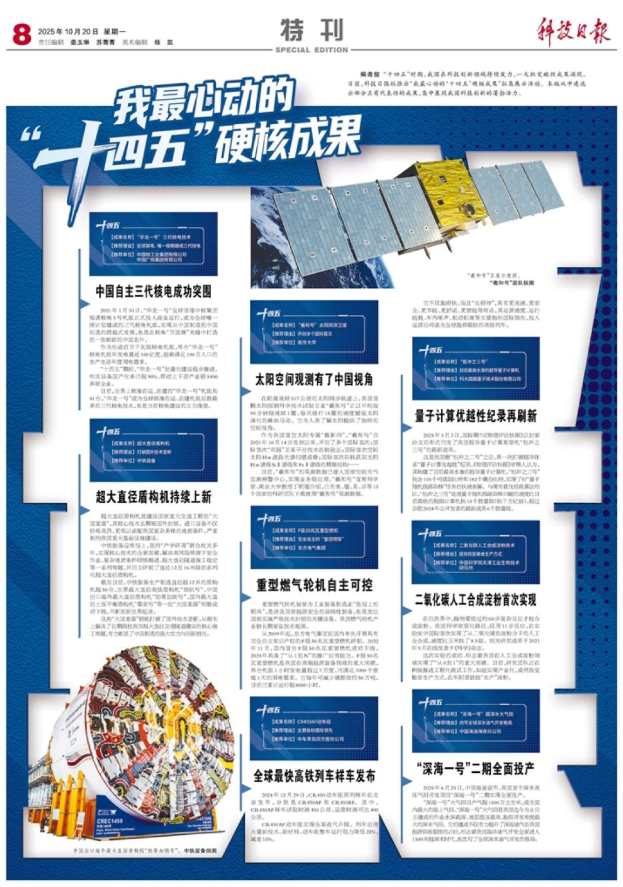
科技创新活力持续迸发!“十四五” 这些硬核成果值得细看
Ke Ji Ri Bao· 2025-10-20 05:13
Group 1: Nuclear Power Development - The "Hualong One" nuclear power unit at Fuqing Nuclear Power Plant has officially commenced commercial operation, marking a significant achievement in China's third-generation nuclear technology [3] - The "Hualong One" unit has an annual electricity generation capacity of nearly 10 billion kWh, sufficient to meet the annual electricity needs of 1 million people [3] - During the 14th Five-Year Plan period, the construction of "Hualong One" units is progressing steadily, with a domestic equipment localization rate exceeding 90%, benefiting over 5,400 upstream and downstream enterprises [3] Group 2: Heavy Machinery and Infrastructure - The development of large-diameter shield tunneling machines has broken foreign technology monopolies, addressing key construction challenges in China's transportation infrastructure [5] - China Railway Equipment has produced over 50 large-diameter shield machines, including the world's largest high-speed rail shield machine, showcasing China's manufacturing capabilities [5] Group 3: Space Exploration - The "Xihe" solar observation satellite has been capturing solar evolution data, providing a unique perspective for understanding the sun [7] - The satellite has achieved several international firsts in solar observation technology and has made its data available to research teams from 15 countries [7] Group 4: Energy Equipment - The successful development of the domestically produced F-class 50 MW heavy-duty gas turbine represents a significant breakthrough in China's high-end energy equipment sector [9] - This turbine can generate over 70,000 kWh of electricity per hour, enough to meet the daily electricity needs of 7,000 households, and can reduce carbon emissions by approximately 500,000 tons annually [9] Group 5: High-Speed Rail - The CR450 train set, capable of reaching a testing speed of 450 km/h and an operational speed of 400 km/h, represents a significant advancement in high-speed rail technology [11] - The train features a 22% reduction in running resistance and a 10% weight reduction, making it the fastest high-speed train globally upon its operational launch [11] Group 6: Quantum Computing - The "Zuchongzhi 3" superconducting quantum computing prototype has set a new record for quantum computing superiority, outperforming the fastest classical algorithms by 15 orders of magnitude [13] - This achievement highlights China's advancements in quantum computing technology and its potential to lead in this field [13] Group 7: Artificial Synthesis - Chinese scientists have achieved the first artificial synthesis of starch from carbon dioxide in a simplified process, significantly faster than natural methods [15] - This breakthrough could revolutionize food production methods if successfully industrialized [15] Group 8: Offshore Gas Development - The "Deep Sea No. 1" Phase II project has commenced full production, becoming China's largest offshore gas field with a daily output exceeding 15 million cubic meters [17] - This project marks a significant advancement in deep-water oil and gas development in China, entering the ultra-deep water era [17]
薛定谔亲外孙创业量子计算,老黄早早就成了股东
量子位· 2025-10-19 04:10
Core Viewpoint - PsiQuantum, a quantum computing startup co-founded by the grandson of physicist Erwin Schrödinger, has raised $1 billion in a single funding round, setting a record for quantum computing startups. This funding aims to help the company build a million-qubit quantum computer by 2028, surpassing competitors like Google and IBM [10][11][12]. Company Overview - PsiQuantum was founded in 2016 with the goal of creating the first usable quantum computer. Initially based in the UK, the company relocated to Silicon Valley to better access funding [17][18]. - The company has established partnerships with major semiconductor manufacturers and has developed a new technology called Fusion-Based Quantum Computing (FBQC), which has been published in a leading scientific journal [21][22][24]. Funding and Growth - The recent $1 billion funding round was led by BlackRock, Temasek, and Baillie Gifford, marking a significant milestone in the quantum computing sector [10]. - PsiQuantum has secured various contracts, including a $22.5 million deal with the U.S. Air Force Research Laboratory and a $619 million order from the Australian government for a utility-scale quantum computer [27][29]. Technical Innovations - Unlike most quantum computers that use electrons or atoms, PsiQuantum's qubits are based on photons, allowing for easier integration with existing semiconductor manufacturing processes and operation at room temperature [32][33]. - The company has introduced the Omega chip set, designed for practical quantum computing, which includes components necessary for building a million-qubit quantum computer [36][38]. Leadership and Expertise - The founding team of PsiQuantum includes experts with strong academic backgrounds in quantum physics, such as CEO Jeremy O'Brien and CTO Mark Thompson, who have extensive experience in the field [43][44][55]. - The team is driven by a sense of social responsibility to bring quantum technology to fruition, reflecting their commitment to advancing the field [51][52].

研判2025!中国量子模拟器行业发展历程、相关政策及市场规模分析:从理论突破到市场增长,迈向前沿应用的新征程[图]
Chan Ye Xin Xi Wang· 2025-10-19 01:21
Core Insights - The quantum simulator industry in China is projected to reach a market size of approximately 1.506 billion yuan in 2024, reflecting a year-on-year growth of 15.23% [10][11] - Key challenges facing the quantum simulator sector include quantum noise accumulation and system scalability [10] - The development of modular architectures in quantum simulators, such as the nano-electronic quantum simulator by a US-UK joint team, enhances scalability from single units to large networks [10][11] Industry Overview - Quantum simulators are specialized computational tools based on quantum mechanics principles, primarily used to simulate the behavior of quantum systems [2] - They are categorized into digital quantum simulators and analog quantum simulators [2] Industry Development History - The concept of quantum simulation was established in 1982 by Richard Feynman, with significant milestones achieved in subsequent years, including the realization of the Fermi-Hubbard model by the University of Science and Technology of China in 2024 [4][5] - The development trajectory showcases a complete evolution from theoretical foundations to technological breakthroughs [4] Relevant Policies - Quantum technology has been included in China's "14th Five-Year Plan," emphasizing its importance as a core future industry [6] - The government has introduced various policies to support the research and industrialization of quantum technology, enhancing its global competitiveness [6] Industry Value Chain - The upstream of the quantum simulator industry includes essential components such as quantum chips, dilution refrigerators, and quantum light sources [8] - The midstream focuses on the manufacturing of quantum simulators and software development, while the downstream applications span finance, pharmaceuticals, logistics, and energy sectors [8] Market Size - The quantum simulator market in China is expected to grow significantly, with a projected size of 1.506 billion yuan in 2024, driven by advancements in quantum technology and government support [10][11] - Investment in quantum technology has surged, with 29 financing events recorded in the first eight months of 2025, marking a 93.33% increase year-on-year [10][11] Key Companies' Performance - The competitive landscape of the quantum simulator industry is characterized by leading hardware companies like GuoDun Quantum and Benyuan Quantum, which have established significant technological barriers [11] - GuoDun Quantum reported a revenue of 121 million yuan in the first half of 2025, a 74.54% increase year-on-year, with R&D investment also rising [11][12] Industry Development Trends 1. **Technological Integration and Hardware Breakthroughs**: The next five years will see deep integration of quantum simulators with AI and digital twin technologies, enhancing performance and reducing error rates [14] 2. **Deepening Application Scenarios**: Quantum simulators will penetrate core sectors such as manufacturing and finance, optimizing processes and improving returns [14] 3. **Accelerated Standardization**: China aims to lead in establishing international standards for quantum simulators, enhancing compatibility and competitiveness on a global scale [15]