
新式茶饮

Search documents
奶茶品牌,开卷养生
Guan Cha Zhe Wang· 2025-09-18 12:45
Core Insights - The new tea beverage industry is undergoing a transformation from "tasty" to "healthy," with health and wellness becoming mainstream consumer demands [1][2] - The market size of China's new tea beverage industry is projected to reach 354.72 billion yuan in 2024 and exceed 400 billion yuan by 2028 [1] - Over 40% of consumers indicate that "health risks" are a primary reason for potentially reducing their purchases of ready-made tea beverages [1] Industry Trends - The competition in the new tea beverage sector is shifting from a "traffic battle" to a "value battle," with consumers increasingly concerned about health attributes and nutritional content [2] - A survey shows that 49.4% of consumers worry about health impacts from new tea beverages, while 42.2% fear weight gain [2] - The rise in mental health issues, such as anxiety and depression, is influencing consumer preferences towards healthier beverage options [2] Product Innovations - Brands like "沪上阿姨" are launching initiatives such as the "五色慢养" plan, which combines traditional health wisdom with modern tea experiences [3][4] - New products emphasize health benefits, such as high fiber and low burden, with examples including "五黄高纤慢养瓶" and "五黑焕发慢养瓶" [4] - Other brands are also innovating, with "喜茶" introducing a "light milk tea" series and "奈雪的茶" focusing on functional beverages [4] Challenges and Opportunities - The industry faces challenges in balancing health benefits with taste, as reducing sugar and fat may impact flavor [5] - There is a lack of unified standards for "healthy tea beverages," leading to quality inconsistencies in the market [5] - Consumer education on health and nutrition is necessary to correct misconceptions about healthy eating [5] Future Outlook - The competition in the tea beverage industry will evolve to encompass product innovation, supply chain management, standardization, and consumer education [6]


霸王茶姬、洽洽瓜子和足力健,为何都在卷跨界?
Sou Hu Cai Jing· 2025-09-16 00:17
Group 1 - The core viewpoint of the article highlights the trend of cross-industry operations among companies in China as a strategic choice to adapt to a saturated market and declining growth in existing sectors [2][3][13] - Bawang Tea Ji has transformed from a tea beverage brand to a comprehensive lifestyle brand, launching a wide range of products including clothing and accessories, thus creating a holistic shopping experience for consumers [5][7] - The diversification efforts of companies like Qiaqia and Zuli Jian reflect a response to slowing growth in their primary markets, with Qiaqia facing significant challenges in its expansion into the liquor and beauty sectors, resulting in a drastic decline in net profit [8][9] Group 2 - The success of Bawang Tea Ji's cross-industry strategy is attributed to its strong brand recognition and alignment with consumer preferences, leading to increased customer loyalty and higher profit margins in its apparel segment compared to its beverage business [7][10] - In contrast, Qiaqia's attempts to diversify have not yielded the expected results, with its core business suffering due to a lack of brand coherence and experience in new markets, leading to an 86% drop in net profit in the first half of 2025 [8][9] - Zuli Jian's entry into the organic food market is seen as a logical extension of its brand, aiming to create a comprehensive health-focused ecosystem for elderly consumers, with plans to open hundreds of stores nationwide [10][12] Group 3 - The article emphasizes that the current wave of cross-industry ventures is driven by market saturation and growth anxiety, as companies seek new avenues for expansion amid declining growth rates in their traditional sectors [13][14] - Digital platforms have facilitated these cross-industry efforts, allowing companies to test new products and gather consumer feedback at a lower cost, exemplified by Bawang Tea Ji's successful foray into apparel through its online store [13][14] - The article warns that while cross-industry strategies can open new growth opportunities, they require careful planning and alignment with brand values to avoid pitfalls, as demonstrated by Qiaqia's struggles [14][15]


新消费浪潮下,新式食饮或迎来结构性机遇
2025-09-11 14:33
Summary of Conference Call Records Industry Overview - The new tea beverage industry is experiencing a structural opportunity amidst the new consumption wave, with a projected net decrease of approximately 40,000 stores in 2024, while the average transaction price stabilizes as mid-to-high-end brands cease aggressive price cuts to protect franchisee profitability [1][3] - The Southeast Asian ready-to-drink beverage market shows significant growth potential, with a compound annual growth rate (CAGR) of about 16% from 2018 to 2023, and per capita consumption significantly lower than in China [1][6] Key Insights and Arguments - In the first half of 2025, the tea beverage industry performed well due to improved competition dynamics, a slowdown in price wars, and increased sales driven by delivery platform subsidies [3] - The delivery subsidy war initiated by platforms like JD.com, Meituan, and Ele.me has led to a surge in sales for tea and coffee products, benefiting most tea companies with positive same-store sales growth [3][4] - The performance of tea companies is expected to further diverge as delivery subsidies taper off in 2026, with companies possessing strong supply chains and operational capabilities likely to maintain their competitive edge [4] - Notable brands such as Mixue Ice City and Gu Ming are highlighted as having strong growth potential due to their operational strengths and market positioning [4] Overseas Expansion - Domestic tea brands are actively expanding into overseas markets, particularly in Southeast Asia, where climate and cultural similarities favor the acceptance of tea beverages [5][6] - Mixue Ice City leads in overseas store count with 4,733 locations, while MOMO has over 1,000 stores in Indonesia, indicating substantial growth opportunities in international markets [5] ETF and Investment Opportunities - The Hong Kong Consumption 50 ETF focuses on new consumption sectors, including tea beverages, trendy toys, gold jewelry, and cosmetics, benefiting from anticipated interest rate cuts and inflows from southbound capital [1][7] - The National Index Hong Kong Consumption Index is more diversified compared to traditional A-share indices, focusing on emerging industries and offering higher growth potential [8][12] - The outlook for the new consumption market in the fourth quarter is optimistic, with expected increases in penetration rates for ready-to-drink tea and toys, supported by favorable economic conditions and policy measures [9][13] Future Trends and Recommendations - Future trends in the emerging consumer market will revolve around policy leverage, capital focus, technological integration, and overseas expansion [13] - Investment opportunities in the emerging consumer market are promising, with significant growth potential and favorable valuations for companies in the new consumption space [14]
猛开 5.3 万家门店后,蜜雪冰城将狂奔向何处?
Jing Ji Guan Cha Wang· 2025-09-11 03:16
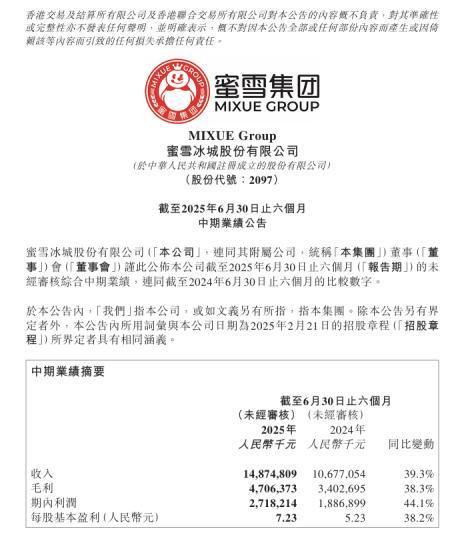
Core Insights - The performance of Mixue Group in the first half of the year shows both strengths and weaknesses, with significant revenue and profit growth but signs of slowing expansion [1][5]. Financial Performance - In the first half of the year, Mixue Group reported total revenue of approximately 14.87 billion RMB, a year-on-year increase of 39.3%, and a net profit exceeding 2.72 billion RMB, up 44.1% year-on-year [2][4]. - The growth is primarily driven by the increasing number of stores, which boosts sales of related products, equipment, and franchise services [2][4]. Market Expansion and Strategy - Mixue Group is adjusting its domestic expansion strategy, slowing down the pace of new store openings due to limited market growth [5][20]. - The company is actively seeking new growth opportunities in overseas markets, although this path presents challenges [5][32]. - As of June 30, 2025, Mixue Ice City has over 53,000 stores globally, surpassing major competitors like McDonald's and Starbucks [8][10]. Business Model and Revenue Sources - Mixue Ice City operates primarily on a franchise model, with 99.97% of its stores run by franchisees, which is a high ratio in the industry [8][9]. - The majority of revenue comes from selling raw materials and equipment to franchisees, accounting for over 97% of total revenue [10][11]. - Despite rising costs of raw materials, the gross margin from product and equipment sales remains competitive at 30.3% [12][15]. Competitive Landscape - Mixue Ice City dominates the low-priced tea beverage market, with its main products priced between 2 to 8 RMB, while competitors are positioned in higher price ranges [18][19]. - The company has a significant presence in lower-tier cities, with 57.6% of its stores located in third-tier cities and below [20][21]. Challenges and Adjustments - The new-style tea beverage market is approaching saturation, leading to increased competition and a rise in store closures for Mixue Ice City [21][23]. - The company has closed nearly 1,200 stores in the domestic market in the first half of the year and is focusing on optimizing store locations and improving profitability [23][25]. Future Growth Prospects - Mixue Group is exploring two main avenues for future growth: international expansion and coffee market entry [30][38]. - The company has begun to open stores in Central Asia and is planning to enter markets in the Americas, although its overseas expansion has slowed recently [32][36]. - The coffee brand "Lucky Coffee" aims to replicate the success of Mixue Ice City, with a target of 10,000 stores, but faces stiff competition in both domestic and international markets [38][39].
新式茶饮解锁年轻人茶文化新体验
Bei Jing Qing Nian Bao· 2025-09-03 00:30
Core Insights - The new-style tea drinks, such as milk cap tea and fruit tea, have become a fresh window for young people to understand traditional tea culture, utilizing high-quality tea leaves, fresh milk, and natural ingredients [1] Industry Trends - The core appeal of new-style tea drinks lies in the pursuit of high-quality raw materials and innovative taste experiences, with a focus on preserving the authentic aroma and flavor of tea through precise brewing techniques [2] - The development of new-style tea drinks has evolved towards a "health experience," emphasizing low sugar, low calorie, and balanced nutrition in product development, catering to consumer health demands [3] Consumer Preferences - The primary consumer group for new-style tea drinks is young people aged 25 to 30, who value quality of life and are open to trying new flavors and seasonal limited editions, while also being health-conscious [5] - New-style tea drinks are expanding from urban core areas to broader regions, with significant growth in lower-tier cities, indicating a strong market penetration [5] Experience Factors - The success of new-style tea drinks revolves around various experiential factors, including innovative product offerings, strict quality control, cultural and spatial experiences, health-conscious options, and convenient ordering through digital platforms [4]
霸王茶姬进入菲律宾市场,上半年海外市场增速超国内
第一财经· 2025-09-02 13:32
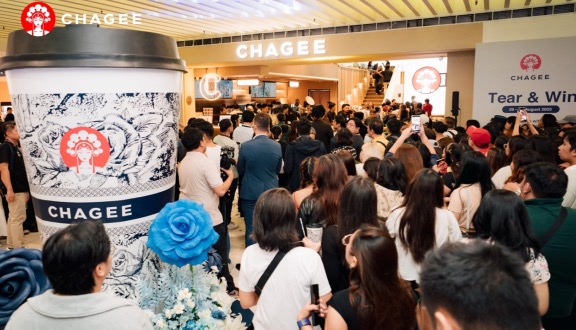
Core Insights - Bawang Tea Ji has officially entered the Philippine market with the opening of three stores in the Manila metropolitan area, selling over 23,000 cups in the first three days [3][4] - Southeast Asia is a primary overseas market for Bawang Tea Ji, marking the Philippines as its seventh international market, with a total of 208 overseas stores as of June 30 [4][5] - The company's overseas market GMV reached 235.2 million yuan in Q2, a year-on-year increase of 77.4% and a quarter-on-quarter growth of 31.8% [5] Expansion Strategy - Bawang Tea Ji's overseas store expansion includes markets in Malaysia (178 stores), Singapore (16), Indonesia (8), Thailand (5), and the USA (1), with additional presence in Vietnam [4] - The company is strategically targeting Southeast Asia due to lower labor costs and a significant Chinese population, which is conducive for new tea beverage enterprises [6] Financial Performance - In Q2, the average monthly GMV per store in the Chinese market was 404,350 yuan, with same-store GMV decreasing by 23% year-on-year [5] - The decline in same-store sales is attributed to exceptionally strong performance in Q2 2024 and intensified price competition on delivery platforms, leading to temporary customer diversion [5]
霸王茶姬进入菲律宾市场 上半年海外市场增速超国内
Di Yi Cai Jing· 2025-09-02 13:03
Group 1 - Bawang Chaji has opened three stores in the Philippines, marking its entry into the market and achieving over 23,000 cups sold in the first three days [1] - Southeast Asia is a primary overseas market for Bawang Chaji, with the Philippines being its seventh international market [1] - As of June 30, Bawang Chaji has expanded its overseas stores to 208, covering Malaysia (178), Singapore (16), Indonesia (8), Thailand (5), and the United States (1) [1] Group 2 - Bawang Chaji's overseas market GMV reached 235.2 million yuan in Q2, a year-on-year increase of 77.4% and a quarter-on-quarter growth of 31.8% [1] - In the Chinese market, Bawang Chaji's average monthly GMV per store was 404,350 yuan, with same-store GMV decreasing by 23% compared to last year [1] - The decline in same-store GMV is attributed to strong comparative data from Q2 2024 and intensified price competition on delivery platforms [1]
霸王茶姬进入菲律宾市场,上半年海外市场增速超国内
Di Yi Cai Jing· 2025-09-02 10:10
Group 1 - Southeast Asia is a primary overseas market for BaWangChaJi, with the recent opening of three stores in the Philippines marking its entry into the country [1] - The three stores in the Philippines are located in key business districts of the Metro Manila area, selling over 23,000 cups within the first three days of operation [1] - BaWangChaJi has expanded its overseas store count to 208, covering markets including Malaysia (178 stores), Singapore (16 stores), Indonesia (8 stores), Thailand (5 stores), and the United States (1 store) [1] Group 2 - In Q2, BaWangChaJi's overseas market GMV reached 235.2 million yuan, representing a year-on-year increase of 77.4% and a quarter-on-quarter growth of 31.8% [1] - In contrast, the average monthly GMV per store in the Chinese market was 404,350 yuan, with same-store GMV declining by 23% year-on-year [1] - The decline in the Chinese market is attributed to strong comparative data from Q2 2024 and intensified price competition on delivery platforms, which has temporarily diverted some customer traffic [1] Group 3 - Southeast Asia is often the first destination for new tea beverage companies due to low labor costs, proximity to China, and a significant Chinese population [3] - Other companies, such as Nayuki and Cha Bai Dao, are also expanding in Southeast Asia, with Nayuki opening a store in Chiang Mai, Thailand, and Cha Bai Dao entering the Singapore market [3] - The opening of new stores in Southeast Asia has seen significant customer interest, with one store experiencing wait times exceeding 2 hours [3]
曾经的奶茶巨头书亦烧仙草,为啥掉队了?
Hu Xiu· 2025-09-02 03:38
Group 1 - The company, Shuyi Shao Xian Cao, once held a strong position in the new-style tea beverage industry, ranking second after Mixue Ice City [1] - The company expanded aggressively, opening 7,000 stores, but is now facing significant challenges with a large number of store closures [1] - The company is struggling to recover its second-hand equipment, which is now being sold as scrap metal, indicating a severe decline in its operational viability [1]
港交所一杯茶:茶饮中场激战正酣,半年报透视生死局
Ge Long Hui· 2025-09-01 19:18
Core Insights - The new-style tea beverage industry is undergoing rapid differentiation and reshuffling, shifting from "scale expansion" to "quality competition" [1] - The industry is experiencing a Matthew effect, where strong players dominate while weaker ones struggle [1] Company Performance - Mixue Ice City reported revenue of 14.875 billion and net profit of 2.718 billion, with both revenue and net profit growth exceeding 39% [1] - Gu Ming demonstrated impressive growth with revenue of 5.663 billion, a year-on-year increase of 41.2%, and net profit soaring by 121.5% to 1.625 billion [1][3] - Hu Shang A Yi achieved revenue of 1.818 billion, up 9.7%, and net profit of 203 million, an increase of 20.9% [3] - Cha Bai Dao's total revenue was 2.5 billion, a slight increase of 4%, but net profit rose significantly by 40% to 333 million [3] - Nai Xue's Tea faced challenges with revenue of 2.178 billion, a year-on-year decline of 14.4%, and a net loss of 118 million [3] Market Dynamics - The number of stores and supply chain capabilities have become critical competitive advantages for tea beverage giants [4] - Mixue Ice City has over 53,000 stores globally, adding nearly 10,000 in the first half of 2025, while Gu Ming has 11,179 stores [4] - Supply chain management is increasingly viewed as a key differentiator in the industry, with companies like Mixue and Gu Ming focusing on self-sourcing and efficient logistics [4][13] Consumer Trends - There is a growing consumer preference for low-sugar, low-calorie, and functional tea beverages, while many brands remain focused on traditional offerings [6] - The industry faces cost pressures, with significant portions of revenue consumed by material, labor, and rental costs [6] Strategic Directions - Major tea beverage companies are targeting lower-tier markets as a new growth area, with Mixue and Gu Ming establishing a strong presence in these regions [8] - The coffee segment is emerging as a secondary battleground, with companies like Mixue and Gu Ming expanding their coffee offerings significantly [9][10] Investment Landscape - The tea beverage industry is seeing a wave of IPOs, emphasizing the importance of profitability over mere expansion [12][15] - Companies that can effectively manage their supply chains and demonstrate profitability are more likely to attract investor interest [13][15]