租赁和商务服务

Search documents
国家统计局:三方面积极变化彰显我国加快培育新动能成效
Xin Hua Cai Jing· 2025-11-14 05:12
Group 1 - The core viewpoint of the article emphasizes the acceleration of new momentum cultivation and economic structure optimization in China, which is beneficial for economic development [1] Group 2 - Market demand is revitalizing, with new demands continuously expanding. From January to October, online retail sales of physical goods accounted for 25.2% of total retail sales, an increase of 0.2 percentage points from the previous period [1] - Investment in key areas is increasing, with high-tech sectors seeing rapid growth. From January to October, investment in the aerospace and equipment manufacturing industry grew by 19.7%, while information services investment increased by 32.7% [1][2] - The export of electromechanical and high-tech products is expanding, with electromechanical products accounting for 60.7% of total exports from January to October [2] Group 3 - The trend of industrial upgrading is evident, with advanced manufacturing and modern service industries increasing their share. From January to October, the added value of large-scale equipment manufacturing grew by 9.5%, contributing 58.7% to the growth of large-scale industrial added value [2] - The development of emerging industries is strengthening, with digital economy and green low-carbon transformation advancing. From January to October, the added value of the digital industry manufacturing sector grew by 9.5% [3] - The future outlook indicates that new production capacity and high-quality economic development trends are positive, with a focus on promoting high-quality development and integrating technological and industrial innovation [3]
国家统计局发布重要数据
新华网财经· 2025-11-14 04:15
Economic Overview - In October, the national economy maintained a stable and progressive development trend, with industrial added value increasing by 4.9% year-on-year, service production index rising by 4.6%, and retail sales of consumer goods growing by 2.9% [1][10]. Industrial Production - The industrial added value for October increased by 4.9% year-on-year and 0.17% month-on-month. The mining industry grew by 4.5%, manufacturing by 4.9%, and electricity, heat, gas, and water production and supply by 5.4% [3]. - Equipment manufacturing and high-tech manufacturing sectors showed strong growth, with increases of 8.0% and 7.2% respectively, outpacing the overall industrial growth by 3.1 and 2.3 percentage points [3]. - The profit of industrial enterprises from January to September reached 53,732 billion yuan, a year-on-year increase of 3.2% [3]. Service Sector - The service production index rose by 4.6% year-on-year in October, with significant growth in information transmission, software, and IT services (13.0%), leasing and business services (8.2%), and finance (5.6%) [4]. - The business activity index for the service sector was at 50.2%, indicating stable activity levels [4]. Retail Sales - In October, the total retail sales of consumer goods reached 46,291 billion yuan, a year-on-year increase of 2.9% [5]. - Online retail sales amounted to 127,916 billion yuan, growing by 9.6% year-on-year, with physical goods online retail accounting for 25.2% of total retail sales [5]. Fixed Asset Investment - From January to October, fixed asset investment (excluding rural households) was 408,914 billion yuan, a year-on-year decrease of 1.7%. However, manufacturing investment grew by 2.7% [6]. - Real estate development investment saw a significant decline of 14.7% [6]. Trade and Exports - In October, the total import and export value was 37,028 billion yuan, a slight increase of 0.1% year-on-year, with exports decreasing by 0.8% and imports increasing by 1.4% [7]. - From January to October, the total import and export value reached 373,090 billion yuan, a year-on-year increase of 3.6% [7]. Employment and Prices - The urban surveyed unemployment rate in October was 5.1%, showing a slight decrease from the previous month [8]. - The Consumer Price Index (CPI) rose by 0.2% year-on-year in October, reversing from a decline of 0.3% in the previous month [9]. - The Producer Price Index (PPI) for industrial producers decreased by 2.1% year-on-year, with the decline narrowing compared to the previous month [9]. Conclusion - Overall, the national economy in October showed stability and progress, with ongoing structural adjustments and challenges ahead. The focus remains on expanding domestic demand and stabilizing employment and market expectations [10].


增长5.5%!深圳,最新公布→
证券时报· 2025-10-30 11:47
Economic Growth - Shenzhen's GDP for the first three quarters of 2025 reached 27,896.44 billion yuan, with a year-on-year growth of 5.5% at constant prices [1] - The primary industry added value was 17.45 billion yuan (0.0% growth), the secondary industry was 9,946.06 billion yuan (3.5% growth), and the tertiary industry was 17,932.93 billion yuan (6.6% growth) [1] Industrial Performance - The industrial added value above designated size in Shenzhen grew by 5.0% year-on-year, accelerating by 0.7 percentage points compared to the first half of the year [1] - Key sectors such as general equipment manufacturing, instrument manufacturing, and computer, communication, and other electronic equipment manufacturing saw growth rates of 16.6%, 7.5%, and 6.0% respectively [1] - High-tech product output continued to grow rapidly, with civil drones, industrial robots, and 3D printing equipment increasing by 46.9%, 38.2%, and 33.6% respectively [1] Service Sector - The added value of the service industry in Shenzhen was 17,932.93 billion yuan, with a year-on-year growth of 6.6%, which is an acceleration of 0.5 percentage points from the first half of the year [2] - Financial services, information transmission, software, and IT services, as well as leasing and business services grew by 14.5%, 9.7%, and 5.6% respectively [2] Consumer Market - The total retail sales of consumer goods in Shenzhen reached 7,560.81 billion yuan, with a year-on-year growth of 3.6%, slightly up by 0.1 percentage points from the first half of the year [2] - Retail sales of essential goods showed strong growth, with food and daily necessities increasing by 8.4% and 7.5% respectively [2] - The policy of replacing old consumer goods continued to show effects, with retail sales of home appliances and audio-visual equipment, cultural and office supplies, and communication equipment increasing by 41.5%, 28.2%, and 6.1% respectively [2] - Online retail sales grew rapidly, with a 17.8% increase in retail sales through the internet [2] Foreign Trade - Shenzhen's total import and export volume reached 33,643.29 billion yuan, with a year-on-year growth of 0.1% [2] - Exports were 20,382.04 billion yuan (down 4.7%), while imports were 13,261.25 billion yuan (up 8.4%) [2] - High-tech product exports increased by 9.7% [2] Investment Trends - Fixed asset investment in Shenzhen decreased by 17.4% year-on-year [3] - Real estate development investment fell by 24.8%, while infrastructure investment grew by 6.8% and industrial technological transformation investment surged by 42.7% [3] Financial Sector - As of the end of September, the balance of deposits in financial institutions (including foreign capital) in Shenzhen was 143,649.54 billion yuan, with a year-on-year growth of 5.6% [3] - The balance of loans in financial institutions (including foreign capital) was 99,404.44 billion yuan, with a year-on-year growth of 5.0% [3]
上海市委财经工作委员会会议举行,调度部署下阶段经济运行重点工作
Di Yi Cai Jing· 2025-10-29 14:02
Core Viewpoint - The meeting emphasized the need to enhance the scientific and precise management of economic operations, aiming to successfully conclude the year and the "14th Five-Year Plan" [1][3]. Economic Performance - The city's economy has shown a continuous recovery this year, with the first three quarters demonstrating stable progress and better-than-expected performance, reflecting strong resilience and vitality [2]. Strategic Focus - The meeting highlighted the importance of maintaining a clear mindset, seizing the time window, and striving to be proactive and competitive, with a focus on stabilizing employment, enterprises, markets, and expectations [2][3]. Policy Implementation - There is a call to effectively utilize policy combinations to amplify the effects of initiatives, explore growth potential in key areas, and accelerate the formation of tangible work outputs [3]. Industry Development - The meeting stressed the need to promote the transformation and upgrading of key industries, enhance the integration of culture, tourism, commerce, and sports, and develop the "event economy" [3]. Market Expansion - Emphasis was placed on leveraging comparative advantages to explore diversified markets and support enterprises in optimizing their overseas layouts [3]. Reform and Innovation - The meeting underscored the importance of releasing the dividends of reform and opening up, creating new growth points, and supporting "hard tech" companies in utilizing capital markets for accelerated growth [3]. Future Planning - There is a focus on preparing for the "15th Five-Year Plan" and the upcoming year, with a call for determination and effort to achieve the annual economic and social development goals [3].
前三季度深圳用电量增4.39%
Shen Zhen Shang Bao· 2025-10-28 07:08
Group 1: Overall Electricity Consumption in Shenzhen - Shenzhen's total electricity consumption reached 96.85 billion kWh in the first three quarters of the year, reflecting a year-on-year growth of 4.39% [1] - The electricity consumption from the secondary and tertiary industries was 44.37 billion kWh and 35.42 billion kWh, respectively, with growth rates of 2.48% and 6.25% [1] - The Deep-Shan Special Cooperation Zone led the growth with a remarkable 26.4% increase in electricity consumption, achieving a historical monthly high of over 200 million kWh in September [1] Group 2: Industrial Electricity Consumption - Industrial electricity consumption in Shenzhen was 42.75 billion kWh, marking a year-on-year increase of 3.12%, accounting for 44.1% of total electricity consumption [1] - The manufacturing sector consumed 34.45 billion kWh, with a growth rate of 2.9% [1] - High-tech and equipment manufacturing saw a consumption of 3.062 billion kWh, growing by 5.81%, indicating Shenzhen's push to become a global leader in advanced manufacturing [1] Group 3: Growth in the Tertiary Industry - The tertiary industry's electricity consumption growth was significantly driven by the information transmission, software, and IT services sector, which grew by 23.12% [2] - Other sectors such as wholesale and retail, and leasing and business services also showed strong growth rates of 18.82% and 9.60%, respectively [2] - The increase in electricity demand reflects the rapid growth of data centers, charging services, and large commercial areas in Shenzhen [2] Group 4: Electric Vehicle Charging Infrastructure - The total electricity consumption for charging stations in Shenzhen reached 5.129 billion kWh in the first three quarters, with a monthly growth rate exceeding 14% [3] - The Sha Bao International Innovation Park supercharging station has become essential for many ride-hailing and new energy vehicles, with a cumulative charging volume of over 716,900 kWh this year [3] - The rapid expansion of electric vehicle ownership and charging demand highlights the progress in building a comprehensive energy supply network in Shenzhen [3]

今年前三季度深圳全社会用电量同比增长4.39% 第三产业用电增速明显
Mei Ri Jing Ji Xin Wen· 2025-10-27 08:10
Core Insights - Shenzhen's total electricity consumption reached 96.85 billion kWh in the first three quarters of the year, marking a year-on-year increase of 4.39% [1] Group 1: Electricity Consumption Breakdown - The electricity consumption by the secondary and tertiary industries, as well as residential use, were 44.37 billion kWh, 35.42 billion kWh, and 17.01 billion kWh respectively, with year-on-year growth rates of 2.48%, 6.25%, and 5.65% [1] - Industrial electricity consumption in Shenzhen was 42.75 billion kWh, reflecting a year-on-year increase of 3.12%, accounting for 44.1% of total electricity consumption [1] - Within the industrial sector, manufacturing electricity consumption was 34.45 billion kWh, with a year-on-year growth of 2.9% [1] Group 2: Sector-Specific Growth - The automotive manufacturing and computer, communication, and other electronic equipment manufacturing sectors saw significant electricity consumption growth rates of 22.81% and 9.49% respectively [1] - The tertiary sector's electricity consumption growth was notably strong, particularly in the information transmission, software and IT services, wholesale and retail, and leasing and business services industries, which grew by 23.12%, 18.82%, and 9.60% respectively [1] - This growth reflects the increasing electricity demand from data centers, charging services, and large commercial districts in Shenzhen [1]
市北高新:10月24日召开董事会会议
Mei Ri Jing Ji Xin Wen· 2025-10-24 11:35
Group 1 - The company Shibei Gaoxin (SH 600604) held its 24th meeting of the 10th board of directors on October 24, 2025, via telecommunication to discuss the proposal for the second extraordinary general meeting of shareholders in 2025 [1] - For the first half of 2025, Shibei Gaoxin's revenue composition was as follows: leasing and business services accounted for 65.85%, real estate accounted for 34.13%, and other businesses accounted for 0.03% [1] - As of the report date, Shibei Gaoxin's market capitalization was 12.2 billion yuan [1] Group 2 - The Chinese innovative drug sector has sold overseas authorizations worth 80 billion USD this year, indicating a hot secondary market in biomedicine, while the primary market is facing challenges in fundraising [1]

上海前三季度GDP同比增长5.5%,金融市场活跃财政收支增长
Bei Ke Cai Jing· 2025-10-22 06:02
Economic Overview - Shanghai's GDP for the first three quarters reached 40,721.17 billion yuan, with a year-on-year growth of 5.5% at constant prices [1] - The primary industry added value was 64.26 billion yuan, growing by 0.9%; the secondary industry added value was 8,448.67 billion yuan, growing by 3.9%; and the tertiary industry added value was 32,208.24 billion yuan, growing by 5.9% [1] Industrial Performance - The industrial added value in Shanghai increased by 5.2% year-on-year, with the total output value of industrial enterprises above designated size growing by 5.7% [2] - Key manufacturing sectors showed significant growth: railway, shipbuilding, aerospace, and other transport equipment manufacturing grew by 15.9%; electrical machinery and equipment manufacturing grew by 14.3%; and computer, communication, and other electronic equipment manufacturing grew by 12.1% [2] - The three leading manufacturing industries saw an 8.5% increase in output value, outpacing the overall industrial growth by 2.8 percentage points [2] - Strategic emerging industries in manufacturing grew by 7.3%, with the new energy sector growing by 19.6% and the new generation information technology sector growing by 10.9% [2] Tertiary Sector Growth - The tertiary sector's added value increased by 5.9%, with information transmission, software, and IT services growing by 15.5% [2] - The financial sector's added value was 6,965.27 billion yuan, reflecting a growth of 9.8% [2] - The transportation, warehousing, and postal services sector grew by 5.2%, while leasing and business services grew by 3.2% [2] Investment Trends - Fixed asset investment in Shanghai grew by 6.0%, with industrial investment surging by 20.3% [3] - Urban infrastructure investment increased by 11.7%, while real estate development investment grew by 2.2% [3] Consumer Market - The total retail sales of consumer goods reached 12,302.77 billion yuan, with a year-on-year growth of 4.3% [3] - Categories such as sports and entertainment goods, furniture, and home appliances saw significant retail growth, with increases of 27.7%, 22.1%, and 28.2% respectively [3] Financial Market Activity - Major financial market transaction volumes increased by 12.7%, with the Shanghai Stock Exchange's securities transaction volume growing by 38.4% [3] - By the end of September, the balance of deposits in financial institutions reached 23.84 trillion yuan, growing by 8.4% year-on-year [3] Consumer Prices and Income - The consumer price index (CPI) remained stable year-on-year, with a slight decrease of 0.1% in September [4] - The average disposable income per capita in Shanghai was 69,220 yuan, reflecting a year-on-year growth of 4.3% [5] - The average urban unemployment rate was 4.2% [5]
GDP同比增长5.5%!上海前三季度成绩单出炉
Di Yi Cai Jing Zi Xun· 2025-10-22 01:41
Economic Overview - Shanghai's GDP for the first three quarters reached 40,721.17 billion yuan, with a year-on-year growth of 5.5% at constant prices [1] Industrial Production - Industrial added value in Shanghai grew by 5.2% year-on-year, with total industrial output value increasing by 5.7% [2] - Key manufacturing sectors showed significant growth: railway, shipbuilding, aerospace, and other transport equipment increased by 15.9%, electrical machinery and equipment by 14.3%, and computer and communication equipment by 12.1% [2] - The three leading manufacturing sectors (AI, integrated circuits, and biomedicine) saw production value growth of 12.8%, 11.3%, and 3.6% respectively [2] - Strategic emerging industries in manufacturing grew by 7.3%, with new energy industries up by 19.6% [2] Tertiary Sector Growth - The tertiary sector's added value increased by 5.9%, with information transmission, software, and IT services growing by 15.5% [3] - The financial sector's added value reached 6,965.27 billion yuan, marking a 9.8% increase [3] Fixed Asset Investment - Fixed asset investment in Shanghai rose by 6.0%, with industrial investment surging by 20.3% [4] - Urban infrastructure investment grew by 11.7%, while real estate development investment saw a modest increase of 2.2% [4] Consumer Market - Retail sales of consumer goods totaled 12,302.77 billion yuan, reflecting a year-on-year growth of 4.3% [5] - Categories such as sports and entertainment goods, furniture, and home appliances experienced significant retail growth, with increases of 27.7%, 22.1%, and 28.2% respectively [5] Financial Market Activity - Major financial markets in Shanghai saw a transaction volume increase of 12.7%, with the Shanghai Stock Exchange's securities transaction volume up by 38.4% [6] - By the end of September, the balance of deposits in financial institutions reached 23.84 trillion yuan, a year-on-year increase of 8.4% [6] Price Stability and Income Growth - Consumer prices remained stable, with the CPI unchanged year-on-year [7] - The average disposable income for residents reached 69,220 yuan, reflecting a growth of 4.3% [7]
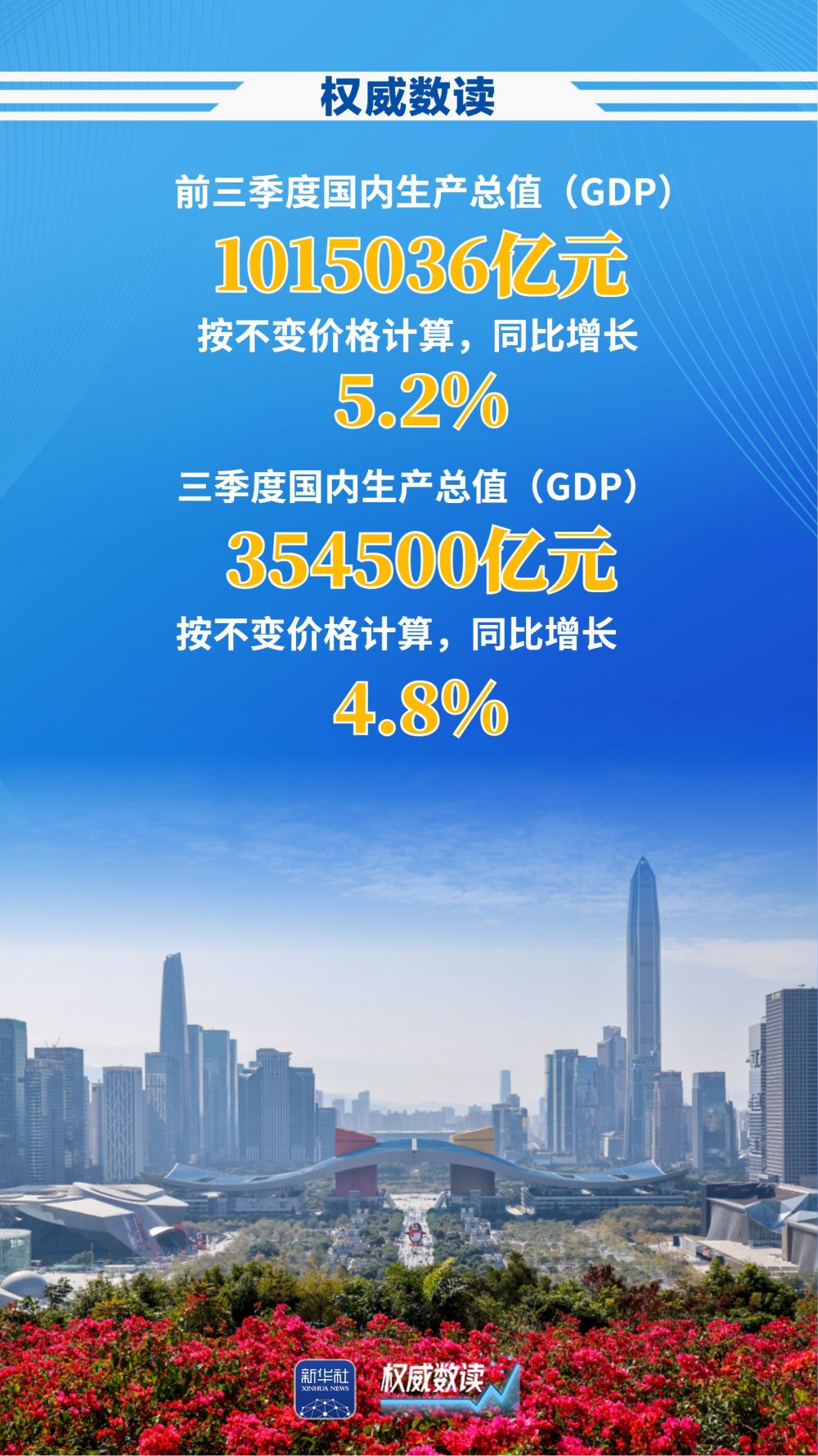
权威数读|5.2%!前三季度经济延续稳中有进态势
Xin Hua She· 2025-10-20 08:33
Economic Overview - The Chinese economy has shown resilience and vitality, maintaining a steady development trend despite external pressures and internal challenges [1]. Agriculture Sector - The added value of agriculture (planting industry) increased by 3.6% year-on-year, with the total summer grain and early rice output reaching 178.25 million tons, an increase of 190,000 tons or 0.1% compared to the previous year [7]. Manufacturing Sector - The industrial added value of enterprises above designated size grew by 6.2% year-on-year, with the added value of equipment manufacturing increasing by 9.7% and high-tech manufacturing by 9.6% [11]. Service Sector - The modern service industry has developed well, with the added value of information transmission, software, and IT services growing by 11.2%, leasing and business services by 9.2%, and transportation, warehousing, and postal services by 5.8% [15]. Retail Sector - The total retail sales of consumer goods reached 3.65877 trillion yuan, a year-on-year increase of 4.5%, while online retail sales amounted to 1.1283 trillion yuan, growing by 9.8% year-on-year [18]. Trade Sector - The import and export of goods continued to grow, with an ongoing optimization of the trade structure [19].