
老年用品

Search documents
视频丨从老有所养到老有所享 我国银发消费正跨越升级
Yang Shi Xin Wen Ke Hu Duan· 2025-12-01 00:51
Group 1: Market Overview - The implementation plan aims to create three trillion-level consumption sectors and ten hundred-billion-level consumption hotspots by 2027, with the elderly products market being one of the trillion-level sectors [1] - The elderly products market in China has grown from 2.6 trillion yuan in 2014 to 5.4 trillion yuan in 2024, reflecting a compound annual growth rate of 7.3% [1] Group 2: Technological Innovations - The introduction of exoskeleton robots in parks has garnered interest from elderly individuals, providing assistance that reduces physical exertion by approximately 30% [7][9] - Smart wheelchairs equipped with AI algorithms can autonomously navigate based on user commands, addressing mobility challenges for the elderly [13][15] - The acceptance of technology among the elderly is increasing, with 68.2% of individuals aged 60-75 using smart devices [17] Group 3: Elderly Tourism Trends - The elderly tourism market has evolved from traditional sightseeing to a more personalized and quality-focused experience, with over 280 million elderly tourists expected in 2024 [21] - Customized travel products are on the rise, with a 42% year-on-year increase in cross-province travel orders for the 55-70 age group, and 35% of these being tailored travel options [25] Group 4: Health and Wellness Services - High-quality health and wellness services are becoming essential in addressing the aging population, with advancements in medical insurance and smart elderly care facilities [29][35] - The integration of medical services across regions has improved elderly care, allowing for direct settlement of medical expenses without prior approval [29] - The development of elderly care centers is supported by government funding, with significant growth in the number of facilities and available beds [35]


增强消费品供需适配性 释放经济澎湃动力
Zheng Quan Ri Bao· 2025-11-30 16:22
Group 1 - The core viewpoint of the article emphasizes the implementation plan by six departments to enhance the adaptability of supply and demand in consumer goods, aiming for significant structural optimization by 2027 and a high-quality development pattern by 2030 [1][2] - The plan sets two main goals: to create three trillion-level consumption sectors and ten hundred-billion-level consumption hotspots by 2027, and to establish a mutually reinforcing interaction between supply and demand by 2030 [1][2] - The current consumer market in China is experiencing accelerated upgrades and faster segmentation, with diverse demands for personalized, high-quality, intelligent, and green products, while facing structural contradictions due to oversupply of homogeneous and low-end products [1] Group 2 - The plan focuses on the "silver economy" and children's products, targeting the growing elderly population and increasing birth rates as significant growth opportunities [2] - Key areas highlighted in the plan include smart connected vehicles, consumer electronics, smart wearables, and civilian drones, aligning with the development direction of new productive forces [2] - Cultural elements are integrated into products, with an emphasis on transforming traditional aesthetics and heritage skills into marketable goods, aiming to boost consumer confidence and drive consumption through cultural identity [2][3]
多部门最新回应,关于促进家电家居等大宗消费
Sou Hu Cai Jing· 2025-11-30 12:09
Core Insights - The Chinese government has introduced a plan to enhance the adaptability of supply and demand in consumer goods, aiming to create three trillion-level consumption sectors and ten hundred-billion-level consumption hotspots by 2027, with a focus on high-quality development by 2030 [1] Group 1: Development Goals - By 2027, China aims to establish three trillion-level consumption sectors and ten hundred-billion-level consumption hotspots [1] - By 2030, the goal is to achieve a high-quality development pattern where supply and consumption interact positively, with a steady increase in consumption's contribution to economic growth [1] Group 2: Key Consumption Areas - The three trillion-level consumption sectors include elderly products, smart connected vehicles, and consumer electronics [1] - The ten hundred-billion-level consumption hotspots cover categories closely related to daily life, such as baby products, smart wearables, cosmetics, fitness equipment, outdoor products, pet food, civilian drones, trendy toys, jewelry, and national fashion apparel [1] Group 3: Current Market Trends - In the first ten months of this year, the trade-in policy for consumer goods has generated over 2.4 trillion yuan in sales, benefiting more than 360 million people [3] - Retail sales of home appliances, furniture, and communication equipment have seen approximately 20% year-on-year growth, maintaining a rapid growth rate [3] Group 4: Regulatory and Standardization Efforts - The State Administration for Market Regulation has released 22 national standards related to energy and water consumption for daily consumer goods, enhancing the supply of quality products to meet consumer demand [3] - The plan emphasizes the development of energy-efficient and environmentally friendly products suitable for rural areas, including efficient range hoods, gas stoves, water heaters, and bathroom products [3][4]
打造万亿级消费领域 政策发力激活内需市场“结构红利”
Zheng Quan Ri Bao Wang· 2025-11-29 03:28
Core Viewpoint - The implementation plan aims to enhance the adaptability of supply and demand in consumer goods, setting quantifiable targets of three trillion-level consumption sectors and ten hundred-billion-level consumption hotspots by 2027, thereby optimizing the supply structure of consumer goods [1][2]. Group 1: Implementation Plan Goals - By 2027, the plan targets a significant optimization of the consumer goods supply structure, establishing three trillion-level consumption sectors and ten hundred-billion-level consumption hotspots [1]. - By 2030, a high-quality development pattern characterized by positive interaction between supply and consumption is expected to be fundamentally established, with a steady increase in the contribution of consumption to economic growth [2][3]. Group 2: Market Context and Trends - As of now, the total variety of consumer goods in China has reached 230 million, with over 100 categories, including home appliances and furniture, leading global production [2]. - In the first ten months of this year, retail sales of goods reached 36.6 trillion yuan, showing a year-on-year growth of 4.4%, which is an acceleration of 1.2 percentage points compared to the same period last year [2]. Group 3: Focus Areas for Development - The plan emphasizes the cultivation of key areas such as elderly products and smart connected vehicles, reflecting the demand driven by demographic changes and technological upgrades [4]. - The elderly products market is projected to grow from 2.6 trillion yuan in 2014 to 5.4 trillion yuan by 2024, with a compound annual growth rate of 7.3%, highlighting the importance of the silver economy [4]. Group 4: Strategies for Implementation - The plan includes measures to enhance the supply of elderly products, such as developing necessary products like nursing robots and health monitoring devices, and promoting home modifications for the elderly [4]. - To achieve the set goals, the plan calls for accelerated technological innovation, market cultivation through new consumption scenarios, and the establishment of a supportive policy framework [5].
到2027年将形成3个万亿级消费领域——推动供给与消费良性互动、相互促进
Ren Min Ri Bao· 2025-11-29 02:52
Core Viewpoint - The implementation plan aims to enhance the adaptability of supply and demand in consumer goods, addressing structural mismatches and promoting high-quality consumption in China [1][2][4]. Group 1: Current State of Consumer Goods Supply - China's consumer goods supply has entered a new development stage characterized by high quality and reasonable pricing, meeting the basic needs of the population, although structural mismatches still exist in certain sectors [2][4]. - High-end brands in sectors such as jewelry, bags, and cosmetics are still relatively scarce, indicating a need for innovation and supply that aligns with the quality and personalization demands of consumers [2][4]. Group 2: Proposed Measures in the Implementation Plan - The plan outlines five key measures to address supply-demand mismatches, including expanding new technology applications, enhancing the supply of unique and new products, and accurately matching different demographic needs [3][4]. - Specific initiatives include promoting flexible production models, developing new product categories in health and green sectors, and creating new consumption scenarios and business models [3][4]. Group 3: Market Potential and Growth Areas - The plan anticipates the emergence of new consumption markets worth trillions of yuan, with goals to establish three trillion-level consumption fields and ten hundred-billion-level consumption hotspots by 2027 [5]. - Key areas identified for growth include elderly products, smart connected vehicles, and consumer electronics, with additional hotspots in children's products, smart wearables, cosmetics, fitness equipment, and more [5][6]. Group 4: Role of Technology and Innovation - The widespread application of artificial intelligence is transforming the consumer market, with a focus on integrating new technologies into the entire supply chain of consumer goods [7]. - The plan emphasizes the need for collaboration among various departments to ensure the effective implementation of policies that enhance the quality of supply and meet consumer demands [8][9]. Group 5: Economic Contribution and Future Goals - By 2030, the plan aims to establish a high-quality development pattern where supply and consumption interact positively, with a steady increase in consumption's contribution to economic growth [8]. - Recent data indicates that retail sales reached 36.6 trillion yuan in the first ten months of the year, reflecting a year-on-year growth of 4.4%, suggesting a stable development trend in consumer spending [8].

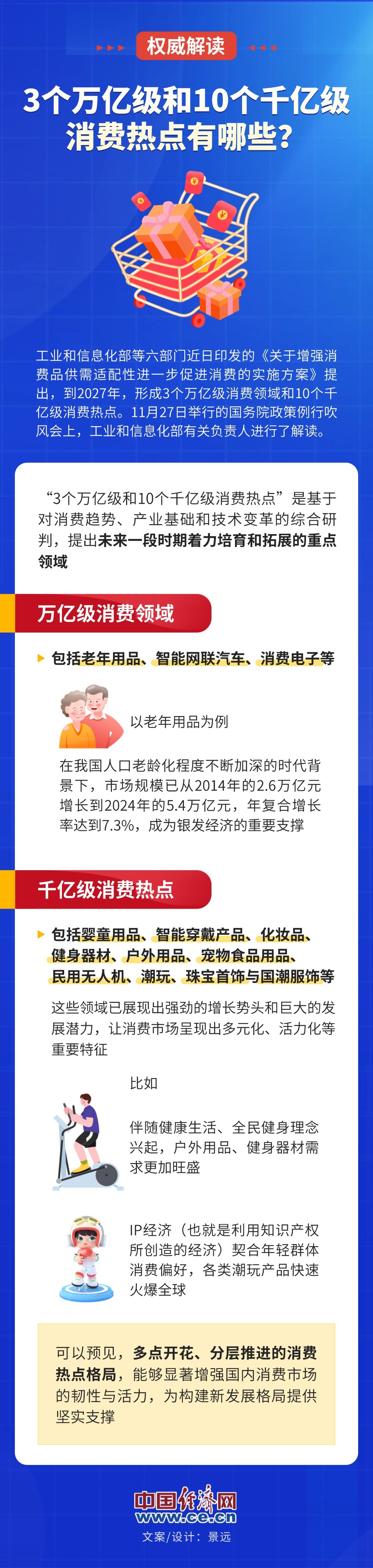
【图解】权威解读:3个万亿级和10个千亿级消费热点有哪些?
Zhong Guo Jing Ji Wang· 2025-11-29 01:34
Core Insights - The implementation plan by six departments, including the Ministry of Industry and Information Technology, aims to establish three trillion-level consumption sectors and ten hundred-billion-level consumption hotspots by 2027, based on comprehensive analysis of consumption trends, industrial foundations, and technological changes [3][4]. Trillion-Level Consumption Sectors - The three trillion-level consumption sectors identified include elderly products, smart connected vehicles, and consumer electronics. For instance, the market size for elderly products has grown from 2.6 trillion yuan in 2014 to an expected 5.4 trillion yuan by 2024, reflecting a compound annual growth rate of 7.3%, highlighting the significance of the silver economy [4]. Hundred-Billion-Level Consumption Hotspots - The ten hundred-billion-level consumption hotspots encompass a diverse range of products, including baby products, smart wearable devices, cosmetics, fitness equipment, outdoor goods, pet food, civilian drones, trendy toys, jewelry, and national trend clothing. These sectors are showing strong growth momentum and significant development potential, contributing to a diversified and vibrant consumer market [4][6]. Emerging Trends - The rise of health-conscious living and the concept of national fitness are driving increased demand for outdoor products and fitness equipment [6]. - The IP economy, which leverages intellectual property to create economic value, aligns with the consumption preferences of younger demographics, leading to a rapid global popularity of trendy toy products [8]. Market Resilience - The multi-faceted and layered approach to consumption hotspots is expected to significantly enhance the resilience and vitality of the domestic consumer market, providing solid support for the construction of a new development pattern [8].
推动消费品供需实现“双向奔赴”
Ren Min Ri Bao Hai Wai Ban· 2025-11-28 21:27
Core Viewpoint - The Ministry of Industry and Information Technology, along with five other departments, has issued an implementation plan aimed at enhancing the adaptability of consumer goods supply and demand, focusing on resolving mismatches and optimizing supply-side structures to achieve dynamic equilibrium over the next five years [1] Group 1: Implementation Goals - By 2027, the plan aims to establish three trillion-level consumption sectors and ten hundred-billion-level consumption hotspots [2] - By 2030, a high-quality development pattern characterized by positive interaction between supply and consumption is expected to be formed, with a steady increase in the contribution of consumption to economic growth [1][2] Group 2: Key Consumption Areas - The trillion-level consumption sectors include elderly products, smart connected vehicles, and consumer electronics [2] - The hundred-billion-level consumption hotspots encompass baby products, smart wearable devices, cosmetics, fitness equipment, outdoor products, pet food, civilian drones, trendy toys, jewelry, and national trend clothing [2] Group 3: Policy Deployment - The implementation plan includes five targeted policy deployments from both supply and demand perspectives to ensure seamless integration from production to consumption [2] - On the supply side, the focus is on new technology applications, brand promotion, and standard upgrades to enhance product quality and align domestic standards with international ones [2] - On the demand side, the plan emphasizes policy guidance, financial support, and the creation of a safe and reliable consumption environment [2][4] Group 4: Market Context - China is the world's second-largest consumer market, with commodity consumption remaining dominant; per capita commodity consumption expenditure has increased from 8,000 yuan to 15,000 yuan since 2013 [4] - In the first ten months of this year, the "old for new" consumption initiative has generated over 2.4 trillion yuan in sales, benefiting more than 360 million people [4]
万亿银发赛道:政策市场双轮驱动 机器人等智慧养老产品加速落地
Xin Jing Bao· 2025-11-28 14:00
Core Viewpoint - The article highlights the opportunities arising from the aging population in China, emphasizing the government's initiative to enhance consumer goods supply and demand adaptability through a new implementation plan aimed at promoting consumption and upgrading industries [1][2]. Group 1: Government Initiatives - The Chinese government has issued a plan to optimize the supply structure of consumer goods by 2027, aiming to create three trillion-level consumption sectors and ten hundred-billion-level consumption hotspots [1][2]. - The plan is the first consumption promotion policy document released after the 20th National Congress of the Communist Party of China, focusing on high-quality development and the dynamic balance of supply and demand [1]. Group 2: Market Growth in Elderly Products - The market for elderly products in China is projected to grow from 2.6 trillion yuan in 2014 to 5.4 trillion yuan by 2024, with a compound annual growth rate of 7.3%, indicating a significant expansion in the silver economy [2]. - The elderly population aged 60 and above is expected to reach 310.31 million by the end of 2024, accounting for 22% of the total population, which reflects a shift in demand from survival to development and participation [8]. Group 3: Technological Innovations in Elderly Care - Various innovative elderly care products are being developed, such as adaptive exoskeleton robots and portable bathing machines, which are being introduced into communities to enhance the quality of life for seniors [3][4]. - The Shanghai Elderly Care Technology Industrial Park has been established to foster innovation in elderly care products, with over 70 companies already participating [3]. Group 4: Rental and Accessibility of Elderly Care Products - A new rental service for rehabilitation aids has been introduced in Shanghai, allowing seniors to rent essential care products at a low monthly fee, making advanced technology more accessible [5][6]. - The introduction of intelligent companion robots, such as "UnyBan," aims to provide emotional support and practical assistance to the elderly, enhancing their daily lives [7]. Group 5: Future Outlook and Challenges - Experts emphasize the need for government intervention to address the supply gap in elderly products, particularly for low-income and rural populations, to ensure a balanced market [8][9]. - The integration of AI technology into elderly care products is seen as a key driver for future growth, with a focus on creating personalized solutions that meet the specific needs of seniors [9][10].

华夏时评:万亿消费蓝图的增长逻辑与挑战
Hua Xia Shi Bao· 2025-11-28 13:42
Core Viewpoint - The implementation plan aims to enhance the adaptability of supply and demand in consumer goods, focusing on expanding domestic demand and promoting consumption as a strategic foundation for economic growth [2][3]. Group 1: Key Concepts of the Implementation Plan - The core concept of the implementation plan is "adaptability," which emphasizes a two-way engagement between supply and demand, ensuring that consumer preferences guide production [3][4]. - The plan outlines the goal of establishing three trillion-level consumption sectors and ten hundred-billion-level consumption hotspots by 2027, marking a shift from directional guidance to precise policy measures [3][4]. Group 2: Targeted Consumption Areas - The three trillion-level consumption sectors include elderly products, smart connected vehicles, and consumer electronics, while the ten hundred-billion-level hotspots encompass baby products, smart wearables, cosmetics, fitness equipment, outdoor goods, pet supplies, civilian drones, trendy toys, jewelry, and national fashion [4]. - The elderly products sector already has a solid foundation, while the smart connected vehicle sector reflects a logic of "incremental expansion," and consumer electronics' potential is driven by AI technology [4]. Group 3: Supply-Side Revolution - The core logic of promoting consumption is a supply-side revolution that aims to create new demand through improved production quality and relevance [5][6]. - The plan's three policy pillars include comprehensive integration of "AI+" actions, flexible manufacturing transformations, and mandatory upgrades to standard systems [5][6]. Group 4: Demand-Side Considerations - The plan also addresses the need for demand-side policies to match the rich supply-side offerings, emphasizing the importance of stable income expectations for consumer spending [6]. - Successful consumption stimulation requires a dual-driven approach from both supply and demand sides, with a focus on creating new jobs through AI and ensuring that technological advancements translate into increased worker income [6]. Group 5: Overall Implications - The implementation plan represents a significant upgrade in China's consumption policy, leveraging AI empowerment, flexible manufacturing, and standard upgrades to create a viable market potential [6]. - The success of supply-side initiatives is contingent upon effective demand-side matching, highlighting the need for policies that not only enhance product intelligence and scene richness but also address consumer income stability [6].
推动供给与消费良性互动、相互促进
Ren Min Ri Bao· 2025-11-28 09:47
Core Insights - The Ministry of Industry and Information Technology, along with five other departments, has issued an implementation plan aimed at enhancing the adaptability of supply and demand in consumer goods, further promoting consumption [1] Group 1: Supply and Demand Transformation - The current supply of consumer goods in China has entered a new development stage characterized by high quality and price, but structural mismatches in supply and demand still exist in certain areas [2] - The implementation plan proposes five measures to address these mismatches, including expanding new product supply and accelerating the application of new technologies and models [2][3] Group 2: Market Segmentation and Consumer Needs - The plan emphasizes the need to cater to diverse consumer needs across different age groups, including initiatives for children's safety and elderly-friendly products [3][5] - It aims to create new consumption scenarios and business models, promoting platforms for product launches and exhibitions [3][6] Group 3: Economic Contribution and Growth - By 2027, the plan aims to create three trillion-yuan-level consumption sectors and ten hundred-billion-yuan-level consumption hotspots, including areas like elderly products and smart connected vehicles [4] - The contribution of consumption to economic growth is expected to steadily increase, with a goal of achieving a high-quality development pattern by 2030 [7] Group 4: Quality and Safety Standards - The National Development and Reform Commission plans to enhance supply quality by focusing on technology leadership and improving brand standards [8] - The State Administration for Market Regulation is set to strengthen the quality and safety of consumer goods, particularly for vulnerable groups such as the elderly and children [8]