Smartphones

Search documents
TrendForce:2026 全球手机产量恐衰退10%至11.35 亿台
Huan Qiu Wang· 2026-02-12 05:45
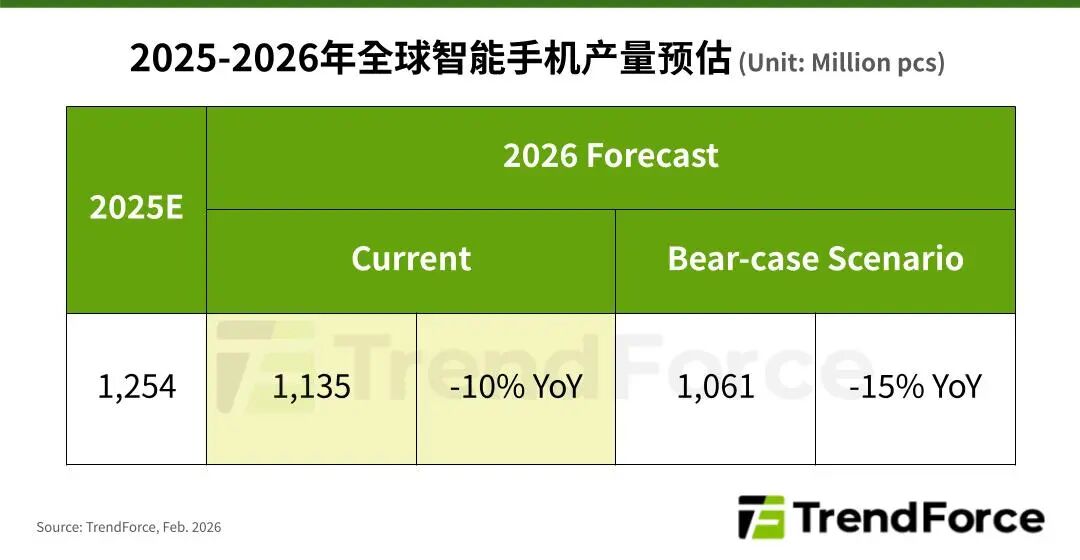
Core Insights - The smartphone industry is facing significant challenges due to a sharp increase in memory prices, which is expected to lead to a notable decline in global smartphone production by 2026 [1] Group 1: Production Forecast - Global smartphone production is projected to decrease by 10% in 2026, reaching approximately 1.135 billion units [1] - If memory prices continue to rise, the production decline could extend to 15% or more, with annual capacity potentially dropping to a minimum of 1.061 billion units [1] Group 2: Cost Impact - The surge in memory prices has directly increased the manufacturing costs of smartphones [1] - For instance, the estimated contract price for a mainstream configuration of 8GB RAM and 256GB storage has risen by nearly 200% compared to the same period in 2025 [1] - The share of memory costs in the overall smartphone production costs has escalated from the previous range of 10%-15% to now 30%-40% [1] Group 3: Manufacturer Strategies - The significant rise in costs has compelled smartphone manufacturers to adjust their production and operational strategies [1] - Manufacturers are responding by raising the prices of end products, restructuring product mix, or optimizing hardware configurations to cope with cost pressures [1]
Meta Platforms Is Preparing for AI's "iPhone Moment": Is the Stock a Buy?
Yahoo Finance· 2026-02-11 18:57
Core Insights - Meta Platforms aims to revolutionize daily interactions with artificial intelligence (AI) through innovative products like AI glasses, potentially leading to significant financial rewards for the company in the future [2][5]. Group 1: AI Glasses and Market Potential - AI glasses are seen as an advanced version of AI chatbots, equipped with cameras and microphones to interact with the environment in real time, thus enhancing user experience [3][4]. - Mark Zuckerberg believes that AI glasses represent the future of technology, similar to the transition from flip phones to smartphones, suggesting that in a few years, most glasses worn will be AI-enabled [4]. - The smart eyewear industry is projected to exceed $30 billion by 2030, with the potential for even greater growth if Meta Platforms successfully leads this market transformation [5]. Group 2: Company Strategy and Growth - Meta Platforms has partnered with well-known eyewear companies to enhance its product offerings, and sales of its AI glasses have reportedly more than tripled in 2025, indicating strong market demand [5]. - The company is positioning itself as a leader in the AI glasses market, which could provide a lucrative opportunity as consumer adoption increases [5].

全球在使用的苹果三星手机均超过10亿部 7家国内品牌进入前10
Xin Lang Cai Jing· 2026-02-11 10:16
在活跃量进入前10的厂商中,除了摩托罗拉和真我,其余8家的活跃量是都在2亿部之上。(海蓝) 【TechWeb】2月11日消息,据外媒报道,有市场研究机 构发布了全球智能手机活跃量报告,从品牌来看苹果是 高居第1,三星电子紧随其后,两家双双超过了10亿部, 小米、OPPO、vivo等国内厂商,也都进入了前10,6家 的活跃量超过了2亿部。 市场研究机构在报告中表示,全球活跃的智能手机在 2025年同比增长2%。 具体到厂商方面,在全球目前活跃的智能手机中,苹果 所占的比例接近25%,三星电子则是接近20%,他们也 是仅有的两家活跃量超过10亿部的厂商。 活跃量进入前10的另外8家,分别是小米、OPPO、 vivo、传音、华为、荣耀、摩托罗拉、真我,其中的小米的份额是超过了10%,OPPO和vivo在5%到 10%之间。 【TechWeb】2月11日消息,据外媒报道,有市场研究机构发布了全球智能手机活跃量报告,从品牌来 看苹果是高居第1,三星电子紧随其后,两家双双超过了10亿部,小米、OPPO、vivo等国内厂商,也都 进入了前10,6家的活跃量超过了2亿部。 市场研究机构在报告中表示,全球活跃的智能手机在202 ...

打明牌:苹果赢得2025智能手机市场增量与存量竞争
3 6 Ke· 2026-02-11 09:35
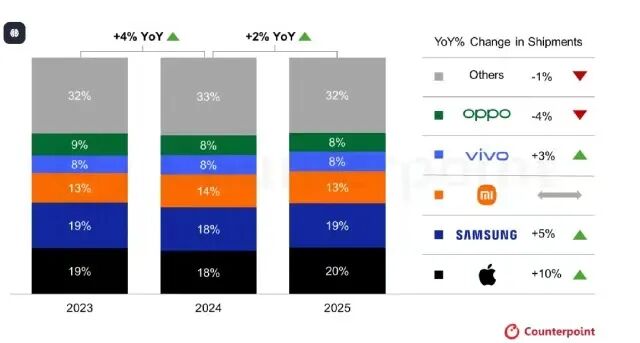
Group 1 - Apple is the biggest winner in the global smartphone market in 2025, achieving a 20% market share and leading both the incremental and installed base competition [1][3][6] - The global smartphone market saw a 2% year-on-year increase in shipments, driven by strong demand in emerging markets and improved economic momentum [1][3] - Apple’s iPhone 17 series significantly contributed to its market share, with one in five new smartphones sold being an iPhone [1][3] Group 2 - In terms of active installed base, Apple holds a 25% share, making it the leader in the global active smartphone market, with over 1 billion active devices [3][10] - Apple and Samsung are the only two manufacturers with over 1 billion active devices, together accounting for 44% of the total active devices [3][10] - Apple's net increase in active devices in 2025 surpassed the total of its next seven competitors combined [5] Group 3 - The iPhone 17 series has been particularly successful in China, with over 10 million units activated for the Pro series and over 20 million for the entire series [9] - Apple's long-term software support and updates contribute to the longevity and value retention of its devices, enhancing user satisfaction and loyalty [10][12] - Apple's strategy of providing extensive software updates and support has created a positive cycle for its user base, encouraging repeat purchases and service revenue [13][15] Group 4 - Apple's service revenue reached $30.01 billion in Q4 2025, a 14% year-on-year increase, driven by its strong installed user base [15] - The smartphone market is entering a phase of slower growth, making the management of existing users increasingly important for manufacturers [16] - Other Chinese brands like Xiaomi, Vivo, OPPO, and Huawei also achieved significant milestones in active device installations, indicating a competitive landscape [16]

TrendForce集邦咨询:存储器涨势加剧终端售价压力 2026年全球手机产量或降至约11.35支
Zhi Tong Cai Jing· 2026-02-11 09:13
Group 1 - The estimated contract price for mainstream memory capacity of 8GB+256GB is expected to rise nearly 200% in Q1 2026 compared to the same period in 2025 [1] - The BOM cost share of memory in smartphones has increased from approximately 10-15% to 30-40% [1] - TrendForce suggests that raising terminal prices has become a necessary choice for maintaining operations, prompting brands to adjust product mix or configurations in response to the ongoing surge in memory prices [1] Group 2 - Samsung, as the leading smartphone brand and a major player in the memory industry, is expected to see a decline in production volume due to overall market weakness, although the reduction will be less severe [1] - Apple, with a higher proportion of high-end models, is better positioned to absorb rising memory costs and has a consumer base more accepting of price adjustments, providing some support for its production performance [1] - Transsion, with a higher proportion of low-end models, is expected to face significant production cuts due to its sensitivity to cost fluctuations and the price sensitivity of its target customers [1] Group 3 - Vivo, Oppo, Xiaomi, and Honor will face not only memory cost pressures in 2026 but also competition from Huawei, which is focusing on promoting its HarmonyOS platform and has a relatively flexible pricing strategy [2] - TrendForce predicts that Huawei may experience the smallest production adjustment among brands and could even see growth despite the challenges [2] - The current decline in terminal sales, triggered by rising memory prices, is compounded by the fact that most electronic devices are sufficiently functional to meet consumer needs, leading to decreased replacement demand and extended upgrade cycles [2]
研报 | 存储器涨势加剧终端售价压力,2026年全球手机产量恐面临下行风险
TrendForce集邦· 2026-02-11 09:01
Core Insights - The global smartphone production is expected to decline by 10% in 2026 due to rising storage prices, with total production estimated at approximately 1.135 billion units [2] - In a bearish scenario, the decline could extend to 15% or more, affecting various brands differently based on their product structure and regional presence [2] Group 1: Storage Price Impact - The estimated contract price for mainstream storage (8GB + 256GB) in Q1 2026 has surged nearly 200% compared to the same period in 2025 [5] - The BOM cost share of storage in smartphones has increased from approximately 10-15% to 30-40% [5] - Brands are likely to raise terminal prices to maintain operations and may need to adjust product configurations in response to ongoing storage price increases [5] Group 2: Brand-Specific Production Outlook - Samsung, as the leading smartphone brand and a major player in the storage industry, is expected to see a decline in production, but the drop will be less severe due to its vertical integration advantages [6] - Apple, with a higher proportion of high-end models, is better positioned to absorb rising storage costs and has a consumer base more accepting of price adjustments, providing some support for its production performance [6] - Xiaomi and Transsion, which focus on low-end models, are more sensitive to cost fluctuations and are expected to experience significant production cuts in 2026 [6] Group 3: Competitive Landscape and Market Dynamics - Brands operating primarily in the Chinese market, such as Vivo, Oppo, Xiaomi, and Honor, face not only storage cost pressures but also competition from Huawei, which is expected to have a more flexible pricing strategy [6] - Huawei is projected to have the smallest production adjustment among brands and may even experience growth despite the challenging environment [6] Group 4: Consumer Behavior and Market Trends - The current decline in terminal demand is triggered by rising storage prices, but the overall functionality of electronic devices has reached a level that satisfies most consumers' daily needs, leading to longer replacement cycles [7] - Even if storage prices stabilize in the future, the underlying structural changes in consumer behavior may not reverse in the short term [7]

静水之下,vivo的平常心与进取心
Guan Cha Zhe Wang· 2026-02-08 00:56
Core Insights - The smartphone industry is transitioning from "incremental competition" to "deep cultivation of existing markets" due to various factors, including AI advancements and fluctuations in key component prices [1] - Vivo's CEO, Shen Wei, emphasizes a dual approach of "calmness" and "proactiveness" to address industry anxieties, focusing on user orientation and innovation as core strategies for sustainable growth [1][3] Group 1 - The Chinese smartphone market in 2025 is characterized by intense competition among leading brands and challenges brought by AI applications, leading to two common strategies: engaging in "parameter wars" or chasing short-term trends [3] - Vivo's strategy of "calmness" reflects a rare strategic stability, focusing on long-term goals rather than being distracted by immediate opportunities, as articulated by Shen Wei's philosophy of "choosing not to act" to maintain focus on core business [3][4] - Vivo's commitment to "user orientation" is seen as a fundamental principle, emphasizing the importance of delivering quality products and experiences, which aligns with the long-term strategies of world-class companies [4] Group 2 - Vivo translates its strategic calmness into sustained investments in four key areas: design, imaging, system, and performance, adopting a "technical compounding" investment approach rather than seeking short-term breakthroughs [6] - The "flying geese" model of industry collaboration is crucial for Vivo, as it partners with key players like MediaTek and BOE to ensure technological differentiation and resilience, aligning with national strategies for strengthening industrial capabilities [8]

跻身全球第四,一家中国手机企业穿越周期的方法论
Guan Cha Zhe Wang· 2026-02-08 00:52
文 观察者网 吕栋 时间来到2026年,手机行业于多重变量交织中前行。AI大模型以更高效的算法架构加速科技产品进 化,内存等关键元器件价格波动则成为行业增长转型的"催化剂",进一步加速了智能手机行业从"增量 争夺"转向"存量深耕"。 在这个充满不确定性的变局时刻,几乎所有企业都在追问:如何才能实现可持续增长?如何构建穿越周 期的核心竞争力? "世界越喧哗,内心越要平静。"vivo创始人、总裁兼首席执行官沈炜近日在2025年年会致辞中,以"平 常心"与"进取心"为关键词,为普遍性的行业焦虑,提供了一个兼具哲学思辨与实践理性的解题思路。 其核心可归结为:以"平常心"埋头种因,拒绝焦虑,深耕用户导向;以"进取心"向上生长,聚焦创新, 将理念转化为扎实的组织能力。 这是一家企业长达30年的经营智慧,也是中国科技产业在从"规模扩张"转向"质量引领"的关键转折点 上,一种值得借鉴的成长范式。 择其不为,在不确定性中向下扎根 刚刚过去的2025年,中国手机市场呈现出一幅充满张力的图景:头部品牌竞争胶着,大模型端侧落地带 来应用挑战……为缓解集体性焦虑,市场上有两种策略比较常见:要么卷入"参数战"与"价格战"的零和 内耗,要 ...
中端手机春节“生死战”:集体涨价,进退两难
凤凰网财经· 2026-02-06 11:38
Core Viewpoint - The mid-range smartphone market is facing significant challenges due to rising memory prices, leading to increased prices or reduced specifications, which undermines the value proposition of mid-range devices [2][3][19]. Group 1: Market Trends - The mid-range smartphone segment has seen its market share decline from 35% in 2021 to an expected 23% by 2027, while the entry-level market remains stable at 41%-45% [13]. - In January 2026, Android manufacturers launched five mid-range models, indicating a crowded market with intense competition [4]. - The mid-range segment, which once accounted for over half of the smartphone market, now serves around 500 million users in China, with a significant portion of sales concentrated in the 2000-4000 yuan price range [6][12]. Group 2: Product Features and Consumer Preferences - Recent mid-range models emphasize battery life, with many devices featuring batteries over 6000mAh, catering to the increasing reliance on smartphones [7][11]. - Manufacturers are shifting focus from parameter-heavy designs to user experience, with features tailored to specific use cases, such as gaming or photography [11][19]. - The best-selling model recently is the OPPO Reno 15, with sales reaching 1.1875 million units shortly after launch, followed by the Honor 500 series [11]. Group 3: Pricing and Profitability - Rising memory chip prices have significantly impacted mid-range device costs, with LPDDR4X prices increasing by nearly 80% and LPDDR5X prices more than doubling [19][21]. - Many manufacturers have opted to raise prices by 200-600 yuan for new models to maintain profit margins, with the average profit for a 3000 yuan device dropping to just 30 yuan [18][21]. - The introduction of government subsidies has not led to substantial sales increases in the mid-range segment, with growth primarily occurring in high-end and low-end markets [15][24]. Group 4: Future Outlook - The mid-range smartphone market is at a critical juncture, with predictions of a 3%-4% decline in overall smartphone shipments in 2026 [24]. - Companies are exploring strategies to simplify product offerings and enhance competitiveness, such as introducing "super standard versions" to streamline configurations [24][25]. - The ongoing price increases and market saturation may lead to further challenges for mid-range devices, potentially marking 2026 as one of the toughest years for this segment [25].
从“猎奇”到“信赖”:折叠屏手机用户发展洞察报告
艾瑞咨询· 2026-02-05 00:00
本报告利用定量问卷调研、专家访谈及桌面研究多种研究方法,综合分析了折叠屏手机行业的发展现状、市 场竞争格局、用户行为及需求,预测产品未来趋势。报告指出,全球折叠屏手机市场持续增长,尤其是中国 市场表现突出,技术进步和产业链完善推动了产品形态的多样化。在竞争格局方面,中国成为全球折叠屏手 机的主要增长引擎,市场份额呈现集中趋势,华为以较高的份额持续引领行业。用户对折叠屏手机购买意愿 不断提高,对产品功能和体验有更高要求。展望未来,折叠屏手机产品将实现从小众市场向大众市场过渡, 市场需求持续增长,硬件优化创新和软件协同生态构建和智能交互体验的提升将是关键发展方向。随着消费 者对折叠屏手机认可度提升,购买意愿增强,折叠屏手机消费将逐步实现从"猎奇尝鲜"到"信赖常用"的转 变。 折叠屏手机 丨洞察 报告 摘要: 全球智能手机市场已全面进入存量竞争 2014年-2017年期间,智能手机市场仍处于增量发展阶段,全球出货量由12.4亿部增长至14.6亿部的 峰值。自2017年起,市场进入存量竞争阶段,年均出货量下降约2.52%,至2024年全球智能手机出 货量已降至12.2亿部。 折叠屏手机成为突破市场增长瓶颈的战略方向 ...