外卖

Search documents
外卖“新国标”落地,美团、淘宝闪购、京东发声:积极助力
Nan Fang Du Shi Bao· 2025-12-05 08:56
Core Viewpoint - The implementation of the new national standard for food delivery platforms, titled "Basic Requirements for Delivery Platform Service Management" (GB/T 46862—2025), aims to address issues such as "ghost deliveries," irrational competition, and insufficient protection of delivery personnel's rights within the industry [1][2][7]. Group 1: Standard Implementation - Major food delivery platforms, including Meituan, Taobao Flash Purchase, and JD Delivery, have committed to voluntarily implementing the new national standard and integrating its requirements into their operational management and service processes [1][7]. - All three platforms participated deeply in the drafting and formulation of the standard, contributing to discussions on core clauses and endorsing principles such as fair competition and service quality enhancement [2][4][6]. Group 2: Focus Areas of the Standard - The standard focuses on four main areas: merchant management, platform fees and promotional practices, labor management, and dispute resolution within the platform [1][7]. - Specific measures include requiring merchants to provide location-verified videos to combat "ghost deliveries," implementing dynamic review mechanisms for risk monitoring, and ensuring transparency in fee structures by detailing service charges to merchants [8]. Group 3: Industry Impact and Future Directions - The standard represents a shift from an "efficiency-first" approach to a "people-centered" philosophy, aiming to balance corporate profits with the rights of workers in the delivery sector [9]. - The market regulatory authority plans to promote the standard actively, encouraging the industry to adopt these guidelines to enhance service management and protect the rights of various stakeholders [9].



中国三大外卖平台:自愿执行“新国标”
Zhong Guo Xin Wen Wang· 2025-12-05 08:20
中国三大主要外卖平台4日至5日接连发文称,自愿执行外卖"新国标",积极助力推动外卖行业规范管 理、品质服务、理性竞争、生态共赢。 中国国家市场监管总局日前发布实施推荐性国家标准《外卖平台服务管理基本要求》(以下简称《基本 要求》),业内称之为外卖"新国标"。"新国标"针对近年来外卖行业存在的"幽灵外卖"、非理性竞争以及 外卖配送员权益保障不足等问题,进一步立下"新规矩"。 (文章来源:中国新闻网) 今年,外卖平台"补贴大战"引发社会高度关注,中国官方多次就市场公平有序竞争问题约谈多家外卖平 台企业。在官方"约谈"后,今年8月,饿了么、美团、京东平台同日发文抵制行业内恶性竞争,并提出 进一步规范外卖平台补贴行为等有关举措。 此次出台的《基本要求》9月下旬公开征求意见,聚焦平台内商户管理,强化主体责任落实,守护消费 者"舌尖上的安全";聚焦平台收费与促销行为,强化竞争秩序规范;聚焦平台用工管理,强化配送员权 益保障;聚焦平台内争议处理,引导平台建立完善消费者权益保护体系,完善消费者、商户、配送员等 多元主体投诉机制。 据中国互联网络信息中心统计,截至2024年底,中国网上外卖用户规模达5.45亿人,约占网民整体的 ...
淘宝闪购、美团、京东外卖齐发声明
Guan Cha Zhe Wang· 2025-12-05 08:15
Core Viewpoint - The market regulatory authority has implemented a recommended national standard for food delivery platforms to address issues such as "ghost deliveries," irrational competition, and insufficient protection of delivery personnel rights [1] Group 1: Key Focus Areas of the Standard - Focus on merchant management within platforms, emphasizing the responsibility of platforms to manage and serve merchants effectively, including compliance with food safety standards [1] - Focus on platform fees and promotional activities, aiming to clarify fee structures and promote fair competition by ensuring transparency in pricing and promotional rules [1] - Focus on labor management for delivery personnel, proposing measures to protect their rights, including reasonable working hours, professional training, and diverse protection mechanisms [1] - Focus on dispute resolution within platforms, encouraging the establishment of a consumer rights protection system and transparent complaint handling processes [1] Group 2: Industry Response - Major platforms such as Taobao Shangu, Meituan, and JD Delivery have publicly committed to implementing the national standard, recognizing its importance for fair competition and service quality [2] - These platforms participated in the drafting and discussion of the standard, expressing their commitment to integrate its requirements into their operations and improve service management for merchants and delivery personnel [2] - The platforms view the implementation of this standard as an opportunity to promote industry regulation, quality service, rational competition, and a win-win ecosystem, contributing to the sustainable development of the food delivery sector [2]

剑指“幽灵外卖”“外卖员权益”,外卖服务管理有国标了 美团、京东外卖、淘宝闪购发声
Mei Ri Jing Ji Xin Wen· 2025-12-05 08:13
Core Viewpoint - The introduction of the national standard for food delivery platforms aims to address long-standing issues such as "ghost deliveries," the protection of delivery personnel's rights, and irrational competition among platforms, thereby enhancing the overall service management and transparency in the industry [1][2][3]. Group 1: National Standard Implementation - The national standard titled "Basic Requirements for Food Delivery Platform Service Management" was released by the State Administration for Market Regulation on December 4, 2023, and major platforms like Meituan, JD Delivery, and Taobao Shanguo announced voluntary compliance [1][2]. - The standard mandates that merchants actively participate in the "Internet + Bright Kitchen" initiative, which involves real-time video monitoring of food preparation processes, and platforms are required to support this implementation [1][3]. Group 2: Merchant Management - The standard emphasizes the need for stricter management of merchants to combat "ghost deliveries" and "explosive orders," requiring merchants to provide location-verified videos and ensuring that platforms conduct monthly checks on at least 5% of merchant operations [3][4]. - It also highlights the importance of food safety risk identification and mandates verification of merchant information in cases of customer complaints or discrepancies in operational addresses [3]. Group 3: Pricing Behavior - The standard addresses issues of excessive and irrational pricing by platforms, stating that the costs of promotional activities should be borne by the platforms themselves and not passed on to merchants or delivery personnel [4]. - It prohibits platforms from penalizing merchants who do not participate in promotions by reducing their visibility or limiting their traffic [4]. Group 4: Delivery Personnel Rights - The standard calls for the optimization of scheduling algorithms and the protection of delivery personnel's rights, including fair compensation and the provision of subsidies during adverse conditions [5]. - It specifies that penalties for delivery delays should not involve deductions from earnings, promoting a more equitable treatment of delivery workers [5]. Group 5: Consumer Rights Protection - The standard addresses consumer rights by prohibiting practices such as "big data killing" and personal information leakage, ensuring that promotional pricing is applied equally to all consumers under similar conditions [5]. - It mandates clear notifications for automatic renewals and extensions to protect consumer interests [5]. Group 6: Industry Transition - The food delivery market is shifting from a focus on aggressive subsidies and competition to a model emphasizing food safety, service quality, and social responsibility, marking a transition to a "quality competition" phase [2][6]. - Recent financial reports indicate that major platforms have incurred significant costs in their competitive strategies, leading to a collective reflection on sustainable development paths within the industry [6][7]. - The introduction of the national standard is seen as a catalyst for this transition, providing clear guidelines for enhancing service quality and operational transparency [7].
剑指“幽灵外卖”与非理性竞争!监管最新明确
券商中国· 2025-12-05 06:54
Core Viewpoint - The article discusses the implementation of a national standard for food delivery platforms aimed at addressing issues such as "ghost deliveries," irrational competition, and insufficient protection of delivery personnel's rights, thereby promoting a fair and orderly market environment [1][2][3]. Group 1: Regulatory Framework - The State Administration for Market Regulation has introduced a recommended national standard titled "Basic Requirements for Service Management of Delivery Platforms," focusing on merchant management within platforms and emphasizing food safety responsibilities [1][2]. - The standard aims to clarify platform charging rules and promotional activity management, promoting transparency in fees and rationality in promotional rules [1][2]. Group 2: Industry Challenges - The rapid growth of the food delivery industry has led to significant challenges, including "ghost deliveries," irrational competition, and inadequate rights protection for delivery personnel, which hinder sustainable development [2][3]. - The competitive landscape of the delivery industry is relatively concentrated, with issues such as cost transfer from promotions, forced merchant participation in activities, and malicious marketing practices becoming prevalent [3]. Group 3: Labor Rights and Delivery Personnel - The standard proposes measures to address the long working hours and high intensity of work faced by delivery personnel, aiming to enhance their labor rights and reduce their burdens [4].

美团、京东外卖、淘宝闪购集体声明:自愿执行!外卖新国标:骑手连续接单超4小时,暂停派单20分钟,保障骑手平均每周至少休息一天
Mei Ri Jing Ji Xin Wen· 2025-12-05 06:03
Core Viewpoint - The recent implementation of the national standard "Basic Requirements for Delivery Platform Services" aims to address issues in the food delivery industry, including "ghost deliveries," irrational competition, and insufficient protection of delivery personnel's rights. Group 1: Delivery Personnel Rights Protection - The new standard mandates that delivery platforms and partner companies must ensure adequate rest for delivery personnel, limiting their daily working hours to a maximum of 8 hours and requiring a fatigue alert after 4 continuous hours of work [5][6]. - Platforms are prohibited from using algorithms or incentives to force delivery personnel into overtime work, emphasizing the need for a fatigue alert mechanism and ensuring at least one day off per week for delivery personnel [6][15]. Group 2: Merchant Management - Merchants are required to provide a video for location verification, and platforms must ensure consistency between the video and merchant licenses [8]. - Platforms are encouraged to provide "order surge" alerts to merchants and consumers to promote rational ordering behavior [11]. Group 3: Pricing and Fees - The standard outlines three types of fees: technology service fees, delivery service fees, and promotional service fees, with a requirement for platforms to disclose detailed billing information to merchants [12][13]. - Platforms must not transfer promotional costs to merchants or impose unreasonable conditions for participation in promotional activities [13][14]. Group 4: Consumer Rights Protection - Platforms are required to establish a consumer rights protection system that ensures timely responses and safeguards consumer rights, including the right to information and fair treatment [15]. - Personal information collection must be reasonable and consensual, with restrictions on unsolicited commercial communications [15]. Group 5: Complaint and Appeal Mechanisms - Platforms must clarify the procedures for merchant and delivery personnel appeals, ensuring timely responses and simplified processes [16][17]. - A tiered response mechanism for consumer complaints must be established, with immediate human responses for serious safety issues [18].
外卖“新国标”来了!新在哪?(附一图读懂)
Xin Hua She· 2025-12-05 05:22
Core Viewpoint - The newly implemented national standard for food delivery platforms aims to enhance management practices, improve service quality, and foster a win-win situation for all stakeholders in the food delivery industry [1]. Group 1: Industry Standards - The standard addresses prominent issues within the food delivery sector, focusing on merchant management, food safety responsibilities, and consumer protection [1]. - It emphasizes the importance of food safety, urging platforms to take responsibility for ensuring the safety of food delivered to consumers [1]. Group 2: Market Competition - The standard aims to simplify fee structures and regulate promotional activities to create a fair and orderly competitive environment within the market [1]. - By addressing these aspects, the standard seeks to promote healthy competition and innovation in the food delivery industry [1]. Group 3: Labor Rights - The standard also focuses on labor management, particularly concerning the rights and protections of delivery personnel, including aspects like remuneration, working hours, and social security [1]. - This initiative is intended to strengthen the protection of delivery workers' rights and improve their working conditions [1].
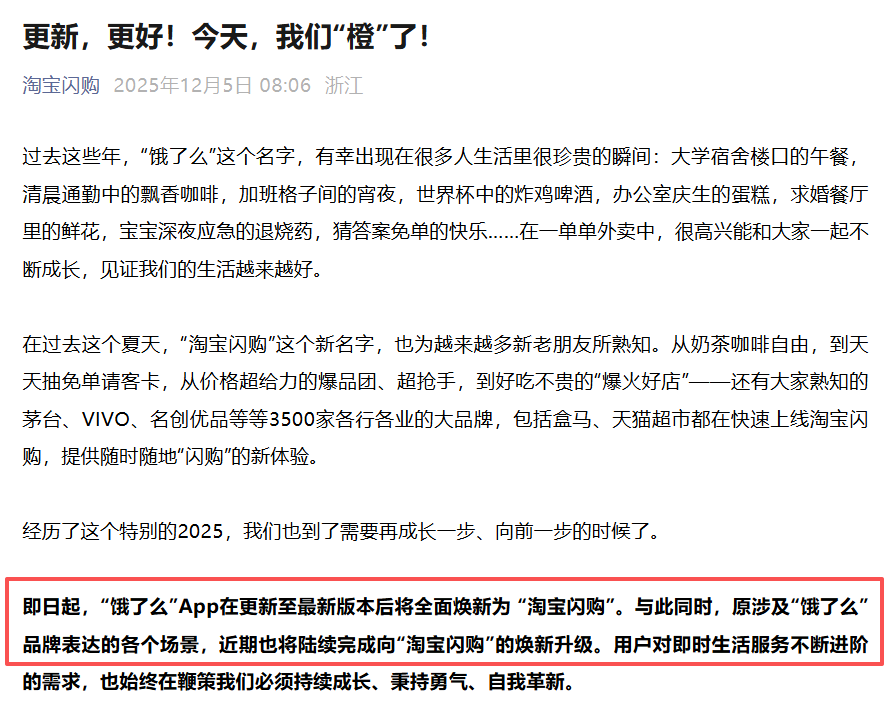
饿了么更名!外卖“三巨头”集体声明
Zhong Guo Zheng Quan Bao· 2025-12-05 05:20
Core Viewpoint - Ele.me has rebranded to Taobao Flash Purchase, marking a step towards integrating lifestyle services with e-commerce as part of Alibaba's strategy to create a large consumer platform [4]. Group 1: Company Updates - Ele.me and Taobao Flash Purchase will undergo a complete rebranding, with the transition starting immediately [1]. - Alibaba's revenue for Q2 of FY2026 (Q3 2025) was 2,477.95 billion yuan, a 5% year-on-year increase, but operating profit dropped by 85% to 53.65 billion yuan due to investments in instant retail and user experience [5]. - Meituan reported a slight revenue increase of 2% to 954.88 billion yuan for Q3 2025, but faced an adjusted net loss of 160.10 billion yuan, compared to a profit of 128.29 billion yuan in the same period last year [4]. Group 2: Market Competition - The intense competition in the food delivery sector has significantly impacted the financial performance of major players like Alibaba, Meituan, and JD.com [4]. - JD.com reported a total revenue of 2,991 billion yuan for Q3, a 14.9% year-on-year increase, but net profit fell by 54.7% to 53 billion yuan, with new business losses reaching 157.4 billion yuan [5]. Group 3: Strategic Focus - Both Alibaba and JD.com view instant retail as a long-term strategy, with JD.com focusing on establishing market share in the "quality takeaway" sector [5]. - Alibaba has seen significant improvements in unit economic efficiency (UE) for Taobao Flash Purchase since October, with losses per order halved compared to July and August [6]. - Meituan's CEO emphasized the unsustainability of the price war in the food delivery market, advocating for high-quality and sustainable development in the industry [6].
美团、京东外卖、淘宝闪购发布声明
证券时报· 2025-12-05 04:45
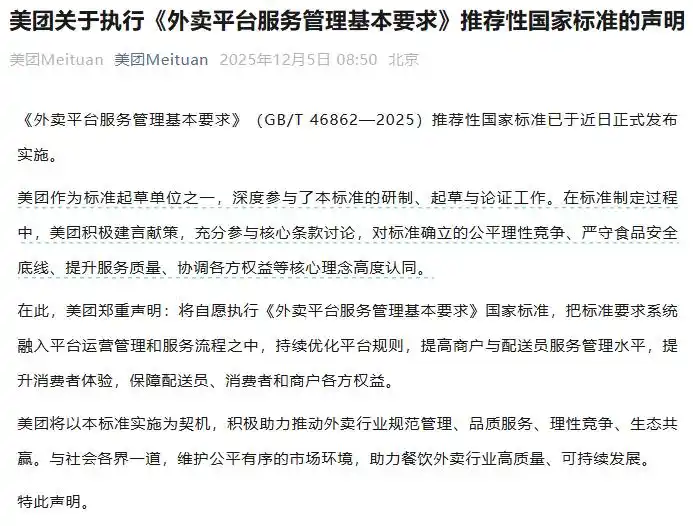
Core Viewpoint - The article discusses the implementation of the national standard "Basic Requirements for Delivery Platform Services" by Meituan, JD.com, and Taobao, emphasizing their commitment to improving service quality and ensuring fair competition in the food delivery industry [1][5]. Group 1: Standard Implementation - Meituan, JD.com, and Taobao, as drafting units, actively participated in the formulation of the national standard and expressed strong agreement with its core principles, including fair competition, food safety, service quality enhancement, and stakeholder rights coordination [5]. - All three companies declared their voluntary commitment to integrate the standard's requirements into their operational management and service processes, aiming to optimize platform rules and improve service management for merchants and delivery personnel [5]. Group 2: Regulatory Background - The National Market Supervision Administration announced the approval and implementation of the "Basic Requirements" standard to address issues such as "ghost deliveries," irrational competition, and insufficient protection of delivery personnel's rights [6]. - The administration has previously engaged in discussions with delivery platforms to ensure compliance with laws and regulations, emphasizing the need for platforms to uphold fair competition [6]. Group 3: Standard Development Process - The development of the standard involved extensive consultations with experts, platform companies, industry associations, and representatives from merchants and delivery personnel to enhance its practicality and effectiveness [7]. - The standard addresses key issues in the delivery industry, focusing on merchant management, competition order, delivery personnel rights protection, and dispute resolution mechanisms [7].
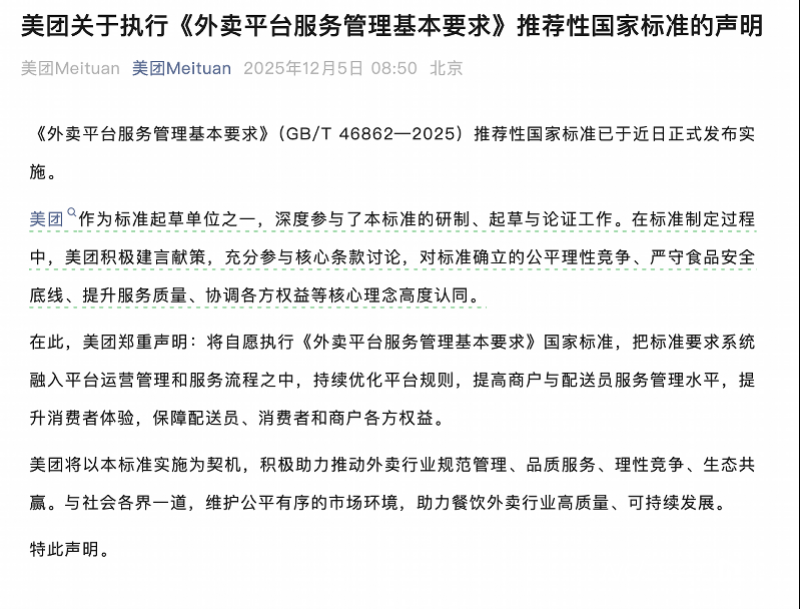
美团、京东外卖发布声明
券商中国· 2025-12-05 04:03
Core Viewpoint - The newly implemented national standard "Basic Requirements for Delivery Platform Service Management" (GB/T 46862—2025) aims to address issues in the food delivery industry, such as "ghost deliveries," irrational competition, and insufficient protection of delivery personnel's rights [2]. Group 1: Implementation of Standards - Meituan and JD Delivery, as co-drafters of the standard, have committed to voluntarily implementing the "Basic Requirements" and integrating its principles into their operational management and service processes [1]. - Both platforms emphasize the importance of fair competition, food safety, service quality enhancement, and the protection of the rights of consumers, merchants, and delivery personnel [1]. Group 2: Focus Areas of the Standard - The standard focuses on four key areas: 1. Merchant management within the platform, emphasizing the responsibility of the platform [2]. 2. Pricing and promotional activities, aiming to regulate competitive practices [2]. 3. Employment management of delivery personnel, ensuring their rights are protected [2]. 4. Dispute resolution mechanisms within the platform, promoting collaborative solutions [2]. Group 3: Industry Impact - The implementation of this standard is seen as an opportunity to promote standardized management, quality service, rational competition, and ecological win-win scenarios in the food delivery industry [1]. - The platforms aim to work with various stakeholders to maintain a fair and orderly market environment, contributing to the high-quality and sustainable development of the food delivery sector [1].