量子科技

Search documents
帮主郑重午评:早盘低开翻红!海南、电网爆了,午后这么操作更稳
Sou Hu Cai Jing· 2025-11-05 05:07
Core Viewpoint - The market experienced a low opening but rebounded by midday, indicating resilience despite a decrease in trading volume, suggesting caution among investors [1][5]. Group 1: Market Performance - The three major indices opened lower, but by midday, the Shanghai Composite and ChiNext indices turned positive, with the Shenzhen Component only down 0.15% [1]. - Over 3,000 stocks in the market saw gains, indicating a broad recovery despite initial fears [1]. Group 2: Sector Highlights - The Hainan Free Trade Zone and electric grid equipment sectors performed exceptionally well, with stocks like Haima Automobile achieving four consecutive daily limits and several others hitting daily limits as well [3]. - The semiconductor and quantum technology sectors faced notable declines, attributed to profit-taking rather than fundamental issues [3][4]. Group 3: Trading Strategy - For investors holding stocks in the Hainan and electric grid sectors, it is advised to avoid overextending positions and to monitor trading volume before making further investments [3][5]. - Investors with semiconductor and quantum technology stocks should hold if the companies' fundamentals remain strong, as short-term adjustments are normal [4]. - New investors are encouraged to avoid chasing stocks that have already surged significantly and instead look for reasonably valued stocks in related sectors or those with solid earnings support [4].


A50直线拉升,海南自贸爆发,A股230万新股民入市
2 1 Shi Ji Jing Ji Bao Dao· 2025-11-05 04:14
Market Overview - On November 5, A-shares opened lower but rebounded, with the Shanghai Composite Index up 0.05% and the Shenzhen Component down 0.15% at midday. The total trading volume in the Shanghai and Shenzhen markets was 1.14 trillion yuan, a decrease of 79.9 billion yuan compared to the previous trading day [1][2]. Sector Performance - Sectors such as Hainan, electric grid equipment, consumer goods, and coal saw significant gains, while quantum technology, semiconductors, and gaming sectors experienced declines. Notably, electric grid equipment stocks surged, with companies like Moen Electric and China Energy Electric achieving consecutive gains, and TBEA hitting a new high [5]. - The Hainan sector remained active following the implementation of new duty-free policies on November 1, leading to increased shopping activity compared to previous years [5]. New Investor Activity - In October, the Shanghai Stock Exchange reported 2.31 million new A-share accounts, a decrease of 21.36% from September's 2.94 million. Year-to-date, the total number of new accounts reached 22.46 million, reflecting a year-on-year increase of 10.57% [9][10]. Cryptocurrency Market - The cryptocurrency market faced significant downturns, with Bitcoin dropping below $99,000 and over 480,000 traders liquidated, resulting in a loss of $2 billion in the past 24 hours [11][12].
午评:沪指探底回升半日微涨,海南自贸区、电网设备板块集体爆发
Xin Lang Cai Jing· 2025-11-05 04:13
Market Overview - The three major indices showed mixed performance in early trading, with the Shanghai Composite Index up 0.05%, the Shenzhen Component down 0.15%, and the ChiNext Index up 0.17% [1] - The total trading volume in the Shanghai, Shenzhen, and Beijing markets reached 1.1497 trillion yuan, a decrease of 81.4 billion yuan compared to the previous day [1] - Over 3,000 stocks in the market experienced gains [1] Sector Performance - The Hainan Free Trade Zone, electric grid equipment, airport and shipping, tourism and hotels, and food and beverage sectors saw the largest gains [1] - The semiconductor, quantum technology, and gaming sectors experienced the most significant declines [1] Notable Stocks - The Hainan Free Trade Zone sector showed strong performance, with Haima Automobile achieving four consecutive trading limit-ups, and companies like Caesar Travel, Hainan Development, and Intercontinental Oil & Gas hitting the daily limit [1] - The electric grid equipment sector also saw a collective surge, with Zhongneng Electric achieving two consecutive limit-ups, and nearly ten stocks including New Energy Taishan and Sun Cable hitting the daily limit [1] - Other sectors such as batteries and retail showed intraday fluctuations [1] - Conversely, the storage chip sector faced adjustments, with stocks like Fudan Microelectronics, Yunhan Chip City, and Zhaoyi Innovation declining [1] - Quantum technology concept stocks also retreated, with Keda Guokuan, Fujida, and Guodun Quantum experiencing declines [1]
市场低开高走,沪指、创业板指双双探底回升翻红,电网设备集体爆发
Feng Huang Wang Cai Jing· 2025-11-05 03:47
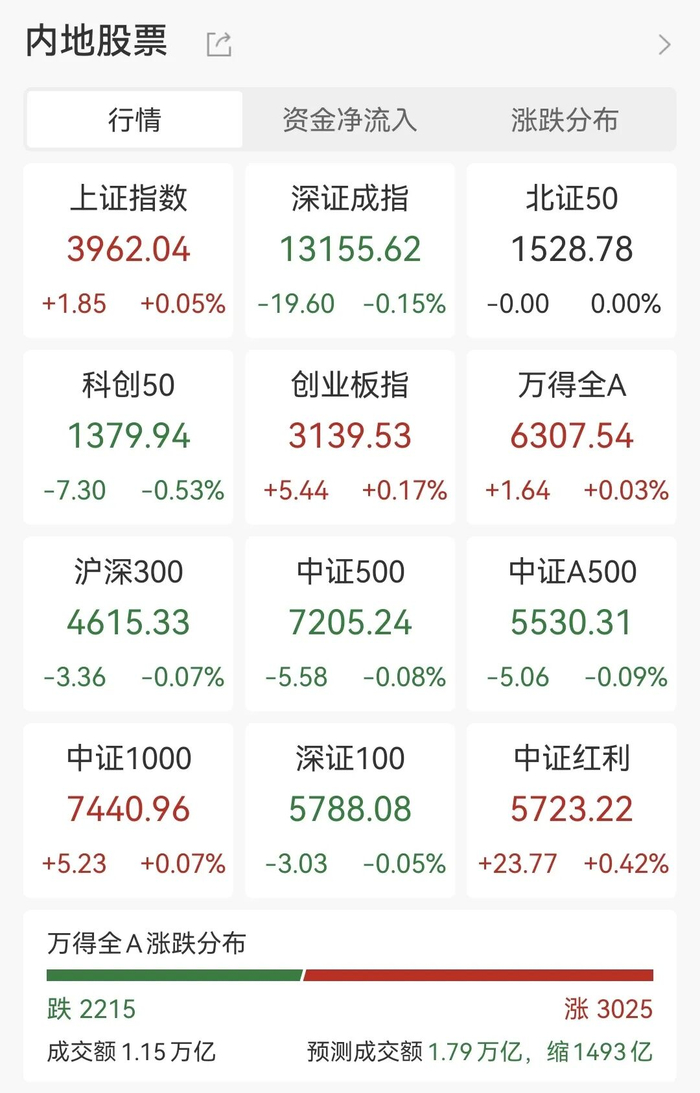
Market Overview - The market opened lower but rebounded, with the Shanghai Composite Index and the ChiNext Index both turning positive. As of the midday close, the Shanghai Composite Index rose by 0.05%, while the Shenzhen Component Index fell by 0.15%, and the ChiNext Index increased by 0.17% [1] - The total trading volume in the Shanghai and Shenzhen markets reached 1.14 trillion, a decrease of 79.9 billion compared to the previous trading day [1][6] Index Performance - The Shanghai Composite Index closed at 3962.04, with a slight increase of 0.05%. The Shenzhen Component Index closed at 13155.62, down by 0.15%. The ChiNext Index ended at 3139.53, up by 0.17% [2][3] - The North 50 Index remained unchanged at 1528.78 [2] Sector Performance - The electric grid equipment sector saw significant gains, with stocks like Moen Electric and China Energy Electric achieving consecutive gains, and Tebian Electric hitting a new high [1] - The consumer sector also performed well, with multiple stocks such as Caesar Travel and Anji Food reaching their daily limit [1] - The coal sector was active, with Antai Group achieving 9 gains in 15 days and Baotailong hitting the daily limit [1] - The Hainan sector showed strength again, with stocks like Haima Automobile reaching their daily limit [1] - In contrast, the quantum technology sector experienced a downturn, with stocks like Keda Guokuan and Geer Software seeing significant declines [3] Market Sentiment - 60.03% of users are bullish on the market [4] - The market showed a total of 3032 stocks rising, 198 remaining flat, and 2216 declining, with 58 stocks hitting the daily limit [5]


A股,探底回升
财联社· 2025-11-05 03:43
Market Overview - A-shares opened lower but rebounded, with both the Shanghai Composite Index and the ChiNext Index turning positive. The half-day trading volume in the Shanghai and Shenzhen markets reached 1.14 trillion yuan, a decrease of 79.9 billion yuan compared to the previous trading day [1]. Sector Performance - The electric grid equipment sector saw significant gains, with stocks like Moen Electric, Zhongneng Electric, and Shima Power achieving consecutive gains, while Tebian Electric hit a new high with a limit-up [3]. - The consumer sector also performed well, with multiple stocks such as Caesar Travel and Anji Food reaching their daily limit [3]. - The coal sector remained active, with Antai Group achieving 9 gains in 15 days and Baotailong hitting a limit-up [3]. - The Hainan sector strengthened again, with stocks like Haima Automobile reaching their daily limit [3]. - On the downside, quantum technology stocks experienced adjustments, with Keda Guokuan and Geer Software seeing significant declines [3]. Index Performance - By the end of trading, the Shanghai Composite Index rose by 0.05%, the Shenzhen Component Index fell by 0.15%, and the ChiNext Index increased by 0.17% [3].

A股午评:创业板指涨0.17%,超3000股上涨,海南自贸区板块爆发
Ge Long Hui· 2025-11-05 03:40
A股三大指数早盘低开高走,沪指涨0.05%报3962.04点,深成指跌0.15%,创业板指涨0.17%,北证50平 收。沪深京三市半日成交额11497亿元,较上日缩量814亿元,全市场超3000只个股上涨。盘面上,海南 自贸区、电网设备、免税店板块集体走强,半导体、量子科技板块跌幅居前。 ...
上市公司投身产业实践 绘制昂扬向上科创曲线
Zhong Guo Zheng Quan Bao· 2025-11-04 20:17
Core Insights - The "14th Five-Year Plan" has laid a solid foundation for China's technological strength, with a projected R&D investment exceeding 3.6 trillion yuan in 2024, marking a 48% increase from 2020 [1] - A-shares listed companies are pivotal in transforming policy blueprints into industrial practices, with a total R&D investment of 1.16 trillion yuan in the first three quarters of 2025, reflecting a 3.88% year-on-year growth [1] - The focus on key areas such as integrated circuits, advanced materials, and biomanufacturing is expected to drive significant breakthroughs in core technologies during the "15th Five-Year Plan" [2] Group 1: Technological Breakthroughs - The "15th Five-Year Plan" emphasizes the need for decisive breakthroughs in critical core technologies across various sectors, including integrated circuits and high-end instruments [2] - Companies like Zhichun Technology are transitioning from equipment suppliers to solution partners, enhancing their competitive edge in the semiconductor industry [2] - The continuous increase in R&D investment by listed companies is crucial for enhancing their global market competitiveness [2] Group 2: Emerging and Future Industries - The development of strategic emerging industries such as new energy, aerospace, and low-altitude economy is highlighted as essential for economic growth [3] - Companies are actively engaging in the development of AMOLED display technologies, with a projected shipment area of nearly 8.8 million square meters in 2024 [3] - The rise of low-altitude economy is seen as a transition from policy-driven to technology-driven growth, with companies focusing on safety and efficiency [3] Group 3: Capital Market and Innovation Ecosystem - The capital market is undergoing reforms to support emerging industries, with companies like Yushu Technology and Blue Arrow Aerospace advancing their IPO processes [4] - The integration of innovation resources is being promoted, with companies forming innovation alliances to enhance collaboration across various sectors [5] - Artificial intelligence is identified as a key accelerator for the integration of technological and industrial innovation, with significant growth in AI applications [6]
六大产业成长空间大 59只概念股业绩有望持续高增长
Zheng Quan Shi Bao· 2025-11-04 17:37
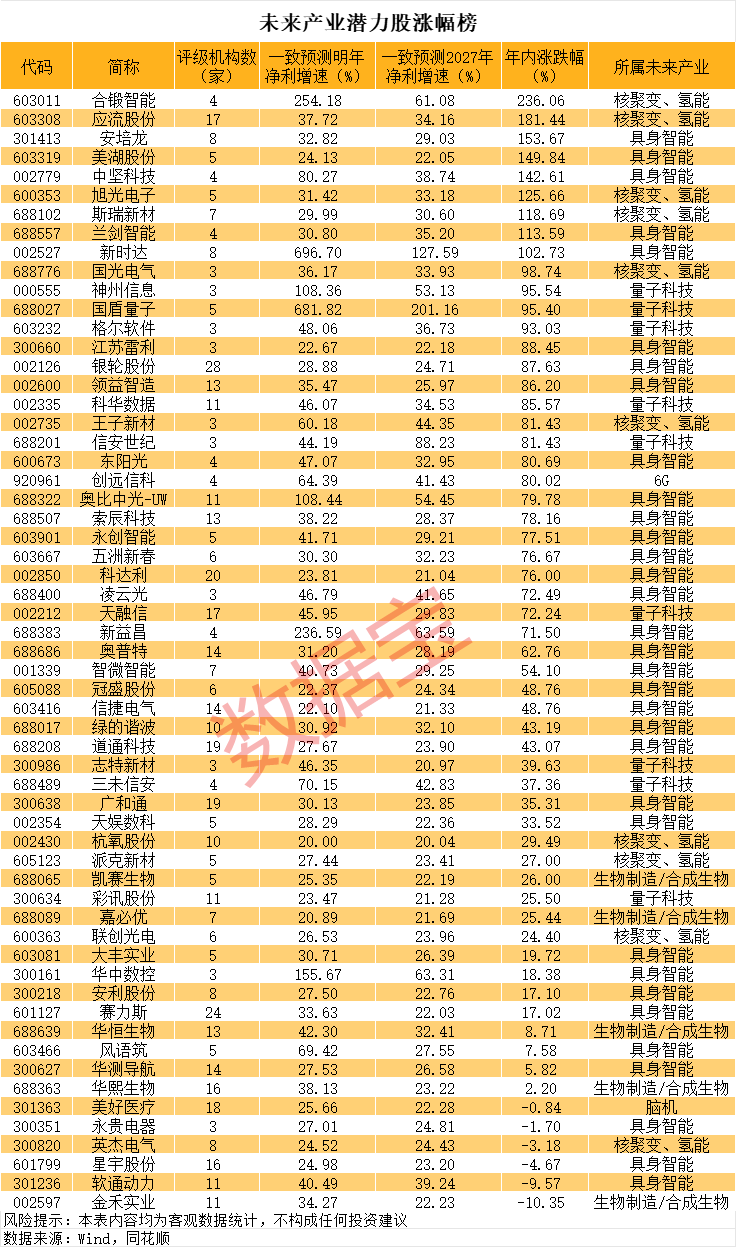
Core Insights - The major bull stocks this year are concentrated in sectors such as artificial intelligence, precious metals, robotics, and innovative pharmaceuticals, many of which are closely related to future technology industries [1] - The "14th Five-Year Plan" emphasizes the forward-looking layout of future industries, promoting quantum technology, biomanufacturing, hydrogen energy, nuclear fusion energy, brain-computer interfaces, embodied intelligence, and 6G as new economic growth points [1] - The 2025 Government Work Report explicitly states the establishment of a growth mechanism for future industry investment, nurturing sectors like biomanufacturing, quantum technology, embodied intelligence, and 6G [1] Industry Analysis - Huazhong Securities believes that the "14th Five-Year Plan" provides clear deployment for emerging industries and forward-looking layouts, reflecting strong policy support for high-level technological development [1] - According to data, 142 stocks have been mentioned in institutional research reports related to future industries, with 66 stocks involving embodied intelligence, 33 stocks involving hydrogen energy or nuclear fusion, and 20 stocks involving quantum technology [2] - Quantum technology, including quantum computing, quantum communication, and quantum measurement, is expected to see significant growth during the "14th Five-Year" period, with continuous technological breakthroughs paving the way for future commercialization [3] Company Performance - Companies like Guandun Quantum and New Era (002527) are predicted to have net profit growth rates exceeding 100% over the next two years, while others like Hezhong Intelligent (603011) and Shenzhou Information (000555) are expected to exceed 50% [3] - The average stock price increase for the mentioned companies is close to 62%, significantly outperforming the broader market, with stocks in embodied intelligence and nuclear fusion showing particularly strong performance [3] - Silver Wheel Co. (002126) and Zhongjian Technology (002779) have been highlighted for their involvement in the embodied intelligence sector, with both companies having seven research reports mentioning them [2]


成都锦江区构建“1+6+2”未来产业发展新格局
Zhong Guo Fa Zhan Wang· 2025-11-04 11:01
Core Viewpoint - The Jinjiang District is actively promoting the development of future industries, focusing on six key sectors, to drive high-quality regional growth and innovation [1][3][4]. Group 1: Future Industry Development - The "14th Five-Year Plan" emphasizes the acceleration of future industry layout, with Jinjiang District aligning its strategies to build a modern industrial system [3][4]. - Jinjiang District aims to establish a "100 billion-level future industry pilot zone" and attract over 1,000 high-growth enterprises by 2027 [9][12]. Group 2: Key Sectors - The six key sectors identified for development include: - **Intelligent 6G**: Focus on semantic communication and integrated sensing, with plans to incubate over 10 key projects [8][15]. - **Brain-Computer Interface**: Establishing a research system to attract leading enterprises and produce globally influential innovations [11][15]. - **Quantum Technology**: Promoting the integration of technology breakthroughs with industry applications [12][15]. - **Embodied Intelligence**: Launching the world's first dual-legged robot for specific applications, enhancing the "Jinjiang-made" brand [12][15]. - **Low-altitude Economy**: Developing a drone theme park and promoting various application scenarios [12][15]. - **Intelligent Connected Vehicles**: Completing initial smart road upgrades to support integrated applications [12][15]. Group 3: Strategic Initiatives - Jinjiang District is implementing innovative administrative models to enhance collaboration across departments and support future industry development [12][15]. - The district is diversifying investment paths, including "fund + direct investment" models, to provide comprehensive financial support for innovative enterprises [12][15]. - High-standard infrastructure is being developed, including specialized buildings for 6G and embodied intelligence, to support industry growth [12][15]. Group 4: Policy Support - A comprehensive policy toolkit has been introduced to support future industry development, including incentives for startups, original research, talent acquisition, and enterprise growth [17]. - The district is committed to fostering a new ecosystem for future industries by integrating key resources such as talent and research [17].
“十五五”未来产业潜力股,揭秘!
Zheng Quan Shi Bao· 2025-11-04 10:37
Group 1 - The core viewpoint of the articles highlights the strong performance of technology stocks in 2023, particularly in sectors related to AI, precious metals, robotics, and innovative pharmaceuticals, with significant gains observed in various indices and concept stocks [1][2]. - The "14th Five-Year Plan" emphasizes the strategic development of future industries, including quantum technology, biomanufacturing, hydrogen energy, nuclear fusion, brain-computer interfaces, embodied intelligence, and 6G technology, as new economic growth points [2][3]. - A total of 142 stocks have been identified by institutions as related to future industries, with 66 stocks specifically linked to embodied intelligence, indicating a growing interest and investment potential in this area [3][4]. Group 2 - Companies such as GuoDun Quantum and XinShiDa are projected to have net profit growth rates exceeding 100% over the next two years, reflecting strong market expectations for these firms [5][6]. - The average stock price increase for the identified potential stocks is approximately 62% year-to-date, significantly outperforming the broader market, with several stocks experiencing price doubling [5][6]. - The report lists specific stocks with high growth potential, including HeZuo Intelligent, YingLiu Technology, and AnPei Long, which are associated with future industries like nuclear fusion and embodied intelligence, showcasing their robust growth forecasts [6][8].