贸易

Search documents
湖南孙捷商贸有限公司成立 注册资本200万人民币
Sou Hu Cai Jing· 2025-11-11 08:16
Core Insights - Hunan Sunjie Trading Co., Ltd. has been established with a registered capital of 2 million RMB [1] - The legal representative of the company is Sun Jie [1] - The company's business scope includes various sales and services related to construction materials and electronic products [1] Business Scope - The company engages in the sale of construction materials, including building materials, steel products, lime, gypsum, refractory materials, bricks, blocks, and decorative materials [1] - It also provides furniture installation and maintenance services, labor services (excluding labor dispatch), and sales of network equipment and electronic products [1] - The company is authorized to conduct legal activities that are not prohibited or restricted by laws and regulations [1]
昆明“十四五”:经济总量连续跨过7000亿元、8000亿元台阶
Sou Hu Cai Jing· 2025-11-11 02:43
Economic Growth - Kunming's economic total has continuously surpassed 700 billion and 800 billion yuan since the start of the 14th Five-Year Plan, contributing to the province's economic growth rate increasing from 13.3% in 2020 to 31.9% in 2024 [1] - The city has focused on industrial development, with five industry chains including chemicals, metallurgy, tobacco, digital economy, and biomedicine reaching a scale of 100 billion yuan, while two additional chains in equipment manufacturing and new materials are accelerating towards the same goal [1] Industrial Development - Kunming has implemented reforms to address development challenges and stimulate market dynamics, establishing key industrial cooperation parks such as the Mohan-Ding border cooperation zone and the Shanghai-Yunnan Port Kunming Science and Technology City [1] - A total of 49 projects have been launched in the Mohan area, and the Shanghai-Yunnan Port Kunming Science and Technology City has attracted 123 enterprises [1] Investment Environment - The city has been recognized as one of the top investment hotspots in China for three consecutive years, significantly improving its business environment [1] - Kunming has taken the lead in the western region by introducing regulations to promote the development of the private economy and establishing an "Entrepreneur Day" [1] Trade and Tourism - Kunming is transforming its geographical advantages into developmental strengths, expanding its openness to a broader range of areas and depths [2] - The city's foreign trade import and export volume has increased from 54.59% in 2021 to 61.7% in 2024, indicating a significant rise in its trade activities [2] - In 2024, Kunming is expected to receive 996,000 inbound tourists, a year-on-year increase of 147.6%, with international tourism revenue reaching 417 million USD, up 129.6% year-on-year [2]
专访欧委会贸易总司原司长:数字监管分歧或将引发欧美贸易新争端
2 1 Shi Ji Jing Ji Bao Dao· 2025-11-11 00:12
Group 1: U.S.-EU Trade Relations - The U.S. trade policy is causing a fundamental shift in U.S.-EU trade relations, moving away from a rules-based system to a more aggressive stance [1][5] - The EU is facing a "perfect storm" in its steel and automotive industries due to U.S. tariffs of 50% on steel and 15% on automobiles, leading to significant pressure on these sectors [2][6][7] - The recent framework agreement between the U.S. and EU is viewed as a "risk mitigation" measure rather than a stable foundation for trade relations [5][12] Group 2: EU's Strategic Response - The EU is adopting a "diversification" strategy to reduce reliance on the U.S. by pursuing trade agreements with countries like Indonesia, Malaysia, Thailand, and India [2][10][11] - The EU aims to strengthen its internal market resilience while avoiding a protectionist path similar to the U.S. [2][11] - The EU is committed to compliance with WTO rules while addressing the challenges posed by U.S. unilateral actions [2][11] Group 3: Future Trade Disputes - The digital regulation area is anticipated to be a new focal point for trade disputes, with U.S. tech companies pressuring the government to counter EU digital rules [2][13] - Potential conflicts may also arise from EU climate legislation, particularly regarding environmental regulations [2][13] - The U.S. has threatened to initiate investigations under Section 301 against EU digital regulations, indicating a risk of escalating tensions [12][13] Group 4: WTO Reform and Leadership - The EU is called to take a leadership role in WTO reforms, focusing on key areas such as subsidy rules, economic security policies, and dispute resolution mechanisms [3][14] - Cooperation with like-minded countries and key players like China is essential for effective WTO reform, particularly in subsidy rule discussions [3][14] - The EU's strategy includes enhancing its free trade agreement network, aiming to solidify partnerships that adhere to a rules-based trade system [17]
乐路希卡贸易(上海)有限公司成立 注册资本1万人民币
Sou Hu Cai Jing· 2025-11-10 21:14
Core Viewpoint - Recently, LeLuxika Trading (Shanghai) Co., Ltd. was established with a registered capital of 10,000 RMB, indicating a new player in the trading sector focusing on various sales and consulting services [1] Company Summary - The legal representative of LeLuxika Trading is Dong Jie, suggesting a centralized management structure [1] - The company’s registered capital is 10,000 RMB, which is relatively low, indicating it may be in the early stages of development [1] - The business scope includes general projects such as sales agency, home goods sales, daily necessities sales, internet sales (excluding items requiring permits), metal products sales, hardware wholesale, plastic products sales, office supplies sales, and enterprise management consulting [1]
关税战未停!进博会放大招引全球,中国如何扛起自由贸易大旗?
Sou Hu Cai Jing· 2025-11-10 17:05
Core Insights - The 8th China International Import Expo (CIIE) is taking place from November 5 to 10, 2025, amidst a backdrop of renewed trade tensions between China and the U.S. due to the "reciprocal tariff war" initiated by the Trump administration [1][3] Group 1: Significance of CIIE - CIIE is a unique platform focused solely on imports, reflecting China's commitment to balancing trade rather than solely emphasizing exports [3][10] - The event aims to demonstrate China's openness to global trade and its intention to foster trade balance with other countries [3][10] Group 2: Practical Outcomes - The Shanghai State-owned Assets Division signed contracts worth nearly 3 billion yuan, with significant procurement intentions in key sectors like bulk commodities and biomedicine [8][10] - The healthcare sector also benefited, with over 2 billion yuan spent on imported medicines and supplies, directly alleviating the medical burden on citizens [10] Group 3: Global Trade Dynamics - The CIIE serves as a platform for countries lacking export capabilities to enhance their strengths and develop products suitable for the Chinese market [11][24] - The event highlights China's role as a staunch advocate for free trade, contrasting with the U.S.'s recent shift towards protectionism [15][24] Group 4: Future Trade Relations - There is potential for U.S.-China trade to reach 1 trillion USD, with suggestions for increased U.S. exports of competitive goods to China [20][22] - The importance of mutual respect and cooperation between the U.S. and China is emphasized, as both nations can benefit from a collaborative approach rather than a confrontational one [22][24]

四川金顶(600678.SH):参股子公司开物信息不涉及太空算力等相关业务
智通财经网· 2025-11-10 11:24
Core Viewpoint - Sichuan Jinding (600678.SH) has announced significant corporate actions, including the transfer of equity in a subsidiary and the establishment of a new company, which may impact its financial reporting and operational focus [1] Group 1: Equity Transfer - The company will hold a board meeting on January 8, 2025, to approve the transfer of part of its equity in the subsidiary Kaiwu Information to Beijing Xingshan Digital Technology Co., Ltd. [1] - Following this transfer, the company will no longer have control over Kaiwu Information and will exclude it from its consolidated financial statements [1] - As of now, Kaiwu Information has not achieved profitability, focusing on 5G smart mining construction and unmanned system software and hardware services, with no involvement in space computing [1] Group 2: New Company Establishment - The company has committed to invest 4 million yuan in establishing a new subsidiary, Dingjin Gold, as a reserve for related trading business [1] - Currently, the registered capital has not been fully paid, and Dingjin Gold has not commenced any business activities [1] - The establishment of Dingjin Gold is not expected to have a significant impact on the company's operations for the fiscal year 2025 [1]

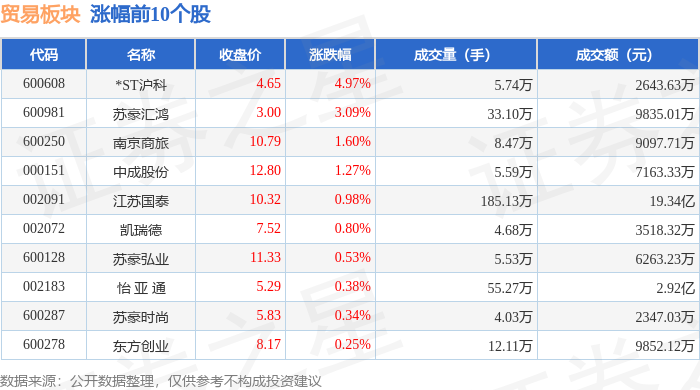
贸易板块11月10日跌0.12%,中信金属领跌,主力资金净流出6553.21万元
Zheng Xing Xing Ye Ri Bao· 2025-11-10 08:48
| 代码 | 名称 | 收盘价 | 涨跌幅 | 成交量(手) | 成交额(元) | | --- | --- | --- | --- | --- | --- | | 601061 | 中信金属 | 15.59 | -2.87% | 91.03万 | 14.14亿 | | 600710 | 苏美达 | 11.25 | -2.85% | 23.91万 | 2.71亿 | | 600058 | 五矿发展 | 9.53 | -0.94% | 17.66万 | 1.69 Z | | 600278 | 东方创业 | 8.17 | 0.25% | 1 12.11万 | 9852.12万 | | 600287 | 亦蒙时尚 | 5.83 | 0.34% | 4.03万 | 2347.03万 | | 002183 | 怡亚通 | 5.29 | 0.38% | 55.27万 | 2.92亿 | | 600128 | 示索弘业 | 11.33 | 0.53% | 5.53万 | 6263.23万 | | 002072 | 凯瑞德 | 7.52 | 0.80% | 4.68万 | 3518.32万 | | 002091 | 江苏国泰 ...

美国就业市场显露降温迹象,私人数据揭示增长动能减弱
Sou Hu Cai Jing· 2025-11-10 08:24
Group 1 - Private sector added 42,000 jobs in October, showing a slight recovery but still significantly lower than earlier this year [3] - Industries such as trade, transportation, and utilities are actively hiring, while professional services and information sectors are experiencing job losses [3] - Cumulative layoffs in 2023 have exceeded 1.1 million, a 44% increase compared to the same period last year, with technology and retail sectors being the hardest hit [4] Group 2 - The University of Michigan's consumer confidence index dropped to 50.3 in November, the lowest level since 2022, influenced by rising prices and government shutdown concerns [4] - Current employment conditions are favorable for those employed but challenging for job seekers, indicating a "very uncomfortable economic situation" [5] - Market analysts suggest that the mixed data may lead the Federal Reserve to interpret the labor market's softening as a signal for potential changes in monetary policy [5]

东方创业进博会打造全球美食剧场,解码首秀经济
Guo Ji Jin Rong Bao· 2025-11-10 08:10
Core Insights - The article highlights the "spillover effect" demonstrated by Dongfang International Entrepreneurship Co., Ltd. at the 8th China International Import Expo, showcasing a diverse range of global culinary offerings [1] Company Highlights - Dongfang International Entrepreneurship Co., Ltd. created a "food theater" at the expo, featuring premium Australian steaks, Italian fine wines, popular Japanese toast, and remarkable Scottish whisky [1] - The company's participation reflects its strategic understanding of the "first show economy" and its commitment to engaging with international markets [1]

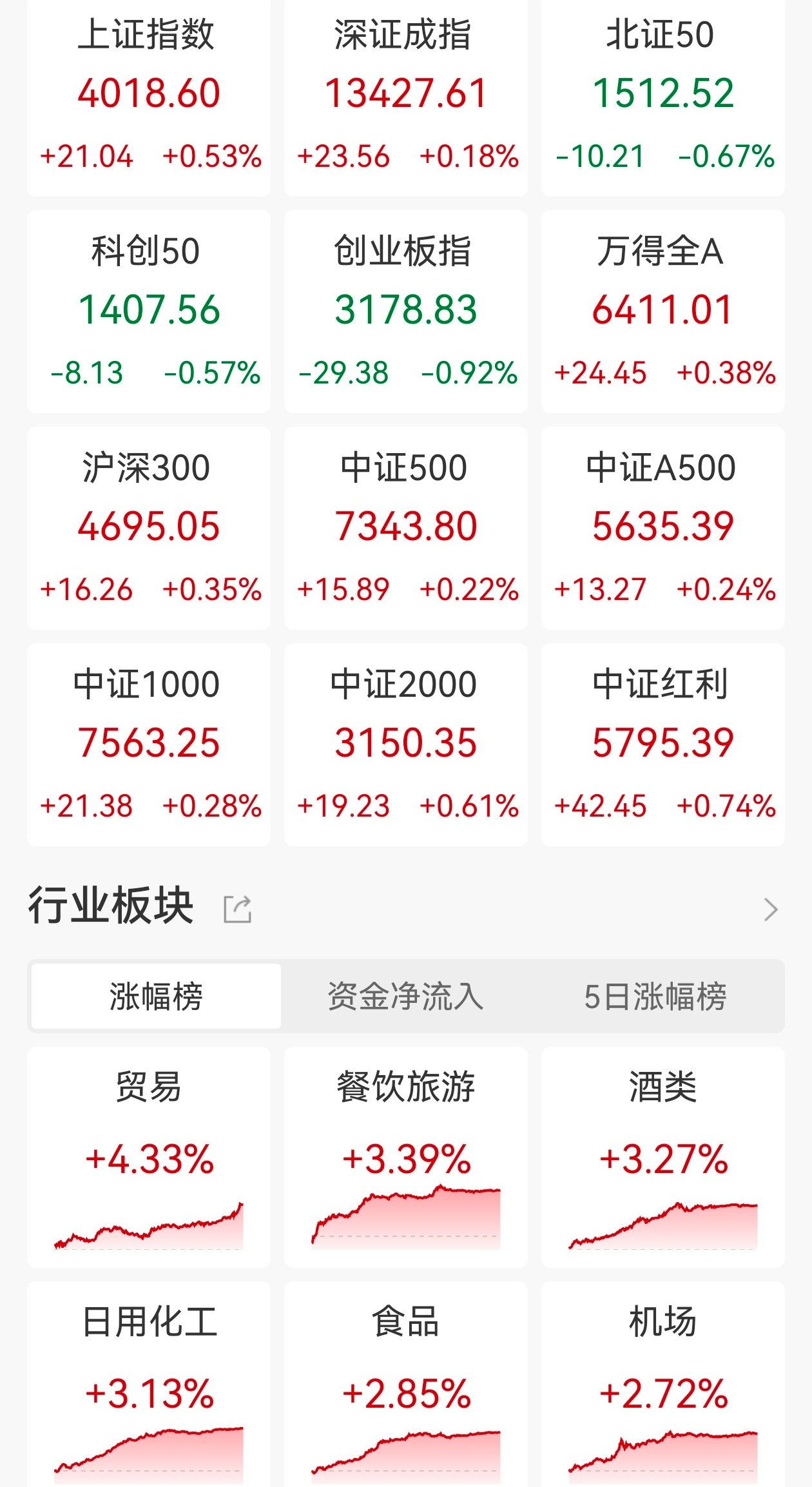
A股收评:三大指数涨跌不一,沪指涨0.53%报4018点,大消费、氟化工板块走高
Ge Long Hui· 2025-11-10 07:06
Market Overview - The three major A-share indices showed mixed results, with the Shanghai Composite Index rising by 0.53% to close at 4018 points, the Shenzhen Component Index increasing by 0.18%, while the ChiNext Index fell by 0.92% [1] - The total market turnover reached 2.19 trillion yuan, an increase of 174.2 billion yuan compared to the previous trading day, with nearly 3400 stocks rising [1] Sector Performance - The Ministry of Finance announced continued implementation of measures to boost consumption, leading to a collective rise in the consumer sector, with significant gains in dairy, duty-free, liquor, and food and beverage stocks [1] - Notable stocks that hit the daily limit include China Duty Free Group, Zhuangyuan Pasture, Jiu Gui Jiu, and Huifa Food [1] - The fluorochemical sector remained active, with Tianji Co. hitting the daily limit [1] - The cultivated diamond sector also saw gains, with World exceeding a 13% increase at one point [1] - Precious metals surged as New York gold prices reached 4060 USD, with Hunan Gold leading the gains [1] - Other sectors with notable increases included organic silicon, commercial retail, aviation, and Xiaohongshu concepts [1] Declining Sectors - The shipbuilding sector experienced a decline, with Guorui Technology dropping nearly 9% [1] - The robotics sector also fell, with multiple stocks like Top Group declining over 6% [1] - The minor metals sector weakened, with Dongfang Tantalum hitting the daily limit down [1] - Other sectors with significant declines included power equipment, superconductors, CPO concepts, and copper cable high-speed connections [1] Top Gainers and Fund Flows - The top gainers included trade (+4.33%), catering and tourism (+3.39%), and liquor (+3.279%) [2] - Net inflows were observed in daily chemical (+3.13%), food (+2.85%), and airport sectors (+2.729%) [2]