锂电池

Search documents
利好来了,五部门联合发文
21世纪经济报道· 2026-01-19 08:02
Core Viewpoint - The article discusses the implementation of zero-carbon factory construction in China, emphasizing the government's commitment to promoting green and low-carbon development through a series of guidelines and policies aimed at reducing carbon emissions across various industries [1][2]. Group 1: Policy and Guidelines - On January 19, 2026, five government departments issued the "Guiding Opinions on Zero-Carbon Factory Construction," which outlines the selection of benchmark zero-carbon factories starting in 2026 [1]. - By 2027, the initiative aims to cultivate zero-carbon factories in sectors such as automotive, lithium batteries, photovoltaics, electronics, light industry, machinery, and computing facilities [1][5]. - The goal is to expand zero-carbon factory construction to industries like steel, non-ferrous metals, petrochemicals, building materials, and textiles by 2030, exploring new decarbonization pathways for traditional high-energy industries [1][5]. Group 2: Construction and Implementation - Zero-carbon factory construction involves continuous reduction of carbon dioxide emissions through technological innovation, structural adjustments, and management optimization [2][4]. - The construction path includes establishing a carbon emission accounting management system, transforming energy structures to be greener, enhancing energy efficiency, analyzing carbon footprints of key products, and improving digital intelligence levels for carbon control [5][6]. - The article highlights that various regions, including Tianjin, Shanghai, Jiangsu, and Guangdong, have begun pilot projects for near-zero carbon factories, with over a hundred near-zero carbon factory lists published [6]. Group 3: Challenges and Future Directions - The construction of zero-carbon factories is a complex and systematic project that involves multiple aspects such as energy structure, process technology, funding, and management services, with significant variations in implementation across different regions and industries [6]. - Challenges include inconsistent evaluation requirements, unverified key technologies, and weak foundations for carbon emission statistics, necessitating enhanced guidance and technical support [6]. - The Ministry of Industry and Information Technology plans to coordinate with other departments to promote the implementation of the guidelines and support high-quality progress in zero-carbon factory construction [6].


宁德时代下发70亿大单!
鑫椤锂电· 2026-01-19 07:58
Core Viewpoint - The article discusses the strategic agreements and market outlook for Dragon Power Technology, focusing on its collaboration with CATL and the implications for the lithium battery materials market. Group 1: Strategic Agreements - Dragon Power Technology announced a new procurement framework agreement with CATL, effective from January 1, 2026, to December 31, 2026, with a transaction cap of up to 7 billion yuan for the year [6] - The new agreement emphasizes domestic market supply of lithium iron phosphate cathode materials, differentiating it from a previous agreement for overseas supply [6] - The collaboration is expected to leverage CATL's extensive sales network and customer base, enhancing market coverage and demand for Dragon Power's products [7] Group 2: Fund Utilization and Project Development - Dragon Power Technology plans to change the use of funds raised from its global offering, reallocating 198 million HKD originally intended for a new production line in Hubei to a high-performance lithium battery cathode materials project in Jiangsu [11] - The funds will be used for equipment procurement and installation, with full utilization expected by the end of 2026 [11] - This decision is based on a careful assessment of the company's project development needs and aims to improve the efficiency of fund usage [11]

利好来了!五部门联合印发《关于开展零碳工厂建设工作的指导意见》
Zhong Guo Ji Jin Bao· 2026-01-19 07:54
Core Viewpoint - The release of the "Guiding Opinions on the Construction of Zero Carbon Factories" aims to enhance energy conservation and carbon reduction in the industrial sector, promoting green and low-carbon transformation while fostering new productive forces [1][2]. Group 1: Overall Requirements - The initiative is guided by Xi Jinping's thoughts on ecological civilization and aims to integrate green energy with modern manufacturing, accelerating technological and industrial innovation to significantly reduce carbon emissions and strengthen green manufacturing [5][6]. Group 2: Principles of Zero Carbon Factory Construction - The construction of zero carbon factories will follow principles such as tailored strategies based on industry needs, innovation-driven approaches, continuous improvement in carbon reduction, and ensuring transparency and standardization in carbon emissions reporting [6][7]. Group 3: Main Goals - The plan includes phased cultivation of zero carbon factories, starting with industries that have urgent decarbonization needs and gradually expanding to more challenging sectors by 2030, with specific targets set for 2026 and 2027 [8]. Group 4: Construction Pathways - Key pathways for construction include establishing a carbon emission accounting system, transitioning to green energy sources, enhancing energy efficiency, analyzing carbon footprints of key products, leveraging digital technologies for carbon management, and implementing carbon offsetting and information disclosure [9][10][11][12]. Group 5: Work Requirements - Local industrial and information departments are encouraged to develop specific implementation plans for zero carbon factory construction, emphasizing collaboration among government, enterprises, and markets, while also enhancing the standard system to support effective management and evaluation of zero carbon factories [13][14].
利好来了,五部门联合发布
Zhong Guo Ji Jin Bao· 2026-01-19 06:34
Core Viewpoint - The release of the "Guiding Opinions on the Construction of Zero Carbon Factories" aims to enhance energy conservation and carbon reduction in the industrial sector, promoting green and low-carbon transformation while fostering new productive forces [1][6]. Group 1: Principles of Zero Carbon Factory Construction - The construction of zero carbon factories follows four principles: tailored strategies based on industry needs, systematic advancement, innovation-driven and technology-enabled approaches, and a commitment to transparency and standardization [4][10]. Group 2: Goals and Phased Implementation - The initiative will prioritize industries with urgent decarbonization needs and lower decarbonization difficulties, with a phased approach starting in 2026 to select benchmark zero carbon factories [4][11]. - By 2027, a batch of zero carbon factories will be established in sectors such as automotive, lithium batteries, photovoltaics, electronics, light industry, machinery, and computing facilities [4][11]. - By 2030, the initiative aims to expand to high carbon intensity industries like steel, non-ferrous metals, petrochemicals, building materials, and textiles, exploring new decarbonization pathways [4][11]. Group 3: Construction Pathways - Key pathways for construction include establishing a carbon emission accounting management system, accelerating the transition to a green and low-carbon energy structure, and enhancing energy efficiency through technological upgrades [5][12][13]. - The initiative emphasizes the importance of carbon footprint analysis for key products to drive collaborative carbon reduction across the entire supply chain [5][14]. - Digitalization and intelligent management will be leveraged to achieve precise measurement and control of energy consumption and carbon emissions [5][15]. Group 4: Implementation Requirements - Local industrial and information authorities are encouraged to develop specific implementation plans for zero carbon factory construction, promoting collaboration among government, enterprises, and markets [16][17]. - A comprehensive standard system will be established to support the management and evaluation of zero carbon factories, ensuring alignment with international standards [16][17].
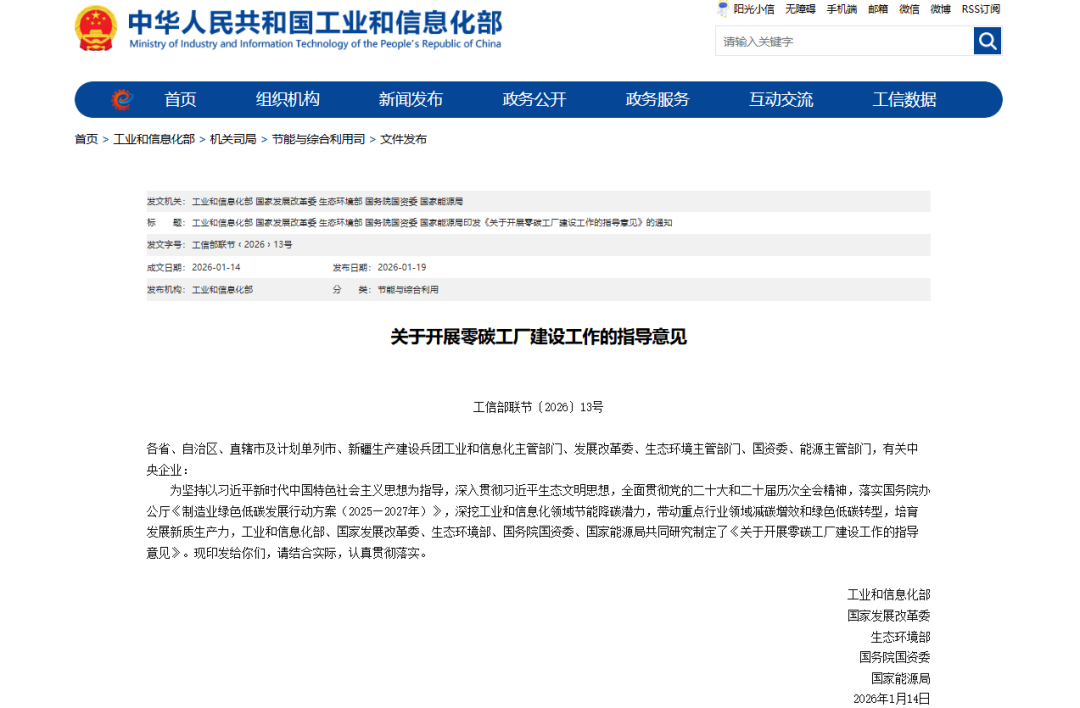
五部门发文:2027年前在汽车等重点领域培育零碳工厂
2 1 Shi Ji Jing Ji Bao Dao· 2026-01-19 06:32
Core Viewpoint - The ongoing trend towards zero-carbon initiatives is being reinforced by the implementation of policies for zero-carbon factories, which are expected to significantly contribute to the green transformation of industries in China [1][4]. Group 1: Policy and Guidelines - The Ministry of Industry and Information Technology, along with four other departments, issued the "Guiding Opinions on the Construction of Zero-Carbon Factories," which outlines the selection of zero-carbon factories starting in 2026 and aims to establish benchmarks for various industries [1][4]. - By 2027, the plan includes the cultivation of zero-carbon factories in sectors such as automotive, lithium batteries, photovoltaics, electronics, light industry, machinery, and computing facilities [1][4]. - The expansion of zero-carbon factory initiatives to traditional high-energy industries like steel, non-ferrous metals, petrochemicals, building materials, and textiles is targeted by 2030 [1][4]. Group 2: Objectives and Implementation - The guiding opinions emphasize a phased approach to nurturing zero-carbon factories, focusing on quality improvement and green transformation across the entire industrial chain [4][5]. - Key objectives include the establishment of a carbon emission accounting management system, enhancing energy efficiency, and promoting digitalization to achieve intelligent carbon control [4][5]. Group 3: Challenges and Support - The construction of zero-carbon factories faces challenges such as inconsistent evaluation standards, unverified key technologies, and weak foundations for carbon emission statistics [6]. - The Ministry of Industry and Information Technology plans to enhance coordination and policy support to facilitate the high-quality advancement of zero-carbon factory construction [6].
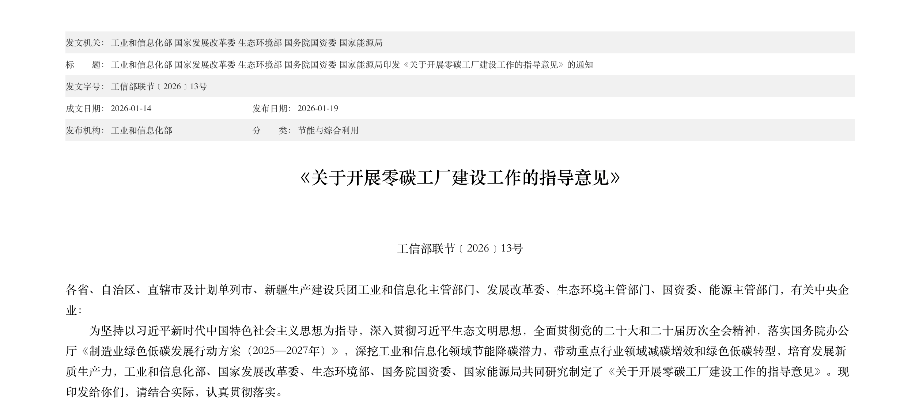
利好来了,五部门联合发布
中国基金报· 2026-01-19 06:23
Core Viewpoint - The article discusses the release of the "Guiding Opinions on the Construction of Zero Carbon Factories" by five Chinese government departments, emphasizing the importance of reducing carbon emissions in industrial sectors and promoting green transformation through zero carbon factory initiatives [2][3]. Group 1: Overall Requirements - The initiative is guided by Xi Jinping's thoughts on ecological civilization and aims to enhance industrial efficiency and promote green transformation across the entire industrial chain [7]. - The construction of zero carbon factories will follow principles such as tailored strategies for different industries, innovation-driven approaches, continuous improvement, and transparency in carbon emissions reporting [8][9]. Group 2: Main Goals - The plan includes a phased approach, starting with industries that have urgent decarbonization needs and are primarily electricity consumers, with a goal to select a batch of zero carbon factories by 2026 [10]. - By 2027, the initiative aims to establish zero carbon factories in sectors like automotive, lithium batteries, photovoltaics, electronics, light industry, machinery, and computing facilities, with further expansion to high carbon intensity industries by 2030 [10]. Group 3: Construction Pathways - Establishing a carbon emission accounting management system is crucial for accurate data support in zero carbon factory construction [11]. - Transitioning to a green and low-carbon energy structure is essential, encouraging the use of renewable energy sources and technologies such as distributed solar and wind power [12]. - Improving energy efficiency through systematic optimization of production processes and adopting advanced technologies is a key focus [13]. - Promoting zero carbon supply chain management and conducting carbon footprint analysis for key products will drive collaborative decarbonization across the industry [14]. - Enhancing digital and intelligent management capabilities will facilitate precise measurement and control of energy consumption and carbon emissions [14]. - Carbon offsetting and information disclosure are necessary to achieve and maintain near-zero carbon emissions [14]. Group 4: Work Requirements - Local industrial and information departments are encouraged to develop specific implementation plans for zero carbon factory construction, promoting collaboration among government, enterprises, and markets [15]. - A comprehensive standard system for zero carbon factories is to be established, providing scientific and practical guidelines for management and evaluation [16]. - The promotion of comprehensive services for energy saving and carbon reduction is essential, including technology transfer and international cooperation [17].

重磅!工信部、国家发改委、国家能源局等5部门发布
中国能源报· 2026-01-19 04:27
Core Viewpoint - The article discusses the guidance issued by the Ministry of Industry and Information Technology and other departments in China regarding the construction of zero-carbon factories, aiming to enhance low-carbon competitiveness and adapt to international trade rules by 2030 [1][3]. Group 1: Overall Requirements - The initiative is guided by Xi Jinping's thoughts on ecological civilization and aims to promote green and low-carbon transformation in key industries, enhancing productivity and achieving carbon peak and neutrality goals [4][5]. - The construction of zero-carbon factories will follow principles such as tailored strategies, innovation-driven approaches, and systematic promotion to ensure effective low-carbon transitions [6][7]. Group 2: Main Goals - From 2026, a selection of zero-carbon factories will be established as benchmarks, with a focus on industries like automotive, lithium batteries, photovoltaics, electronics, light industry, machinery, and computing facilities by 2027 [8][9]. - By 2030, the initiative will expand to include industries such as steel, non-ferrous metals, petrochemicals, building materials, and textiles, exploring new decarbonization pathways [9][10]. Group 3: Construction Pathways - A carbon emission accounting management system will be established to provide accurate data for zero-carbon factory construction, including direct and indirect emissions [11]. - The initiative encourages the transition to green and low-carbon energy structures, promoting the use of renewable energy sources and technologies [12]. - Energy efficiency will be significantly improved through systematic optimization of production processes and the adoption of advanced technologies [13]. - The analysis of carbon footprints for key products will be promoted to drive collaborative decarbonization across the supply chain [14]. - Digitalization and smart technologies will be leveraged to enhance carbon management and operational efficiency [15]. - Carbon offsetting and information disclosure will be implemented to maintain near-zero emissions and improve sustainability reporting [16]. Group 4: Work Requirements - Local authorities are encouraged to develop specific implementation plans for zero-carbon factory construction, promoting collaboration among government, enterprises, and markets [16][18]. - A standard system will be established to support zero-carbon factory management and evaluation, ensuring alignment with international standards [18]. - The promotion of comprehensive services for energy saving and carbon reduction will be encouraged, facilitating technology transfer and market services [18].

关于开展零碳工厂建设工作 五部门联合印发指导意见
Jing Ji Guan Cha Wang· 2026-01-19 04:20
Core Viewpoint - The joint issuance of the "Guiding Opinions on the Construction of Zero Carbon Factories" aims to enhance energy conservation and carbon reduction in the industrial and information sectors, promoting green and low-carbon transformation in key industries and fostering new productive forces [1]. Group 1: Definition and Concept - Zero carbon factory construction refers to the process of continuously reducing carbon dioxide emissions through technological innovation, structural adjustments, and management optimization, aiming for near-zero emissions rather than absolute zero [2]. Group 2: Implementation Phases - The guiding opinions outline a phased approach for cultivating zero carbon factories, starting with the selection of benchmark factories in 2026, followed by the establishment of zero carbon factories in sectors such as automotive, lithium batteries, photovoltaics, and electronics by 2027, and expanding to traditional high-energy industries like steel and petrochemicals by 2030 [3]. Group 3: Construction Pathways - Six major directions for construction are proposed, including establishing a carbon accounting system, optimizing energy structure for source reduction, enhancing energy efficiency for process decarbonization, conducting carbon footprint analysis for collaborative reduction, leveraging digitalization for intelligent carbon control, and implementing carbon offsetting and information disclosure for continuous improvement [4]. Group 4: Work Requirements - The guiding opinions also outline work requirements focusing on organizational implementation, improving standard systems, and promoting comprehensive energy-saving and carbon reduction services. Some regions have already initiated near-zero carbon factory pilot projects, with over 30 related group standards established to lay the foundation for nationwide promotion [5].
五部门:到2027年在汽车、锂电池、光伏、算力设施等行业领域培育建设一批零碳工厂
Jin Rong Jie· 2026-01-19 04:07
Core Viewpoint - The Ministry of Industry and Information Technology, along with other governmental bodies, has issued guidelines for the construction of zero-carbon factories, aiming to enhance energy efficiency and promote green transformation in key industries, thereby supporting carbon peak and carbon neutrality goals [1][4]. Group 1: Guidelines and Principles - The construction of zero-carbon factories will follow four principles: tailored strategies for different industries, systematic advancement, innovation-driven and technology-enabled approaches, and a commitment to transparency and standardization [2]. - A phased approach will be implemented, prioritizing industries with urgent decarbonization needs and lower decarbonization difficulties, with a gradual expansion to more challenging sectors [2][9]. Group 2: Goals and Timeline - By 2026, a selection of zero-carbon factories will be identified to serve as benchmarks, with a target to establish a number of such factories in sectors like automotive, lithium batteries, photovoltaics, electronics, light industry, machinery, and computing facilities by 2027 [2][9]. - By 2030, the initiative aims to extend to high-energy-consuming industries such as steel, non-ferrous metals, petrochemicals, building materials, and textiles, exploring new decarbonization pathways [2][9]. Group 3: Construction Pathways - Key pathways for zero-carbon factory construction include establishing a carbon emission accounting management system, enhancing the green and low-carbon transformation of energy structures, improving energy efficiency, conducting carbon footprint analyses, advancing digitalization, and implementing carbon offsetting and information disclosure [3][9]. Group 4: Implementation and Support - The Ministry of Industry and Information Technology will collaborate with other departments to ensure the effective implementation of the guidelines, encouraging local governments to develop specific plans for zero-carbon factory construction [11][12]. - There will be a focus on developing a standard system for zero-carbon factories and promoting comprehensive energy-saving and carbon-reduction services through collaboration with industry associations and research institutions [12].
宁德时代招投标最新情况
数说新能源· 2026-01-19 03:36
Core Viewpoint - The article discusses the current state of negotiations and pricing for key materials in the lithium battery industry, highlighting the shift from traditional long-term contracts to more flexible, order-based pricing due to market volatility [2] Group 1: Progress and Pricing of Key Materials - Negotiations for most materials for 2026 are not yet locked, with discussions expected to intensify around the Chinese New Year. Currently, only the price for lithium hexafluorophosphate is confirmed at 150,000 yuan/ton [3][5] - Major suppliers include Tianqi Lithium, Tianji, and others, with a general price increase demand of about 10%-15% or higher from suppliers across the board [5] - The price of lithium hexafluorophosphate has risen to approximately 160,000 yuan/ton, while electrolyte prices have surged from about 19,000 yuan/ton to around 60,000 yuan/ton [5] Group 2: Changes in Procurement Models - The traditional "annual bidding" model is no longer viable, with most transactions shifting to spot or short-term agreements due to frequent price fluctuations [5] - The procurement cycle is now aligned with the Chinese New Year, with current production still using prices from the previous cycle [6] Group 3: CATL's Operations and Supply Chain - CATL has a strong ability to absorb and pass on cost increases due to its strategic investments in key material companies and production efficiency improvements [6] - The company has not implemented a blanket price increase for major clients but is focusing on maintaining market share through a responsive pricing mechanism [5][6] Group 4: Product Pricing and Market Outlook - The production plan for Q1 2026 is approximately 229 GWh, slightly down from 249 GWh in Q4 2025, with expectations of a potential recovery in February [6] - The expected revenue per watt-hour is estimated at around 0.6 yuan, with material prices anticipated to rise throughout the year, provided demand remains stable [6][7] - CATL's cost absorption capability is enhanced through production efficiency improvements, allowing it to mitigate the impact of rising raw material costs [7]