
风电

Search documents
2025年全国能源投资保持较快增长 年度重点项目完成投资额首超3.5万亿元
Xin Lang Cai Jing· 2026-01-31 20:32
Core Insights - The national energy investment in China is expected to maintain rapid growth, with the annual investment in key projects exceeding 3.5 trillion yuan in 2025, representing a year-on-year increase of nearly 11% [1] - The investment growth rate outpaces that of infrastructure and manufacturing by 12.9 and 10.1 percentage points, respectively [1] Group 1: Energy Investment Overview - In 2025, five provinces (Inner Mongolia, Xinjiang, Shandong, Guangdong, and Jiangsu) each completed energy investments exceeding 200 billion yuan [1] - The new energy sector, particularly wind and solar power, is projected to see an addition of over 430 million kilowatts in installed capacity, with a cumulative installed capacity surpassing 1.8 billion kilowatts [1] - Investment in onshore wind power projects is expected to grow nearly 50% year-on-year [1] Group 2: Private Sector Investment - Private enterprises in the energy sector are also experiencing rapid growth, with a year-on-year increase of 12.9% in investment for key projects, which is about 2 percentage points higher than the national average [2] - The focus of private investment is primarily in solar power generation, wind power, and coal mining, with double-digit growth in onshore wind and distributed solar photovoltaic sectors [2]
探访中企参与建设的格鲁吉亚风电项目
Xin Hua She· 2026-01-31 11:10
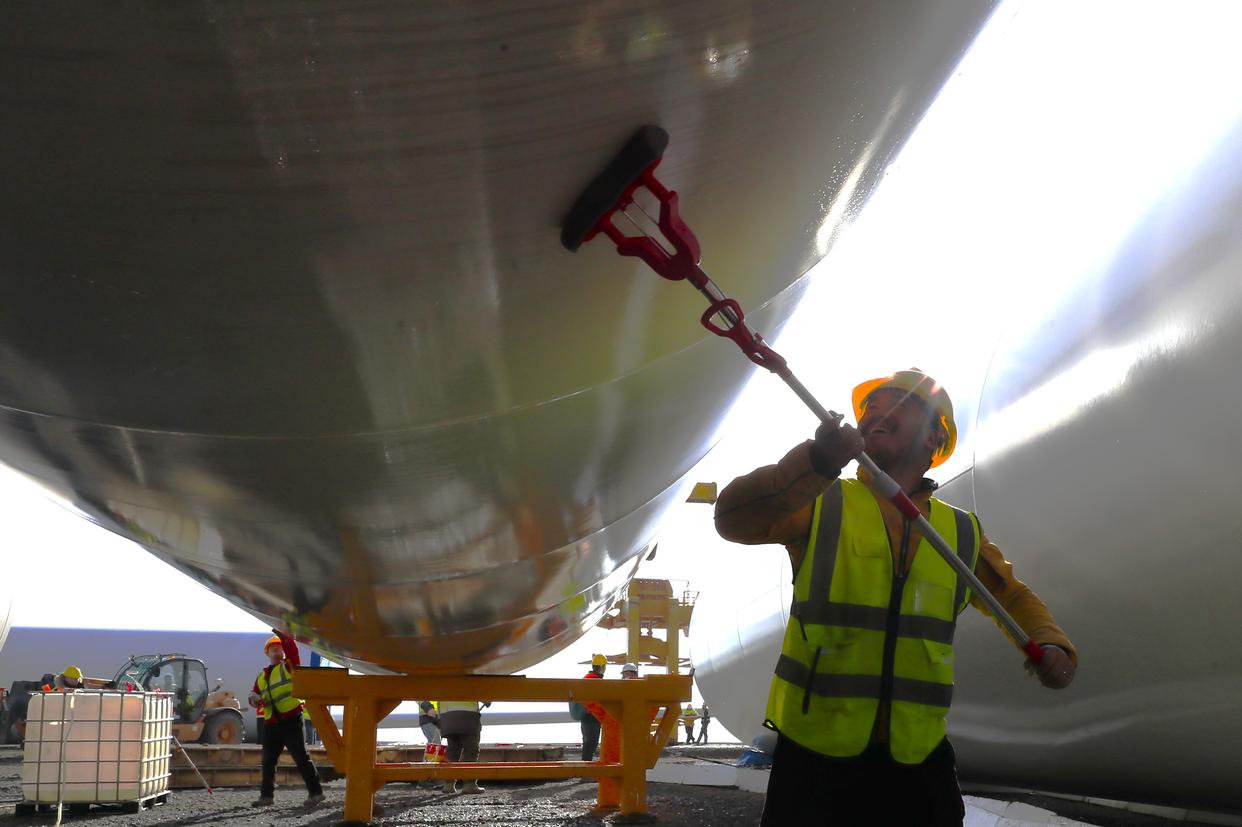
1月29日,在格鲁吉亚什达-卡尔特里大区鲁伊西风电项目现场,一名工人清理塔筒。新华社记者 陈俊锋 摄 由中国企业金风科技参与建设的格鲁吉亚鲁伊西风电项目于2025年12月进入风机吊装阶段。鲁伊西风电项目位于格鲁吉亚中部的什达-卡尔特里大区,距离 格首都第比利斯约100公里。 这是1月29日在格鲁吉亚什达-卡尔特里大区鲁伊西风电项目拍摄的一座已经安装完毕的风机。新华社记者 陈俊锋 摄 1月29日,在格鲁吉亚什达-卡尔特里大区鲁伊西风电项目现场,工人正在安装风机。新华社记者 陈俊锋 摄 这是1月29日在格鲁吉亚什达-卡尔特里大区鲁伊西风电项目拍摄的正在吊装的风机。新华社记者 陈俊锋 摄 这是1月29日在格鲁吉亚什达-卡尔特里大区鲁伊西风电项目拍摄的正在吊装的风机。新华社记者 陈俊锋 摄 1月29日,在格鲁吉亚什达-卡尔特里大区鲁伊西风电项目现场,工人正在安装风机。新华社记者 陈俊锋 摄 这是1月29日在格鲁吉亚什达-卡尔特里大区鲁伊西风电项目拍摄的已经安装完毕的风机。新华社记者 陈俊锋 摄 这是1月29日在格鲁吉亚什达-卡尔特里大区鲁伊西风电项目拍摄的准备安装的风机发电机。新华社记者 陈俊锋 摄 ...


迎峰度冬燃料储备充足
Ren Min Ri Bao· 2026-01-31 05:24
Core Insights - The National Energy Administration reported that the total investment in key energy projects exceeded 3.5 trillion yuan for the first time, with a year-on-year growth of nearly 11% [1] - Investment in renewable energy and green transformation is accelerating, with renewable energy generation capacity expected to exceed 60% by 2025, and onshore wind power investment increasing by nearly 50% year-on-year [1] - Private sector investment in energy projects has also seen significant growth, with a year-on-year increase of 12.9%, particularly in solar power, wind power, and coal mining [2] Investment Growth - The total investment in key energy projects reached over 3.5 trillion yuan, marking a nearly 11% increase compared to the previous year [1] - Five provinces, including Inner Mongolia, Xinjiang, Shandong, Guangdong, and Jiangsu, each completed investments exceeding 200 billion yuan [1] - The investment in new energy storage and hydrogen industries doubled compared to the previous year, with hydrogen production capacity reaching over 250,000 tons per year by the end of 2025 [1] Renewable Energy Focus - By 2025, renewable energy generation is projected to reach approximately 4 trillion kilowatt-hours, surpassing the total electricity consumption of the 27 EU countries [1] - The investment in onshore wind power projects has shown strong growth, with a nearly 50% increase year-on-year [1] - The development of hydrogen energy production, storage, and application processes is progressing, with significant technological breakthroughs achieved [1] Policy and Market Dynamics - The National Energy Administration plans to enhance policy support and market mechanisms to stimulate investment in green energy and optimize the development environment [2] - New policies, such as green electricity direct connection, are being implemented to facilitate the integration of renewable energy with industrial users [2] - The government aims to strengthen the institutional framework to ensure smooth project execution and enhance the synergy between policy and market forces [2] Energy Supply Stability - The overall energy supply remains stable, with sufficient coal reserves and a steady electricity supply during the winter peak [3] - As of January 27, the national coal inventory was 220 million tons, sufficient for 26 days of consumption [3] - Natural gas consumption during the heating season reached 119.52 billion cubic meters, reflecting a year-on-year increase of 4.6%, with stable supply from domestic and imported sources [3]
心智观察所:当特朗普质疑中国风电时,我们在谈论什么
Guan Cha Zhe Wang· 2026-01-31 01:15
Core Argument - The article discusses the irony in Trump's statement about China's wind power infrastructure, highlighting China's significant advancements in wind energy while questioning the U.S.'s lag in energy transition and infrastructure development [1][3][18]. Summary by Sections Wind Power Capacity and Projects - As of November 2025, China's wind power installed capacity exceeds 600 GW, maintaining the world's largest wind power capacity for 15 consecutive years, equivalent to about 600 nuclear power plants [3]. - Major projects include the 1,000 MW Inner Mongolia Energy Xisu Wind Storage Project and the 850 MW Jiangsu Dafeng Offshore Wind Power Project, showcasing China's rapid development in wind energy infrastructure [4][5]. Investment and Infrastructure Development - China's wind power projects integrate various technologies, including energy storage and smart grids, reflecting a systematic approach to energy transition [6]. - The investment model in China involves a mix of government guidance, state-owned enterprises, and private sector participation, allowing for long-term investments in large-scale projects [6][11]. Political and Regulatory Challenges in the U.S. - The U.S. faces political polarization affecting energy policy, with significant differences between the Democratic and Republican parties regarding renewable energy [7]. - The federal structure in the U.S. complicates large infrastructure projects due to varying regulations across states, leading to delays and increased costs [8]. Geographical and Economic Factors - China's geographical diversity allows for optimal wind energy resource utilization, particularly in coastal regions, while the U.S. faces challenges in transmitting wind energy from central plains to coastal population centers [8][10]. - The U.S. capital market prioritizes short-term returns, making it less attractive for long-term investments in wind energy projects compared to China's financial system [10][11]. Social Consensus and Public Support - In China, there is a strong societal consensus on energy transition and green development, while in the U.S., debates on climate change hinder public support for renewable energy projects [12]. - Local opposition to wind projects in the U.S. often arises from concerns about aesthetics and noise, further delaying project implementation [12]. Future Implications and Strategic Importance - The article emphasizes that the competition for clean energy infrastructure is not just an environmental issue but a strategic one, as energy is crucial for future economic competitiveness, particularly in AI and data processing [13][14][18]. - China's investments in wind and solar energy are seen as foundational for future digital economies, while the U.S. risks falling behind if it cannot address its infrastructure and policy challenges [15][18].
三一重能股份有限公司2025年年度业绩预告公告
Xin Lang Cai Jing· 2026-01-30 20:48
Group 1 - The company forecasts a net profit attributable to shareholders of the parent company for 2025 to be between 68 million and 88 million yuan, representing a decrease of 93.1983 million to 113.1983 million yuan compared to the previous year, which is a year-on-year decline of 51.43% to 62.47% [3] - The net profit attributable to shareholders of the parent company, excluding non-recurring gains and losses, is expected to be between 41.5 million and 61.5 million yuan, a decrease of 97.9831 million to 117.9831 million yuan compared to the previous year, reflecting a year-on-year decline of 61.44% to 73.98% [3] - The financial data in this performance forecast has not been audited by an accounting firm [4] Group 2 - The previous year's total profit was 214.9989 million yuan, with a net profit attributable to shareholders of the parent company of 181.1983 million yuan, and a net profit attributable to shareholders of the parent company, excluding non-recurring gains and losses, of 159.4831 million yuan [5] - The basic earnings per share for the previous year was 1.5073 yuan [6] Group 3 - The decline in net profit for 2025 is primarily due to intensified competition in the domestic onshore wind turbine market in 2024, leading to a decrease in bidding prices and a drop in profit margins for wind turbines as large components' prices rise [7] - The market-oriented reform of the on-grid electricity price for new energy in 2025 is expected to further reduce the profit margins of the company's power station products [7] Group 4 - The company’s major shareholder, Wang Zuo Chun, has increased his shareholding by 15,000 shares at a total cost of 379,000 yuan, with no current plans for further purchases [12] - This increase in shareholding does not trigger any change in equity or affect the company's shareholder structure [13][16]

统筹风电开发和林草地保护 推动人与自然和谐共生
Xin Lang Cai Jing· 2026-01-30 16:39
(来源:中国经济导报) 对于风电企业和社会关注的"在哪儿建设"问题,《通知》强调,在严格保护的前提下,合理保障风电项 目要素供给,并从四个维度进行了全面部署。一是坚持规划引领,各地在推动"十五五"规划编制过程 中,要做好风电场项目布局与国土空间规划、林草相关规划、风电发展规划等衔接,推动项目跟着规划 走。二是明确优先布局区域,支持推进以沙漠、戈壁、荒漠地区为重点的大型风光电基地建设;鼓励风 电场项目开发空间集约复合利用,优先布局在沙漠、戈壁、荒漠等区域。三是划定禁建区域,即生态保 护红线、自然保护地、重要湿地、重点国有林区林地草地为禁止建设区域,不得新建、扩建风电场项 目。四是规范可建设区域,即从保护生态价值功能高、生态脆弱区域的林草地和生物多样性等角度出 发,在禁建区域外,支持风电场项目开发建设并规范使用林地草地。 《通知》结合《风电场改造升级和退役管理办法》的规定,区分生态保护红线和自然保护地内外,分别 明确改造升级要求,强化生态修复责任。一是生态保护红线、自然保护地内依法建成的风电场项目,原 则上不进行改造升级;二是在生态保护红线、自然保护地外,重要湿地、重点国有林区林地草地、基本 草原内依法建成的风电 ...
本周十大牛股:C恒运昌暴涨353%领跑,黄金石油批量造牛股,通源石油井喷,湖南黄金、中国黄金等巨头飙涨60%
Jin Rong Jie· 2026-01-30 12:46
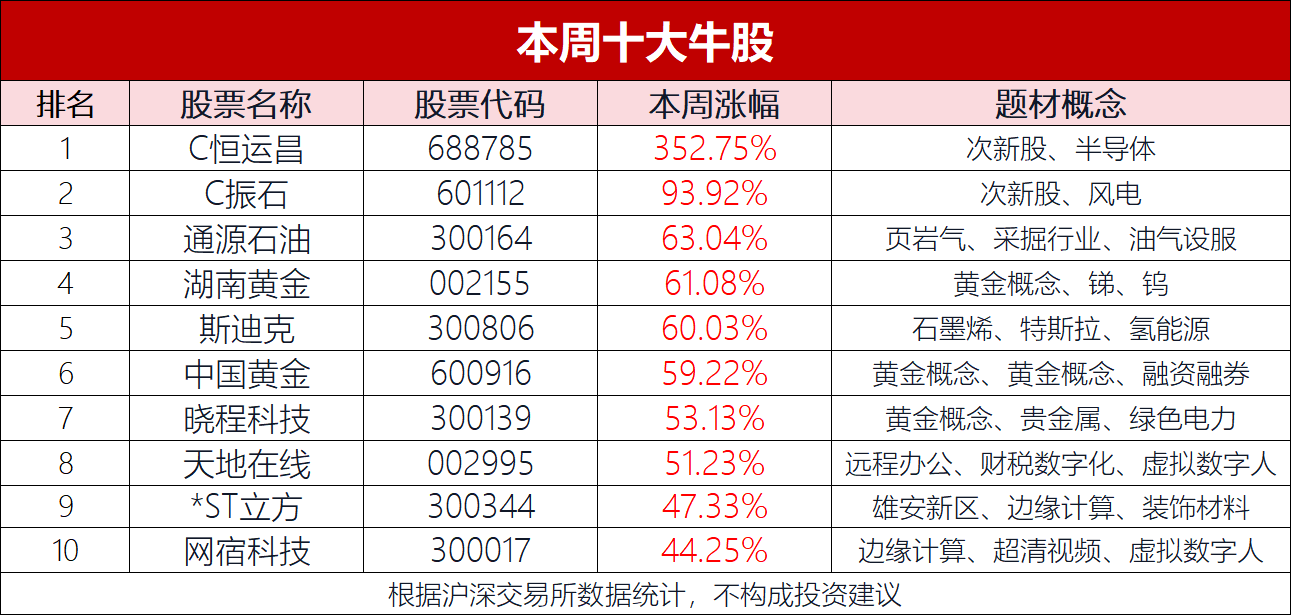
Market Overview - The market experienced high-level consolidation last week, with the Shanghai Composite Index down 1.73%, Shenzhen Component Index down 3.57%, ChiNext Index down 2.80%, and the STAR Market 50 Index down 5.69% [1] Top Performing Stocks - The top ten performing stocks of the week include C Hengyun Chang, C Zhenshi, Tongyuan Petroleum, Hunan Gold, Sidik, China Gold, Xiaocheng Technology, Tiandi Online, *ST Lifang, and Wangsu Technology [1][2] C Hengyun Chang - C Hengyun Chang, a leading supplier of core components for semiconductor equipment and RF power, saw its stock price surge by 352.75% due to technological breakthroughs and the dual push of its listing process [2][3] C Zhenshi - C Zhenshi, a global leader in wind turbine blade materials, experienced a stock price increase of 93.92%, benefiting from the recovery of the wind power industry and its status as the highest fundraising new stock this year [2][3] Tongyuan Petroleum - Tongyuan Petroleum's stock rose by 63.04%, driven by external geopolitical conflicts and the International Energy Agency's upward revision of demand forecasts, enhancing the overall attractiveness of the oil and gas service sector [2][3] Hunan Gold - Hunan Gold's stock increased by 61.08%, supported by significant asset restructuring progress and performance forecasts, attracting investor interest due to its improved fundamentals [2][3] Sidik - Sidik's stock price rose by 60.03%, attributed to breakthroughs in functional coating composite materials and business expansion, including partnerships with Huawei in the magnetic storage field [2][4] China Gold - China Gold's stock increased by 59.22%, influenced by heightened market attention on international gold prices and the company's metal production planning, resonating with market sentiment [2][3] Xiaocheng Technology - Xiaocheng Technology's stock rose by 53.13%, closely linked to the surge in international gold prices and its business structure, with over 86% of its revenue from gold-related activities [2][3] Tiandi Online - Tiandi Online's stock increased by 51.23%, primarily driven by its acquisition of Jiato Group and its focus on AI marketing and virtual digital human sectors [2][4] *ST Lifang - *ST Lifang's stock rose by 47.33%, influenced by expectations of debt restructuring and speculative trading, as the company faces delisting risks due to previous debt issues [2][5] Wangsu Technology - Wangsu Technology's stock increased by 44.25%, benefiting from the surge in AI computing demand and anticipated price increases in cloud services, transitioning from traditional CDN to emerging businesses [2][5]



杨德龙:坚定不移推广价值投资理念 做理性投资者和长期投资者
Xin Lang Cai Jing· 2026-01-30 12:15
Group 1: Value Investment Philosophy - The value investment philosophy advocated by Buffett is applicable to both US and A-share markets, but it requires adaptation to the specific conditions of the A-share market, termed "Chinese-style value investment" [2][12] - Key aspects of "Chinese-style value investment" include considering the predominance of retail investors in the A-share market, which leads to frequent mispricing opportunities and significant volatility, necessitating proper position management rather than simple long-term holding [2][12] - Understanding national policies is crucial; sectors supported by government policies, such as new energy and humanoid robots, should be prioritized, while sectors facing restrictions, like education and real estate, should be avoided [2][12] Group 2: Market Trends and Sector Performance - Traditional sectors, referred to as "old stocks," have faced stagnation, leading to skepticism about the effectiveness of value investing; however, true value investing focuses on investing in companies with future growth potential rather than past performance [3][13] - The technology innovation sector is thriving, supported by government policies and the backdrop of the AI revolution, indicating significant future growth potential and substantial stock price increases [3][13] - The semiconductor industry is characterized by intense competition, with many leading companies vying for dominance, highlighting the inherent risks in technology investments [6][16] Group 3: Valuation Metrics and Investment Strategies - Valuing technology stocks cannot rely solely on traditional metrics like price-to-earnings (P/E) ratios, as their worth is determined by future breakthroughs and market leadership potential [4][14] - Many technology companies require substantial R&D investments and may initially operate at a loss, which does not preclude significant stock price appreciation post-IPO [4][14] - The investment landscape is shifting, with a focus on future performance indicators rather than historical metrics, emphasizing the importance of industry research and analysis [5][15] Group 4: Sector-Specific Insights - The new energy sector, particularly solar energy, has faced challenges due to overcapacity and price wars, but is expected to rebound as the industry undergoes consolidation and innovation [8][18] - The solid-state battery sector is gaining attention, with many leading companies transitioning from lithium battery development, indicating substantial growth potential [8][17] - The electric power sector is highlighted as a critical area for future competition, with China's generation capacity being three times that of the US, positioning it favorably in the global energy landscape [10][19]
2025年全国能源重点项目投资额首超3.5万亿元 同比增长近11%
Zheng Quan Ri Bao Wang· 2026-01-30 11:59
Core Insights - In 2025, national energy investment in China is expected to maintain rapid growth, with the annual investment in key projects exceeding 3.5 trillion yuan, marking a year-on-year increase of nearly 11% [1] - The investment growth rate outpaces that of infrastructure and manufacturing by 12.9 and 10.1 percentage points, respectively [1] Group 1: Investment Characteristics - The investment in new energy green transition sectors is accelerating, with new wind and solar power installations exceeding 430 million kilowatts and cumulative installations surpassing 1.8 billion kilowatts [1] - Investment in onshore wind power projects has seen a nearly 50% year-on-year increase, while new energy storage and hydrogen industries have also experienced significant growth, with key project investments doubling compared to the previous year [1] - Investment in key areas for energy security, such as coal power and conventional hydropower, is expanding effectively, with ongoing construction of hydropower projects in major southwestern river basins [1] Group 2: Private Sector Investment - Investment from private enterprises in key energy projects has grown by 12.9% year-on-year, surpassing the national average growth rate by approximately 2 percentage points [2] - Private sector investments are primarily focused on solar power, wind power, and coal mining, with significant growth in onshore wind and distributed solar photovoltaic sectors [2] Group 3: New Energy Storage Development - By the end of 2025, the installed capacity of new energy storage in China is projected to reach 136 million kilowatts, an 84% increase from the end of 2024, and over 40 times the level at the end of the 13th Five-Year Plan [2] - The average storage duration has increased to 2.58 hours, up by 0.30 hours from the previous year [2] - The trend towards larger-scale projects is evident, with installations of over 100,000 kilowatts accounting for 72% of total capacity, a 10 percentage point increase from 2024 [3] Group 4: Electricity Market Transactions - The total electricity market transaction volume in 2025 is expected to reach a record high of 6.64 trillion kilowatt-hours, reflecting a year-on-year growth of 7.4% [3] - The proportion of market-based electricity transactions has increased to 64.0% of total electricity consumption, up by 1.3 percentage points [3] - Green electricity transaction volumes have surged to 328.5 billion kilowatt-hours, a 38.3% increase, reaching 18 times the scale of 2022 [3]
三一重能(688349.SH):预计2025年归母净利润6.8亿元到8.8亿元,同比减少51.43%到62.47%
Ge Long Hui A P P· 2026-01-30 11:55
Core Viewpoint - Sany Heavy Energy (688349.SH) expects a significant decline in net profit for the year 2025, projecting a net profit attributable to shareholders of between 680 million to 880 million yuan, which represents a decrease of 9.32 billion to 11.32 billion yuan compared to the previous year, equating to a year-on-year decline of 51.43% to 62.47% [1] Financial Performance - The net profit attributable to shareholders, excluding non-recurring gains and losses, is projected to be between 415 million to 615 million yuan, reflecting a decrease of 9.80 billion to 11.80 billion yuan compared to the previous year, resulting in a year-on-year decline of 61.44% to 73.98% [1] Market Conditions - The decline in net profit for 2025 is primarily attributed to intensified competition in the domestic onshore wind turbine market in 2024, leading to a drop in bidding prices for wind turbines [1] - The concentrated delivery and sales of orders won in 2024 in 2025, combined with rising prices for key components such as large castings, blade resins, and tower steel, are expected to negatively impact the company's wind turbine gross margin and profit levels [1] - Additionally, the advancement of market-oriented reforms in the pricing of renewable energy in 2025 is anticipated to result in lower profit margins for the company's power station product sales due to a decrease in the on-grid electricity price for new wind power projects [1]