
PCB

Search documents
新股前瞻|上半年营收翻倍、海外市场贡献关键增量,宝丰堂半导体“趁热”IPO
Sou Hu Cai Jing· 2025-10-12 09:49
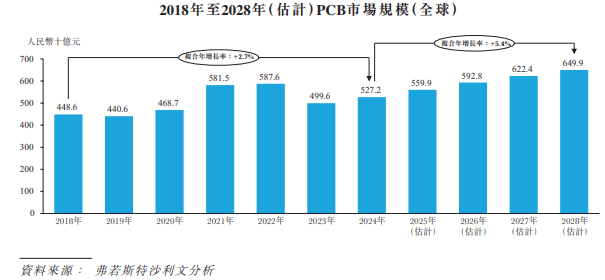
Group 1: Industry Overview - The global capital market is expected to see significant growth in the technology sector, driven by the AI boom and anticipated interest rate cuts by the Federal Reserve, with companies achieving historical highs in stock prices [1] - The global PCB market is projected to grow from 527.2 billion RMB in 2024 to 649.9 billion RMB by 2028, with a compound annual growth rate (CAGR) of 5.4% [1] - The plasma processing equipment market is expected to expand to 390.9 billion RMB by 2028, with a CAGR of approximately 9.2% from 2024 to 2028, driven by demand from the semiconductor and PCB industries [3] Group 2: Company Profile - Zhuhai Baofengtang Semiconductor Co., Ltd. (Baofengtang) has shown continuous development in the semiconductor and PCB manufacturing sectors and has recently filed for a Hong Kong IPO, indicating its ambition for broader market engagement [5] - Baofengtang ranked among the top three in the Chinese PCB plasma stripping equipment market from 2022 to 2024, holding a market share of approximately 3.9% in 2024 [5][6] Group 3: Financial Performance - Baofengtang's revenue from equipment sales accounted for 71.3% to 83% of total revenue from 2022 to the first half of 2025, with total revenue increasing from 79.21 million RMB in 2022 to an estimated 150 million RMB in 2024 [6] - The company's gross profit increased from 39.02 million RMB in 2022 to 74.79 million RMB in 2024, with gross margins ranging from 49.3% to 59.9% during the same period [9] Group 4: Market Dynamics - Baofengtang's revenue sources have diversified, with the share of revenue from mainland China decreasing from 93.4% in 2022 to 75.1% in 2024, while revenue from Thailand, the US, and Vietnam has increased significantly [7] - The plasma processing equipment market in China is highly concentrated, with the top five players holding over 70.4% of the market share in 2024, while Baofengtang's market share remains below 0.01% [10][14] Group 5: Future Strategies - Baofengtang plans to enhance its business layout in the semiconductor manufacturing sector, focusing on improving etching technology and expanding into thin film deposition and advanced packaging [13] - The company aims to strengthen its competitive position in the semiconductor plasma processing equipment market, which is characterized by even higher market concentration than the overall plasma processing equipment market [14]

中银证券研究部2025年10月金股
Bank of China Securities· 2025-10-10 01:56
Core Insights - The report emphasizes the importance of monitoring the U.S. government shutdown and its impact on economic data and market sentiment, alongside the upcoming 20th Central Committee meeting in China, which will focus on the "14th Five-Year Plan" [4][2] - The market is expected to continue a trend of oscillating upward, supported by positive domestic PMI data and expectations surrounding the "14th Five-Year Plan" [4][2] - The report highlights a potential increase in foreign capital inflows in the fourth quarter, which could support the A-share market [4][2] - The core investment direction is likely to remain focused on technology assets in the near term [4][2] October Stock Picks - The October stock picks include: - China Southern Airlines (Transportation) - COSCO Shipping Specialized Carriers (Transportation) - Tongkun Co., Ltd. (Chemicals) - Yake Technology (Chemicals) - CATL (Electric New Energy) - Lingnan Holdings (Social Services) - Jinghe Integrated (Electronics) - Shenzhen South Circuit (Electronics) - GoerTek (Electronics) - Jieshun Technology (Computers) [9][10] September Performance Review - The September stock portfolio outperformed the market, with notable monthly returns exceeding 30% for CATL and Zhaoyi Innovation, and an absolute return of 4.64%, outperforming the market benchmark by 1.44 percentage points [5][6] Transportation Sector: China Southern Airlines - China Southern Airlines is a leading airline service provider with a significant market share and a robust hub network centered in Guangzhou and Beijing. The company is expected to achieve a revenue of 174.22 billion yuan in 2024, reflecting an 8.94% year-on-year growth [11][12] - The airline industry in China has seen a 172.8% growth in passenger transport over the past 15 years, with a projected domestic passenger transport volume of 730 million in 2024, a 17.86% increase [12][13] Transportation Sector: COSCO Shipping Specialized Carriers - The company reported a 44.05% year-on-year increase in revenue for the first half of 2025, reaching 10.775 billion yuan, with a net profit of 825 million yuan, marking a 13.08% increase [14][15] - The demand for specialized vessels remains strong, particularly in the automotive shipping segment, which saw a 439.87% increase in revenue [15][16] Chemicals Sector: Tongkun Co., Ltd. - The company experienced an 8.41% year-on-year decrease in revenue for the first half of 2025, totaling 44.158 billion yuan, with a notable decline in polyester filament prices due to fluctuating oil prices [16][17] - The gross profit margin improved to 6.76%, reflecting a 0.57 percentage point increase year-on-year [17][18] Chemicals Sector: Yake Technology - The company reported steady revenue growth driven by LNG and electronic materials, with a gross profit margin of 31.82% in the first half of 2025 [19][20] - The electronic materials segment saw a 15.37% year-on-year revenue increase, with significant contributions from semiconductor chemical materials [20][21] New Energy Sector: CATL - CATL is projected to achieve a net profit of 50.745 billion yuan in 2024, a 15.01% increase year-on-year, with a total revenue of 362.013 billion yuan [23][24] - The company maintains a leading position in the global battery market, with a 37.9% market share in 2024 [24][25] Social Services Sector: Lingnan Holdings - The company reported an 8.52% year-on-year increase in revenue for the first half of 2025, totaling 2.09 billion yuan, with a net profit of 50 million yuan, reflecting a 24.39% increase [26][27] - The opening of a city duty-free store is expected to enhance customer flow and boost related tourism industry growth [27][28] Electronics Sector: Jinghe Integrated - The company achieved a 28% year-on-year revenue increase in 2024, totaling 9.249 billion yuan, with a net profit of 533 million yuan, marking a 152% increase [29][30] - The company is focusing on optimizing product structure and upgrading technology processes to maintain competitive advantages [30][31] Electronics Sector: Shenzhen South Circuit - The company reported a 25.63% year-on-year revenue increase in the first half of 2025, reaching 10.453 billion yuan, with a net profit of 1.36 billion yuan [32][33] - The PCB business saw a 29.21% year-on-year increase in revenue, driven by demand in communication and data center sectors [33][34]





华金证券:AI算力硬件迭代催生PCB行业结构性增长机遇 高性能PCB需求将大幅增长
智通财经网· 2025-10-09 03:21
Core Viewpoint - The PCB industry is experiencing new growth momentum driven by artificial intelligence (AI), with a continuous upward trend in industry prosperity [1][2] Group 1: Market Growth - The global PCB market size is projected to grow from $62 billion in 2020 to $75 billion in 2024, with a compound annual growth rate (CAGR) of 4.9% from 2020 to 2024 [1] - By 2029, the global PCB market sales revenue is expected to reach $93.7 billion, with a CAGR of 4.6% from 2024 to 2029 [1] Group 2: Demand for High-Performance PCBs - The demand for high-performance PCBs is anticipated to increase significantly due to the high value of AI server PCBs compared to traditional servers [2] - The global sales revenue of high multi-layer PCBs is expected to reach $171 billion by 2029, with the share of high-end HDI PCBs in the global market rising from 47% in 2024 to 57% in 2029, reaching $9.6 billion by 2029 [2] Group 3: Material Considerations - For high-speed PCBs, the use of low roughness copper foil is becoming more common due to skin effect issues, with materials like MidLoss and LowLoss adopting reverse (RTF) copper foil as standard [2] - Low dielectric constant and low loss tangent materials are deemed most suitable for achieving high frequency and speed in PCBs, with Q fabric performance significantly surpassing that of second-generation fabric, potentially disrupting traditional fiberglass material routes [2] Group 4: Companies to Watch - Companies to focus on in the PCB sector include: Huadian Co., Shenghong Technology, Dongshan Precision, Pengding Holdings, Shennan Circuit, Jingwang Electronics, Shenyin Electronics, Guanghe Technology, Nanya New Material, Aoshikang, Shiyun Circuit, Xingsen Technology, Weiergao, Zhongfu Circuit, and Chongda Technology [3] - In the equipment sector: Chipbond Microelectronics, Dazhu CNC, and Dongwei Technology are notable [3] - In the materials sector: Electronic fabric companies like Honghe Technology, Feilihua, and Dongcai Technology, as well as copper foil companies like Tongguan Copper Foil and Defu Technology are recommended [3]
SCHMID Group Expands Advanced Packaging Portfolio to Power the AI Era
Globenewswire· 2025-10-08 14:26
Core Insights - SCHMID Group has expanded its product portfolio to address the increasing demand for advanced packaging substrates and high-performance server boards driven by the AI era [1][14][15] - The semiconductor and advanced packaging sector is projected to grow at a CAGR of around 10% over the next five years, with significant contributions from market leaders like TSMC and NVIDIA [2][15] - The traditional PCB industry is expected to grow at an 8% CAGR, while AI server boards are anticipated to experience a robust growth rate of about 20% [3][15] Company Developments - SCHMID has broadened its InfinityLine product family to enhance its position in next-generation package substrates and AI-server PCBs [4][12] - The company is uniquely positioned to deliver Chip-on-Wafer-on-PCB (CoWoP) solutions, focusing on best-in-class yield and low cost of ownership [5] - SCHMID anticipates that 2025 will be a transition year, with above-market growth expected from 2026 onwards, particularly in AI-driven product lines [6] Product Innovations - The existing InfinityLine H+ remains the top-selling equipment, while the new InfinityLine C+ is on track to become a significant revenue contributor [12] - Upcoming products include InfinityLine L+ for panel-level substrates and InfinityLine P+ for next-generation single panel plating, both set to launch in late 2025 [12] - SCHMID's QuantumLine and SCHMID-AVACO Plasma Equipment are designed to enable high-yield glass core substrate production [12]
科技牛,还远没有结束
大胡子说房· 2025-10-08 04:32
Core Viewpoint - The technology sector is experiencing a significant rally, with various related concepts seeing substantial gains, indicating a strong bullish trend that is expected to continue [3][4][8]. Group 1: Technology Sector Performance - The technology sector, particularly chips and semiconductors, has seen a surge with net capital inflow exceeding 15 billion [4]. - Other segments like CPO optical modules and AI computing power have also shown impressive growth, with the optical index rising by 10% last week [5]. - The humanoid robot sector and consumer electronics linked to technology concepts have also experienced notable price increases, often leading to consecutive trading halts [6]. Group 2: Historical Context and Future Outlook - Historical data shows that previous bull markets in the A-share market were driven by technology stocks, such as the 2005-2006 and 2015 bull markets, where stocks like Hengsheng Electronics and Storm Technology saw increases of 1120% and 1950%, respectively [10][12][15]. - The current bull market is expected to continue as long as the overall market remains bullish, with technology stocks leading the charge [17]. Group 3: Capital Market Dynamics - The technology sector requires breakthroughs that necessitate capital market support for pricing and financing, highlighting the importance of funding for technological advancement [18][22]. - The A-share market has seen technology stocks account for a quarter of the total market capitalization over the past five years, indicating a strong focus on technology as a key growth area [33]. - The ongoing bull market in technology is viewed as essential for the future development of the industry, driven by investor expectations rather than current profits [26][29]. Group 4: Market Adjustments and Opportunities - While the technology sector is expected to continue its upward trajectory, some stocks may reach a temporary peak, suggesting potential for short-term corrections [30][31]. - Any adjustments in the technology sector should be viewed as opportunities for new investments rather than signs of a market downturn [35][38].

节前调研,机构扎堆去哪儿?
Shang Hai Zheng Quan Bao· 2025-10-02 12:09
Group 1 - Institutional research is actively seeking quality investment opportunities ahead of the National Day holiday, with around 200 listed companies receiving investor inquiries from September 22 to September 28, particularly in the technology and high-end manufacturing sectors [1] - Companies' fourth-quarter operational plans, order status, production capacity, and overseas expansion are key focus areas for institutional investors, indicating a positive outlook for several industries [1][4] Group 2 - The electronic, AI, and electrical equipment sectors are receiving significant attention from institutional investors, with companies like Jingzhida being the most favored, hosting nearly 150 institutional inquiries during the specified period [2] - Jingzhida is focusing on its computing chip testing business, emphasizing the integration of computing and storage chips in the AI era, and plans to collaborate closely with downstream clients to provide high-end testing solutions [2] Group 3 - Ant Group and Gaweida have established a strategic partnership aimed at leveraging AI big data services in the banking and fintech sectors, with a projected global fintech market size exceeding $450 billion by 2025 [3] - Companies like Xintai are exploring AI applications in biopharmaceuticals, while Jinggong Technology is advancing its exoskeleton robot development, aiming for mass production of its second-generation model [3] Group 4 - Many companies report a strong order backlog and saturated production capacity, reflecting robust business momentum and industry vitality [4][5] - For instance, ShenNan Circuit is expanding its PCB production capacity through new factories and technological upgrades, while Huatuo Cable is facing capacity constraints despite having ample orders [4][5] Group 5 - Companies like Dangsheng Technology are achieving significant breakthroughs in both production capacity and sales, with plans to increase lithium iron phosphate production capacity to 120,000 tons annually by the second half of 2025 [5] - Mingtai Aluminum is also expanding its overseas production capacity, with plans to invest in a new cold-rolled project to increase capacity by 30,000 to 40,000 tons [5] Group 6 - Huidian Co.'s production base in Thailand is set to enter small-scale production by the second quarter of 2025, with expectations of gradually releasing production capacity and achieving economic scale by the end of 2025 [6]
年内涌现53只“翻倍基”,2025年前三季度基金业绩放榜
Zheng Quan Shi Bao· 2025-10-02 11:11
Core Insights - The public fund industry has experienced a fruitful year in the structural bull market leading up to Q3 2025, with active equity funds making a significant comeback [1] - A total of 53 funds have achieved over 100% returns year-to-date, with active equity funds accounting for 42 of these, highlighting the effective strategies of fund managers in high-growth sectors like technology and innovation [2][4] - Gold ETFs have emerged as the standout performers in the commodity fund sector, with all 14 gold ETFs showing gains exceeding 40% year-to-date [5] Fund Performance - The top-performing fund, managed by Ren Jie, is the Yongying Technology Smart Selection A, with a return of 194.49%, heavily invested in the overseas computing power industry [2] - The second-best performer is the Huatai-PineBridge Hong Kong Advantage Selection A, achieving a return of 155.09%, focusing on Hong Kong's innovative pharmaceutical stocks [2] - Other notable funds include the China Europe Digital Economy A with a return of 140.86%, and two additional funds with returns of over 128% [3] Gold ETF Highlights - Gold ETFs have shown remarkable performance, with the top two funds achieving returns of 41.48% and 41.47% respectively [5] - Over the past three years, these gold ETFs have accumulated returns exceeding 110%, indicating strong long-term investment potential [6] - The recent surge in international gold prices, reaching a high of $3922.7 per ounce, is expected to further enhance the investment value of gold [6] Asset Allocation Outlook - Looking ahead to Q4, market sentiment remains high, with structural opportunities continuing to emerge, although some signs of overvaluation are noted [7] - Investment strategies may shift from growth to cyclical and consumer sectors, with a focus on underperforming cyclical stocks that may benefit from policy changes [8] - The ongoing AI technology revolution is expected to provide a premium for related assets, despite current high valuations [8][9] - The bull market trend is anticipated to continue, with a focus on emerging technologies and cyclical financials, particularly in the Hong Kong market [9]
年内涌现53只“翻倍基”!2025年前三季度基金业绩放榜
Sou Hu Cai Jing· 2025-10-02 07:20
Core Insights - The public fund industry has experienced a fruitful year in the structural bull market, with active equity funds making a significant comeback, particularly supported by the AI computing and innovative pharmaceutical sectors [1][2]. Group 1: Fund Performance - A total of 53 funds have achieved over 100% returns year-to-date as of September 30, with 42 of these being active equity funds, showcasing the fund managers' effective strategies in high-growth sectors [2][4]. - The top-performing fund, managed by Ren Jie, achieved a return of 194.49%, heavily investing in the overseas computing industry chain, with significant contributions from stocks like Shenghong Technology, which surged 581% this year [2][3]. - Other notable funds include Zhang Wei's fund with a 155.09% return, focusing on Hong Kong's innovative pharmaceuticals, and Feng Ludan's fund with a 140.86% return, both capitalizing on the AI industry chain [3]. Group 2: Commodity Performance - Gold ETFs have emerged as the standout performers in the commodity fund sector, with all 14 gold ETFs showing gains exceeding 40% year-to-date, driven by rising international gold prices [5][6]. - The highest-performing gold ETFs, managed by Zhao Xu and Rong Ying, reported returns of 41.48% and 41.47%, respectively, reflecting strong long-term investment value [5][6]. Group 3: Market Outlook - Looking ahead to Q4, several fund companies suggest maintaining a focus on growth sectors while also considering cyclical and consumer stocks, as the market has already seen significant gains [7][8]. - The ongoing AI technology innovation is expected to provide a premium valuation for related assets, despite potential short-term volatility [8][9]. - The overall market sentiment remains bullish, with continued optimism for emerging technologies and cyclical financial sectors, particularly in the context of the "anti-involution" policies that may enhance competition in the renewable energy sector [9].



悄然调仓!重仓算力的基金,筹码松动
证券时报· 2025-10-01 14:08
Core Viewpoint - The A-share market has experienced significant fluctuations since September, with a shift from a focus on AI computing power to sectors like solid-state batteries, robotics, non-ferrous metals, and gaming, indicating a rapid rotation of market themes [1] Group 1: Fund Adjustments - Some public funds have shown significant deviations between net value and holdings, suggesting early "leaks" of fund managers' latest adjustments [2] - Funds heavily invested in computing power have begun to show signs of adjustment, with examples like the Xin'ao Advantage Industry Mixed Fund, which saw a net value increase of 1.91% on a day when its major holdings fell [4] - The Yongying Technology Smart Mixed Fund, despite a drop in its major overseas computing stocks, only fell 0.94% on a day when a larger decline was expected, indicating a divergence from its holdings [4][5] Group 2: Consumer Sector Shifts - The previously underperforming consumer sector is showing signs of "stop-loss" and "defensive switching," with funds like Nanhua Ruiying experiencing significant declines despite their major holdings rising [6] - Fund managers are expressing optimism about sectors like humanoid robots and solid-state batteries, suggesting a shift in focus towards technology and innovation [7][8] Group 3: Market Dynamics - The unusual movements in fund net values reflect the extreme structural characteristics of the current A-share market, where rapid sector rotations pose challenges for fund managers [10] - Fund managers are advised to dynamically adjust their strategies in response to changing market conditions, moving away from underperforming sectors towards those with higher growth potential [11] - There is a growing interest in new marginal changes and investment directions, particularly in AI-related assets and the semiconductor sector, as the market evolves [11]

三大股指集体上涨,人工智能相关ETF全线走高,5G通信ETF(515050)上涨2.34%
Mei Ri Jing Ji Xin Wen· 2025-09-29 08:33
Market Performance - The three major indices collectively rose on September 29, with the Shanghai Composite Index up by 0.9%, the Shenzhen Component Index up by 2.05%, and the ChiNext Index up by 2.74% [1] - The total trading volume in the Shanghai and Shenzhen markets reached 21,781 billion yuan, an increase of 120 billion yuan compared to the previous day [1] - Over 3,500 stocks in the market experienced gains, with sectors such as securities, batteries, non-ferrous metals, and steel leading the gains, while education, pork, coal, and chemical pharmaceuticals saw declines [1] ETF Performance - Major broad-based ETFs saw significant afternoon gains, with the A500 ETF (512050) rising by 1.39% [1] - AI-related ETFs performed well, with the Chip ETF (159995) and AI ETF (515070) both increasing by 1.14% [1] - The 5G Communication ETF (515050) rose by 2.34%, and the ChiNext AI ETF (159381) increased by 1.33%, indicating strong performance in the AI computing hardware supply chain [1] Sector Focus - Recent domestic policies and structural industry trends have garnered attention, with market funds gradually shifting from the computing power sector to other low-valuation growth sectors [1] - The market is expected to maintain a slow bull trend in the medium term, with structural growth sectors becoming key investment opportunities [1] - Key sectors to watch include new energy, humanoid robots, innovative pharmaceuticals, and non-ferrous metals, which are expected to have concentrated catalytic events [1] Earnings Expectations - According to Industrial Securities, industries with upward revisions in profit expectations since September are primarily concentrated in technology, advanced manufacturing, cyclical, consumption, and finance [2] - The third quarter reports will serve as an important window to validate the economic cycle for strong sectors represented by technology and advanced manufacturing [2] - In the technology growth narrative, sectors such as AI, innovative pharmaceuticals, and new energy have seen trading congestion return to reasonable levels, suggesting a potential focus on growth trends [2]