
脑机接口

Search documents
华创证券:政策加码、临床加速 脑机接口产业化进入关键阶段
智通财经网· 2026-01-12 01:57
Core Insights - The commercialization of brain-computer interfaces (BCIs) is steadily advancing, presenting vast market opportunities in China, where competition is still in its early stages with most companies being small and not yet in a saturated market [1] - Invasive BCIs have significant advantages in signal quality, while non-invasive BCIs offer high safety and ease of use, serving as a complement to invasive types [1] - The current focus of the industry is on the medical field, with potential future expansion into non-medical areas [1] Group 1: Global Developments - Neuralink, a global leader in BCIs, is expected to enter the commercialization phase by 2026, with 12 patients having successfully implanted devices as of September 2025 [2] - Neuralink plans to increase the number of electrodes in its devices to over 30,000 by 2028, aiming for comprehensive brain connectivity [2] - The company has outlined three core product lines: Telepathy for motor disabilities, Blindsight for visual impairments, and Deep for neurological disorders [2] Group 2: Competitive Barriers - Key competitive advantages for Neuralink include flexible electrode arrays, precise implantation robots, and low-power intracranial signal processing systems [3] - The development of a closed-loop technical system through interdisciplinary research and clinical collaboration is essential for domestic companies [3] Group 3: Industry Trends in China - National strategies are guiding the BCI industry, with policies expected to be released in 2025 to support development [4] - Clinical advancements are accelerating, with significant breakthroughs in invasive and semi-invasive BCI systems reported in 2025 [4] - The financing market for BCIs is thriving, with 24 financing events recorded in 2025, marking a 30% increase year-on-year [4] - The supporting industrial chain for BCIs is rapidly forming, with pilot implementations in medical and everyday scenarios [4]
1.12盘前速览 | 20万颗卫星申请创纪录!AI热点扩散,沪指放量破4100
Jin Rong Jie· 2026-01-12 01:46
【卫星互联网】 国家级战略:我国向国际电联申请超20万颗卫星频轨资源,专家解读此举标志卫星资源申请上升至国家 战略层面。 国内外进展:美FCC批准SpaceX部署7500颗二代星;上海、海南等地推进商业火箭及回收技术;国内多 款新火箭计划近期首飞。 应用与畅想:SpaceX在伊朗开通星链;NASA载人绕月任务计划2月发射;《人民日报》文章提及"南天 门计划"概念。 相关ETF: 卫星产业ETF(场内:159218) 【人工智能】 模型进展:DeepSeek V4或于春节发布,聚焦编程能力;行业领袖热议AI范式演进与模型"品味"竞争。 相关ETF: 云计算ETF(场内:159890,场外:021716)、软件龙头ETF(场内:159899,场外:018385)、 半导体设备ETF(场内:561980,场外:020464)、TMT50ETF(场内:159909,场外:004409) 产业生态:马斯克宣布一周内开源X平台推荐算法;沃尔玛将商品购物集成至Gemini;Meta成为全球最 大核能买家。 硬件与供应:闪迪要求客户预付全款锁定未来1-3年存储芯片配额;卖方提示部分光模块上游物料面临 硅光替代带来的过剩压力。 ...
脑机接口产业专题解读
2026-01-12 01:41
Summary of Brain-Computer Interface (BCI) Industry Conference Call Industry Overview - The BCI industry is experiencing growth due to supportive healthcare policies, with non-invasive treatment priced around 980 yuan and invasive procedures costing several thousand yuan, encouraging hospitals to invest in related equipment and training [1][4] - The integration of BCI systems with hospital HIS systems significantly impacts renovation needs, requiring data center and IoT platform expansion for deep integration [1][5] Key Insights - Hospitals prioritize budget and cost-effectiveness when procuring BCI devices, with the introduction of specialized billing codes allowing hospitals to recover costs and meet departmental development needs, leading to a projected significant increase in procurement over the next 3-5 years [1][8] - AI technology has made advancements in data processing for BCI, improving signal quality through noise reduction algorithms and potentially identifying biomarkers for neurodegenerative diseases, providing early warning tools for the health sector [1][9][10] - Invasive BCIs primarily address issues like hearing and pain relief, with prices around tens of thousands of yuan, while non-invasive BCIs are used for rehabilitation, with market acceptance dependent on their efficacy compared to traditional methods [1][12] Financial Trends - Overall capital expenditure for hospital equipment is expected to decline in 2026, although investments in AI-assisted diagnostic systems may lead to slight growth [1][14] - The procurement of BCI devices is influenced by hospitals' financial calculations regarding costs, payback periods, and additional revenue generation, with specialized billing codes facilitating easier market acceptance [1][8] Market Dynamics - The demand for BCI technology in the medical field is growing, but large-scale applications remain limited; current support from national policies is crucial for market recognition [3][4] - The market for mid-range BCI devices is significantly affected by the downturn in medical procurement, suggesting a need to lower costs to penetrate community and home markets [2][19] Potential Applications - Beyond rehabilitation, BCI technology has potential applications in mental health management, emotional regulation, and sleep control, but must demonstrate clear advantages over traditional products to gain traction [11] - BCI devices show promise in autism intervention, allowing real-time monitoring and personalized training adjustments, which could significantly benefit families [13] Challenges and Considerations - The integration of BCI data into electronic medical records is still in progress, with current data primarily used for monitoring rather than as a basis for clinical decisions [17] - The combination of BCI technology with neurostimulation products could enhance treatment efficacy, but may also increase costs, necessitating clear value propositions to ensure market acceptance [21][22] Conclusion - The BCI industry is poised for growth driven by policy support and technological advancements, but faces challenges in cost management and market acceptance. The focus on integrating BCI into broader healthcare applications and ensuring its efficacy will be critical for future success [1][19]
双融日报-20260112
Huaxin Securities· 2026-01-12 01:37
Market Sentiment - The current market sentiment score is 90, indicating an "overheated" market condition, which suggests a high level of investor optimism [5][7][18]. Hot Themes Tracking - **Robotics Theme**: The establishment of a national standard organization for humanoid robots and embodied intelligence marks a transition from "technical exploration" to "industrial collaboration" and "scale deployment," which is expected to accelerate technology implementation and ecosystem formation. Related stocks include Sanhua Intelligent Control (002050) and Wolong Electric Drive (600580) [5]. - **Banking Theme**: Bank stocks exhibit high dividend characteristics, with the CSI Bank Index yielding 6.02%, significantly higher than the 10-year government bond yield. In a slowing economy with increased market volatility, bank stocks are seen as important investment targets for long-term funds such as insurance and social security. Related stocks include Agricultural Bank of China (601288) and Ningbo Bank (002142) [5]. - **Brain-Computer Interface Theme**: Neuralink plans to begin large-scale production of brain-computer interface devices in 2026, with a projected global market size of $12.4 billion by 2034 and a CAGR of 17% from 2025 to 2034. Related stocks include Aipeng Medical (300753) and Maipu Medical (301033) [5]. Capital Flow Analysis - The top ten stocks with the highest net inflow include Leo Group (002131) with a net inflow of 178.99 million, Kunlun Wanwei (300418) with 138.48 million, and Sanhua Intelligent Control (002050) with 124.27 million [8]. - The top ten stocks with the highest net outflow include Yanshan Technology (002195) with a net outflow of -349.89 million and Zhongji Xuchuang (300308) with -203.89 million [10]. Industry Insights - The banking sector is highlighted for its stability and high dividend yield, making it a favorable choice for long-term investors during economic slowdowns [5]. - The robotics industry is poised for growth due to new standards that will facilitate collaboration and reduce development costs, indicating a shift towards more scalable applications [5]. - The brain-computer interface market is expected to grow significantly, driven by advancements in technology and increasing demand for innovative medical solutions [5].
中金:港股和A股谁“错”了?
Xin Lang Cai Jing· 2026-01-12 01:18
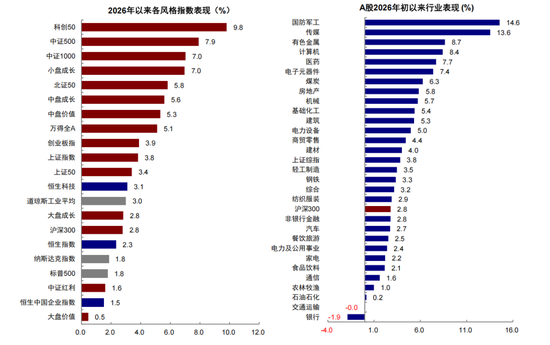
Group 1 - The core driver of the A-share market's strong performance at the beginning of 2026 is the "excess liquidity" chasing "scarce return assets," rather than significant changes in the macroeconomic fundamentals [2][11] - The A-share market has shown a clear structural preference for sectors like commercial aerospace, non-ferrous metals, and brain-computer interfaces, with small-cap stocks outperforming large-cap stocks [2][3] - The A-share market's gains have primarily been driven by valuation expansion, while traditional consumer stocks have lagged behind due to their closer correlation with domestic demand fundamentals [2][5] Group 2 - The Hong Kong stock market has underperformed due to a lack of attractive structural opportunities and a weaker funding environment, reflecting a deteriorating fundamental backdrop [10][13] - The absence of significant inflows from southbound capital has been noted, with December's average daily inflow dropping to 10.9 million HKD, significantly lower than the 60 million HKD average for the entire year [18][20] - The Hong Kong IPO market remains active, with a total of 2,858 million HKD raised in 2025, but the overall market performance has been muted compared to A-shares [20][21] Group 3 - Historical analysis indicates that the "spring market" effect is more pronounced in A-shares than in Hong Kong stocks, with A-share indices showing an average increase of 4.6% during the period from early December to early March, compared to only 0.5% for Hong Kong stocks [23][24] - The A-share market has consistently outperformed the Hong Kong market in terms of sector performance, particularly in technology, military, and home appliance sectors, which have shown average gains around 10% [23][24] Group 4 - The structural differences between A-shares and Hong Kong stocks lead to varying earnings growth rates, with A-shares expected to see a growth rate of 4%-5% in 2026 compared to 3% for Hong Kong stocks [30] - A-shares benefit from a more favorable micro liquidity environment, while Hong Kong stocks face multiple constraints, including potential declines in southbound capital inflows [33][34] - The unique structural opportunities in Hong Kong, such as high dividend yields and sectors like internet and innovative pharmaceuticals, provide a complementary investment avenue despite the overall market underperformance [35][36]

【华创医药】华创医疗器械求索系列11:脑机接口行业——政策加码,临床加速,产业化进入关键阶段
华创医药组公众平台· 2026-01-12 00:51
Core Viewpoint - The article discusses the development and commercialization of brain-computer interface (BCI) technology, highlighting its market potential, competitive landscape, and various applications, particularly in the medical field [3][5]. Group 1: Brain-Computer Interface Overview - BCI technology establishes a direct communication pathway between the brain and external devices, with steady progress in commercialization leading to vast market opportunities [3]. - The competitive landscape in China's BCI sector is still in its early stages, with most companies being small and not yet in a saturated market [3]. - There are two main types of BCI products: invasive BCIs, which offer significant signal quality advantages, and non-invasive BCIs, which are safer and easier to operate, serving as a complement to invasive types [3]. - Current applications are primarily in the medical field, with future potential to expand into non-medical areas [3]. - The industry chain has high technological barriers at the upstream level, while the mid and downstream sectors exhibit strong agglomeration effects [3]. Group 2: Global Leader Neuralink's Path to Industrialization - Neuralink, a global pioneer in BCI, is expected to enter the industrial application phase by 2025, with 12 patients having successfully implanted devices [4]. - The company plans to scale production of BCI devices starting in 2026, transitioning from laboratory research to large-scale manufacturing [4]. - Neuralink has outlined a three-step technology iteration plan, aiming to increase the number of electrodes in implants significantly by 2028 to enable comprehensive brain connectivity [4]. - The company has identified three core product lines: Telepathy for motor function recovery, Blindsight for visual perception restoration, and Deep for neurological function recovery [4]. - Neuralink's competitive advantages include advanced electrode technology, precise implantation robotics, and low-power signal processing systems [4]. - The development of Neuralink offers insights for domestic companies, emphasizing the importance of interdisciplinary research, clinical collaboration, and gradual commercialization [4]. Group 3: Factors Driving BCI Industrialization in China - National strategies are guiding the BCI sector, with local policies being introduced to support its development [5]. - Clinical advancements are accelerating, with significant breakthroughs in various BCI applications, including invasive and semi-invasive systems [5][6]. - The financing market for BCI is thriving, with 24 financing events recorded in 2025, marking a 30% year-on-year increase [5]. - The supporting industry chain for BCI technology is rapidly forming, facilitating the practical application of BCI in medical, production, and daily life scenarios [6]. Group 4: Key Companies in the BCI Sector - Notable companies in the BCI field include: - Xinwei Medical (interventional BCI) - Maipu Medical (neurosurgical consumables) - Kefu Medical (bionic implant BCIs) - Meihua Medical (upstream BCI industry) - Sanbo Brain Science (neurological specialty medical group) - Weisi Medical (rehabilitation BCIs) - Mailande (rehabilitation BCIs) - Xiangyu Medical (rehabilitation BCIs) - Chengyitong (comprehensive BCIs) - Aipeng Medical (neuro-regulation BCIs) - Chuangxin Medical (exoskeleton BCIs) [11].

脑机接口获20亿融资 行情里的资金门道
Sou Hu Cai Jing· 2026-01-12 00:42
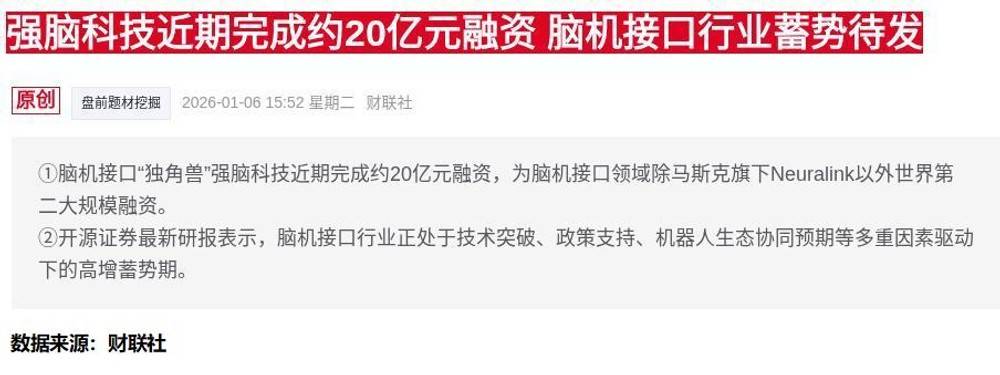
Group 1 - The core point of the news is that the brain-computer interface sector is gaining traction, with a recent $2 billion financing round led by established institutions and listed companies, indicating strong investor interest and potential growth in the industry [1] - The "14th Five-Year Plan" has highlighted the importance of the brain-computer interface sector, with specific goals set for 2030 to position the industry among the world's leaders [1] - According to Open Source Securities, the sector is currently in a "high growth accumulation period," with projections estimating a global market size of $12.4 billion by 2034, growing at an annual rate of 17% [1] Group 2 - The article discusses how stock price movements are often influenced by unseen large capital transactions, rather than being purely random or based on luck [3] - It highlights that certain stocks, particularly in sectors like steel, electric power equipment, and IT, experienced sudden price increases due to prior accumulation of capital, which was not immediately visible to the average investor [3][5] - The use of quantitative data systems allows for the identification of trading patterns among institutional and retail investors, revealing when significant capital movements occur [5][7] Group 3 - The brain-computer interface sector, like other industries, does not experience sudden price changes without underlying capital movements; news serves as a catalyst rather than the cause [9] - The article emphasizes that monitoring capital movements through quantitative data can provide insights into potential stock price movements, reducing the need for speculation [10] - The focus on understanding capital actions rather than chasing market trends can lead to more informed investment decisions [10]
机构:政策持续加码 关注脑机接口板块投资机会
Zheng Quan Shi Bao Wang· 2026-01-12 00:40
Group 1 - The National Medical Products Administration has publicly announced the formulation plan for two recommended industry standards related to brain-computer interface (BCI) invasive devices and their reliability verification methods [1] - Guosen Securities believes that the BCI industry has entered a critical phase of transitioning from technological breakthroughs to commercialization, driven by policies, technology, and application scenarios [1] - The global market for BCIs is expected to experience explosive growth due to favorable policies, including the "14th Five-Year Plan," medical insurance coding, and the implementation of medical device standards, alongside the anticipated mass production of Neuralink and breakthroughs in domestic clinical applications [1] Group 2 - Dongguan Securities reports that Elon Musk's Neuralink plans to begin large-scale production of BCI devices in 2026, with a focus on highly automated surgical procedures [2] - A significant breakthrough involves the electrode wires penetrating the dura mater without the need for removal, which is expected to enhance the BCI sector and boost the overall pharmaceutical and biotechnology market [2] - The BCI industry is identified as a future industry clearly outlined in the "14th Five-Year Plan," with ongoing policy support, suggesting investment opportunities in the BCI sector [2]
中金:港股和A股谁“错”了?
中金点睛· 2026-01-11 23:58
Core Viewpoint - The strong performance of A-shares at the beginning of 2026 is primarily driven by "excess liquidity" chasing "scarce return assets," rather than significant changes in the macroeconomic fundamentals [2][3][5]. Group 1: A-share Market Dynamics - The A-share market has seen a 16-day consecutive rise, with small-cap stocks outperforming large-cap stocks, continuing the trend from 2025 [3][5]. - The main contributors to the A-share gains are valuation expansions, with sectors like commercial aerospace and materials leading the charge [5][8]. - A-share trading volumes have reached historical highs, with a single-day turnover exceeding 30 trillion yuan, indicating strong market activity [5][8]. Group 2: Hong Kong Market Performance - The Hong Kong market has lagged behind, primarily due to a lack of attractive structural opportunities and weaker capital flows [9][11]. - Key sectors in Hong Kong, such as dividends, internet, and new consumption, are not currently in the market's focus, leading to underperformance [11][19]. - The Hong Kong IPO market remains active, with significant fundraising, but the overall market sentiment is subdued compared to A-shares [17][19]. Group 3: Capital Flow and Liquidity - Domestic capital flows have favored A-shares, with southbound capital flows slowing down significantly since late 2025 [15][19]. - The liquidity environment for A-shares is more favorable, benefiting from domestic microeconomic conditions, while Hong Kong faces constraints from external factors [28][30]. - The anticipated inflow of southbound capital in 2026 may not match the record levels seen in 2025, as A-shares attract more attention [30][32]. Group 4: Structural Differences and Future Outlook - A-shares are expected to have a higher overall profit growth rate of 4%-5% in 2026, compared to Hong Kong's 3%, driven by stronger sectors like technology and manufacturing [25][26]. - The structural advantages of Hong Kong, including its focus on dividends and innovative drugs, provide unique investment opportunities, even as A-shares outperform overall [30][32]. - The ongoing credit cycle and its impact on market dynamics will guide investment strategies, with a focus on sectors like AI, dividends, and cyclical stocks [33].

多重利好叠加释放 脑机接口板块“带飞”持仓基金净值
Zheng Quan Shi Bao· 2026-01-11 16:55
板块热度飙升 Wind数据显示,上周,万得脑机接口概念指数(8841700)大涨18.95%。相关概念股中,创新医疗收获 涨停五连板,南京熊猫、普利特分别录得涨停四连板,美好医疗、三博脑科等也连续4个交易日大涨。 脑机接口板块大涨的背后,是政策、技术、产业与资本的多重利好叠加释放。 2026年开年,脑机接口一跃成为全球科技与资本市场的焦点之一。 近日,特斯拉CEO马斯克宣布,旗下Neuralink公司将于2026年启动脑机接口设备的"大规模生产",并将 转向"更加精简和几乎完全自动化的外科手术流程",这一表态也迅速点燃了市场热情。几乎前后脚,国 内脑机接口独角兽企业强脑科技宣布完成了约20亿元融资,规模位居全球第二。 在海外量产预期、国内政策支持与临床突破的多重共振下,A股脑机接口板块掀起了涨停潮。在板块大 涨的这波行情中,提前埋伏其中的基金也明显受益,净值大幅攀升。 脑机接口,这个一度只存在于科幻作品中的概念,正加速走进现实。 政策、技术与资本共振 1月5日,华银健康生活主题灵活配置单日涨幅达11.8%,领跑全市场基金;长城消费增值混合、国泰创 新医疗混合等单日涨幅也超过10%,位居市场前十。根据2025年 ...